What is a Bear Market? Stages, Survival, and Strategies

Bull markets make you feel like a genius, but bear markets are where real generational wealth is built. We break down the capitulation phases and dollar-cost averaging blueprints needed to survive the cycle.
The Natural Correction: Demystifying the Market Downcycle
- In global financial markets, euphoria is a highly addictive state. During standard expansionary bull markets, rising asset prices create a powerful psychological loop, drawing in speculative capital and masking underlying structural flaws. However, no market moves upward indefinitely. When over-leverage, changing macroeconomic parameters, or shifting risk tolerances collide, the market undergoes a necessary correction.
- A Bear Market is broadly defined as a sustained period where asset prices fall by 20% or more from their recent all-time highs, accompanied by pervasive pessimism and a contraction in investor sentiment. While painful, these downturns serve as a structural cleansing mechanism. They eliminate speculative bubbles, wipe out over-leveraged entities, and reset valuation models, setting the stage for the next macro cycle expansion.
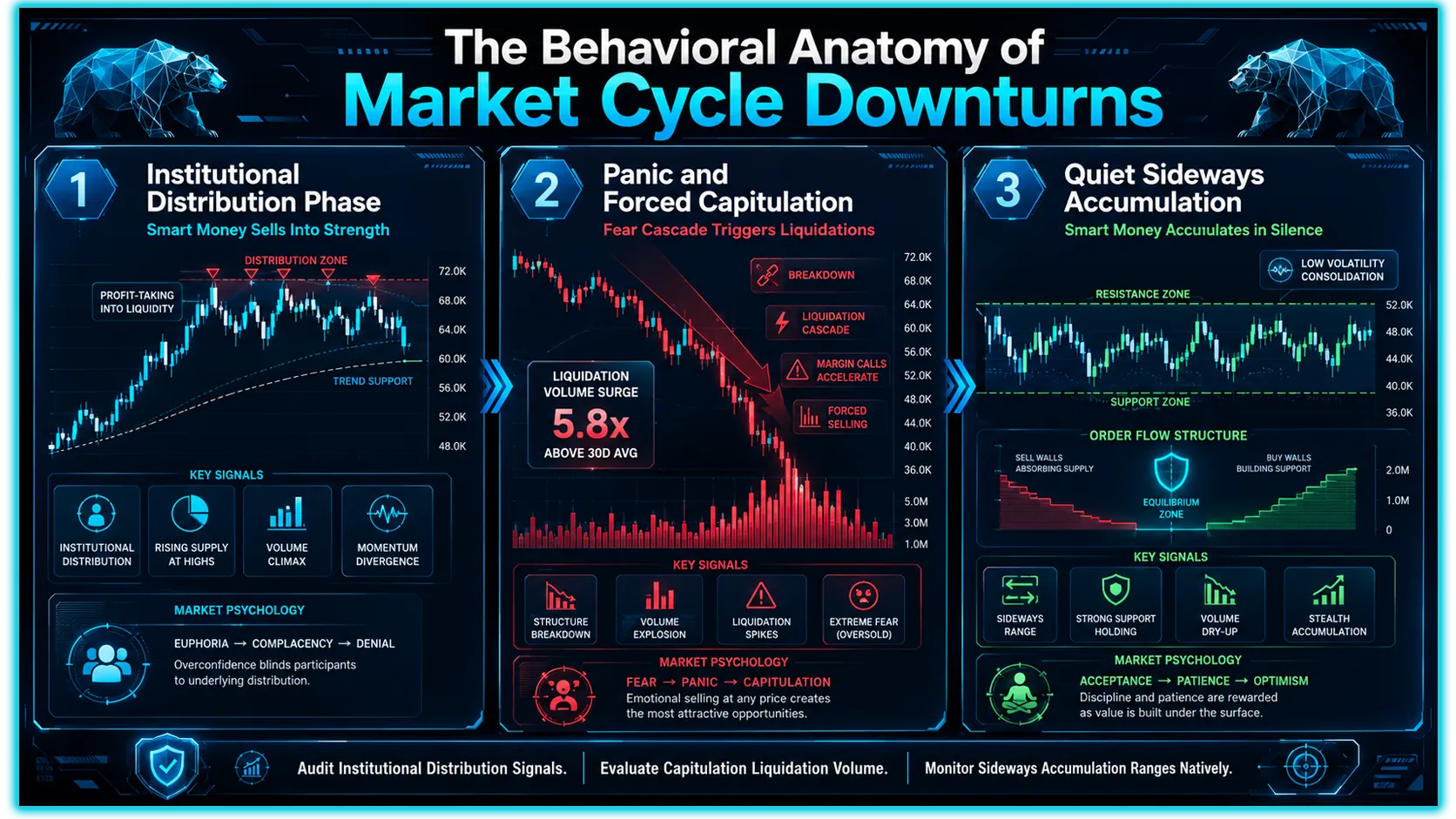
1. The Behavioral Anatomy: The Three Stages of a Downturn
Bear markets do not materialize overnight as a single vertical drop. They unfold as progressive, psychological shifts in participant behavior, moving through distinct phases.
Phase 1: Distribution (The Silent Exit)
At the peak of a bull market, optimism remains incredibly high among the public. However, beneath the surface, institutional market makers and sophisticated allocators recognize that valuations have overextended past fundamental realities. During this distribution phase, smart money begins quietly selling down their exposure into retail buy orders, causing prices to flatten out into a topping structure.
Phase 2: Panic and Capitulation (The Liquidations)
- As the absence of institutional buying leaves the market thin, a sudden catalyst (such as an interest rate spike, an enterprise default, or an unexpected economic shift) triggers a rapid downward move. Fear replaces complacency.
- This phase is defined by high volatility and cascading liquidations. Margin calls force over-leveraged traders to exit, causing forced automated liquidations that drive asset prices down faster. This phase culminates in Capitulation, a massive, high-volume sell-off where investors completely surrender, selling their remaining spot assets regardless of intrinsic value simply to stop the emotional pain of daily losses.
Phase 3: Stabilization and Accumulation (The Boring Sidelined Range)
- Following the capitulation event, the market enters its longest and most exhausting phase: quiet sideways stagnation. The frantic selling stops because the weak-handed participants have fully exited, but there is no immediate catalyst to drive asset prices higher. Volatility collapses, trading volumes dry up, and media attention fades completely.
- During this boring consolidation window, patient, long-term allocators execute quiet accumulation strategies, vacuuming up deeply discounted assets from exhausted sellers before the next macro cycle turns.
2. Survival Fundamentals: Capital Preservation Strategies
Surviving a multi-month or multi-year downcycle requires a fundamental shift in your core operational metrics. In a bull market, your primary objective is maximizing profit generation; in a bear market, your sole mandate is Capital Preservation.
The Mathematical Reality of Loss: If an asset in your portfolio suffers a 50% drawdown, it does not require a simple 50% rally to return to breakeven: it demands a 100% gain just to recover your initial principal. Protecting your capital base from devastating drawdowns is the most critical key to long-term survival.
To preserve your portfolio's capital base during a bear market, consider these tactical rules:
Eliminate Leverage completely: Using leverage inside a systemic downcycle is financial suicide. Thin liquidity profiles cause sudden, volatile price wicks that can instantly trigger automated liquidations, wiping out your margin balance before the market stabilizes.
Insulate an Operating Runway: Never invest capital that you require to cover real-world cost-of-living expenses. Forcing yourself to liquidate long-term spot assets at the exact bottom of a cycle to pay for immediate liabilities destroys financial compounding models.
3. Defensive Execution Models: Tactical Blueprints
Active participants do not simply hide in cash during a macro downcycle; they adapt their execution frameworks to exploit compressed valuations safely.
Dollar-Cost Averaging (DCA)
Attempting to time the absolute bottom of a capitulation event is an unviable strategy. Instead, sophisticated participants deploy Dollar-Cost Averaging (DCA). By dividing your capital into fixed chunks and purchasing a chosen blue-chip asset at set intervals (e.g., every Monday), you mathematically smooth out your cost basis, accumulating deep value throughout the cycle.
Defensive Yield Accumulation
When capital growth stalls, your focus should shift toward capturing predictable, lower-risk cash flows. Moving your liquid capital out of volatile, high-beta speculative positions and routing it into short-term government treasuries, high-grade corporate debt, or heavily audited stablecoin lending vaults allows your portfolio to compound safely in real terms while waiting for the macro environment to recover.
Bear Market Phases Compared
| Phase Name | Investor Sentiment | Primary Market Action |
| Distribution | Extreme Euphoria | Quiet Institutional Exit |
| Capitulation | Intense Panic / Despair | Cascading Liquidations |
| Accumulation | Extreme Boredom | Sideways Consolidation |
Defensive Portfolio Allocation
| Strategy Type | Target Allocation | Primary Objective |
| Cash / Stables | High Priority | Maximizes dry powder |
| Spot Blue-Chips | Gradual Accumulation | Lowers average cost basis |
| High-Beta Alts | Minimal Exposure | Prevents portfolio drains |
4. Real-Time Telemetry Tracking via DEXTools
- As markets complete their capitulation loops, shake out over-leveraged participants, and transition into quiet, sideways accumulation phases, keeping constant track of localized liquidity pool parameters, volume spikes, and smart money token reallocations is a vital risk management requirement. Sourcing analytics through advanced decentralized charting architectures like DEXTools gives market participants an essential universal platform to monitor live token behaviors, evaluate pool depths, and inspect contract parameters across all public execution networks.
- By leveraging core features like the Pair Explorer, Live New Pairs dashboard, and the integrated Trade Story or Top Traders diagnostic tools, technical traders can seamlessly audit localized volume trends, track large whale wallet capital reallocations via the Big Swap Explorer, and check automated contract safety scores before initiating any on-chain interactions. This ensures your hardened hardware setup interacts safely with verified market venues as you look for assets exhibiting strong, relative structural resilience during market-wide downcycles.
You can access DEXTools here and start trading today!
Disclaimer: This article is for informational purposes only and does not constitute investment advice, financial advice, trading advice, or any other kind of advice. DEXTools does not recommend buying, selling, or holding any cryptocurrency or token. Users should conduct their own research and consult with a qualified financial advisor before making any investment decisions. Cryptocurrency investments are volatile and high-risk. DEXTools is not responsible for any losses incurred.
BULL Token Defies the Bear: First Major Pump of the April 2026 Downturn What Is a Dead Cat Bounce in Crypto? Explained 2026 Pair Explorer Data Trend Reversals: A Pro Trading Guide Crypto Market Analysis 2026: Capital Rotation & L3 Growth