What is a Bull Market? How to Identify and Position

Bull market cycles generate life-changing paper returns, but greed frequently prevents traders from realizing their gains. We break down indicators and capital rotation paths.
The Anatomy of Expansion: Understanding the Bull Cycle
- In global financial networks, market sentiment functions as a pendulum swinging between extreme fear and unbridled optimism. While bear markets serve as structural purges that eliminate over-leverage and reset overvalued assets, the subsequent expansionary phase re-ignites the wealth-generation engine.
- A Bull Market is structurally defined as a prolonged market lifecycle characterized by consistently rising asset prices, systemic risk-on investor confidence, and aggressive capital inflows. Identifying a bull market before it reaches peak euphoria requires moving past surface-level media hype. Successful capital allocators rely on quantifiable on-chain indicators, structural capital rotation scripts, and programmatic profit-taking frameworks to maximize returns while managing downstream risk.
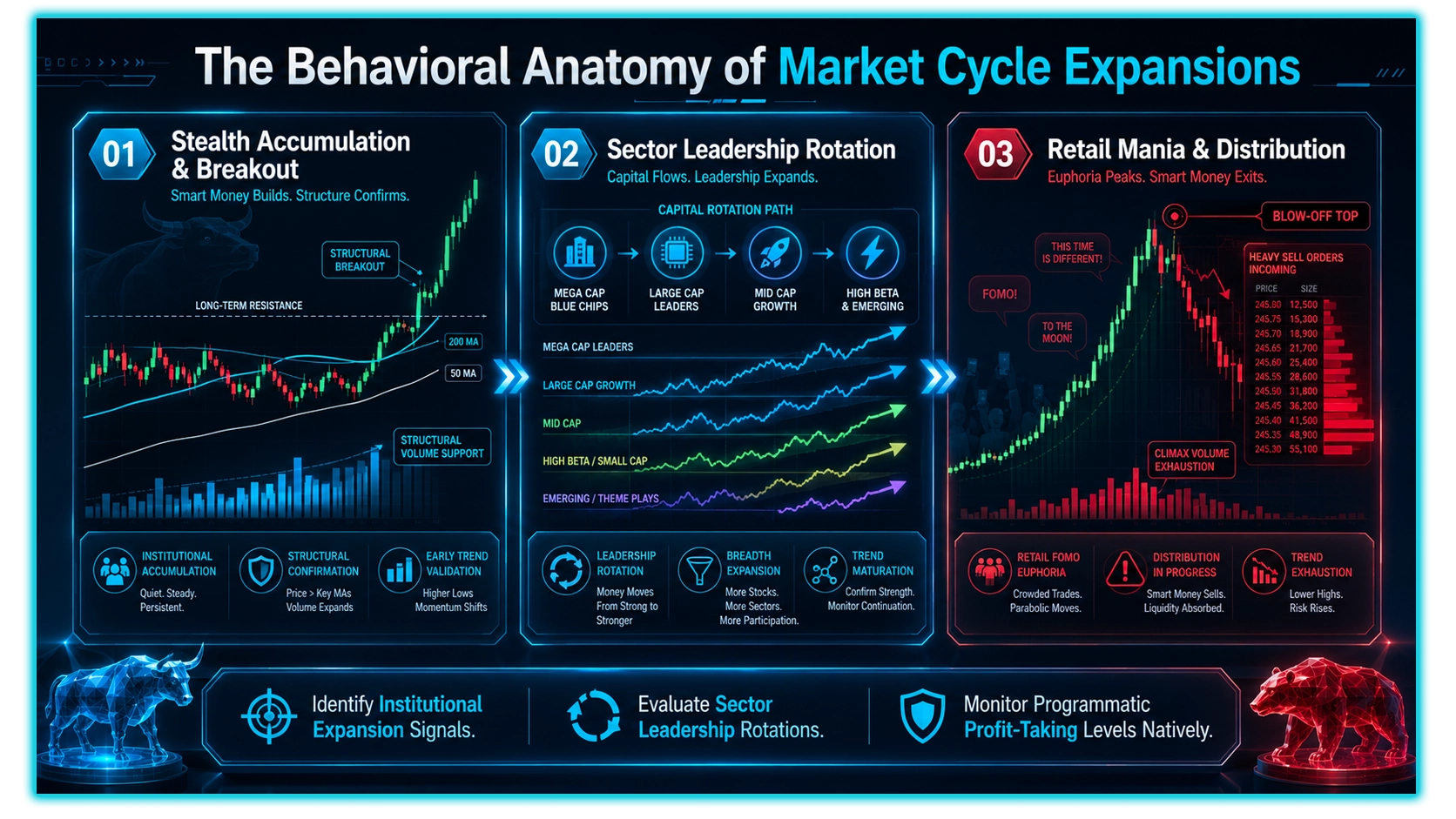
1. Core Indicators: Quantifying the Shift to Expansion
A bull market does not start because retail participants suddenly become excited; it starts when institutional accumulators silently exhaust the available spot supply during sideways consolidation ranges. Recognizing this baseline shift requires tracking specific structural indicators.
Trend Verification and Moving Averages
The foundational signal identifying a macro trend reversal is the Golden Cross. This technical milestone manifests on aggregate price charts when a short-term trend line (typically the 50-day moving average) breaks decisively above a long-term structural baseline (the 200-day moving average). This crossover confirms that near-term buying momentum has eclipsed historical distributions, shifting the macro architecture from defensive consolidation to expansion.
On-Chain Inflow Telemetry
In decentralized asset networks, real-time capital velocity serves as an un-falsifiable diagnostic tracker. Analysts monitor stablecoin printing metrics alongside the aggregate exchange supply drawdowns of base layer blue-chips. When stablecoin supplies scale to new highs while liquid token balances on centralized exchanges plunge toward multi-year lows, it signals that large-scale buyers are aggressively absorbing spot supply and moving it into cold storage vaults, creating a supply-shock runway.
2. Sector Leadership: Tracking the Capital Rotation Web
Wealth generation inside an expansionary cycle is a rolling wave. Capital does not flood into every speculative asset class simultaneously; it maps through a highly predictable cascade known as Capital Rotation.
Understanding this sequence prevents you from trapping your capital in lagging sectors while alternative niches experience explosive growth:
Stage 1: The Blue-Chip Anchor: The initial stage of a bull market is completely dominated by major assets (such as Bitcoin or Ethereum). Institutional allocators focus exclusively on deep liquidity venues, driving the base layer higher while the broader market watches silently.
Stage 2: The Beta Layer Expansion: Once the primary assets establish stable, elevated price plateaus, early allocators rotate their accrued paper profits down-curve. Capital seeks higher yield multipliers, flowing directly into major Layer 1 networks, established Layer 2 scaling layers, and highly audited decentralized finance blueprints.
Stage 3: Narrative Mania (The Long Tail): In the final, speculative phases of the cycle, risk tolerances collapse entirely. Capital floods into high-beta speculative micro-caps, un-audited algorithmic experimental protocols, and hyper-reactive narrative trends. While this stage yields intense vertical gains, it represents the highest-risk phase of the expansion.
3. Strategic Positioning: Building the Expansion Portfolio
Positioning yourself inside an active bull market requires transitioning your portfolio from capital preservation to growth maximization, without abandoning foundational risk parameters.
Conforming to Core Strength: Resist the temptation to constantly trade out of your primary ecosystem positions to chase sudden, random green candles across the market. The core of your portfolio should remain anchored in the sector leaders that are actively driving the macro expansion.
The Asymmetric Moonbag Allocation: Dedicate a controlled, non-essential fraction of your portfolio (such as 10% to 15%) to capture hyper-growth narratives early in their distribution cycle. Once a high-beta token achieves a massive multiplier, extract your initial seed capital back to stablecoins, allowing the remaining "moonbag" profits to run completely risk-free.
4. The Art of Profit-Taking: Executing the Exit Script
The most difficult psychological hurdle in an expansionary cycle is overriding human greed. In a bull market, many participants generate life-changing paper returns, only to give 100% of it back during the ensuing bear market because they lacked a formalized de-risking script.
The Realized Value Reality: Wealth is never officially created when an asset price increases on a screen; it is only secured the exact millisecond you convert that volatile asset back into a liquid unit of account or sovereign stablecoin pool.
To escape the cycle with your profits intact, implement an automated exit pipeline:
Programmatic Scale-Outs: Establish rigid, non-negotiable price targets before the market enters vertical mania phases. For example, program your execution desk to automatically liquidate 20% of a position every time the asset clears a major psychological or structural resistance milestone.
Trailing Stop-Loss Infrastructure: As an asset scales into price discovery zones, deploy dynamic trailing stop-loss orders behind the active price action. This allows your capital to capture extended upside runs while providing an automated exit trigger that seals your gains if the market suffers a sudden macro trend reversal.
Key Bull Market Indicators
| Indicator Type | Technical Tool | Market Signal |
| Trend Shift | Golden Cross | Macro trend reversal |
| Capital Volume | Exchange Supply Plunge | Spot token supply shock |
| Stablecoin Velocity | Aggregated Printing | Fresh buying power injection |
Capital Rotation Phases
| Cycle Phase | Leading Sector | Risk Assessment |
| Phase 1 | Primary Blue-Chips | Low Structural Risk |
| Phase 2 | Layer 1s & Core DeFi | Moderate Market Risk |
| Phase 3 | Speculative Micro-Caps | Extreme Capital Threat |
5. Real-Time Telemetry Tracking via DEXTools
- As bull market cycles accelerate, token liquidities fracture across alternative execution layers, and new speculative narratives launch daily, keeping constant track of real-time trading volumes, token creation logs, and localized pool depths is a vital requirement to capture alpha safely. Sourcing analytics through advanced decentralized charting architectures like DEXTools gives market participants an essential universal platform to monitor live token behaviors, evaluate pool depths, and inspect contract parameters across all public execution networks.
- By leveraging core features like the Pair Explorer, Live New Pairs dashboard, and the integrated Trade Story or Top Traders diagnostic tools, technical traders can seamlessly audit localized volume trends, track large whale wallet capital reallocations via the Big Swap Explorer, and check automated contract safety scores before initiating any on-chain interactions. This ensures your hardened hardware setup interacts safely with verified market venues as you position your capital ahead of expanding network trends.
You can access DEXTools here and start trading today!
What Is a Golden Cross in Crypto Trading?Liquidity Rotation: How Capital Moves Between Tokens Inside the Same NarrativePair Explorer Data Trend Reversals: A Pro Trading GuideChain Rotation: How Traders Detect Liquidity Moving Between EcosystemsGolden Cross in Crypto TradingOn-Chain Data Signals for High-Growth Crypto AssetsLiquidity Rotation Between TokensDetecting Liquidity Moving Between Ecosystems
Disclaimer: This article is for informational purposes only and does not constitute investment advice, financial advice, trading advice, or any other kind of advice. DEXTools does not recommend buying, selling, or holding any cryptocurrency or token. Users should conduct their own research and consult with a qualified financial advisor before making any investment decisions. Cryptocurrency investments are volatile and high-risk. DEXTools is not responsible for any losses incurred.