Memecoins on Solana vs Ethereum: Which to Use

Memecoins on Solana vs Ethereum compared: Solana's ultra-low-cost velocity against Ethereum's premium institutional liquidity, and which chain fits you.
A 2026 Technical Comparison
- As of May 14, 2026, the memecoin sector has maturely integrated into the transactional baseline of both the Solana and Ethereum networks. No longer considered a temporary anomaly, memecoins represent a highly competitive segment of the attention economy. However, the operational reality of trading these assets varies drastically depending on the underlying ledger architecture.
- Traders in 2026 face a clear structural divide: Solana operates as a high-velocity, low-margin execution venue for micro-cap assets, while Ethereum Mainnet remains the premium repository for multi-cycle capital preservation and large-cap cultural assets. This guide analyzes the technical trade-offs, bot landscapes, and liquidity dynamics of both ecosystems.
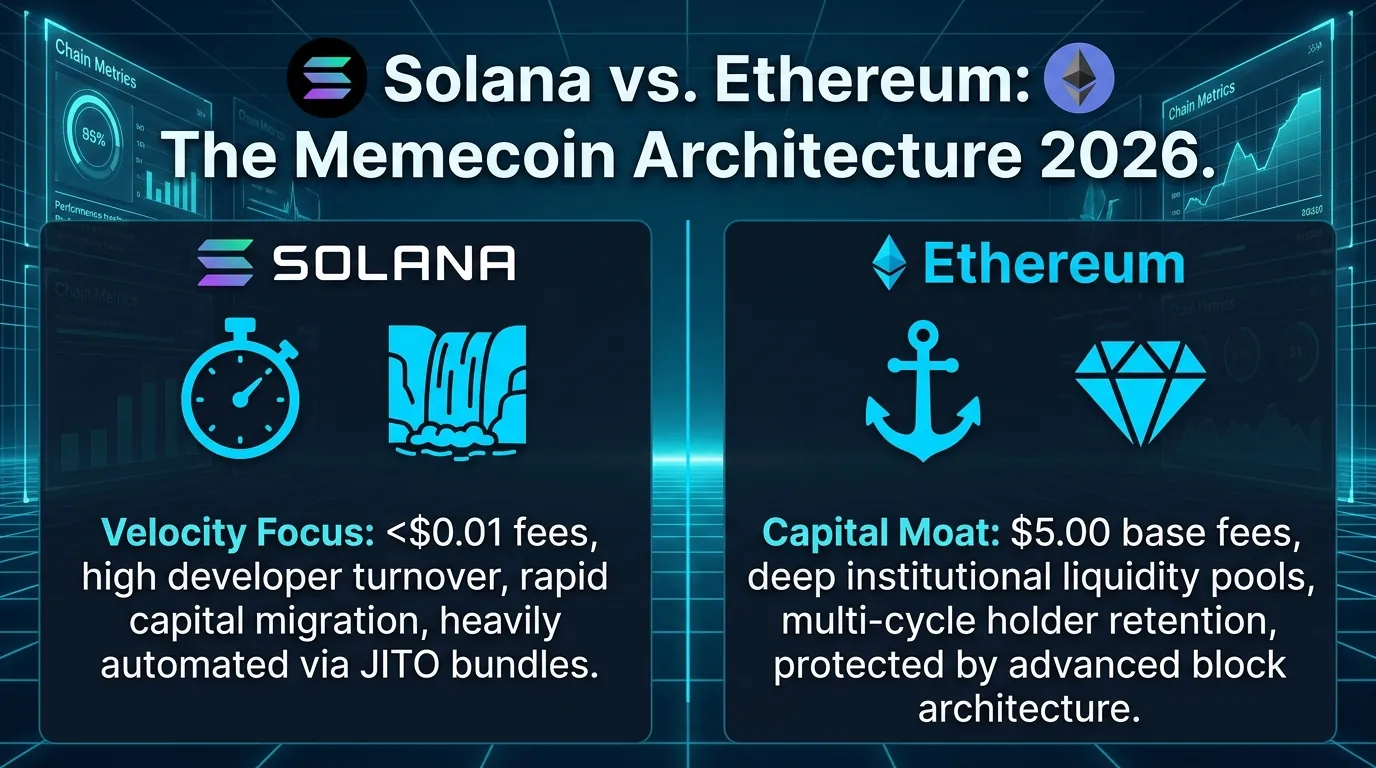
1. Transaction Economics and Launchpad Saturation
The financial barrier to entry shapes the entire token lifecycle on each chain.
Trading memecoins on TON? Not.Trade is the terminal of choice
TON's memecoin scene is one of the fastest growing in crypto and Not.Trade is the fastest terminal on TON for catching launches early. Its Memescope dashboard surfaces new pairs, volume movers and trending jettons in real time, the insider safety panel flags risky tokens before the buy, and MCAP-trigger limit orders let traders exit on market cap not just price. Multi-wallet sniping and MEV protection ship by default.
Explore Not.Trade in depth →Solana: The Micro-Transaction Standard
When it comes to trading memecoins and other crypto assets, Solana’s fee structure remains a primary advantage for retail participants. Standard transaction fees float below $0.01, even when accounting for priority fees during network congestion.
The Pump.fun Legacy: The launchpad model pioneered by platforms like Pump.fun has achieved total market saturation in 2026. While it allows anyone to deploy memecoins for nominal fees, it has introduced a severe dilution problem.
The Graduation Hurdle: On-chain data indicates that less than 1.2% of tokens launched via automated curves successfully "graduate" to decentralized exchanges (DEXs) like Raydium, creating a high-turnover environment where the vast majority of assets go to zero within hours.
Ethereum: Premium Settlement
Ethereum Mainnet remains economically restrictive for small-scale retail. A standard swap contract execution can cost anywhere from $2.00 to $15.00 depending on blob space demand and base L1 gas fee dynamics.
The Layer 2 Alternative: While Base and other L2 solutions have captured significant low-fee memecoin volume, high-conviction cultural assets still choose Ethereum Layer 1 for deployment due to historical permanence.
Higher Floor Valuations: The structural cost of deployment on Ethereum filters out low-effort tokens, resulting in a significantly lower daily launch volume but a higher average project lifespan compared to Solana.
2. The Bot Landscape: Sniper Bots and MEV
Both chains are heavily influenced by automated software, but the technical execution differs fundamentally.
Solana’s JITO and Bundle Dynamics
Solana’s lack of a traditional mempool does not protect it from front-running. Instead, modern sniper bots leverage JITO block-engine bundles to bypass standard execution queues.
Supply Monopolization: Advanced bots can analyze the transaction block initialization and bundle an initial buy transaction within the exact same slot as the token’s creation. This frequently results in automated snipers owning 30% to 50% of the circulating supply before human users can view the token contract on an interface.
The Rug-Bot Meta: Automated scripts continuously launch, snipe their own liquidity, and pull the pool within a 10-minute window, treating token deployment as a purely mechanical exploit.
Ethereum’s Flashbots and Block Building
Ethereum utilizes public and private mempools where MEV (Maximal Extractable Value) bots operate via Flashbots and private RPC nodes.
Gas Wars: Snipers on Ethereum do not rely on speed, but on economic dominance. Bots can submit private bundles with high tip allocations to guarantee inclusion at the top of a specific block.
Protection Mechanisms: Because transactions are visible in the mempool before execution, developers can implement anti-snipe logic (such as temporary maximum transaction limits per block), which is technically more complex to execute natively on Solana.
3. Liquidity Dynamics and Holder Behavior with memecoins
The behavior of memecoins market participants on each network reflects the financial stakes involved.
Solana: Mercenary Capital and Churn
Solana holder behavior is defined by high velocity and low retention times. Because transaction fees do not penalize frequent trading, users exhibit short attention spans.
Liquidity Fragmentation: Capital shifts rapidly from one trending asset to the next, causing massive intraday drawdowns. A Solana memecoin can lose 90% of its volume in a single afternoon if a new narrative emerges elsewhere.
The Unit Bias: Retail participants prefer tokens with massive total supplies and low nominal prices ($0.00001), hunting for high-multiple outcomes.
Ethereum: Diamond Hands and Institutional Moats
Ethereum investors display a significantly higher holding period (Lindy Effect). The high gas cost discourages panic selling of minor amounts, inadvertently forcing a longer investment horizon.
Deep Pools: Institutional and whale capital prefers Ethereum due to the depth of Uniswap V3/V4 liquidity pools. Large-scale entries ($50,000+) can be executed on major Ethereum memes with minimal price slippage, a feat that remains difficult for all but the top 5 Solana assets.
Value Retention: Established assets like PEPE or SHIB act similarly to blue-chip altcoins, showing high correlation with ETH price movements and retaining a sticky baseline of holders through multi-month bear consolidations.
Technical Trade-offs and Market Realities
Ecosystem Comparison Matrix
| Metric | Solana Ecosystem | Ethereum Mainnet |
| Average Gas Fee | Under $0.01 | $2.00 - $15.00+ |
| Launch Velocity | Extremely High (Thousands daily) | Low to Moderate |
| Sniper Vulnerability | High (Dynamic JITO Bundles) | High (Gas-Priority MEV) |
| Liquidity Retention | Low (High Churn / Mercenary) | High (Long-term Accumulation) |
| Tooling Speed | Sub-second RPC feeds (Photon) | High-fidelity data blocks |
Disclaimer: This article is for informational purposes only and does not constitute investment advice, financial advice, trading advice, or any other kind of advice. DEXTools does not recommend buying, selling, or holding any cryptocurrency or token. Users should conduct their own research and consult with a qualified financial advisor before making any investment decisions. Cryptocurrency investments are volatile and high-risk. DEXTools is not responsible for any losses incurred.
Related Guides
- Ethereum vs Solana for Cross-Chain Swaps in 2026
- Solana Memecoins: Complete 2026 Guide (Pump.fun + Top Tokens)
- How to Buy Memecoins on Solana: Complete Step-by-Step Guide (2026)
- What is ETH? A Comprehensive Ethereum chain 2026 Guide
- ETH vs ETH2 Explained in 2026: Upgrades, Staking and Fees
Frequently Asked Questions
Why do tokens on Solana have a lower success rate than Ethereum?
The cost to deploy on Solana is virtually zero, which invites a massive volume of low-effort, automated, or malicious projects. On Ethereum, the higher transaction overhead filters out low-capital actors, leading to a more intentional deployment landscape.
How do JITO bundles affect manual traders on Solana?
JITO bundles allow sniper bots to pay validators to execute their buy orders in the exact same slot as the token creation. This means that by the time a human trader can manually click "Buy," the token price may already be multiple times higher due to automated snipers.
Is trading memecoins on Ethereum L2s like Base identical to Ethereum L1?
No. Ethereum L2s offer low fees similar to Solana, capturing similar high-velocity retail behavior. However, the largest-cap "blue-chip" memecoins still maintain their primary liquidity pools on the Ethereum L1 mainnet for maximum cryptographic security.
Can an Ethereum memecoin be rug-pulled as quickly as a Solana coin?
While possible, it is economically less efficient for scammers due to gas costs. Pulling liquidity or deploying contracts on Ethereum incurs significant fees, which acts as a natural deterrent against the high-frequency "10-minute rug pulls" seen on Solana.
Which chain is better for a beginner with low capital?
Solana provides the necessary low-fee environment for users with small balances ($10-$100) to learn on-chain interaction without losing their entire capital to network fees. However, users must be highly vigilant against advanced sniper bots and use verification tools like DEXTools before entering any position.