What Is Aster Crypto (ASTER)? A Guide to the Multi-Chain Perp DEX
— By Tony Rabbit in Tutorials

The decentralized futures market has evolved past network constraints. We analyze the architecture, capital efficiency, and hyper-deflationary tokenomics of Aster.
Aster and the Rise of Multi-Chain Perp DEX Infrastructure
- The landscape of decentralized derivatives has entered a new era of structural integration with the rise of the Multi-Chain Perp DEX model. For years, decentralized futures platforms suffered from fragmented liquidity networks, excessive slippage, and vulnerable transparent order books that exposed institutional whales to predatory Miner Extractable Value (MEV) bot manipulation. Traders looking for advanced financial instruments were repeatedly forced to migrate back to centralized exchanges to achieve capital efficiency and competitive execution speeds.
- Aster completely shifts this infrastructure paradigm. Emerging from the strategic merger of Astherus and APX Finance, Aster unifies decentralized perpetual futures execution with advanced yield-generation engines. Backed by institutional venture infrastructure like YZi Labs, the network serves as a non-custodial bridge across BNB Chain, Ethereum, Arbitrum, and Solana. By eliminating the necessity for multi-step cross-chain bridging while introducing up to 1001x leverage, portfolio cross-margining, and hidden zero-knowledge order matching, Aster positions itself as a dominant institutional primitive within the modern decentralized ecosystem.
1. Dual Trading Architecture: Simple Mode vs. Pro Mode
Aster optimizes its execution layer by bifurcating its platform into two distinct user interfaces, catering to alternative risk tolerances and computational needs.
Aster Simple: The 1001x Leverage Engine
- Designed for retail accessibility and high-velocity capital deployment, the Simple Mode interface allows for one-click trading with leverage parameters scaling up to 1001x. This engine operates via a unified liquidity reserve known as the Aster Liquidity Pool (ALP).
- To safeguard the system from false liquidations or localized price anomalies, Aster integrates a multi-oracle network utilizing high-fidelity data feeds from Pyth Network, Chainlink, and Binance Oracle. The platform features built-in MEV resistance at the contract layer, ensuring retail trades are insulated from sandwich attacks and predatory front-running during high-volatility events.
Aster Pro: Institutional Order-Book Microstructure
- For institutional trading desks and advanced algorithmic market makers, Aster Pro introduces a high-throughput Central Limit Order Book (CLOB). This interface replicates the depth and tooling of centralized derivatives venues, incorporating automated grid trading algorithms, advanced conditional triggers, and custom portfolio margin frameworks.
- The Pro Mode infrastructure supports both single-asset margin (utilizing isolated USDT pools) and multi-asset mode. Under the multi-asset cross-margin framework, traders can pool multiple distinct cryptocurrencies simultaneously to back their open futures positions. The engine programmatically applies volatility-adjusted haircut discounts to each collateral asset, maximizing capital utilization while safely balancing cross-portfolio risk.
2. Capital Efficiency: The "Trade & Earn" Ecosystem
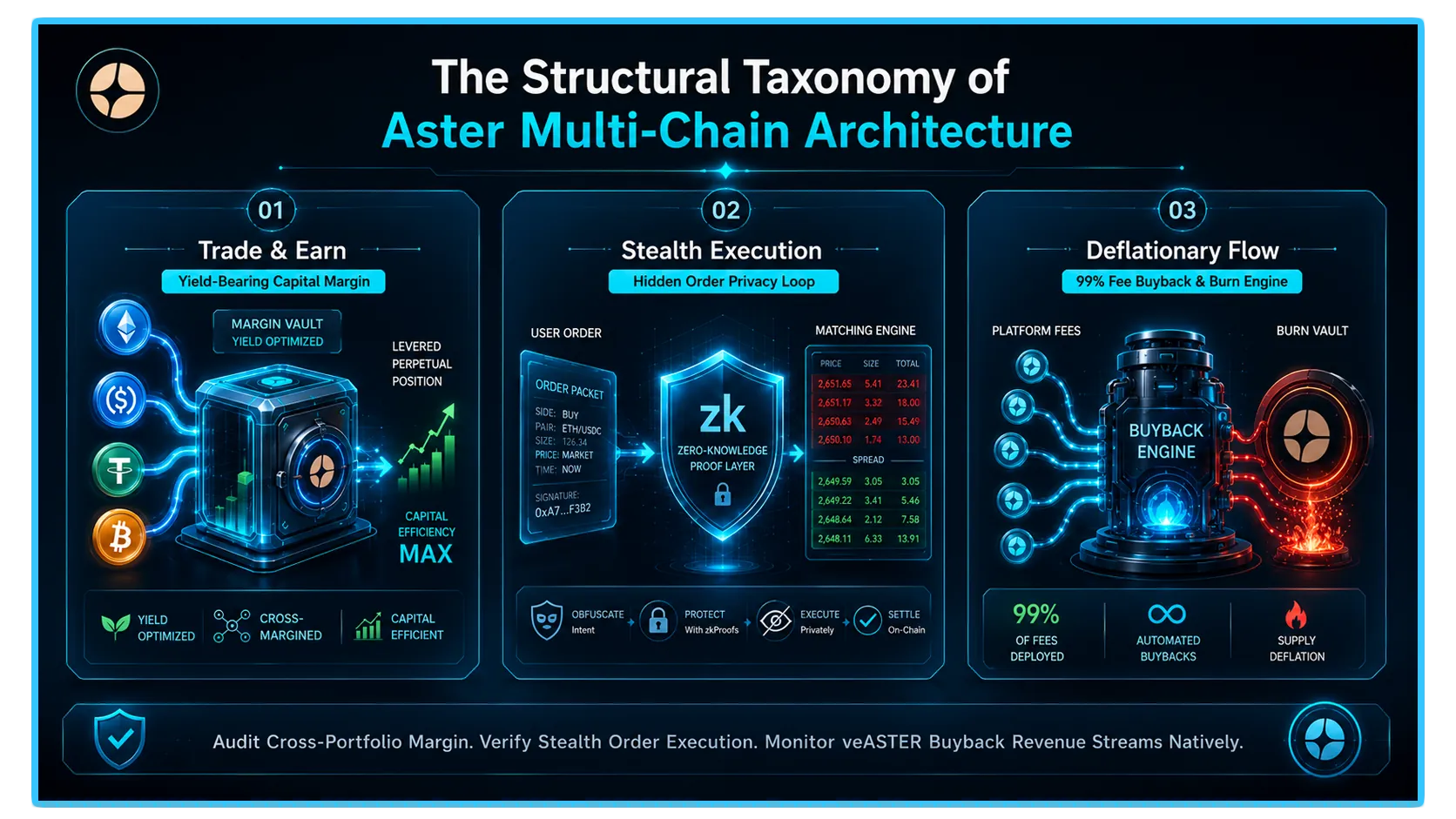
The primary structural innovation of Aster is its direct integration of yield-bearing assets into active derivative margin accounts. In conventional trading frameworks, capital deployed as margin sits completely idle inside clearing vaults, subjecting the allocator to significant opportunity costs. By acting as a unified Multi-Chain Perp DEX, Aster ensures that liquidity remains aggregated across networks rather than siloed inside static non-productive contracts.
The platform's native "Trade & Earn" engine transforms this workflow by enabling continuous capital productivity:
USDF Integration: Aster features its own fully collateralized, yield-bearing stablecoin known as USDF, minted one-to-one against USDT. This asset programmatically generates organic yields of up to 15% APY utilizing institutional delta-neutral hedging strategies.
Liquid Staking Derivatives (LSDs): Allocators can deposit specialized liquid staking assets, such as asBNB, directly into their Pro Mode margin accounts.
Simultaneous Revenue Streaming: While a trader maintains an active long or short position on the order book, their underlying collateral continues to accrue native validation rewards and protocol staking incentives in real-time, eliminating capital stagnation.
Traditional Finance Convergence: On-Chain Stock Perpetuals
- Expanding beyond native digital assets, Aster bridges traditional finance with Web3 by introducing non-custodial stock perpetual derivatives. Professional allocators can speculate on or hedge equity volatility for global enterprises like Tesla and Apple with up to 50x leverage.
- These instruments operate 24/7 across dedicated institutional sessions (including pre-market, regular market, post-market, and overnight trading hours) allowing global capital to react instantly to macroeconomic catalysts without intermediation.
3. Stealth Execution: Preventing MEV via Hidden Orders
- On transparent public blockchains, large-scale institutional orders face immense predatory front-running. When a whale submits a substantial block trade, high-frequency MEV algorithms scan the public mempool, front-run the entry, and push the execution price against the trader, resulting in severe slippage and artificial liquidation hunting.
- Aster elegantly resolves this vulnerability through its native Hidden Orders architecture, establishing a decentralized dark pool environment inside a public ledger.
- When an investor utilizes a Hidden Order, the smart contract leverages localized zero-knowledge proof parameters to obscure the order's total size and specific execution intent from the public-facing central limit order book. The transaction remains completely invisible to external scanners and automated front-running scripts until the exact moment of execution.
- This stealth execution framework ensures that institutional entities can accumulate or liquidate massive structural positions without moving the spot price against themselves, mitigating slippage and rendering predatory liquidation hunting mathematically impossible.
4. ASTER Tokenomics: The Aggressive Buyback and Burn Model
The ASTER token serves as the core economic substrate powering the network's governance, loyalty structures, and fee-reduction frameworks. Operating as a BEP-20 token with a maximum lifetime supply cap of 8 billion units, ASTER’s market design underwent a monumental structural transformation to tighten value capture for long-term ecosystem stakers.
The 198% Deflationary Loop Mechanics
Under the protocol's upgraded economic structure, Aster implements a hyper-aggressive revenue recycling engine that binds token value directly to real-world trading volume:
99% Fee Capture: The protocol channels exactly 99% of all daily platform trading fees toward an automated Time-Weighted Average Price (TWAP) buyback program executed continuously on-chain.
veASTER Redistribution: All ASTER tokens acquired through this daily buyback program are routed to a verified public rewards pool and distributed proportionally to users who lock their assets into veASTER (voter-escrowed ASTER) loyalty contracts.
99% Matching Burn: For every single token bought back and distributed to stakers, the protocol executes an identical matching burn, destroying an equivalent number of tokens directly from the team and treasury reserve allocations.
- This dual-action engine accelerates a massive deflationary spiral, systematically removing tokens from circulation until the maximum supply contracts from 8 billion down to a hard target of 3 billion units.
- Furthermore, to expand the platform's utility, permitless spot token listings require a flat listing fee of $50,000 USDT, which is routed entirely into the exact same automated TWAP buyback and burn framework, cementing ASTER as one of the most aggressively value-aligned assets in the decentralized derivatives sector.
5. Cross-Chain Settlement and Volatility Telemetry
- Navigating a high-performance derivatives environment spanning multiple independent blockchains requires deep visibility into underlying spot market liquidity. While Aster's automated routing allows users to execute trades on Solana or Arbitrum smoothly from a single wallet interface, tracking the real-world depth of the base tokens across decentralized liquidity pools is essential for calculating exact arbitrage windows and verifying order book health.
- DEXTools provides the critical data infrastructure necessary to audit these cross-chain movements in real-time. By utilizing advanced pair tracking, order book data visualization, and large-scale whale wallet monitoring, participants can cross-reference Aster's on-chain metrics with live decentralized spot market data. This independent verification layer ensures that your multi-asset portfolio configurations are anchored by genuine, high-fidelity liquidity depth across the entire Web3 ecosystem. Ultimately, the development of an institutional-grade Multi-Chain Perp DEX redefines capital efficiency on-chain.
Disclaimer: This article is for informational purposes only and does not constitute investment advice, financial advice, trading advice, or any other kind of advice. DEXTools does not recommend buying, selling, or holding any cryptocurrency or token. Users should conduct their own research and consult with a qualified financial advisor before making any investment decisions. Cryptocurrency investments are volatile and high-risk. DEXTools is not responsible for any losses incurred.