What is Babylon? Bitcoin Staking Explained
— By AliceOnChain in Tutorials

An advanced, technical deep dive into Babylon's revolutionary trustless Bitcoin staking architecture, exploring how it scales network security and how traders can analyze emerging ecosystem assets.
For the complete, up-to-date guide, read our full guide here.
What is Babylon? Bitcoin Staking Explained
The concept of generating yield on Bitcoin historically presented a fundamental architectural dilemma. Because Bitcoin's scripting language is intentionally restrictive and lacks a native Turing-complete virtual machine like Ethereum, users looking for yield traditionally had to rely on centralized custodians or multi-signature wrapped token bridges. These methods introduce significant counterparty, smart contract, and bridge vulnerabilities, often running counter to the core ethos of decentralized finance (DeFi).
The emergence of the Babylon protocol represents a structural paradigm shift in capital efficiency for the world's oldest digital asset. By introducing a framework for native, trustless architecture, this mechanism changes how asset utility is perceived. In this technical guide, the core mechanics of Bitcoin staking explained below will demystify how BTC holders can lock their assets directly on the Bitcoin blockchain to secure external Proof-of-Stake (PoS) networks. This framework explores the underlying cryptomechanics of the Babylon architecture, examines its implications for institutional and retail liquidity, and demonstrates how sophisticated on-chain analysts can utilize DEXTools to track and trade emerging tokens within this expanding ecosystem.
The Core Problem: Capital Inefficiency and Security Fragmentation
Proof-of-Stake networks rely heavily on the economic value of their native tokens to protect against Sybil attacks. For newer or smaller Layer 1 and Layer 2 blockchains, establishing a high economic security threshold can be capital-intensive and highly inflationary, as they must emit significant amounts of native tokens to incentivize validators.
Conversely, Bitcoin represents over a trillion dollars in dormant economic security. While highly secure, this capital remains largely underutilized outside of basic spot trading and passive accumulation. Previous attempts to port this liquidity over to PoS ecosystems required wrapping BTC into tokens like wBTC or tBTC. This approach forces users to assume smart contract risks on third-party chains or entrust assets to centralized custodians. If a bridge is exploited, the underlying backing is compromised, leading to devastating systemic failures.
Babylon solves this problem by decoupling the staking asset from the execution layer of the PoS network. With the structural logic of Bitcoin staking explained through decentralized validation, the protocol allows Bitcoin to act as an economic collateral layer while keeping the assets secured by the core consensus rules of the Bitcoin network itself.
How Babylon Achieves Trustless Bitcoin Staking
To understand how Babylon functions without smart contracts or external bridges, it is necessary to examine three fundamental cryptographic primitives that the protocol leverages: extractable one-time signatures (EOTS), time-locks, and cryptographic covenant mechanics natively supported by Bitcoin’s Taproot upgrade. When breaking down the core concepts of Bitcoin staking explained by cryptography, these three elements form the baseline of secure asset deployment.
1. Extractable One-Time Signatures (EOTS)
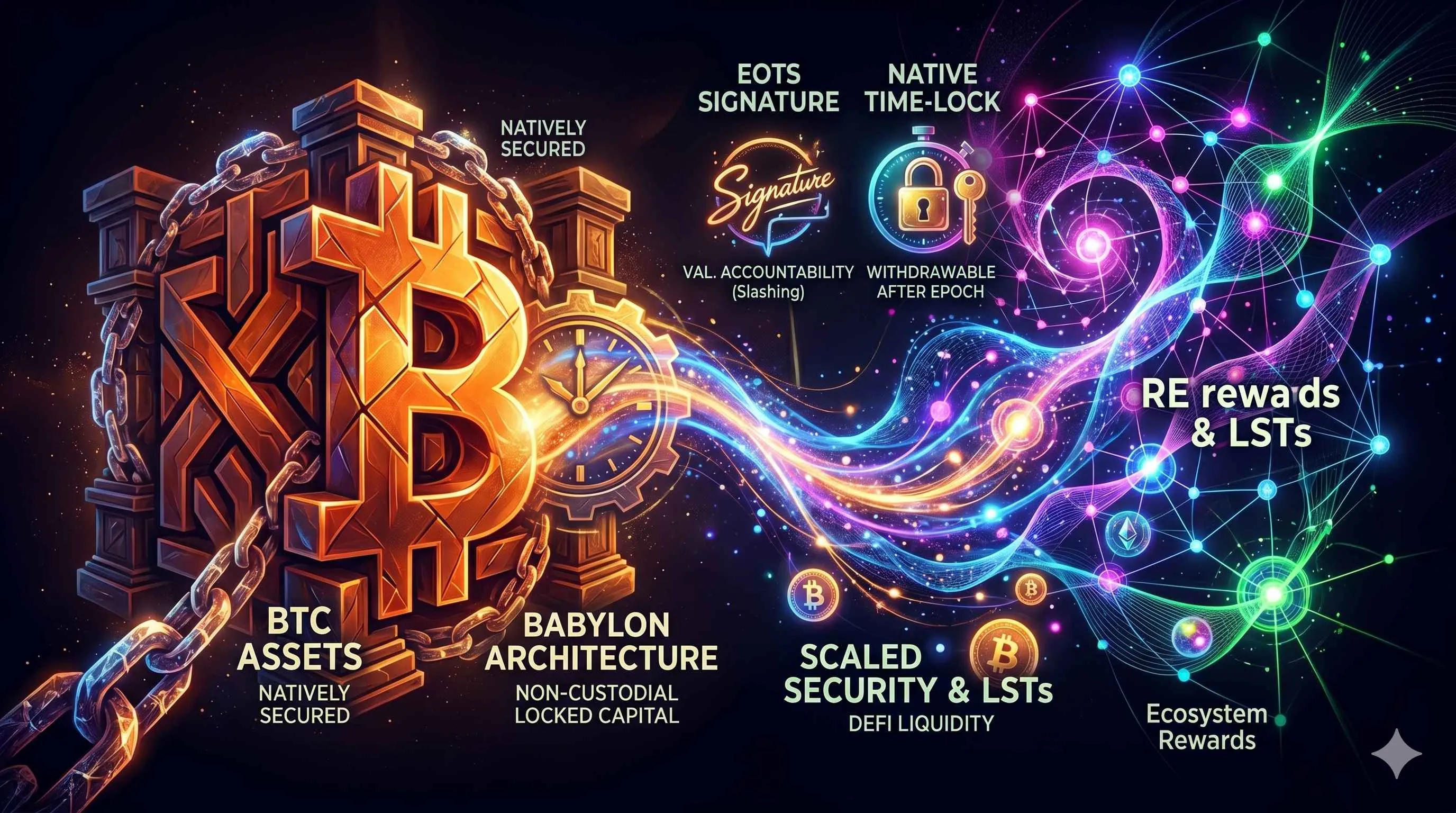
The primary mechanism for enforcing accountability in PoS networks is "slashing"-the permanent confiscation of staked capital if a validator attempts to sign two conflicting blocks at the same block height (double-signing). Babylon achieves this on the script-level Bitcoin blockchain via EOTS.
When a user stakes Bitcoin through Babylon, they sign a transaction using EOTS. If the validator behaves honestly, the signature remains private and secure. However, if the validator attempts to sign two different blocks at the same height, the underlying mathematical property of EOTS allows anyone to extract the private key associated with that stake. Once the private key is exposed, the network can programmatically execute a transaction that sends the staked Bitcoin to an unspendable burn address, successfully enforcing a native on-chain slashing condition.
2. Native Bitcoin Time-Locks
Instead of transferring BTC to a third-party wallet, stakers lock their funds in a specialized Bitcoin multi-signature script. This script utilizes Bitcoin's native CheckSequenceVerify (CSV) or CheckLockTimeVerify (CLTV) opcodes. The funds are locked for a predetermined epoch.
Once the time-lock expires, the staker can generate a standard transaction to withdraw their funds back to their primary wallet. At no point during an honest staking cycle do the funds leave the custody of the user’s cryptographic parameters or enter a bridge contract. Within the parameters of Bitcoin staking explained in technical documentation, this native time-lock functions as the ultimate non-custodial guarantee for participants.
3. The Babylon Integration Layer
Babylon itself operates as a separate Cosmos-SDK-based blockchain that acts as a control plane. It timestamps staking operations, aggregates validator signatures, and relays consensus data between the Bitcoin network and the consumer PoS chains. By acting as a secure administrative middleware, Babylon ensures that the external PoS network can verify the exact state and finality of the locked Bitcoin before granting voting power to its validators.
Market Implications: A New Era for On-Chain Liquidity
The successful deployment of trustless infrastructure has profound implications for market structure, asset valuation, and on-chain behavior.
First, it alters the velocity of Bitcoin supply. As institutional and large retail holders lock up significant tranches of BTC for staking yield, the liquid circulating supply on centralized exchanges may contract, structurally impacting spot market volatility and order book depth. With the dynamics of Bitcoin staking explained through supply contraction, asset scarcity on secondary markets can influence broader token valuations.
Second, it establishes a foundational yield curve for Bitcoin. Historically, Bitcoin yield was synthetic or driven by centralized lending desks. Babylon establishes a decentralized, risk-adjusted reference rate for native BTC. This benchmark will inevitably dictate how other DeFi applications price risk and incentives moving forward.
Third, it catalyzes an entirely new ecosystem of liquid staking tokens (LSTs) and restaking protocols built on top of Babylon. Just as Lido and EigenLayer transformed the Ethereum DeFi landscape by freeing up locked capital, protocols leveraging Babylon allow users to mint liquid wrappers representing their staked Bitcoin. These secondary assets then flow directly into decentralized exchanges, AMMs, and lending markets, generating highly dynamic trading environments.
How to Analyze and Trade the Babylon Ecosystem via DEXTools
As liquidity pours into Babylon-related projects, liquid staking protocols, and ecosystem reward tokens, on-chain analysts must adapt their methodology to evaluate these highly volatile assets. Navigating these emerging markets requires a structured approach to risk management, volume tracking, and contract verification. Having the layout of Bitcoin staking explained from an economic perspective allows traders to look at these derivatives with a clearer lens.
Tracking Capital Inflows with Pair Explorer
When new liquid staking tokens or ecosystem governance assets launch on decentralized venues like Uniswap, PancakeSwap, or Balancer, the first point of reference is the DEXTools Pair Explorer. Analysts should look beyond basic price action and closely monitor the structural relationship between volume and liquidity.
A healthy, sustainable token launch typically displays an ascending or stabilized liquidity-to-market-cap ratio. If a token's market capitalization expands rapidly while the total value locked (TVL) in its liquidity pool remains shallow, the asset becomes highly susceptible to extreme volatility and slippage. Monitoring the real-time order flow on the Pair Explorer helps traders identify whether a pump is driven by widespread accumulation or artificially engineered by low-depth wash trading.
Evaluating Risk Metrics and Holder Distribution
New ecosystems are hotbeds for experimental tokenomics and malicious actors. Before interacting with any Babylon-adjacent asset, leveraging the integrated security audits on DEXTools is critical. This feature flags critical contract vulnerabilities such as honeypot functions, modifiable minting parameters, or hidden transaction taxes that could lock user capital unexpectedly.
Furthermore, analyzing holder distribution is paramount. By integrating tools like Bubblemaps or utilizing the Holder Analysis tab on DEXTools, traders can evaluate if a significant percentage of the token supply is concentrated within a cluster of inter-connected wallet addresses. High concentration among a few non-exchange addresses represents severe structural risk, as whale liquidation events can cascade price through support levels instantly.
Volatility Management and On-Chain Behavior
The trading of ecosystem reward tokens often correlates strongly with the technical milestones of the underlying infrastructure project. For instance, when Babylon opens a new staking cap or completes a major network upgrade, related ecosystem assets frequently experience high directional volatility.
To navigate these shifts safely, traders should incorporate traditional technical analysis tools-such as identifying major horizontal support and resistance zones or tracking RSI divergences-alongside real-time on-chain metrics. Setting automated DEXTools Price Alerts allows market participants to monitor critical breakouts or breakdown points without succumbing to emotional FOMO or panic selling. Managing risk through disciplined position sizing and gradual profit-taking is essential when trading highly speculative, early-stage ecosystem tokens. With the foundational patterns of Bitcoin staking explained through market execution, managing downside risk becomes a function of tracking on-chain distribution.
Conclusion: The Architecture of Scaled Security
The Babylon protocol provides an elegant, cryptographic answer to a long-standing challenge: how to securely monetize the economic security of Bitcoin without sacrificing its core decentralized principles. By combining extractable one-time signatures with native time-locks, Babylon expands the utility of Bitcoin from a passive store of value to a foundational infrastructure layer for multi-chain security.
As this ecosystem matures, the flow of capital will continue to generate highly complex trading opportunities across decentralized networks. With the macro thesis of Bitcoin staking explained through programmatic yield, successful market participants will be those who combine a deep technical understanding of infrastructure protocols like Babylon with rigorous, data-driven on-chain analysis. By leveraging the advanced charting, security audits, and liquidity tracking features of DEXTools, traders can navigate these emerging frontiers with clarity, precision, and robust risk management.
Top 5 Whale Tracking Tools in 2026: Large Wallet Monitoring Across ChainsWhat Is Babylon Bitcoin Staking: Complete BTC Self-Custody Staking Guide (2026)
Borrow Cap vs Supply Cap: How Lending Limits Protect DeFi Markets
Pair Explorer Data Trend Reversals: A Pro Trading Guide
Disclaimer: This article is for informational purposes only and does not constitute investment advice, financial advice, trading advice, or any other kind of advice. DEXTools does not recommend buying, selling, or holding any cryptocurrency or token. Users should conduct their own research and consult with a qualified financial advisor before making any investment decisions. Cryptocurrency investments are volatile and high-risk. DEXTools is not responsible for any losses incurred.
Related Guides
- What Is Babylon Bitcoin Staking: Complete BTC Self-Custody Staking Guide (2026)
- What Is Solv Protocol Solv Bitcoin Staking Btcfi Guide 2026
- What Is Lombard Finance? LBTC Bitcoin Liquid Staking Guide 2026
- What is Staking? Proof of Stake Beginner Guide
- What Is Staking in Crypto? How It Works, Rewards, Risks and Best Practices (2026)
Frequently Asked Questions
What is Babylon in crypto?
Babylon is a project focused on enabling Bitcoin staking to help secure other networks. It aims to let Bitcoin holders participate in staking-style activity using a trust-minimized design.
What is Bitcoin staking?
Bitcoin staking refers to mechanisms that let Bitcoin be used to help secure networks or earn rewards without traditional smart contract staking. Approaches in this area aim to keep custody and security in mind for holders.
How does Bitcoin staking differ from proof-of-stake on other chains?
Bitcoin uses proof-of-work and does not have native staking like proof-of-stake chains, so Bitcoin staking relies on additional protocols and mechanisms. These designs aim to put Bitcoin to work while managing custody and security risks.
What are the risks of Bitcoin staking protocols?
Risks can include smart contract or protocol bugs, slashing-style penalties in some designs, and reliance on the protocol's security assumptions. Users should understand how their Bitcoin is held and what could cause loss before participating.