What Is Milady (CULT)? Remilia NFT + Cult Coin Ecosystem Guide 2026
— By Whatsertrade in Tutorials
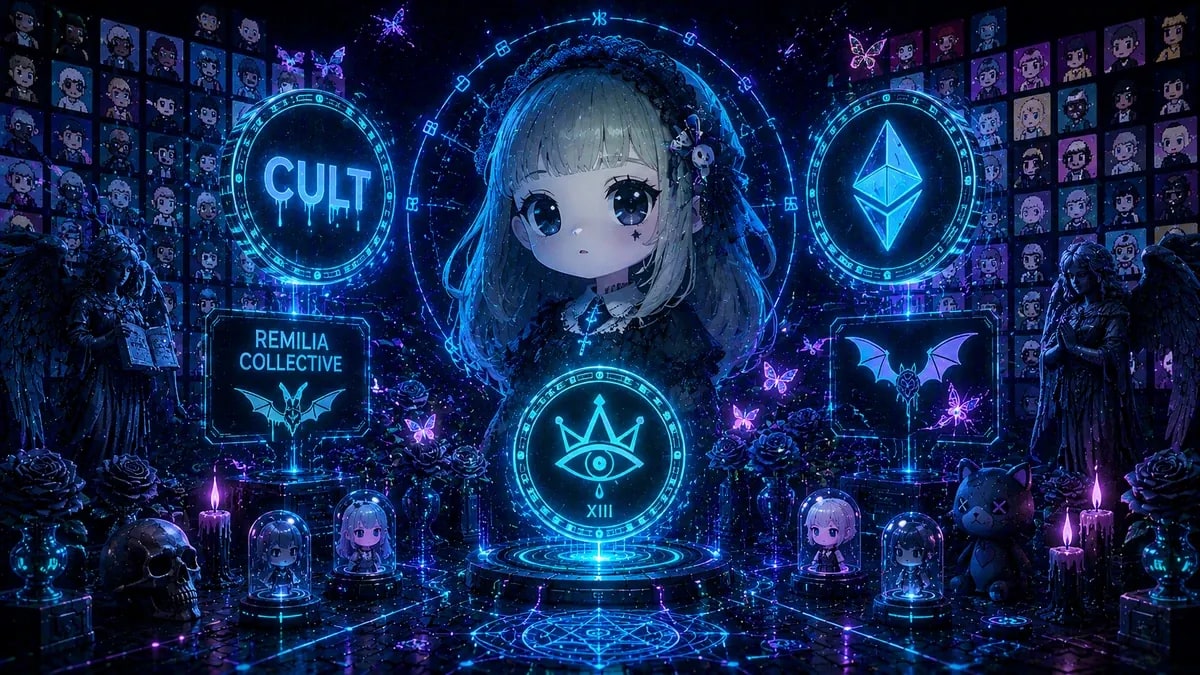
Milady Maker is a collection of ten thousand neochibi anime PFP NFTs deployed on Ethereum in August 2021 by Remilia Corporation, with five style cores Lolita, Harajuku, Gyaru, Hypebeast and Prep. In December 2024 the project launched CULT, the official ERC twenty cult coin of the ecosystem, and in January 2025 Vitalik Buterin acquired Milady number nine thousand two hundred and eighty six and set it as his X profile picture. Full 2026 guide: Charlotte Fang controversy, network spirituality philosophy, Remilio Babies, Miladycraft, the magazine and record label, CULT tokenomics, comparison vs Pudgy Penguins, BAYC and Azuki, and the real risks.
What Is Milady (CULT)? Remilia NFT + Cult Coin Ecosystem Guide 2026
In August 2021, while Bored Apes were busy minting golden fur on luxury yachts and CryptoPunks were trading at six figures inside auction houses, a small group of anonymous artists led by a polarizing figure named Charlotte Fang quietly deployed a collection of ten thousand pastel anime girls on Ethereum. The collection was called Milady Maker. The aesthetic was loud, soft, and deliberately ugly in the way only intentional art can be. The price was a fraction of an ETH. Within four years that same project would be name dropped on Vitalik Buterin's X profile picture, accumulate one of the most loyal communities in crypto, spawn an official ERC twenty token, and force every NFT analyst to redraw the map of what an internet culture coin can be.
Milady is not a normal NFT project. It does not chase mainstream brand deals the way Pudgy Penguins does. It does not lean on minimalist anime cool the way Azuki does. It does not trade on luxury status signaling the way Bored Ape Yacht Club does. Milady is a self described cult, a philosophical experiment in what the project calls network spirituality, an art world inside Ethereum, and since December 2024 the home of an official cult coin named CULT that exists to power that ecosystem.
This evergreen guide walks through everything that matters about Milady and CULT in 2026. We cover the August 2021 launch, the Remilia Corporation collective behind the art, the five style cores that define the neochibi aesthetic, the Charlotte Fang founder controversy, the moment Vitalik Buterin acquired Milady number nine thousand two hundred and eighty six and made it his X profile picture in January 2025, the December 2024 CULT coin launch, the Miladycraft Minecraft server, the Remilio Babies derivative collection, the quarterly magazine and record label, and a direct comparison against Pudgy Penguins, Bored Ape Yacht Club, and Azuki.
Featured Snippet
Milady Maker is a collection of ten thousand profile picture NFTs deployed on Ethereum in August 2021 by Remilia Corporation, a collective of anonymous artists once led by Charlotte Fang. The collection features a neochibi anime aesthetic inspired by Tokyo street fashion and is built around five style cores: Lolita, Harajuku, Gyaru, Hypebeast and Prep. In December 2024, Remilia launched CULT, the official ERC twenty token of the Milady ecosystem, which functions as the cultural and treasury asset of the broader Remilia universe. In January 2025, Vitalik Buterin set Milady number nine thousand two hundred and eighty six as his X profile picture, an event widely credited with catalyzing the collection's return to top tier NFT status alongside Pudgy Penguins, Azuki and Bored Ape Yacht Club.
Before going into the specifics, it is worth setting expectations. Milady is an NFT collection first and a token second. The cultural and aesthetic identity of the project predates CULT by more than three years, and any honest analysis of CULT has to be grounded in the broader Remilia ecosystem rather than treated as a standalone memecoin. If you are new to NFTs as a primitive, our explainer on what an NFT actually is covers the fundamentals, and our deeper dive into the ERC seven hundred and twenty one standard explains the technical primitive Milady is built on.
Milady lives on Ethereum, which is the native home of most blue chip NFT collections. If you are still building a foundation, our companion piece on how Ethereum works for beginners covers the chain itself, and our walkthrough on how to use OpenSea is the most direct path to actually browsing Milady listings.

What Exactly Is Milady Maker as a Collection
Strip away the cultural baggage for a moment. As a piece of code, Milady Maker is an ERC seven hundred and twenty one smart contract on Ethereum that records ownership of ten thousand unique non fungible tokens, each one corresponding to a hand stylized profile picture of a young female character drawn in a deliberately rough chibi anime style. The contract was deployed in August 2021 during the peak of the first major NFT cycle, the same window that produced the Bored Ape Yacht Club, Loot, Cool Cats, World of Women and a few hundred other collections.
What makes Milady visually distinct is the commitment to neochibi as a design language. Neochibi blends classical chibi proportions, oversized head, simplified features, expressive eyes, with a wider palette of contemporary Tokyo street fashion references. The result does not look like Sanrio, does not look like Studio Ghibli, and does not look like the polished anime adjacent art seen in Azuki. Milady art is intentionally unpolished, often described by holders as cute, weird, and aggressively online. That aesthetic decision has aged well. Years after launch the art still reads as a unified visual identity rather than a dated mint cycle artifact.
The collection is structured around five style cores, an internal taxonomy that the Remilia artists used to bucket trait combinations during generation. The five cores are Lolita, Harajuku, Gyaru, Hypebeast and Prep. Each one references a real subculture from Tokyo or adjacent youth fashion scenes and each Milady leans visually toward one of the five. Hypebeast cores feature streetwear logos and chunky sneakers. Lolita cores carry frilled dresses and Victorian ribbons. Gyaru cores are tanned with bleached hair and dramatic makeup. Prep cores look like a Manhattan private school. Harajuku cores pull from the most chaotic end of Tokyo fashion. Collectors trade and rank Miladys partially on the strength of their style core and on rare trait combinations within each core.
Who Is Remilia Corporation
Milady was not deployed by a venture backed startup with a marketing team and a press kit. It was launched by Remilia Corporation, a self described collective of anonymous artists, programmers and writers whose stated mission has always been to build what they call an internet native art world. Remilia treats Milady as one work inside a larger body of output that includes derivative NFT collections, a quarterly print magazine, a record label, a Minecraft server, a series of web experiments, and most recently the CULT token. The corporation framing is deliberately ironic. There is no traditional corporate structure, no equity, no board of directors, and no formal headquarters. It is a loose creative collective operating under a brand.
The early identity of Remilia was closely associated with one individual, Charlotte Fang, who is widely credited as the founder and creative direction of the project. Fang is also the central figure in the founder controversy that hit Milady in May 2022, which we cover in detail below. Following that controversy Charlotte Fang stepped back from public leadership and Remilia restructured around a broader group of contributors. As of 2026 the project presents itself as a decentralized collective without a single visible founder, even though the brand and the lore Charlotte Fang shaped continue to define the cultural identity.
From a holder perspective, the relevant point is that Remilia is not run like a typical NFT studio. There is no road map of seasonal drops timed to maximize floor price. There is no aggressive licensing program selling Milady characters to consumer brands. The output is artistically driven, sometimes obscure, often deliberately niche, and always tied back to the same internal lore and aesthetic. That posture is closer to an independent record label or art collective than to a venture funded company, and it explains a lot about why the project has retained cultural credibility even through difficult periods.
August 2021 Launch and the First Cycle
Milady minted in August 2021 at a low mint price during a window of extreme NFT activity. The initial sale moved relatively slowly compared to the most hyped launches of that summer. Milady did not sell out in minutes, did not reach a six figure floor on day one, and was not immediately treated as a blue chip. The first months on the secondary market saw the floor oscillate at a fraction of an ETH while Bored Ape Yacht Club, CryptoPunks and Doodles dominated the conversation.
What set Milady apart in the months after launch was the depth of the community that began forming around the art. Holders did not just flip their pieces. They built lore, designed Discord channels, produced fan art at industrial scale, organized in person meetups, and started using their Miladys as profile pictures across what was then still Twitter. The PFP behavior signaled something specific. Holders did not see Milady as a speculative position waiting to be exited. They saw it as a tribe affiliation. That early reframing from collectible to identity is one of the single most important moments in Milady's trajectory.
Charlotte Fang and the May 2022 Controversy
In May 2022 the Milady project nearly collapsed under a controversy that has been documented extensively by mainstream crypto press, including Decrypt, NFT Evening and the Web3 Is Going Great archive. Web3 Is Going Great catalogued the incident as a case study in NFT founder risk. The trigger was the public re identification of Charlotte Fang as the person behind a previous online persona named Miya, who had been associated with extreme online communities and a controversial podcast known for promoting harmful ideologies. The disclosure forced a reckoning inside Milady's community and across crypto.
The floor price of Milady collapsed sharply in the immediate aftermath. A subset of holders sold and condemned the project. Marketplaces faced pressure to delist. A breakaway group attempted to fork the collection and produce a competing project. Charlotte Fang issued public apologies and stepped back from operational leadership, and Remilia restructured its public face to emphasize the broader collective rather than any single founder. None of this fully resolved the underlying questions about Fang's prior activities, but it did create a window for the project to continue.
What happened next is genuinely unusual in the NFT space. Rather than fading into irrelevance after a founder scandal, Milady stabilized and slowly rebuilt cultural momentum through the bear market of 2022 and 2023. The art continued to circulate. The community remained engaged. Remilia continued producing new work. By late 2024, several years after the controversy, Milady was once again treated as a culturally significant collection by parts of crypto media. Whether one views that trajectory as redemption, as moral compromise by the market, or as a separate question entirely from the art, depends on one's own values. This guide does not take a position on the controversy itself. It does flag, very explicitly, that the founder history is material context for any potential collector and is not optional reading.
Network Spirituality as a Philosophy
One of the most distinctive elements of the Milady project is the philosophical framing the founders attached to it. Remilia describes the underlying worldview as network spirituality, a concept Charlotte Fang and adjacent writers developed across blog posts, podcasts and lectures. The core idea is that internet native communities can function as something close to religious or spiritual structures, with shared symbols, rituals, in group ethics, founding myths and a sense of belonging that is no less real for being mediated through screens. Milady is presented as one such structure, half art project, half internet cult, with the NFT as both membership token and personal devotional object.
In practice, network spirituality manifests as a recognizable in group culture. Milady holders refer to themselves using shared vocabulary, treat the visual style as a marker of belonging, and circulate references that only make sense inside the community. The lore has been extensively documented in members.delphidigital.io research and in Sarteri's deep ethnographic writing on Milady, which treats the project less as a token and more as a digital tribe. Some of the framing is sincere philosophy. Some of it is internet irony delivered with a straight face. The honest description is that Milady is an art project that takes its own mythology more seriously than most.
December 2024 and the Launch of CULT Coin
For most of its history Milady existed as a pure NFT project with no associated fungible token. That changed in December 2024 when Remilia officially launched CULT, an ERC twenty token positioned as the official cult coin of the Milady ecosystem. CULT is the first fungible token Remilia has endorsed as canon, which is significant in a project that historically guarded its brand carefully and refused to greenlight derivative tokens.
CULT is positioned not as a utility token in the traditional Web three sense, with staking yields and governance votes and protocol fees, but as a cultural and treasury asset for the broader Remilia ecosystem. The token is meant to function as a tribal token for the Milady community, a coordination asset for ecosystem grants, and a speculative vehicle that retail can hold without needing to acquire a full ETH priced Milady NFT. If you need a refresher on the underlying primitive, our guide on the ERC twenty token standard explains exactly what kind of contract CULT runs on.
The launch was structured to align with Remilia's general aesthetic. There was no traditional venture round, no aggressive presale, and the rollout leaned heavily on community first distribution channels and existing Milady holders. CULT integrated with the Ethereum DEX ecosystem within hours of launch and was indexed on major analytics dashboards. Traders who wanted to monitor the pair could do so using standard tools, and our walkthrough on how to use DEXTools to track new pairs covers exactly the workflow that surfaced CULT during its first weeks of trading.

January 2025 and the Vitalik Buterin Moment
If December 2024 was the moment Milady acquired a token, January 2025 was the moment it acquired the single most powerful endorsement available in crypto. Vitalik Buterin, the co founder of Ethereum, acquired Milady number nine thousand two hundred and eighty six and set the image as his profile picture on X. The move was covered by Decrypt, AInvest and a range of crypto media outlets and was discussed across NFT, memecoin and Ethereum core developer timelines in real time.
Vitalik does not promote NFT collections. He does not endorse memecoins. The choice to publicly hold and use a Milady is therefore unusually loaded. It signaled a few things at once. That Milady had crossed back into mainstream NFT credibility despite its controversial history. That at least one of the most influential figures in Ethereum considered the project culturally significant enough to be willing to display affiliation. And that the broader narrative around network spirituality, internet native art and Ethereum culture had become impossible to ignore.
The market reaction was immediate. Milady floor prices repriced upward inside hours. The CULT token, which had launched only weeks earlier, surged in volume and on chain activity. Wiki dot Remilia dot org saw a sharp increase in traffic. The long dormant question of whether Milady was a top tier blue chip alongside Bored Ape Yacht Club, Pudgy Penguins and Azuki was reopened, with NFT analysts including the team at Delphi Digital writing the project back onto their core watchlists. Vitalik is not the project. He has not endorsed CULT as a financial asset. His profile picture functioned as the highest quality social signal that Milady, as a cultural object, had earned his personal interest.
Milady Timeline From 2021 Launch to 2026 Ecosystem
Remilia Corporation deploys Milady Maker on Ethereum, minting ten thousand unique neochibi profile picture NFTs across five style cores. Initial floor is a fraction of an ETH.
Community forms on Crypto Twitter and Discord. Milady becomes a recognized PFP affiliation rather than a flip. Fan art and lore proliferate. Network spirituality framing becomes core community vocabulary.
Charlotte Fang controversy goes public. Floor collapses. Fang steps back from operational leadership. Remilia restructures public face around the broader collective.
Bear market period. Milady survives where many peer collections vanish. Remilio Babies derivative collection launches. Miladycraft Minecraft server activates. Quarterly magazine and record label expand the ecosystem.
Milady re emerges as a top tier discussion in NFT analysis circles. Delphi Digital and other research desks profile the project. Cultural credibility recovers.
Remilia officially launches CULT, the cult coin of the Milady ecosystem, as an ERC twenty token on Ethereum. Distribution favors community channels.
Vitalik Buterin acquires Milady number nine thousand two hundred and eighty six and sets the image as his X profile picture. Milady floor and CULT volume surge.
Milady consolidates as a top tier PFP collection alongside Bored Ape Yacht Club, Pudgy Penguins and Azuki. CULT stabilizes as the ecosystem token. The broader Remilia universe continues producing magazines, music and software projects.
The Five Style Cores Explained
The five style cores are the most legible way to read a Milady at a glance. Each one references a real subculture and each Milady visually leans toward one of the five. Understanding the taxonomy is essential for any prospective collector because rarity within each core, not just rarity across the entire collection, drives a meaningful share of secondary market pricing.
Lolita Core
Victorian dolls reimagined for Harajuku. Frills, ribbons, lace and pastel colors. Inspired by the Lolita fashion scene that emerged in Tokyo in the nineteen nineties.
Harajuku Core
Maximalist Tokyo street fashion. Conflicting colors, layered accessories, deliberate visual chaos. The most experimental of the five cores.
Gyaru Core
Tanned skin, bleached hair, dramatic eye makeup. References the Gyaru subculture of the nineteen nineties and early two thousands Japan.
Hypebeast Core
Streetwear logos, chunky sneakers, oversized hoodies. The most recognizable to non Japanese audiences. Closest to global youth fashion.
Prep Core
East coast private school. Polo shirts, plaid skirts, blazers and pearls. The most institutional of the cores, often paired with ironic accessories.
The Broader Remilia Ecosystem
Treating Milady as just one NFT collection misses how much of the cultural value is held in the broader Remilia ecosystem. The corporation has spent years building a constellation of adjacent products, each one reinforcing the brand and each one giving holders new ways to participate.
Remilio Babies is the most important derivative collection. It launched as a follow up to the original Milady Maker contract and features a child versioned subset of the same characters, drawn in the same neochibi style but with younger proportions and a parallel set of traits. Remilio Babies trade alongside Miladys on OpenSea and are generally treated by collectors as a junior tier of the same family, in the same way Mutant Apes relate to Bored Apes inside the BAYC universe.
Miladycraft is a Minecraft server operated under the Remilia banner. It runs a curated experience that integrates Milady lore, in jokes and aesthetic into the Minecraft engine, functioning as a social hub for community members. It is not gated to NFT holders alone, but holders receive privileged status and dedicated zones inside the server. The choice to invest in Minecraft as a platform is itself characteristic of Remilia. Rather than building a polished Web three game with token incentives, the project leaned into an existing creative platform that the community already used recreationally.
The quarterly magazine is a print and digital publication produced under the Remilia banner that mixes art, criticism, fiction and interviews around the broader cultural themes the project is interested in. The magazine is one of the strongest signals that Remilia treats itself as a serious art collective rather than a commercial NFT studio. Few profile picture projects publish anything resembling literary criticism. Milady does, regularly.
The record label is the music arm of Remilia, producing and distributing original music tied to the broader Milady aesthetic and community. Releases lean toward hyperpop, ambient and electronic genres, matching the visual identity. Like the magazine, the label functions partly as a cultural product and partly as a community anchor.
Wiki dot Remilia dot org is the canonical knowledge base for the entire ecosystem. It documents the lore, the trait taxonomy, the timeline, the controversy history, the recent developments and the relationships between the various Remilia products. It is one of the most thoroughly documented NFT project wikis in existence and is the first stop for any serious researcher.
CULT Tokenomics in Plain Language
CULT is an ERC twenty token on Ethereum that launched in December 2024 as the official fungible token of the Milady ecosystem. The token is positioned as a cultural and treasury asset rather than as a utility token in the conventional sense. Holders do not stake CULT to earn yield, do not vote on protocol parameters, and do not pay CULT as gas for any specific application. The value proposition is closer to a tribal token, an asset that signals community alignment and provides an entry point for participants who do not own a full Milady NFT.
From a tokenomics perspective, CULT follows a structure typical of community first ERC twenty launches. The token has a fixed maximum supply, distributed across community allocations, ecosystem reserves and liquidity. Distribution mechanics favored existing Milady community channels rather than open presales or venture rounds. The intent, stated by Remilia, was to align the token with the people who had already invested years of attention and culture into the project, rather than to maximize early launch valuation through professional distribution.
Liquidity for CULT lives primarily on Ethereum decentralized exchanges, with the dominant pairs initially routing through ETH and stablecoin pools. The token has been progressively indexed across analytics dashboards, DEX aggregators and major centralized exchange listings as it has matured. Traders interested in tracking CULT can apply the same workflow used for any new ERC twenty token by referencing the verified contract address, checking liquidity depth, and reviewing holder concentration through standard on chain analytics.
Milady Versus Pudgy Penguins Versus BAYC Versus Azuki
To place Milady inside the NFT hierarchy honestly, it has to be compared against the other top tier profile picture collections heading into 2026. None of these comparisons are meant as price predictions. They are designed to clarify what cultural niche each collection occupies and how Milady differs from its peers.

Bored Ape Yacht Club is the most institutional of the four. Launched by Yuga Labs in April 2021, BAYC built its identity around luxury status signaling, celebrity ownership, brand licensing and an aggressive expansion into adjacent products including Mutant Apes, Otherdeed land and the ApeCoin token. BAYC holders trended toward financial professionals, athletes, musicians and traditional luxury consumers. Our deeper coverage of the project is available in our Bored Ape Yacht Club complete guide. Milady occupies almost the opposite cultural position. Where BAYC sells luxury affiliation, Milady sells internet native tribal belonging. The two collections appeal to overlapping wallets but very different aesthetics.
Pudgy Penguins is the most mainstream of the four. After a leadership change in 2022, Pudgy Penguins evolved from a stalled collection into a consumer brand with plush toys in Walmart, an in house animation studio and a major token launch in late 2024. Our deeper breakdown is in our Pudgy Penguins and PENGU token guide. Pudgy chases family friendly mass market reach. Milady deliberately does not. The two projects represent opposite theories of what an NFT brand should become.
Azuki is the most aesthetically polished of the four. Built around a refined anime style inspired by classic manga and modern Japanese illustration, Azuki has launched the BEANZ derivative collection, the ANIME token, and a series of physical product collaborations including streetwear partnerships. Our full breakdown is available in our Azuki anime and BEANZ ecosystem guide. Azuki and Milady both lean on Japanese aesthetic influences but execute them very differently. Azuki is polished, marketable and clean. Milady is rough, internet native and intentionally weird.
Milady sits in a niche of its own. It is more committed to art and lore than BAYC, more deliberately uncommercial than Pudgy Penguins, and more aggressively online than Azuki. The CULT token is therefore a different category of asset from PENGU, APE or ANIME. It is closer in spirit to a tribal coin than to a brand token or a protocol token, and that distinction is the single most important framing for anyone evaluating CULT as a position.
Real Risks Investors Should Take Seriously
Milady and CULT are interesting precisely because the cultural project is unusual, but the assets themselves carry a layered risk profile that any serious collector or holder should understand before sizing positions.
The first risk is founder history. The Charlotte Fang controversy is permanent context. While the project has restructured and Fang has stepped back from public leadership, the underlying disclosures are documented and discoverable. Some collectors, institutions and brand partners will not engage with Milady on principle, and that limits certain expansion paths. Anyone considering an allocation should read the original reporting and decide for themselves whether the cultural and aesthetic merits outweigh the founder history. This is not a question that can be outsourced.
The second risk is narrative decay. CULT in particular benefited from a specific window in late 2024 and early 2025 driven by the token launch and the Vitalik profile picture moment. That energy is not infinite. Tokens tied to cultural moments require continuous narrative renewal, and there is no guarantee that the next twelve months of Remilia output will sustain the same level of attention.
The third risk is concentration. Both Milady NFTs and CULT tokens have meaningful holder concentration in early wallets. For NFTs, that concentration is structural. A few collectors own significant numbers of Miladys. For CULT, the distribution favored community channels but still produced large initial allocations to specific addresses. On chain analytics make this concentration visible, and prospective holders should review the distribution before sizing positions.
The fourth risk is operational. Milady and CULT trade on Ethereum, which means transactions are public, contracts are immutable, and mistakes are permanent. Holders are heavy users of MetaMask, Rainbow, Rabby and similar wallets, which makes them frequent targets for phishing, fake mint pages, and address poisoning attacks. Our guide on how to avoid crypto address poisoning scams is required reading before holding any size in this ecosystem.
Milady and CULT Pros and Cons at a Glance
PROS
One of the most coherent and durable internet native art projects in crypto, with multi year cultural credibility.
Vitalik Buterin profile picture endorsement in January 2025 is the highest possible quality social signal in the Ethereum ecosystem.
Broad ecosystem including Remilio Babies, Miladycraft, the quarterly magazine, the record label and the official wiki, all reinforcing the brand.
CULT provides a fungible entry point for participants who cannot afford a full Milady NFT, with deep Ethereum DEX liquidity.
Strong, cohesive community with one of the most recognizable in group cultures in NFTs.
CONS
Founder history remains material context that some collectors and institutions will not engage with on principle.
CULT has no traditional utility, no protocol fees and no staking yield, making it valuation dependent on cultural narrative.
Concentration in early wallets carries distribution risk both for the NFT floor and for the token.
Niche aesthetic limits the mainstream brand expansion paths available to projects like Pudgy Penguins or BAYC.
High volatility in both the NFT floor and the CULT token, characteristic of cultural and tribal crypto assets.
Best Practices for Collecting Milady or Holding CULT
If, after weighing the cultural project, the founder context and the standard risk profile, you decide to participate in the Milady ecosystem, a few discipline rules separate sustainable participation from emotional speculation. None of this is investment advice. It is operational hygiene.
Size positions assuming a full drawdown is possible. NFT floors and tribal tokens can and do drawdown by ninety percent or more from local highs. If you would not be comfortable with the dollar amount you have allocated going to zero, you have overallocated. This is the most useful rule for the entire category, regardless of how strong the cultural narrative looks at the moment.
Verify the contract address every single time. Imposter Milady contracts have circulated since the original launch and fake CULT pairs have appeared on Ethereum DEX aggregators. Always reference the official token address listed on the verified Etherscan page, on a trusted marketplace like OpenSea, and on at least one major analytics dashboard before approving any swap or NFT purchase. Our walkthrough on verifying tokens and pairs on DEXTools covers the exact workflow.
Use a dedicated trading wallet, not your main self custody wallet, for active Milady and CULT activity. Ethereum NFT and DEX trading accumulates signature approvals and contract interactions. A breach of any one of those contracts should not put your long term holdings at risk. Hardware wallets remain the right home for size positions and long term holdings, regardless of how trusted the project feels.
Understand the cultural context before buying. Milady is not a normal NFT collection. The community has an in group language, a serious aesthetic philosophy, and a complicated history. Owning a Milady or holding CULT signals affiliation. Make sure you actually want to be affiliated before purchasing, because the visual symbolism travels with the asset whether you intend it to or not.
Track ecosystem developments, not just price. Remilia is a producing collective. New magazine issues, music releases, derivative projects and software experiments all feed into the long term cultural value of the asset. Following the production cadence is more useful than watching the floor chart minute by minute.
Frequently Asked Questions About Milady and CULT
1. What is Milady in one sentence?
Milady Maker is a collection of ten thousand neochibi anime profile picture NFTs deployed on Ethereum in August 2021 by Remilia Corporation, a collective of anonymous artists led by Charlotte Fang.
2. What is CULT coin?
CULT is an ERC twenty token launched in December 2024 by Remilia Corporation as the official cult coin of the Milady ecosystem. It functions as a cultural and treasury asset for the community rather than as a traditional utility token.
3. Who is Charlotte Fang?
Charlotte Fang is the artist and writer widely credited as the founder of Remilia Corporation and Milady Maker. Following a May 2022 controversy related to a previous online persona, Fang stepped back from public operational leadership, and Remilia restructured around a broader collective.
4. What is network spirituality?
Network spirituality is the philosophical framing Remilia uses to describe Milady. It treats internet native communities as something close to religious or spiritual structures, with shared symbols, founding myths and in group ethics. Milady is presented as one such structure built on top of Ethereum.
5. What are the five style cores?
The five style cores are Lolita, Harajuku, Gyaru, Hypebeast and Prep. Each one references a real subculture from Tokyo street fashion or adjacent youth scenes, and every Milady leans visually toward one of the five cores.
6. Did Vitalik Buterin really buy a Milady?
Yes. In January 2025 Vitalik Buterin acquired Milady number nine thousand two hundred and eighty six and set the image as his profile picture on X. The move was covered by Decrypt, AInvest and other crypto media and triggered significant repricing across the Milady ecosystem.
7. What is Remilio Babies?
Remilio Babies is the most important derivative collection in the Remilia ecosystem. It features a child version of the same neochibi characters drawn in the Milady visual style and is treated by collectors as a junior tier of the same family.
8. What is Miladycraft?
Miladycraft is a Minecraft server operated under the Remilia banner. It integrates Milady lore, in jokes and aesthetic into the Minecraft engine and functions as a recreational social hub for the community.
9. How does Milady compare to Pudgy Penguins, BAYC and Azuki?
Milady is more art focused and lore driven than BAYC, more deliberately uncommercial than Pudgy Penguins, and more internet native and aggressively weird than Azuki. The four projects represent four different theories of what an NFT brand should become, and Milady is the one most committed to remaining a cultural project rather than a mainstream consumer brand.
10. Where can I buy Milady or CULT?
Milady NFTs trade primarily on OpenSea and other Ethereum NFT marketplaces. CULT is available on Ethereum decentralized exchanges and progressively across major centralized venues. Always verify the official contract address through Etherscan or a trusted analytics dashboard before any purchase or swap.
11. What are the main risks of holding Milady or CULT?
The main risks are the permanent founder context from the 2022 controversy, narrative decay if cultural attention fades, supply concentration in early wallets, niche aesthetic limits on mainstream expansion, and operational risks around phishing, fake mint pages and address poisoning that affect any Ethereum NFT or token holder.
12. Is Milady or CULT a good investment in 2026?
Milady and CULT are cultural assets, not traditional investments. Whether they suit any specific person depends on risk tolerance, comfort with the founder history, time horizon and portfolio context. They can be appropriate as small positions for collectors who understand and value the cultural project. They are not appropriate as core long term holdings for risk averse investors. This guide is informational and not financial advice.
Final Thoughts on Milady and CULT Heading Into the Rest of the Decade
Milady is one of the strangest and most instructive NFT collections of the modern crypto era. Its origin is rooted in a specific kind of internet native art practice that few other projects have committed to with the same seriousness. Its history is marked by a controversy that would have ended most projects but did not end this one. Its return to top tier NFT status in 2025 was catalyzed by the single most influential profile picture endorsement in the entire Ethereum ecosystem. Its expansion into a fungible token through CULT in December 2024 added a new dimension to the ecosystem without abandoning the cultural identity that defined the first three years.
For new collectors and traders approaching Milady and CULT in 2026, the right frame is neither dismissal nor uncritical enthusiasm. Milady is an art project that takes itself seriously, that has produced a real body of work across NFTs, magazines, music, software and community spaces, and that exists in a niche of its own inside the broader NFT hierarchy. CULT is the fungible expression of that ecosystem, with all the strengths and weaknesses that come with being a tribal token rather than a utility token. Treated as a small, well sized speculative or collector position with clear discipline rules and an understanding of the full context, both can be coherent additions to a portfolio. Treated as a guaranteed multiplier, either is a fast path to a painful lesson. Do the homework, read the original reporting on the founder controversy, verify contracts, track holder distribution, and remember that Milady is, at its core, a piece of internet art that became one of the most loyal cultural tribes in crypto.
Related Guides
- What Is Azuki (ANIME)? Anime NFT Collection + Token Ecosystem Guide 2026
- The Open League (TOL): TON Ecosystem Program Guide
- What Is MyShell (SHELL)? The Decentralized AI Agent Ecosystem Explained in 2026
- What Is Cosmos (ATOM): Complete IBC Ecosystem Guide (2026)
- Base Chain Ecosystem Guide: Architecture, Fees, dApps and Coinbase's L2 (2026)