What Is Points Farming in DeFi? Airdrop Points Explained

The token distribution playbook has changed. We dissect the game theory, mechanical architecture, and systemic risks driving the multi-billion-dollar points economy in Web3.
Airdrop Points Explained
- The mechanism of token distribution in decentralized finance (DeFi) has undergone a profound structural paradigm shift. In the early eras of Web3 development, protocols predominantly utilized retroactive airdrops to distribute governance tokens to their community. These distributions were typically indexed against historical on-chain transaction logs, rewarding users who had organically interacted with a smart contract over a multi-month or multi-year horizon. While successful in bootstrapping decentralized governance for pioneers like Uniswap and 1inch, this primitive model introduced severe financial and operational inefficiencies for protocol teams.
- The primary flaw was the proliferation of mercenary capital. Speculative actors could interact with a protocol with minimal capital, trigger the snapshot criteria, receive a substantial allocation of native tokens upon the Token Generation Event (TGE), and immediately liquidate their position on the open market. This systemic dumping structure drained localized liquidity pools, severely depressed token prices, and left protocols with depleted treasuries and non-aligned, ghost communities.
- To resolve this liquidity retention problem, modern Web3 architecture has universally pivoted toward institutionalized loyalty metrics. The rise of programmatic Airdrop Points has fundamentally re-engineered how protocols quantify, incentivize, and retain capital on-chain. This exhaustive guide unpacks the underlying mechanics, game-theoretic frameworks, and systemic risk factors defining the contemporary points economy.
1. The Technical Architecture: How Points Programs Operate
To evaluate the points ecosystem with technical precision, you must recognize that points are not native blockchain tokens. Unlike ERC-20 tokens or unique digital collectibles (NFTs), protocol points do not exist on an immutable, public ledger. They are numerical entries stored inside private, centralized databases managed directly by the protocol development team.
The Off-Chain Accounting Loop
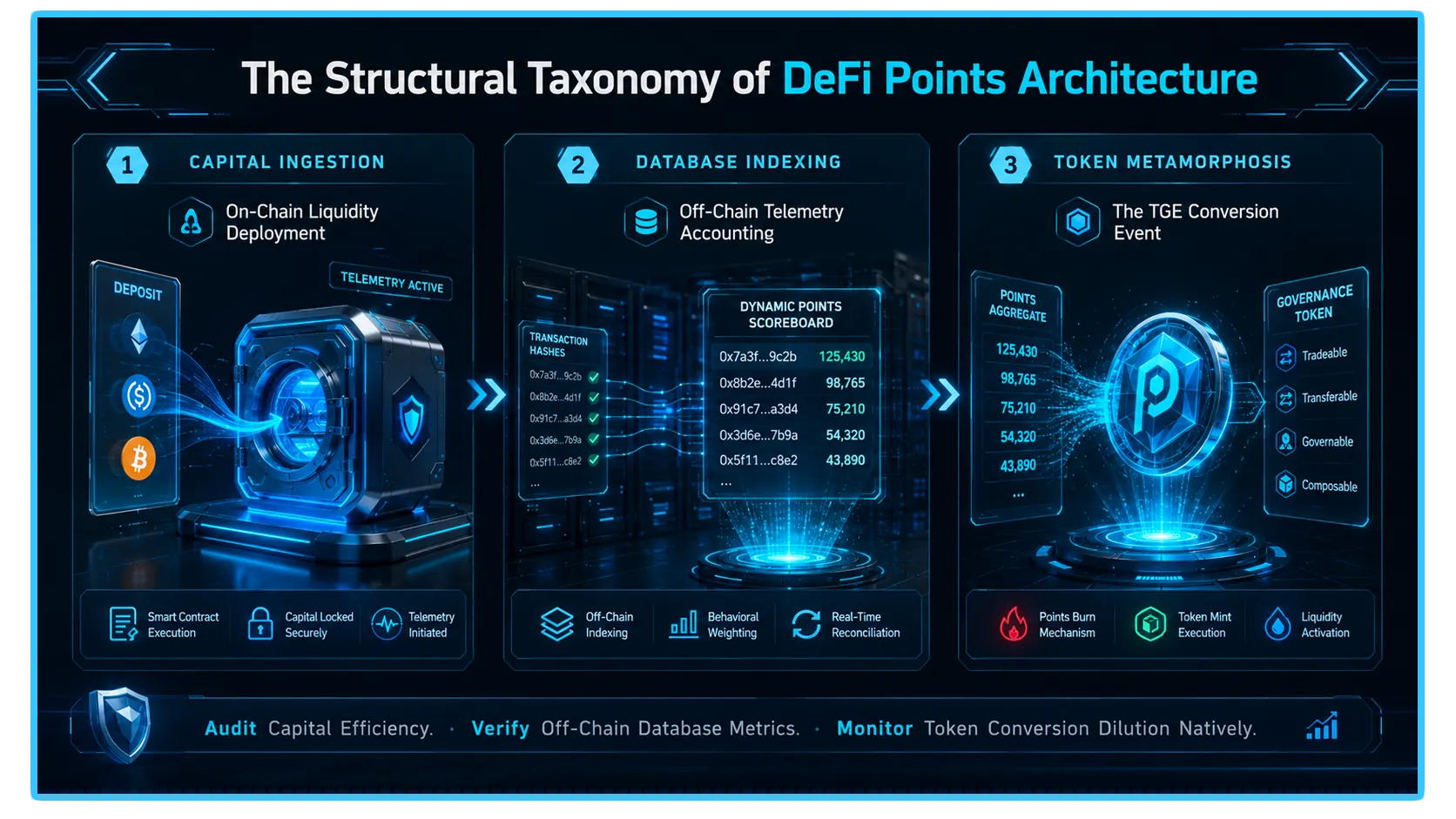
The execution of a points program relies on a hybrid pipeline that links public ledger activity to private database telemetry. The pipeline functions through three distinct operational phases:
On-Chain Ingestion: The user executes a standard cryptographic transaction on a blockchain network. Such as depositing stablecoins into a lending vault, executing a swap on a decentralized exchange, or bridging assets across networks.
Telemetry Indexing: The protocol's internal indexer nodes or specialized data subgraphs continuously scan the blockchain network for incoming transaction hashes interacting with the protocol's specific smart contract addresses.
Database Attribution: Once the transaction is validated on-chain, the indexer updates the protocol's off-exchange SQL or NoSQL database. The user's corresponding public wallet address is attributed a specific numerical score calculated using the protocol's proprietary algorithms.
By moving the accounting layer off-chain, protocol teams bypass the gas fee expenditures and scalability constraints of public ledgers. This architectural flexibility allows developers to adjust points allocations in real-time, implement dynamic multipliers, and launch localized loyalty campaigns without executing expensive smart contract upgrades.
2. The Economic Rationale: Why Protocols Choose Points Over Tokens
The transition from direct token incentives to intermediate points tracking is driven by deliberate game-theoretic strategies designed to maximize capital retention and mitigate regulatory exposure.
The Regulatory Shield
- In the global regulatory landscape, launching a native cryptocurrency token that promises financial returns or grants explicit governance over an enterprise can trigger complex securities violations. Points programs provide a robust legal layer of protection for early-stage development teams.
- Because points are stored inside a private database and possess no explicit cash value, redemption functionality, or secondary market liquidity, they are legally classified as corporate loyalty metrics, identical to airline frequent flyer miles or retail reward cards. The protocol makes no binding legal promise that these points will ever convert into a tradeable financial asset. This ambiguity allows teams to bootstrap massive user activity and gather invaluable stress-test data before navigating the compliance frameworks required to execute a formal TGE.
Retraining Mercenary Capital
- The primary economic utility of points is the manipulation of capital velocity. In a classic airdrop framework, capital enters a protocol, triggers the criteria, and immediately exits. Points programs implement an ongoing, gamified accumulation cycle that disincentivizes capital withdrawal.
- By keeping the final snapshot date and the point-to-token conversion ratio completely opaque, the protocol forces users to keep their assets locked inside the ecosystem to maintain their competitive rank on the global leaderboard. If a user withdraws their liquidity early, they forfeit their accumulation velocity, effectively allowing the protocol to maximize its Total Value Locked (TVL) over a sustained horizon for a fraction of the upfront cost of direct token emissions.
3. Advanced Strategies Matrix for Capital Allocators
As the points economy has institutionalized, advanced participants have abandoned basic manual interactions in favor of complex, capital-efficient deployment strategies designed to extract maximum yield per dollar allocated.
The Leverage and Looping Loop
Sophisticated allocators looking to maximize their accrued Airdrop Points metrics often deploy their assets into multi-layered DeFi lego structures. By combining decentralized lending markets with yield-stripping platforms, farmers can achieve massive capital multipliers.
The Loop Blueprint: An investor deposits an interest-bearing asset (such as stETH) into an advanced collateral vault like Morpho or Aave. They borrow an equivalent value of a correlated stable asset against that collateral, route the borrowed capital back into the primary protocol to double-dip the points velocity, and repeat the cycle multiple times.
Alternatively, allocators utilize specialized yield marketplaces like Pendle Finance. By purchasing Yield Tokens (YT), traders can swap their principal capital for a concentrated stream of pure yield and protocol points. This strategy acts as a capital-efficient multiplier, allowing a user to accumulate the points equivalent of a massive spot position for a fraction of the upfront capital requirement.
4. Systemic Risks: The Invisible Capital Dangers
While points farming offers significant upside potential, the lack of standardized regulation and algorithmic transparency introduces substantial risks for capital allocators.
The Points Inflation and Dilution Paradigm
- The most critical vulnerability inside the points landscape is the infinite dilution problem. Because points are merely numbers inside a private database, there is no hard cap on the total supply of points that an issuer can generate.
- If a protocol experiences an unexpected influx of institutional capital, or if the development team introduces extreme point multipliers late in the campaign to boost headline TVL figures, the total pool of outstanding points can expand exponentially. Since the ultimate token allocation pool is typically a fixed percentage of the total supply (e.g., 7% of tokens distributed to the points campaign), any massive expansion of the points pool directly dilutes the real-world token value of every individual point accumulated by early users.
Shifting Deadlines and Moving Goalposts
- Because the rules of engagement are dictated entirely by a centralized team, developers retain the absolute authority to modify the campaign parameter mid-flight. There have been numerous instances where protocols have unilaterally extended their points campaigns by multiple months, adjusted point-accrual math retrospectively, or introduced unexpected "Sybil-protection" filters that disqualify user wallets based on opaque backend criteria.
- This lack of structural recourse exposes the farmer to immense opportunity costs, as their capital remains trapped in low-yielding vaults while the target protocol continually delays the TGE.
5. On-Chain Diagnostics and Verification via DEXTools
- Navigating a highly speculative, points-driven ecosystem requires independent verification of the actual market microstructure supporting these campaigns. While a protocol's internal leaderboard may display exponential growth, evaluating the health of the underlying liquidity pools on secondary markets is the only way to validate genuine market conviction. Furthermore, the rise of specialized pre-market trading venues allows users to trade points allocations via synthetic IOUs long before the formal token generation event occurs.
- DEXTools provides the critical analytical infrastructure needed to audit these pre-market assets and wrapped points-proxies. By utilizing the Pair Explorer, tracking live buy/sell volume trends, and analyzing liquidity pool depth across decentralized venues, participants can determine if the market is accurately pricing the implied value of the accrued rewards.
- Cross-referencing on-chain data ensuring your capital deployments are backed by real-world secondary market depth, rather than just administrative numbers on a centralized dashboard. while navigating the underlying volatility of Airdrop Points campaigns, the structure ensures you stay ahead of the curve.
Disclaimer: This article is for informational purposes only and does not constitute investment advice, financial advice, trading advice, or any other kind of advice. DEXTools does not recommend buying, selling, or holding any cryptocurrency or token. Users should conduct their own research and consult with a qualified financial advisor before making any investment decisions. Cryptocurrency investments are volatile and high-risk. DEXTools is not responsible for any losses incurred.