What Is a Pump and Dump Scheme in Crypto: How to Spot and Avoid Scams (2026)
— By Tony Rabbit in Tutorials
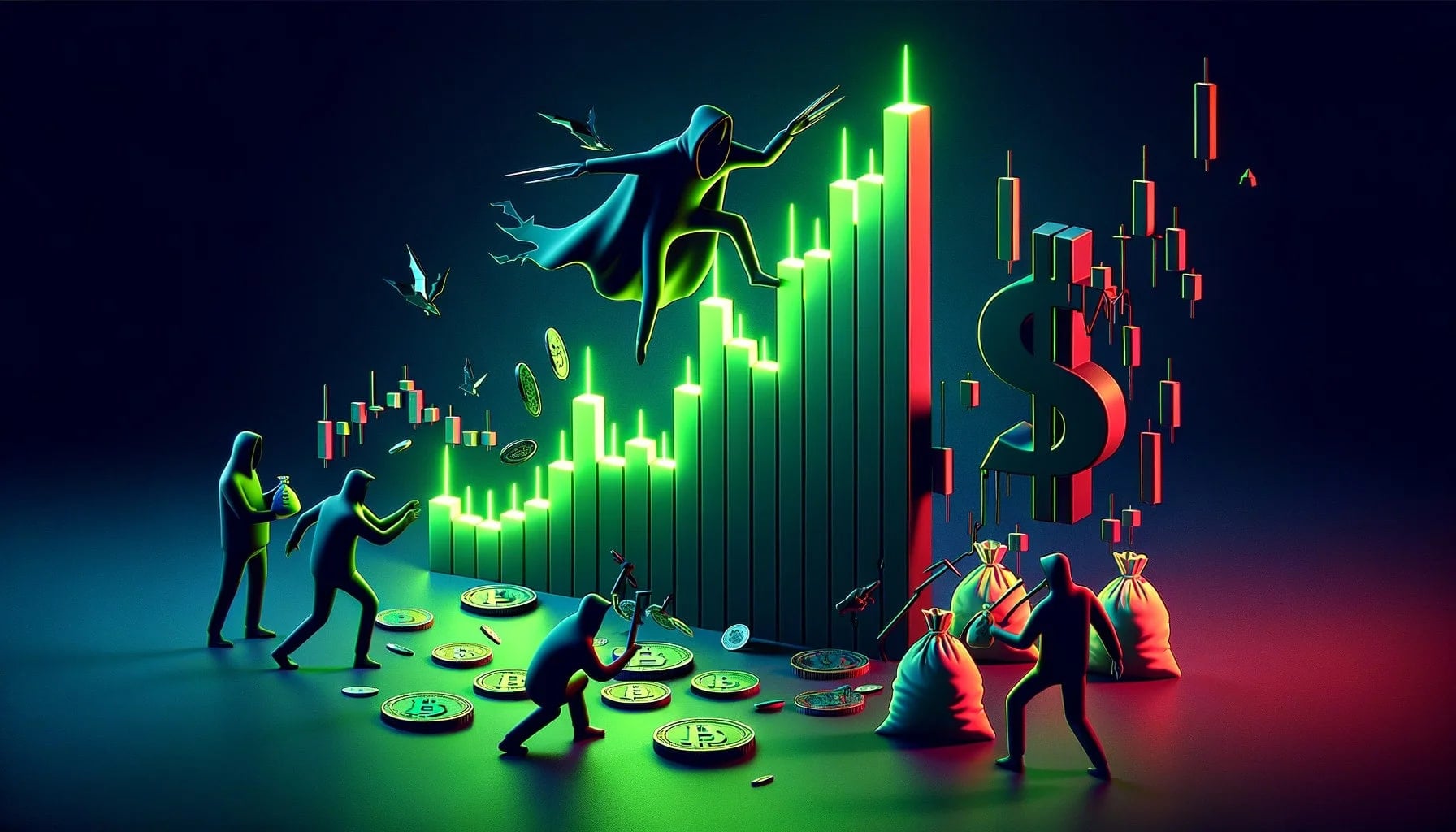
What is a pump and dump in crypto? The 4 stages, on-chain red flags, famous cases, legal status and how to protect yourself from coordinated scams (2026).
If you have spent any time watching low-cap altcoins or memecoins on a DEX, you have seen it happen. A token nobody mentioned five minutes ago suddenly explodes 800%, the chart looks like a vertical green wall, Telegram lights up with screenshots of life-changing gains, and then the candle turns red and never recovers. That is a pump and dump in its purest form. It is not a market accident, it is a coordinated operation, and the people running it are counting on you to be the exit liquidity.
Pump and dump schemes are the single most common type of market manipulation in crypto, especially in the low-liquidity corners of Solana, Base, Ethereum, and BNB Chain where new tokens launch every few seconds. Traditional finance has the SEC and decades of case law trying to suppress these schemes. Crypto has retail traders, anonymous Telegram admins, and a brand new token every block. The result is a market where, if you do not understand how a P&D actually works, you will almost certainly be on the wrong side of one.
This guide is written for retail traders who want to stop being the dump. You will learn the exact four-stage anatomy of a crypto pump and dump, the on-chain red flags you can verify yourself in under sixty seconds, how coordinated pump groups operate behind the scenes, the famous cases that defined the playbook, the legal status across jurisdictions, and a practical protection checklist you can apply today. By the end you will recognize a pump in progress and know whether you are about to ride a real rally or hand your money to somebody else's exit.

What Is a Pump and Dump Scheme
A pump and dump is a form of market manipulation where a small group of insiders artificially inflates the price of a thinly traded asset through coordinated buying and aggressive promotion, then sells their pre-accumulated holdings into the buying pressure they created. The people who bought into the hype are left holding a worthless or near-worthless asset. The pumpers walk away with the money, and the chart never comes back. That is the entire mechanic, repeated thousands of times across thousands of tokens every year.
The scheme is not new. It originated in the early 20th century stock market, where promoters pushed penny stocks via "boiler room" cold-calling operations. By the 1990s and 2000s, the same playbook moved to pink sheets and over-the-counter stocks, with promoters using spam email, fax blasts, and eventually internet message boards to recruit buyers. The 2013 film The Wolf of Wall Street depicts this stock-era version with reasonable accuracy. The mechanics are identical to the crypto version. Only the distribution channel and the underlying asset class have changed.
What makes the crypto version particularly dangerous is the speed and scale. A pump in pink sheet stocks took days to coordinate and weeks to unwind. A crypto pump and dump can be set up in minutes, executed in hours, and rugged so completely that the token is dead before most participants even realize what happened. The combination of 24/7 trading, anonymous teams, permissionless token creation, and viral social media gives manipulators a level of operational freedom that traditional markets never offered.
It is worth defining P&D against related but distinct scams. A pump and dump is not the same as a rug pull, where the team removes liquidity or mints infinite supply. A pump and dump can happen on a perfectly legitimate token where the team is innocent and a coordinated group of traders is simply exploiting low liquidity. The dump comes from selling, not from contract-level theft. Understanding this distinction matters for how you defend yourself, which we cover in the rug pull avoidance checklist.
The 4 Stages of a Pump and Dump
Every crypto pump and dump follows the same four-stage structure. The names change, the tokens change, the chains change, but the choreography is identical. Once you can identify which stage a token is in, you can decide rationally whether to engage, ignore, or step away.
Stage 1: Accumulation
The accumulation stage is invisible to most retail traders. The organizers, usually the dev team or a coordinated pump group, quietly buy the token at very low prices over hours or days. Smart manipulators spread the buys across dozens or hundreds of wallets so the buying does not show up as a single suspicious entity holding 40% of supply. They might use a token launch where they front-run their own launch, or they might be a third-party group accumulating an existing low-cap token whose chart looks dormant. Volume during accumulation is low. The chart looks boring. That is the point.
Stage 2: Pump
The pump begins when the organizers start placing larger, coordinated buys to drive the price up visibly on the chart. This serves two purposes. First, it produces the green candles and "breakout" pattern that algorithmic screeners and trending lists pick up on. Second, it triggers the hype campaign. Telegram channels start posting. Influencers get paid to mention the ticker. Reddit and X fill with screenshots. The first wave of organic retail traders sees a chart going parabolic and rushes in to "catch the move." Their buying continues the pump, which brings in more retail, which continues the pump. This is the self-reinforcing phase the organizers were waiting for.
Stage 3: Peak
The peak is the most psychologically dangerous stage for retail. The token is everywhere. Group chats are euphoric. The chart shows 500% to 5000% gains in a matter of hours. FOMO is at its absolute maximum, and this is precisely when insider wallets start unloading. They sell in chunks small enough not to crash the chart immediately, often using fresh wallets to disguise the activity. They might even place a visible buy wall to give late buyers false confidence while a hidden distribution wallet quietly sells into every green candle. The peak typically lasts minutes to a few hours, not days.
Stage 4: Dump
The dump is what gives the scheme its name. Once the insider supply is mostly liquidated, the remaining sellers all rush for the exit at once. The chart collapses 70% to 99% in minutes. The Telegram channel goes silent or pivots to a new token. The Twitter influencers delete their tweets. Retail buyers wake up to find the token they bought at $0.50 is now trading at $0.0008 with no buyers and most of the original liquidity removed. There is no recovery because there was never any actual demand. The whole rally was manufactured by the people now sitting on millions in profit.
Why Crypto Is Particularly Vulnerable to Pump and Dumps
Pump and dumps exist in every market with thinly traded assets, but crypto offers a uniquely permissive environment. Understanding why the structural conditions favor manipulators is critical to protecting yourself, because the conditions are not going away.
First, crypto markets never close. There is no opening or closing bell, no after-hours suspension, no circuit breakers to halt trading when a token moves 30% in a minute. Manipulators can execute the entire accumulation, pump, peak, and dump cycle inside a single weekend when traditional markets are closed and most retail attention is highest. The continuous nature of the market is a feature for legitimate use cases but a gift for pump organizers.
Second, token teams are very often anonymous. On Solana, Base, and similar chains, a new token can be deployed by a wallet with zero history, no doxxed founders, no company, no registered jurisdiction. There is no entity to subpoena, no executives to interview, no Form 10-K to falsify. If a team disappears after the dump, there is usually nobody to chase. Anonymous teams are one of the most consistent red flags across both rug pulls and pump and dump schemes.
Third, low-cap tokens have low liquidity. A token with a $50,000 liquidity pool can have its price moved 200% by a single $20,000 buy. Compare that to a stock like Apple, where billions of dollars in daily volume make manipulation essentially impossible at retail-scale capital. Crypto memecoins often trade with liquidity so shallow that a coordinated pump group of 200 members each putting in $500 can move the price tenfold. Understanding how to read liquidity is half the battle against P&D schemes.
Fourth, regulatory oversight on memecoins is essentially zero. The US SEC has taken action against some clearly fraudulent ICOs and token offerings, but the average Solana memecoin launched at 3am Sunday morning has no realistic chance of ever being investigated. The EU's MiCA framework, fully effective since late 2024, has tightened rules on stablecoins and centralized exchanges but does very little to address the on-chain wild west of memecoin trading. Manipulators understand this and operate accordingly.
Fifth, social media virality has been weaponized. A 30-second TikTok showing somebody's $300 turning into $30,000 reaches millions of viewers in hours. Telegram groups with 50,000 members can coordinate simultaneous buys in seconds. Paid X engagement makes a worthless token look like the next 100x in real time. The information asymmetry between organizers and retail has never been higher.
How to Spot a Pump and Dump in Real Time
Recognizing a pump and dump while it is happening is a skill you can train. The signals are almost always present if you know what to look for. Here are the six red flags that, in combination, point to coordinated manipulation rather than organic demand.
No doxxed founders, no LinkedIn profiles, no real-world identity. The "team" is a stock photo and a Telegram handle. Maximum deniability for whoever runs the operation.
"100x guaranteed", "next SHIB", "do not miss this one". Real projects do not promise multiples. The promise itself is the bait.
The same ticker appears in 40 different "alpha" groups at the same time. Coordinated copy-paste shilling means a coordinated pump.
"Liquidity locked!" but the lock expires in 30 days, or the dev wallet is excluded, or the team holds 40% in unlocked wallets. The lock is a marketing prop.
"Pump at 8pm UTC", countdown timers, group buy alerts. If everyone is buying together, everyone is also expected to be the exit liquidity together.
Volume goes from $5K to $5M in an hour with no news, no listing, no catalyst. That is not organic discovery, that is a coordinated buy raid.
None of these signals alone is conclusive. A new project with an anonymous team can still be legitimate, especially in DeFi where pseudonymous founders are common. A volume spike can reflect a real partnership announcement. But when three or more of these flags appear simultaneously on the same token, the probability that you are looking at a coordinated pump and dump approaches 100%. Use a memecoin screener that surfaces these patterns automatically rather than scanning by hand.
On-Chain Red Flags You Can Verify Yourself
Social red flags can be faked. On-chain data cannot. Every transaction, every wallet, every liquidity event is permanently visible on the blockchain, and reading it correctly will save you more money than any influencer call. These are the on-chain checks you should run before you click buy on any token under, say, $10 million market cap.
The single most important check is top wallet %. Open DEXTools or a holder analytics tool and look at the top 10 holders. If a small number of non-LP, non-burn wallets hold a combined 40% or more of the supply, you are looking at potential pump and dump fuel. Those wallets can dump on you at any moment. A healthy distribution shows the top 10 holding 15% to 25% maximum, excluding LP and burn addresses. Anything significantly above that, especially if those wallets received tokens at launch or before the public, is a red flag.
The second check is the liquidity lock. Many projects advertise "liquidity locked" without telling you for how long or what percentage. A real lock should be at least 12 months on a verifiable third-party locker like Unicrypt, Team Finance, or PinkLock. Read the token locker guide for the specifics. A 30-day lock that expires in three weeks is not protection, it is theater. Also check what percentage of total liquidity is actually locked. If only 20% of the LP is locked while 80% remains under dev control, the lock is meaningless.
The third check is dev wallet activity. Trace the original deployer wallet. Are they still holding their initial allocation? Have they been moving tokens to fresh wallets that then sell into the pool? On Solana, tools like Solscan and Bubblemaps let you visualize this in seconds. If the dev wallet has been quietly distributing to 20 fresh wallets that are all selling, the dump is already underway and you are seeing the dying pump.
The fourth check is honeypot and tax mechanics. Use a token contract scanner to verify you can actually sell. A surprising number of "pump" tokens are honeypots where buying works but selling reverts. Check the buy tax and sell tax. A token with a 30% sell tax is a slow-motion drain on every exit. Some contracts even allow the owner to modify the tax after launch, meaning a 0% tax at the time of your purchase can become 99% the moment you try to take profit.
The fifth check is pool depth and slippage. Look at how much it would cost to sell a meaningful position back to the pool. If selling $1,000 worth of token would cause 25% slippage, the liquidity is not real. You can technically buy in, but you cannot meaningfully exit without crashing the chart yourself. Read the slippage guide to understand the exact math. A token where exits are mechanically painful is a token built for one-way traffic, and that direction is into the pumpers' wallets.
Coordinated Pump Groups: How They Operate
If you have been on Telegram or Discord for any length of time, you have been invited to "pump groups." Some are obvious scams. Others present themselves as elite alpha communities with paid tiers and "verified" admins. The structure is almost always the same, and understanding it removes the mystery.
A typical pump group has three layers. The inner circle is the organizers, usually 3 to 10 people who pre-buy the target token before the announcement. They control the timing, choose the token, and place the largest pre-pump positions. The middle layer is paid members or VIPs, who pay a monthly subscription for "early signals" and get the ticker 30 to 60 seconds before the public announcement. The outer layer is the free members, who get the ticker last and provide the buying pressure that lets the inner and middle layers exit at a profit.
The pump itself follows a script. A countdown appears in the group: "Pump in 1 hour. Token revealed at T-minus 5 minutes. Buy hard, hold strong, do not paper hand." When the ticker drops, the organizers and VIPs are already positioned. Free members rush to buy. The chart spikes. The organizers begin selling within 30 to 90 seconds of the public reveal. VIPs sell into the next leg up. By the time free members realize the chart is going down, the organizers are gone and the group has moved on to "the next pick coming this weekend."
If a Telegram group promises you a coordinated pump, you ARE the dump. The mathematics of pump groups require somebody to be the exit liquidity, and if you are not in the inner circle, that somebody is you. There is no "ethical" pump group. The model only works if outsiders are converted into bag holders.
Paid pump groups make this even more cynical. Members pay $50 to $500 per month for "signals," then provide the buy pressure that lets the operators exit. The subscription revenue and the dump profits both flow to the same people. From the operator's perspective, free pumps are a one-shot revenue model and paid pumps are a recurring subscription business with the same victims paying every month.
Famous Crypto Pump and Dump Cases
The history of crypto is littered with high-profile pump and dump cases. Studying them is the cheapest education you can get because the patterns repeat across every cycle.
Bitconnect (2016-2018): Although technically a Ponzi scheme rather than a pure P&D, Bitconnect deserves first mention because it combined coordinated promotion, a captive trading platform, and a centrally controlled BCC token into one of the most destructive pump and dumps in crypto history. The token peaked above $400 in late 2017 on the back of relentless influencer promotion. When the platform shut down in January 2018, the price collapsed to near zero within days. Estimated retail losses ran to billions of dollars.
Squid Game Token (November 2021): Launched on BNB Chain at the height of the Netflix show's popularity, SQUID pumped from cents to over $2,800 in less than a week. The token contract was a honeypot. Buyers could not sell. When the developers had pumped enough buy pressure to drain the liquidity pool, they removed all liquidity and disappeared with approximately $3.4 million. The chart on screenshots shows a vertical line up and a vertical line down, which is the visual fingerprint of a pure honeypot pump and dump.
Save the Kids Token (June 2021): A token promoted heavily by YouTube influencers, including some with millions of subscribers, that was structured with vesting tweaks favoring the promoters. The promoters allegedly modified the smart contract to allow them to dump tokens immediately at launch despite advertising a vesting schedule. The price collapsed quickly after launch, leaving the audience that trusted the influencers holding worthless tokens.
Recent Memecoin Cycles (2024-2026): The Solana memecoin explosion since 2024 has produced thousands of micro pump and dump events, often executed within a single hour. Tokens launched on Pump.fun routinely pump to a few million in market cap, get shilled across X and Telegram, then dump 95% within hours as launch insiders cash out. The pattern is so standardized that some on-chain analytics firms now publish real-time "P&D probability" scores for new launches. The volume of these events is staggering. By some estimates, over 90% of memecoins launched in 2025 fit the textbook pump and dump profile.
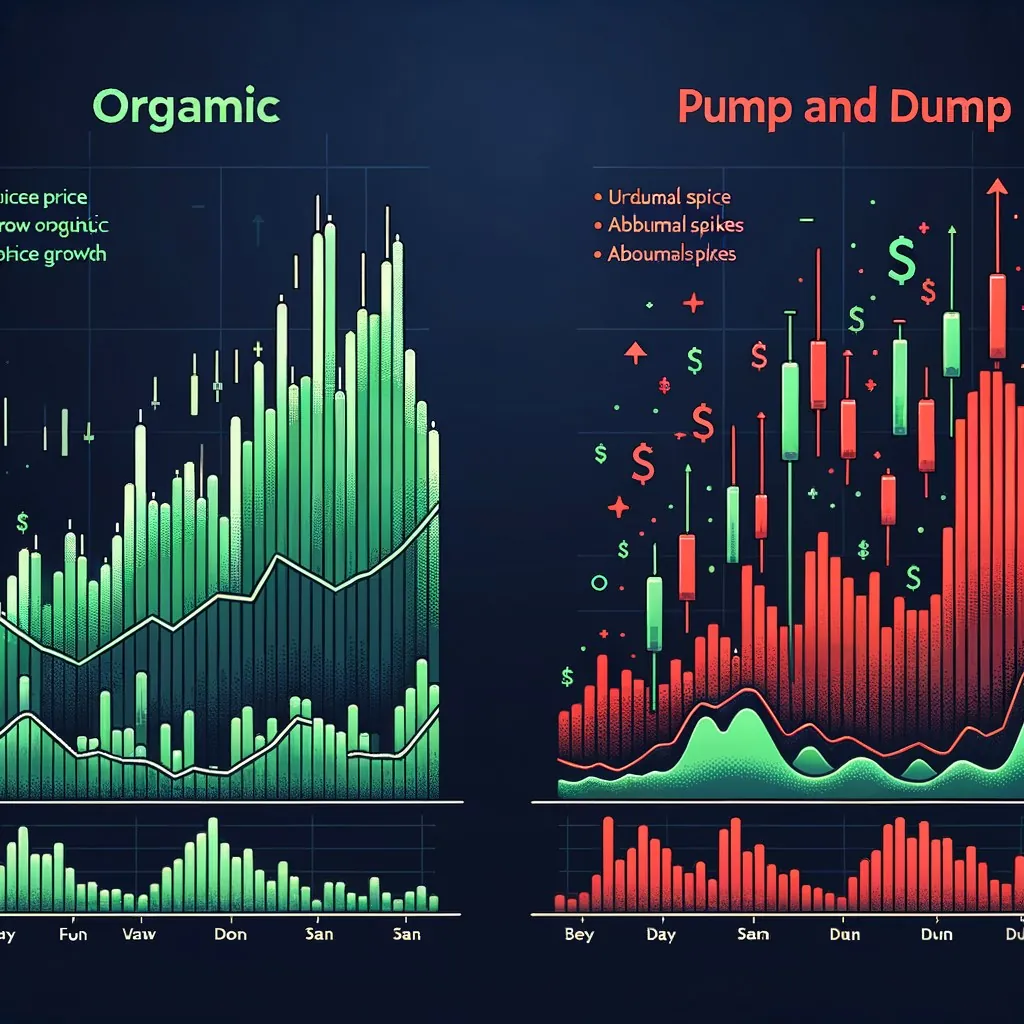
Pump and Dump vs Legitimate Volatility
Not every parabolic chart is a pump and dump. Crypto is volatile by nature, and some of the largest organic moves in history look on a chart very similar to a P&D. Knowing the difference is what separates skilled traders from people who avoid every move and miss every opportunity.
- Chart: stair-stepping highs with consolidation
- Volume: grows steadily, sustained across days
- Holders: growing, well distributed
- Social: organic discussion, not paid blasts
- Liquidity: deep, can absorb large sells
- Catalyst: verifiable news or product
- Chart: vertical spike, no consolidation
- Volume: explodes then dies within hours
- Holders: concentrated, few wallets dominate
- Social: coordinated copy-paste shilling
- Liquidity: shallow, sells crash the price
- Catalyst: vague hype, "next 100x", no substance
An organic rally has time to breathe. Look at Bitcoin's 2020-2021 run, Solana's recovery from 2023 lows, or any major altcoin breakout following a clear narrative. The chart goes up, but with pauses, with corrections, with healthy consolidation. Volume builds rather than flashes. Holder count grows over weeks. There is a story attached to the move, whether it is a protocol upgrade, an institutional adoption event, or a clear narrative shift in the market.
A pump and dump has no time to breathe because the operators do not have time to wait. They need to distribute their bags before retail figures out what is happening. The chart is therefore vertical, the volume is a single explosion rather than a building pattern, and the holder distribution remains concentrated throughout. If you look at a chart and cannot articulate why the price is moving beyond "vibes," you are likely looking at manipulation.
The cleanest test is the day-after test. Real rallies hold most of their gains 24 hours later. Pump and dumps give back 70% to 99% within hours. If you suspect a move is fake, simply do not chase it. Watch what happens the next day. If the token is at a fraction of its peak, you just saved yourself from being the exit liquidity. If it consolidates and continues, you missed a fast move but you protected your capital.
Legal Status: Is Pump and Dump Illegal?
In traditional securities markets, pump and dump is unambiguously illegal. The US Securities Exchange Act of 1934 and decades of SEC enforcement have established clear precedent. Coordinated price manipulation of a registered security, including the spreading of misleading promotional information to inflate the price before selling, can result in criminal prosecution, fines, and prison sentences. People go to federal prison for this every year.
In crypto, the legal picture is messier but tightening. The US SEC has taken the position that many tokens are unregistered securities, and when those tokens are pumped and dumped, the same anti-manipulation laws apply. Several high-profile prosecutions of crypto pump and dump organizers have resulted in convictions, particularly when the schemes involved misleading public statements and coordinated trading. The 2022 case against the operators of HydroGen and the 2023 case against the EthereumMax promoters are examples where US authorities pursued pump and dump-style manipulation in crypto markets.
In the European Union, the MiCA regulation that came fully into force in late 2024 explicitly prohibits market manipulation in crypto, including pump and dump activity, for tokens that fall within its scope. Centralized exchanges operating in the EU now have surveillance and reporting obligations. However, MiCA's reach is limited when it comes to anonymous memecoin tokens traded purely on DEXs, where there is no licensed intermediary to police behavior.
The gray areas remain large. A token launched anonymously on Solana by a wallet with no identifiable controller, pumped by an offshore Telegram group, and dumped on retail buyers around the world is technically illegal in most jurisdictions but practically impossible to prosecute. There is no defendant to indict, no entity to fine, and no clear venue for enforcement. This is why "legal" is a poor protection. The fact that a scheme is illegal does not mean anyone is coming to recover your money. Your protection has to come from not buying in the first place.

How to Protect Yourself: Practical Checklist
The defensive playbook against pump and dumps is not complicated. It is just unsexy enough that most retail traders skip it. Write these rules down and apply them mechanically. The discipline alone will outperform 90% of active memecoin traders.
First, define your rules before you trade, not during. Decide in advance what percentage of your portfolio you will risk on any single low-cap token. A reasonable rule for memecoin speculation is 1% to 3% of your portfolio per position, with a hard cap on total memecoin exposure of perhaps 10% to 20% depending on your risk tolerance. If you blow up a single position, you do not blow up your portfolio.
Second, use stop-losses or pre-committed exits. The most common way people end up holding pump and dump bags is by refusing to sell at a loss when the chart turns. Decide before entering that if the token drops 30% from your entry, you exit, no questions. On chains and DEXs that support limit orders or stop orders, set them. Where they are not supported, set price alerts and act on them automatically.
Third, do your own research. Run the on-chain checks listed earlier in this article. Read the contract on Etherscan or Solscan. Check the holder distribution. Verify the lock. Look at the dev wallet history. Five minutes of DYOR will filter out 80% of pump and dump candidates. If a token does not survive a basic check, it does not deserve your money no matter what the chart looks like.
Fourth, sit out hype cycles. The strongest pump and dump signal of all is the feeling that "everyone is making money except me." That feeling is engineered. The people posting screenshots are either lying, are inner-circle members who got in at the bottom, or will themselves be exit liquidity in 30 minutes. The discipline to do nothing when you feel maximum urgency to do something is the highest-value skill in crypto trading.
Fifth, understand tokenomics before you buy. Total supply, circulating supply, vesting schedule, team allocation, dev allocation, marketing allocation. If you cannot articulate the tokenomics of a project, you cannot understand who can dump on you and when. A token with a "10% unlock every week for the team" is going to face structural selling pressure regardless of price action, and that selling pressure is what pump operators time their exit around.
Sixth, size positions to losses, not gains. Ask yourself: if this position goes to zero in the next hour, am I fine? If the answer is anything other than yes, the position is too large. Most P&D losses are not the dollar amount themselves but the psychological damage of holding too much in a single failed bet. Sizing down preserves both your capital and your ability to think clearly during the next opportunity.
Seventh, beware fast snipe setups. Token sniping bots and aggressive front-running tools claim to get you in first on new launches. In practice, the actual snipers are the launch insiders who programmed their bots to buy the launch transaction in the same block. By the time you "snipe" a token, the people who really sniped it are already 10x ahead of you and looking for exit liquidity. You are the snipe target, not the sniper.
What to Do If You Got Caught in One
If you are reading this after the fact, holding a token that just dumped 90%, you are not alone and there are still rational choices to make. Panicking does not help, but neither does pretending it will recover.
First, accept the loss emotionally and then make the math decision. Ask: if I had cash equal to my current position value, would I buy this token today? Almost always the answer is no. Sell the position, accept the loss, and free the capital for better opportunities. Holding a dead bag in the hope of recovery is the most common way to compound a P&D loss into a permanent loss. Most pump and dumps never recover. Pretending yours is the exception is expensive.
Second, document the on-chain evidence. Save the transaction hashes of your buys, the contract address, screenshots of the holder distribution at the time of your purchase, and any promotional material from Telegram or Discord groups. If the scheme is large enough to attract regulator or class-action attention, you want to be a documented victim, not a vague claim. In some jurisdictions, even small documented losses can support tax loss harvesting against your gains elsewhere.
Third, learn the lesson, do not relive it. Write down exactly what red flags you ignored. Was it the anonymous team? The unrealistic returns promised in the Telegram group? The lack of liquidity lock? The vertical chart you chased? Codify the lesson into your trading rules so the next time the same setup appears, your rules say no automatically. The people who lose the most to pump and dumps are not the people who get caught once. They are the people who get caught repeatedly because they never updated their rules.
Frequently Asked Questions
Is pump and dump illegal in crypto?
In most major jurisdictions, yes. The US SEC, the EU under MiCA, and regulators in the UK, Singapore, and other markets treat coordinated price manipulation as illegal market abuse. Several crypto pump and dump organizers have been prosecuted successfully. The practical issue is enforcement. Anonymous teams on permissionless chains are extremely hard to identify and prosecute, so "illegal" does not mean "punished." Your protection has to come from not buying, not from expecting enforcement to recover your funds.
Can you make money in a pump and dump?
Technically yes, but only if you are early enough that you become part of the pump rather than part of the dump. Some traders try to ride coordinated pumps by entering immediately when the signal drops and exiting within 60 seconds of the public announcement. This is extremely high risk because you are competing with the organizers, who always know more than you. The expected value for retail participants over time is negative. The math favors the organizers and the very first wave, not anyone else.
How do I spot a coordinated pump?
The clearest signals are sudden simultaneous mentions of the same ticker across many unrelated Telegram or Discord groups, a chart that goes vertical with no catalyst, very high holder concentration in a small number of non-LP wallets, shallow liquidity that cannot absorb meaningful sells, and "buy now or miss it" language from accounts that pivot to a different token every week. The presence of three or more of these signals is essentially a confirmation of coordinated activity.
What is the difference between a rug pull and a pump and dump?
A rug pull is a contract-level exit by the project team. They remove liquidity, mint infinite supply, or use a backdoor function in the smart contract to drain funds. A pump and dump is a trading-level exit. The team or a coordinated group sells their pre-accumulated position into retail buying pressure, but the contract itself does not necessarily have any malicious code. The two are often combined. A rug pull is usually preceded by a small pump and dump, and a pump and dump can end in a rug pull. Read the rug pull avoidance guide for the contract-level checks.
Are memecoins all pump and dumps?
A large majority statistically follow the pump and dump pattern, but not all. A small number of memecoins have grown into legitimate communities with sustained organic interest, deep liquidity, and broad holder distribution. Dogecoin, Shiba Inu, and a few others have survived multiple cycles. The distinction is structural. Memecoins with broad distribution, locked liquidity, public teams or fully fair launches, and sustained organic activity behave differently from short-lived launches built explicitly as P&D vehicles. The first category is rare. The second category is the default. Assume any new memecoin is the second until proven otherwise.
Can I report a pump and dump?
Yes, although outcomes vary widely. In the US, you can report to the SEC via the tips and complaints portal and to the CFTC if the asset has commodity characteristics. In the EU, national financial regulators accept market abuse reports under MiCA. Centralized exchanges where the token is listed will also accept abuse reports and may delist the token. Reports do not typically recover your funds but they can contribute to investigations and regulatory enforcement against repeat operators. Document everything on-chain before reporting.
Conclusion
Pump and dump schemes are not going away. They are baked into the structure of permissionless, anonymous, 24/7 markets, and as long as those markets exist, there will be coordinated groups exploiting low liquidity to extract retail capital. The good news is that the patterns are remarkably consistent. Accumulation, pump, peak, dump. Anonymous teams, shallow liquidity, concentrated holders, coordinated shilling. Once you see the template, you cannot un-see it, and the same chart that used to feel like opportunity starts to feel like a trap.
The hardest part of avoiding pump and dumps is not knowledge, it is discipline. You will see other people make money on schemes you avoided. You will feel slow, cautious, unprofitable compared to the screenshots in your feed. Most of those screenshots are either fabricated or belong to the inner circle running the operation. The retail traders who actually post their PnL over a full year, including losses, almost always show net losses from chasing pumps. The ones who quietly build wealth in crypto are the ones who pass on 98% of opportunities and size carefully into the 2% they understand.
Treat this guide as a checklist, not a one-time read. Bookmark it. Re-read it before you click buy on any token under $10 million market cap. Run the on-chain checks. Watch for the four-stage choreography. If a Telegram admin is telling you exactly when to buy and exactly when to sell, you have all the information you need to make the right decision, which is to walk away. The market does not owe you the next 100x. But it absolutely will take everything you give it if you keep handing your money to people whose entire business model is making you the exit liquidity.
Related Guides
- 7 Best Telegram Trading Bots 2026: Safe Picks, Scams to Avoid
- Rug Pull Checklist: 10 Pair Explorer Checks to Avoid Scams
- Crypto Address Poisoning Scams: Complete Avoidance Guide (2026)
- Solana Airdrop Checker: Ensure Safety ; Avoid Scams
- Pig Butchering Scams: How to Spot Romance Crypto Fraud
- What Is a Bull Trap in Crypto? How to Spot and Avoid It (202