Yield-Bearing Stablecoins: The Evolution of Digital Capital

The dollar-pegged asset class has entered a new structural era. We break down the evolution from static collateral to yield-generating tokenized primitives on-chain.
The Next Evolution of Digital Capital
- The decentralized financial landscape has witnessed a profound evolutionary shift with the rise of Yield-Bearing Stablecoins. In the early days of cryptocurrency markets, dollar-pegged tokens were treated strictly as static safe havens: digital cash vehicles used exclusively to escape the violent volatility of native crypto assets like Bitcoin and Ethereum.
- First-generation stablecoins required users to park their wealth in non-productive entries, allowing centralized issuers or protocol reserves to capture the underlying interest generated by those billions of dollars. This model created a stark capital inefficiency for the end-user, who absorbed the smart contract and systemic risks of the asset class without receiving any of the economic rewards.
- The modern paradigm completely reverses this dynamic. By embedding programmatic interest accumulation directly into the token's architectural layer, the current generation of dollar-pegged assets converts passive liquidity into highly productive capital. This guide provides an exhaustive analysis of the mechanical, structural, and risk-management profiles of the leading interest-generating assets dominating the global decentralized ledger today.
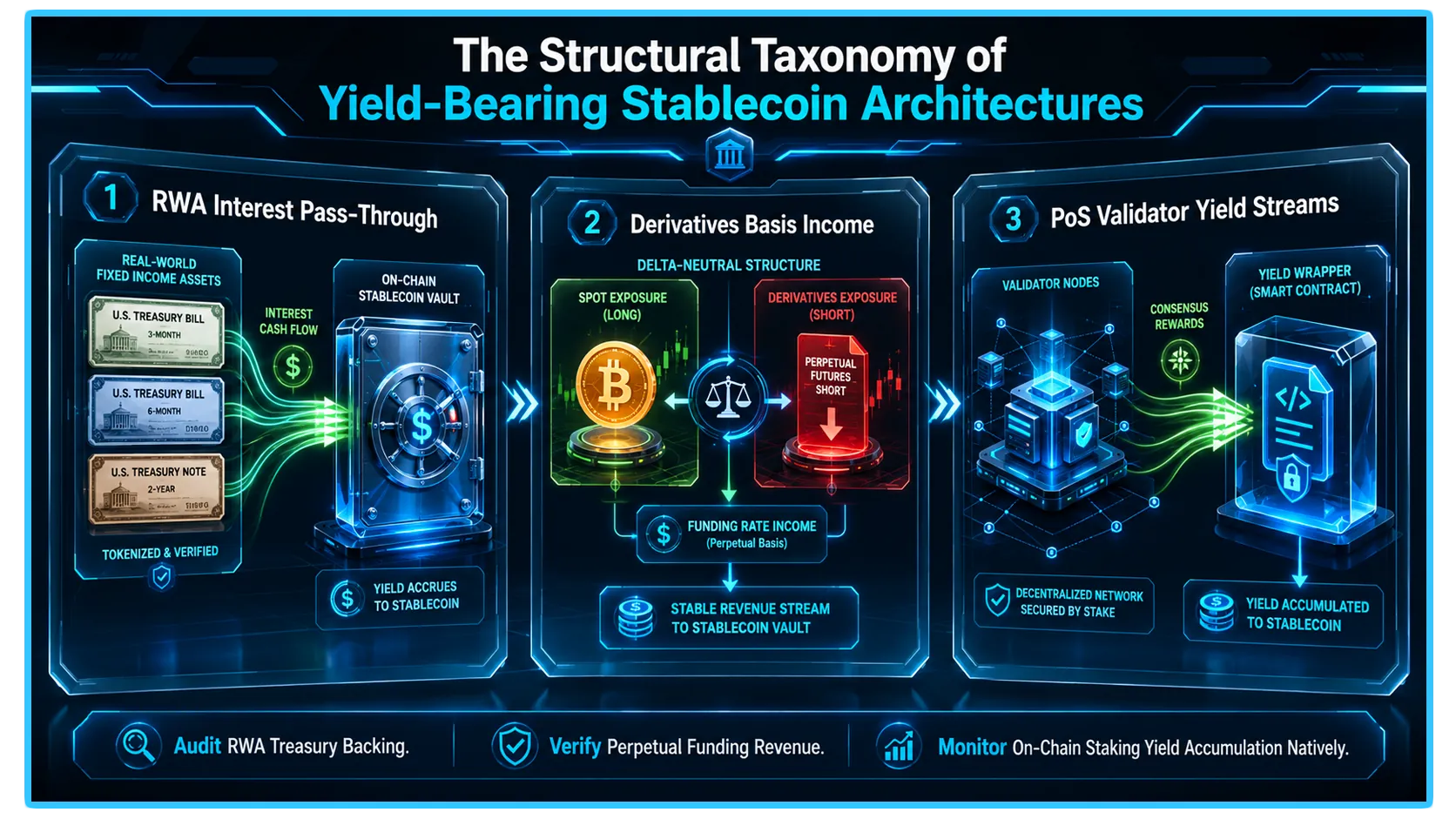
1. The Taxonomy of Tokenized Yield Accumulation
To navigate this asset class with professional rigor, you must first distinguish between the two primary distribution models used by issuers to stream interest to holders: the Rebasing Model and the Accumulating Share Model.
The Rebasing Model (Dynamic Supply)
- Tokens that utilize a rebasing mechanism maintain a static price target (typically exactly one US dollar) while programmatically adjusting the user's token balance at regular intervals. If the underlying reserve generates a positive yield, the protocol mints new tokens and distributes them proportionally across all eligible wallet addresses.
- While visually straightforward, as users can watch their balance increase directly inside their wallets, rebasing tokens introduce significant operational friction. Many decentralized protocols, automated market makers (AMMs), and collateralized debt position (CDP) platforms cannot naturally ingest a token whose supply balances change dynamically outside of explicit transaction events. Consequently, rebasing assets often require secondary wrapping mechanisms to interface safely with broader DeFi applications.
The Accumulating Share Model (Shifting Exchange Rate)
- The accumulating share model represents the institutional standard for modern protocol design. In this architecture, the tokenized share represents a claim on an underlying pool of yield-generating capital. Instead of modifying the user's token quantity, the asset programmatically increases in value relative to the underlying collateral.
- When an investor deposits capital into an accumulating pool, they receive a wrapper token (such as sDAI or sUSDe). Over time, as the underlying pool captures revenue from its native strategies, the redemption value of the wrapper expands. When the user eventually exits the position, they redeem their share token for a larger quantity of the underlying stablecoin than they originally deposited. This mechanism ensures perfect compatibility with standard ERC-20 infrastructure, enabling seamless integration across lending markets, liquidity pools, and derivatives exchanges.
2. Deep Dive: MakerDAO / Sky’s sDAI and Real-World Assets
One of the most structurally resilient models in the interest-bearing ecosystem is sDAI (Staked DAI), an asset that has undergone further refinement following MakerDAO's transition into the Sky ecosystem. This product provides a transparent pass-through mechanism for yields derived directly from institutional-grade legacy debt instruments.
The Enhanced DAI Savings Rate (EDSR) Pipeline
- The capital pipeline of sDAI is anchored by the integration of Real-World Assets (RWAs) into the protocol's backing reserves. Rather than allowing reserve collateral to sit idly as non-interest-bearing fiat or stablecoins, the protocol routes excess capital into specialized legal trusts. These trusts are structurally mandated to purchase short-term United States Treasury bills and highly liquid corporate credit instruments.
- The interest generated by these institutional T-bills flows directly back to the on-chain protocol treasury. Through the DAI Savings Rate (DSR) smart contract, this revenue is streamed directly into the sDAI pool. This operational shift highlights a broader democratization of capital, as Yield-Bearing Stablecoins bridge the divide between legacy debt instruments and permissionless protocol blocks. Investors holding sDAI capture a predictable, low-volatility interest rate underwritten by the sovereign credit of the United States government, completely managed via trustless smart contracts.
3. Deep Dive: Ethena’s sUSDe and Synthetic Internet Bonds
While sDAI draws its economic strength from traditional real-world financial rails, Ethena's sUSDe (Staked USDe) is engineered as a purely crypto-native synthetic asset class. It generates its yield by capitalizing on the structural inefficiencies found within decentralized derivatives markets.
The Dual Engine of sUSDe Revenue
The capital backing sUSDe does not rely on commercial banks or government debt. Instead, it utilizes an automated, delta-neutral hedging strategy to extract yield from two independent digital sources:
| Yield Source | Operational Engine | Economic Substrate |
| Spot Staking Rewards | Native Proof-of-Stake Validation | Ethereum Consensus Layer Issuance |
| Perpetual Funding Fees | Short Perpetual Futures Contracts | Derivative Market Long-Bias Speculation |
- When a user stakes their USDe into the protocol, they are granted sUSDe shares. The backing collateral consists of a balanced basket of liquid-staked Ethereum (such as stETH) paired with an identical, offsetting short perpetual futures position executed across global institutional derivatives platforms.
- Because the directional exposure is perfectly neutralized, the principal capital value remains locked at a stable dollar peg. The yield distributed to sUSDe holders is the combined output of the consensus validation rewards generated by the stETH and the continuous funding fees paid by leveraged long traders to the protocol's structural short positions. During expansionary market phases, this configuration captures substantial capital premiums, offering an unmatched native interest rate within the decentralized ecosystem.
4. Emerging Frameworks: Mountain Protocol (USDM) and Ondo (USDY)
The expansion of tokenized yield vehicles has introduced specialized, regulatory-compliant alternative architectures designed to meet the demands of both institutional allocators and retail users globally.
Mountain Protocol (USDM)
- Mountain Protocol’s USDM is a prime example of a native, rebasing stablecoin fully backed by short-term US Treasuries. Regulated as a digital asset issuer by the Bermuda Monetary Authority (BMA), Mountain Protocol ensures that the underlying backing assets are held within segregated, bankruptcy-remote accounts.
- The interest earned from the Treasury bills is distributed daily to USDM holders via a direct contract rebase. Because it maintains a permanent, hard-pegged primary value of exactly one dollar, it functions identically to standard stablecoins in commerce while streaming daily yield automatically to the holder's address.
Ondo Finance (USDY)
- Ondo Finance approaches the market with a structurally distinct financial wrapper known as USDY (Ondo Short-Term US Government Treasuries). Legally structured as a tokenized secured note, USDY is specifically designed to adhere to international compliance standards, operating under Regulation S exemptions for non-US investors.
- The asset utilizes the accumulating share model, where the token price appreciates daily to reflect the accrued interest generated by the underlying portfolio of bank demand deposits and US Treasuries. This institutional note-based design provides traditional family offices and corporate treasuries with a familiar, legally sound gateway to deploy idle on-chain capital into yield-generating sovereign debt.
5. Systemic Risks and Structural Fault Lines
An institutional-grade deployment of capital into yield-bearing assets requires a thorough counter-evaluation of the specific risk vectors unique to this modern financial architecture.
Smart Contract and Oracle Dependencies
Every interest-bearing vehicle introduces an additional layer of smart contract risk compared to raw, un-staked stablecoins. Capital must interact with complex minting, burning, staking, and exchange-rate calculation modules. An exploit or logical flaw within these advanced contract wrappers can result in an irreversible drain of the underlying collateral, rendering the share tokens worthless.
Negative Funding and Market Reversals
- For synthetic options like sUSDe, the primary threat is a prolonged macro market downturn. If crypto derivatives markets enter an extended bearish phase, perpetual futures funding rates flip into deeply negative regimes.
- In this scenario, the protocol's structural short positions are forced to pay out continuous fees to long traders. If these expenses exceed the native staking yield of the spot collateral, the protocol must drain its independent reserve funds to maintain the asset's dollar peg, creating a real-time stress test for the asset's structural longevity.
RWA Liquidation and Regulatory Friction
For assets backed by real-world instruments like sDAI, USDM, and USDY, the core vulnerabilities are custodial and regulatory. Tokenized assets rely on traditional financial intermediaries to buy, hold, and sell the underlying physical securities. If a partner bank or legal trust faces insolvency, or if international regulators implement aggressive asset-freezing mandates on specific protocol contracts, the on-chain tokenized shares can decouple from their real-world redemptions, trapping user capital inside illiquid on-chain wrappers.
6. Advanced Market Telemetry via DEXTools
- Evaluating the security of yield-bearing protocols requires look-through visibility into live secondary market liquidity pools. While an issuer's internal website may display historical yield percentages and theoretical collateral ratios, tracking the live transaction volume data on decentralized trading venues is the only method to audit real-world market confidence.
- DEXTools provides the critical diagnostic telemetry needed to monitor these assets, allowing investors to track order book pressure, map whale accumulation trends, audit liquidity pool concentration across multiple automated market makers, and identify real-time de-peg events before they impact an overall portfolio configuration.
- By leveraging these real-time analytics, allocators can verify that the velocity of an asset's yield matches its secondary market depth, ensuring their capital remains highly liquid under all market regimes. Ultimately, the institutionalization of crypto-native finance depends on these assets. Embodying this paradigm shift, Yield-Bearing Stablecoins prove that non-volatile assets can offer sustainable economic utility.
You can access DEXTools here and start trading today!
Disclaimer: This article is for informational purposes only and does not constitute investment advice, financial advice, trading advice, or any other kind of advice. DEXTools does not recommend buying, selling, or holding any cryptocurrency or token. Users should conduct their own research and consult with a qualified financial advisor before making any investment decisions. Cryptocurrency investments are volatile and high-risk. DEXTools is not responsible for any losses incurred.