Ethereum Has Gone Nowhere for a Month at About $1,850, but On-Chain Trackers Say Whales Are Loading Up
— By Tony Rabbit in Markets
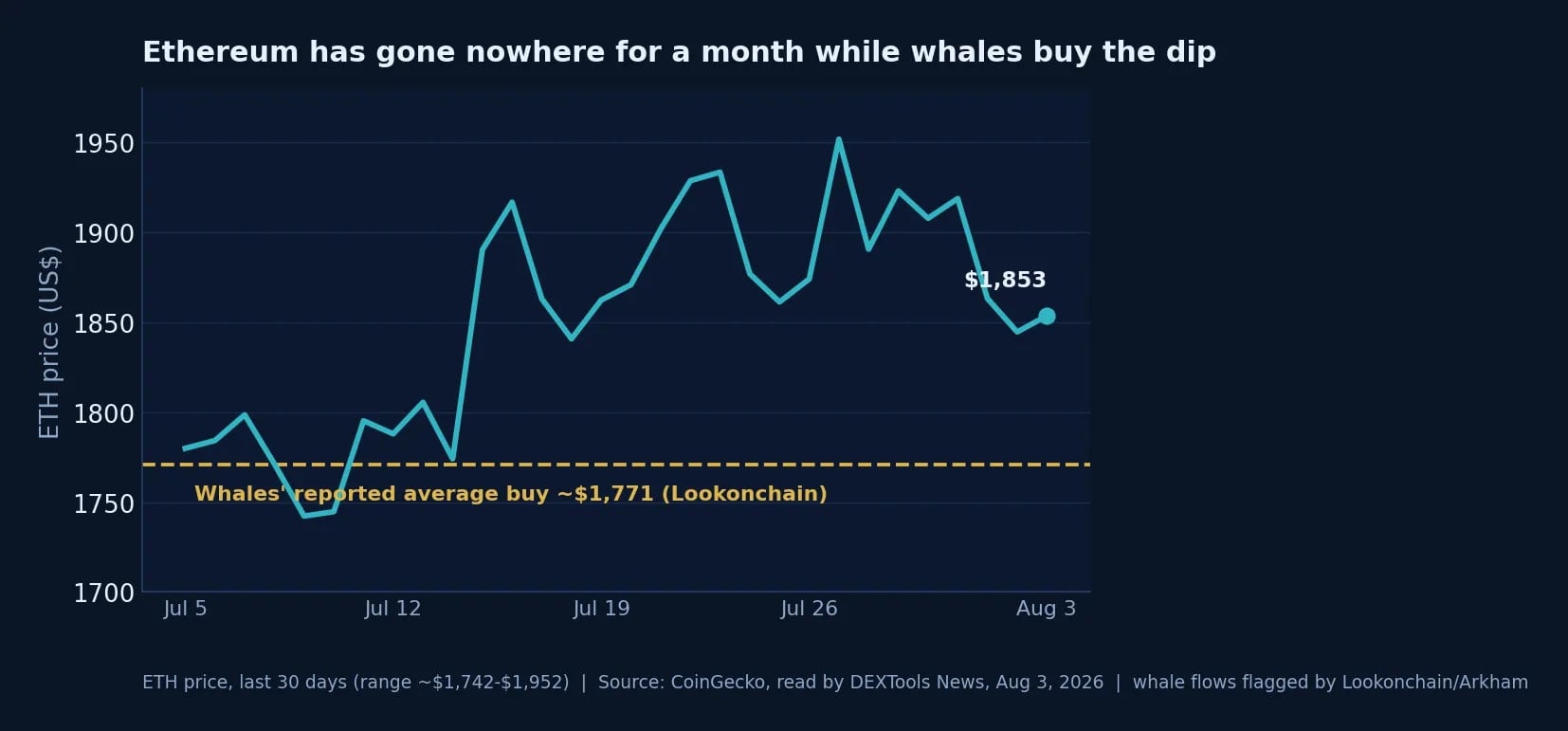
Ethereum has spent a month going nowhere. We pulled the price history: ETH has been pinned between roughly $1,742 and $1,952 and trades around $1,853 today, down about 5% on the week. But on-chain trackers say large wallets are quietly accumulating near the lows, including one that has bought about 74,000 ETH (~$131M) since late June at an average near $1,771, plus continued buying from ETH-treasury holders like Tom Lee's BitMine. We verified the price backdrop ourselves and relay the wallet flows as attributed to the trackers. Accumulating into a flat market is often deliberate, patient capital building positions cheaply before a move.
Ethereum has spent the last month doing a whole lot of nothing. We pulled the price history ourselves, and ETH has been pinned in a narrow band between roughly $1,742 and $1,952, changing hands around $1,853 today, down about 5% on the week and up about 5% on the month. A flat chart usually means a bored market. But underneath the boredom, on-chain trackers are pointing at something more interesting: large wallets appear to be quietly accumulating ETH right here, near the lows.
A month of going nowhere
What the trackers are seeing
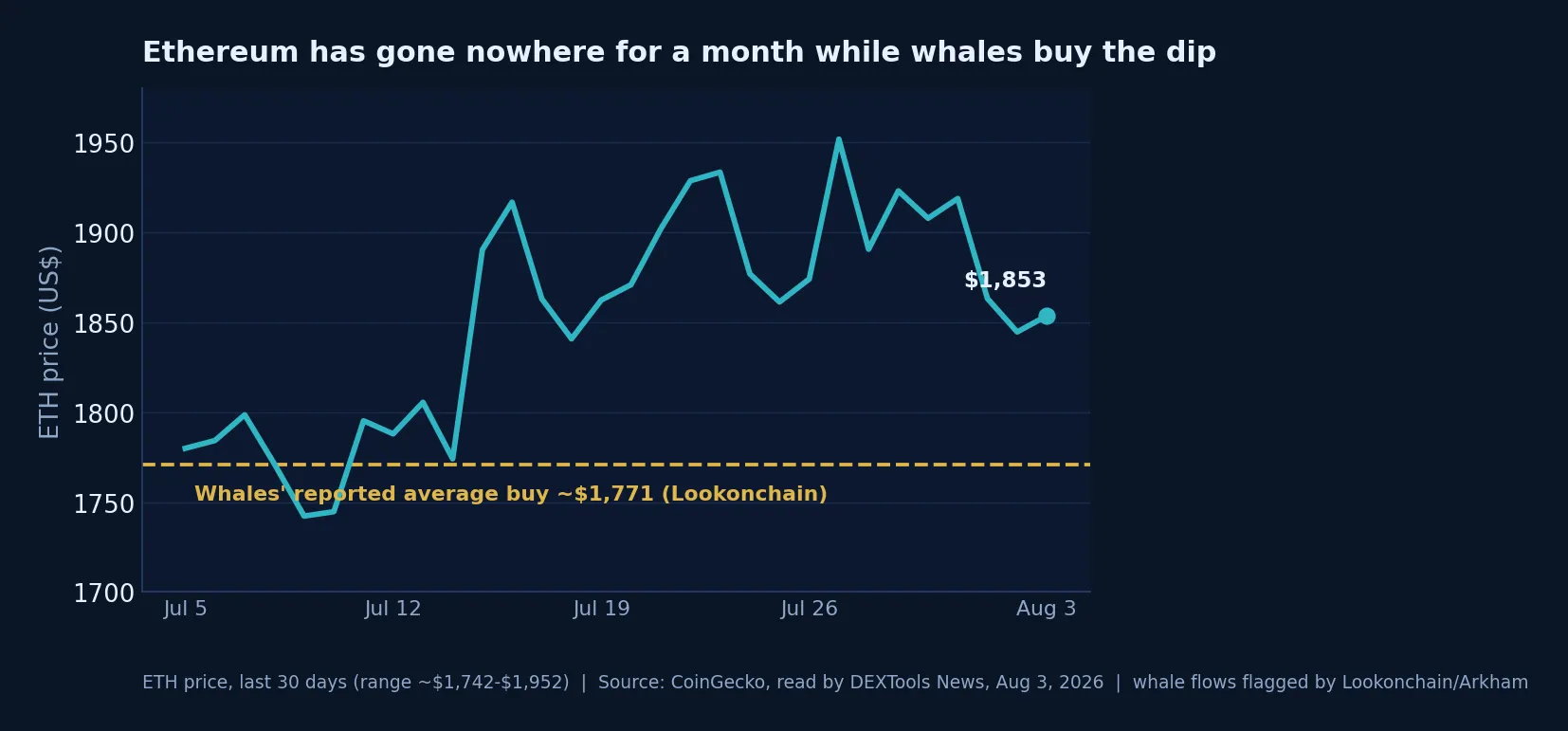
The accumulation calls come from on-chain analytics firms, chiefly Lookonchain using Arkham Intelligence's entity labels. Their standout example is a single wallet that has bought roughly 74,000 ETH, about $131 million, since late June at an average price near $1,771, adding several thousand more ETH this week. Alongside it, ETH-treasury buyers such as Tom Lee's BitMine have reportedly kept adding to their holdings. We verified the price backdrop directly from market data; the specific wallet attributions are the trackers', and we are relaying them as such rather than claiming to have labeled the wallets ourselves.
Why accumulate a coin that is not moving?
Buying into a flat market is often the whole strategy. When a large holder wants to build a position, a quiet, range-bound tape is ideal, because it lets them accumulate near the lows without their own buying pushing the price up against them. Chasing a rally is expensive; loading up during a boring month is cheap. So a sideways chart paired with steady large-wallet buying is not a contradiction. It can be the sign of patient capital positioning before a move rather than reacting to one. The reported average buy near $1,771, just below where ETH trades now, sits right at the bottom of the month's range, which is exactly where accumulators like to work.
The caveat, and the takeaway
None of this is a prediction. Whale accumulation is a signal, not a guarantee; reported flows can reverse, and a coin can stay range-bound for a long time. It is also worth being precise about what is verified: the price action and the range are ours, read from market data, while the wallet-level accumulation is attributed to the trackers that surfaced it. With that said, the setup is a familiar one, an asset that looks boring on the surface while, beneath it, large and patient buyers are said to be doing their shopping. If ETH does eventually break its month-long range, the on-chain footprints being laid down now are where analysts will look first for who saw it coming.
Data note. ETH price figures (a 30-day range of about $1,742 to $1,952, about $1,853 now, down ~5% on the week and up ~5% on the month) were read by DEXTools News from CoinGecko on August 3, 2026. The whale-accumulation details, including a wallet that bought roughly 74,000 ETH (about $131M) since late June at an average near $1,771, and continued buying by ETH-treasury holders such as BitMine, are attributed to Lookonchain using Arkham Intelligence labels and were not independently verified at the wallet level by DEXTools News. This is information, not financial advice.
Related reading
- Ethereum settles half of all stablecoins, yet ETH lags
- ETH is the 2nd-biggest bet on Hyperliquid: the OI map
- A third of all ETH is now staked: the supply squeeze
Frequently asked questions
What is Ethereum's price doing?
Not much, which is the point. Over the past 30 days ETH has traded in a tight band between roughly $1,742 and $1,952, and it sits around $1,853 as of early August 2026, per CoinGecko data read by DEXTools News. That is down about 5% on the week and up about 5% on the month: range-bound, going nowhere in particular.
Are whales buying Ethereum?
According to on-chain trackers, yes. Lookonchain, using Arkham Intelligence's labels, has flagged large wallets accumulating ETH near current levels, including one that has bought roughly 74,000 ETH (about $131 million) since late June at an average price near $1,771, alongside reports of ETH-treasury buyers like Tom Lee's BitMine adding more. These attributions come from the trackers; DEXTools News verified the price context but not the individual wallet labels.
Why would whales accumulate a coin that is not moving?
Accumulating into a quiet, range-bound market is often deliberate: it lets large buyers build positions near the lows without pushing the price up against themselves, which is harder to do in a fast rally. A flat chart with steady large-wallet buying can mean patient capital is positioning ahead of a move rather than chasing one. It is a signal worth noting, not a guarantee of direction.
Is this a good time to buy Ethereum?
That is not something we can answer, and nothing here is financial advice. What the data shows is that ETH has been range-bound around $1,850 for a month while on-chain trackers report whale accumulation near the lows. Those are observations, not a recommendation. Ethereum carries the usual market risk, and reported whale flows can reverse; do your own research before acting.