The GENIUS Act Turns One With Zero Final Rules. The Stablecoin Market Grew $48 Billion Anyway
— By Tony Rabbit in Markets

July 18 was the GENIUS Act's one-year deadline for final US stablecoin rules. It passed with eight proposals and zero final rules, while on-chain data shows the stablecoin market grew from $259.7B to $308.1B in the same year.
Saturday, July 18, was the one-year statutory deadline for US regulators to finalize the rules that make the GENIUS Act, the country's landmark stablecoin law, actually work. The date came and went with eight proposed rules on the books and not a single final rule published by any of the agencies involved. While the rulebook sat unfinished, the market it is supposed to govern added about 48 billion dollars.
That contrast is the story. We pulled the on-chain numbers ourselves on July 19: total stablecoin supply stood at roughly $259.7 billion on July 18, 2025, the day the Act was signed. One year later it is about $308.1 billion, an 18.6 percent increase, recorded entirely under a regime whose final rules do not exist yet.
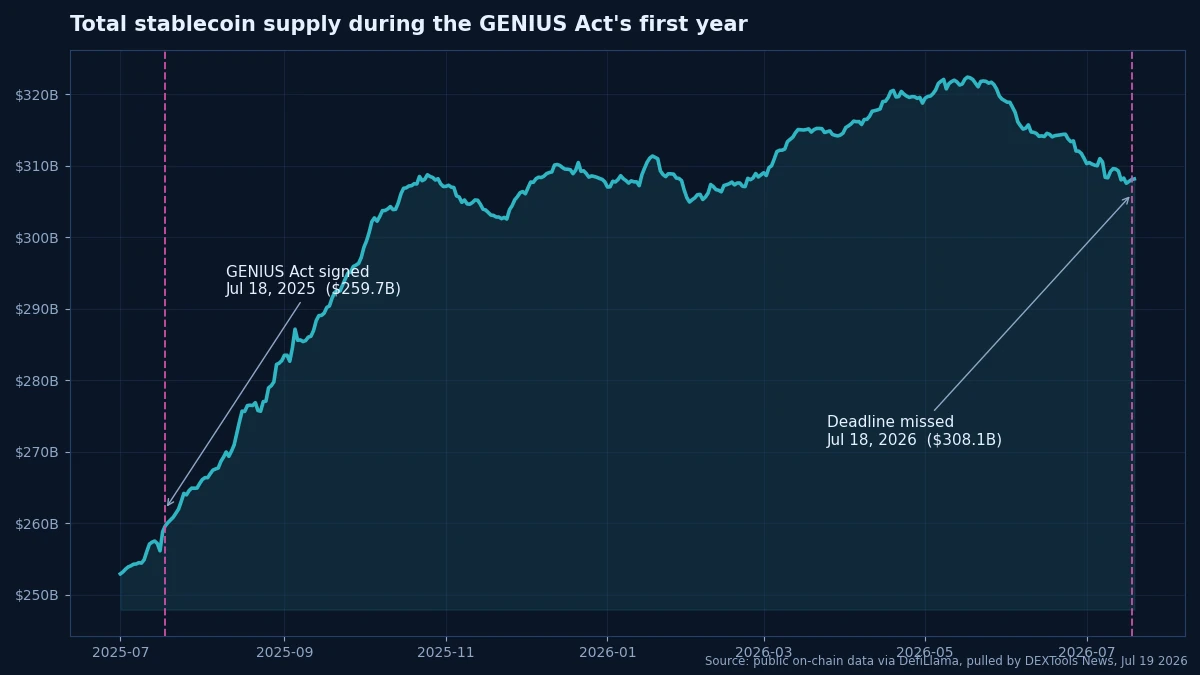
The year in numbers, verified on-chain
Who owns the $308 billion
This is the market the missing rules were supposed to govern, reading circulating supply directly from public data on July 19:
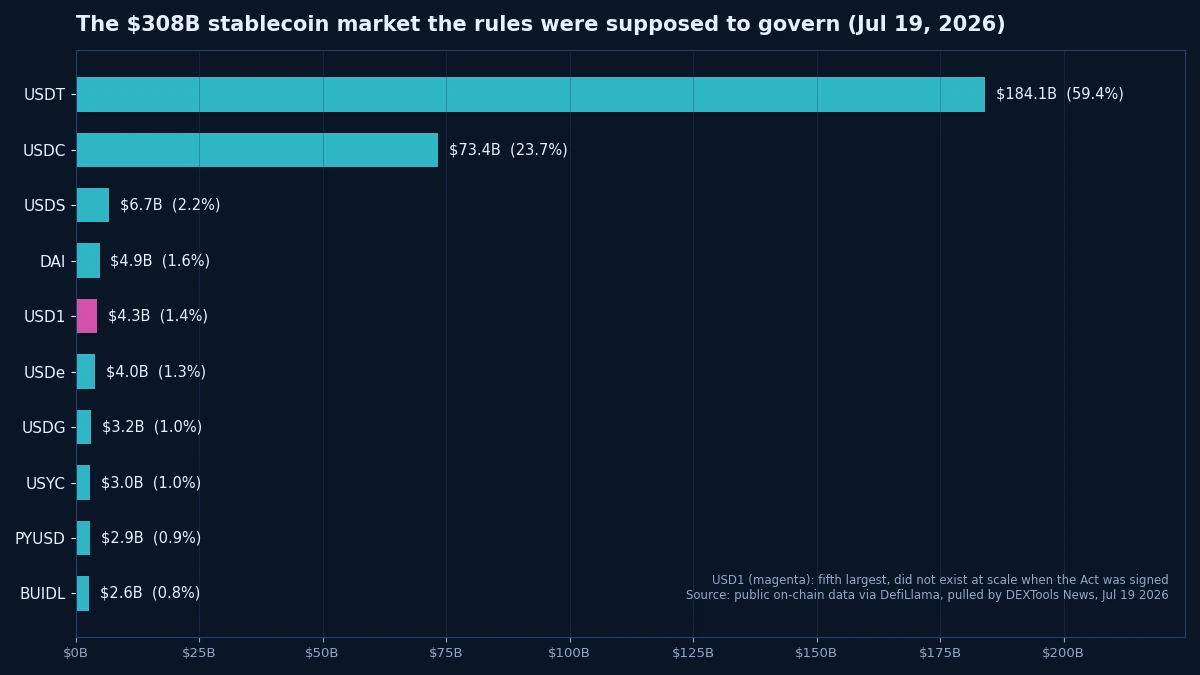
Three details stand out in that chart. First, the concentration: USDT and USDC together are about 83 percent of all stablecoin supply, so whatever the final rules say about those two issuers effectively decides the market. Second, USD1, the World Liberty Financial dollar, is now the fifth largest stablecoin at $4.3 billion despite not existing at scale when the Act was signed. Third, the institutional cohort that grew up during the GENIUS year, PayPal's PYUSD, BlackRock's BUIDL, Ripple's RLUSD and Paxos-backed USDG, has been building inside a regulatory vacuum the law was supposed to close.
What was supposed to happen
The GENIUS Act, signed July 18, 2025, gave federal regulators exactly one year to write the operating manual for payment stablecoins in the United States: the OCC, the Federal Reserve, the FDIC and the NCUA as primary regulators, plus Treasury, FinCEN and OFAC. One year later, this is the actual scoreboard:
Several of those comment windows are still open, which means the rules attached to them realistically cannot be finalized for months. Regulators effectively conceded the deadline in June, when they published three more proposals with comment periods extending past July 18.
What the drafts would actually require
The proposals are not a mystery; the outline of the regime is visible in the drafts. Issuers would need to hold reserves one to one in cash and short-dated Treasuries, honor redemptions within two business days, meet a capital floor that the OCC draft sets at five million dollars, and accept that stablecoin balances are not deposit insured, a point the FDIC has been explicit about. Anti-money-laundering duties would run through FinCEN with a joint customer-identification regime layered on top. None of it is exotic. All of it is unenforceable until the Federal Register says final.

What happens now
Congress wrote no penalty for missing the deadline, but it did write a backstop. The Act takes effect on the earlier of January 18, 2027 or 120 days after final rules are issued. Since no rules are final, and any rule finalized after September 20 cannot move the date up, January 18, 2027 is now effectively the date the US stablecoin regime switches on, rulebook finished or not. Issuers get certainty about the deadline and none about the details: capital treatment, reserve mechanics and custody standards all remain drafts while charter applications and Federal Reserve access decisions are already picking winners.
The issuers left in limbo
The uncertainty does not land evenly. Circle's USDC, the largest US-track issuer, has the most riding on final capital and reserve language. Tether, whose offshore USDT is 59 percent of the market, launched its US-compliant token USAT precisely to have a GENIUS-era vehicle ready, and that plan now waits on a rulebook that does not exist. The yield-adjacent corner, Ethena's USDe, Ondo's USDY and the tokenized treasury products, sits in the most cautious part of the drafts, since GENIUS separates payment stablecoins from anything resembling an investment product. And foreign-issuer treatment, the question that decides how USDT itself is handled on US venues, is exactly the kind of detail that only exists in final text.
Why it matters
Stablecoins are the settlement layer of crypto markets. Every DEX pair quoted in USDT or USDC, every on-chain treasury, every payment rail built this year has been running on infrastructure whose US legal foundation is still in draft form. The market's answer to that uncertainty was to grow 18.6 percent. The question the next six months will answer is whether the final rules, when they land, ratify the market that already exists or force parts of it to restructure, particularly the foreign-issuer and yield-adjacent corners that the drafts treat most cautiously.
The bottom line
A year was the deadline the law set for itself, and the deadline lost. The stablecoin market did not wait for permission: $48 billion of new supply, a new top-five entrant, and an institutional cohort that now includes PayPal, BlackRock and Ripple all arrived while the rulebook stayed in draft. January 18, 2027 is the date to circle. Until then, the biggest sector in crypto keeps operating on proposals.
Data note. Stablecoin supply figures and both charts were produced by DEXTools News on July 19, 2026 from public DefiLlama stablecoin data; the July 2025 baseline comes from the same series, and figures are rounded. Regulatory timeline details reflect Federal Register filings and reporting as of July 18-19, 2026. This article is for information only and is not financial or legal advice.