How Yield-Bearing Stablecoins Differ From USDC

Holding traditional stablecoins means giving a free loan to centralized issuers. We pull back the curtain on the mechanics and risks of yield-bearing digital dollars.
What Are Yield-Bearing Stablecoins and How They Differ From USDC
- The core architecture of decentralized wealth storage has shifted away from asset passivity. In the early chapters of the digital asset economy, simply maintaining a stable 1:1 parity with fiat currency was considered a monumental engineering achievement. Centralized stablecoins like Circle’s USDC and Tether’s USDT emerged as the undisputed transactional backbones of Web3, offering safe harbor from crypto's hyper-volatility.
- However, this convenience came with a massive, unstated financial sacrifice. Traditional stablecoin issuers operate on a highly profitable banking model: they ingest user fiat cash, mint an equivalent volume of non-productive digital tokens, and deploy the underlying reserves directly into interest-bearing traditional assets like short-term U.S. Treasury bills. The issuer pockets 100% of the institutional yield, while the end-user holds a flat bearer asset that pays a structural 0% return.
- The maturation of Yield-Bearing Stablecoins permanently breaks this corporate monopoly. Instead of routing yield exclusively to centralized corporate balance sheets, yield-bearing stablecoins programmatically pass underlying interest streams back to the token holder. This guide unbundles the tokenized mechanics, wrapper architectures, and systemic risk trade-offs separating yield-bearing stable dollars from traditional models like USDC.
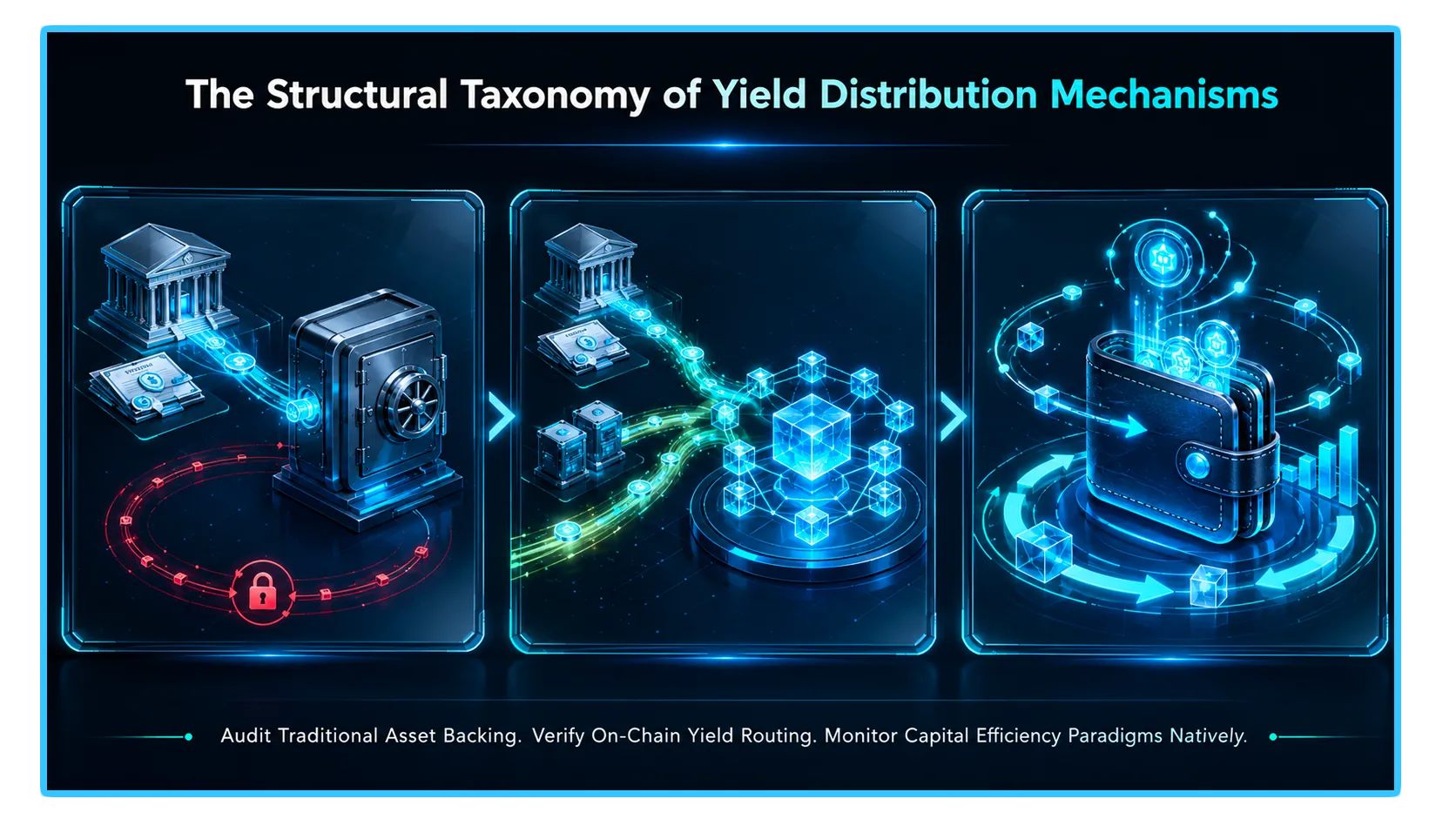
1. The Core Infrastructure: How YBSs Stablecoins Generate Revenue
To evaluate yield-bearing digital dollars with professional-grade precision, you must strip away the marketing layer and analyze the exact on-chain and off-chain routing engines that manufacture the yield. Unlike inflationary reward tokens that rely on artificial mint printing, sustainable yield-bearing primitives capture authentic, external economic revenue through three primary mechanisms:
Tokenized Real-World Assets (RWAs): Primitives like Mountain Protocol (USDM) or Ondo (USDY) pool capital to buy short-term sovereign debt. The interest generated by these underlying U.S. Treasury bills is streamed directly back onto the blockchain ledger.
Delta-Neutral Derivatives Arbitrage: Vehicles like Ethena (USDe) or Falcon Finance (USDf) combine spot crypto assets with equivalent short perpetual futures positions. This synthetic dollar setup harvests positive funding rates from leverage markets, converting short position distributions into consumer yield.
Protocol Governance Fees: Ecosystems like Sky (formerly MakerDAO) route stability fees paid by vault borrowers directly into savings contracts like the Sky Savings Rate (SSR), funding the yield for staked assets like sUSDS.
2. The Structural Divergence: Yield-Bearing Stablecoins vs. USDC
The operational contrast between traditional fiat-backed tokens and yield-bearing alternatives alters the velocity, capital efficiency, and custody profile of digital treasuries.
The Capital Allocation Comparison Matrix
| Financial Metric | Traditional Stablecoins (e.g., USDC) | Yield-Bearing Stablecoins (e.g., sUSDS, sUSDe, USDM) |
| Organic Base Yield | Strict 0% (All interest retained by corporate issuer) | Variable or Fixed macro yield (Typically 4% to 15%+) |
| Reserves Capture Target | Corporate treasury balance sheet expansion | Direct programmatic distribution to token holders |
| Asset Wrapper Mechanics | Flat ERC-20 static token | Rebasing supply or value-accruing contract share |
| Systemic Risk Profile | Centralized counterparty banking & regulatory freeze keys | Multi-layered smart contract exploits & derivative funding flips |
| DeFi Interoperability | Universal baseline pairing currency | High-efficiency collateral requiring custom oracle integration |
3. Token Architecture: Rebasing vs. Value-Accruing Wrappers
Yield-bearing stablecoins are not monolithic; they distribute revenue to your Web3 wallet using two entirely different smart contract standards: Rebasing Tokens and Value-Accruing Share Wrappers.
Rebasing Models (The Balance Modification Loop)
- Tokens utilizing a rebasing standard (such as Mountain Protocol’s USDM) maintain a strict, permanent price quote of exactly $1.00 on decentralized exchanges. To distribute accrued interest, the smart contract executes a periodic global rebase script that programmatically expands or contracts the token quantities sitting inside user wallets.
- If you hold 10,000 USDM and the underlying treasury assets generate a yield tier, your balance will automatically adjust upward to 10,050 tokens. While the token price remains static, your net capital exposure scales.
Value-Accruing Models (The Share Multiplier Loop)
- Advanced yield primitives (such as Sky's sUSDS, Ethena's sUSDe, or Falcon's sUSDf) implement a non-rebasing, ERC-4626 value-accruing share wrapper. Under this framework, your wallet's nominal token count remains completely flat. The harvested yield is injected directly into the main staking vault, programmatically driving up the internal token conversion multiplier.
- Because the volume of underlying assets inside the contract continuously expands while the share supply remains bound to user deposits, the fair market value of the share token appreciates deterministically above $1.00. Upon final redemption, the wrapper is dismantled, allowing the holder to claim a significantly larger volume of basic stablecoins than they initially locked away.
4. Systemic Risks and Structural Fault Lines
An institutional-grade deployment of capital into yield-bearing stablecoins requires a clear-eyed assessment of their unique failure modes. Bypassing the USDC model eliminates the passivity penalty but introduces advanced technological liabilities.
Smart Contract and Wrapping Risk: Traditional USDC relies on a simple, battle-tested token ledger ledger. Yield-bearing tokens, by contrast, are insulated behind complex smart contract vaults, automated market routing systems, and non-custodial pooling scripts. Any minor coding syntax error or reentrancy vulnerability can result in an instantaneous, irreversible drain of your entire collateral position.
Funding Rate Inversions: For synthetic stablecoins that derive yield from derivatives basis trading, extended bear markets present an existential hurdle. If short positions are forced to continuously pay funding fees during aggressive market contractions, the protocol's insurance reserves face immediate compression, creating a potential de-peg catalyst if the core collateral drops below the 1:1 safety threshold.
5. Real-Time Market Telemetry via DEXTools
- Navigating a high-velocity ecosystem where yield-bearing tokens continuously interact with automated market makers and lending protocols requires deep look-through data telemetry. While front-facing protocol dashboards display optimized annualized percentage yields (APY), verifying the actual secondary market liquidity depth, trading volume stability, and peg defense metrics on decentralized venues is the only method to audit genuine systemic health.
- DEXTools provides the critical analytical data infrastructure needed to monitor these asset classes in real-time. By leveraging real-time pair explorers, multi-chain live charts, and advanced wallet flow tracking, market participants can independently verify if a yield-bearing stablecoin maintains tight parity across decentralized exchanges.
- Cross-referencing live market data with on-chain telemetry ensures your portfolio allocations are backed by authentic economic depth, keeping your wealth securely insulated from sudden premium compressions or unexpected liquidity failures across alternative layers. You can access
Disclaimer: This article is for informational purposes only and does not constitute investment advice, financial advice, trading advice, or any other kind of advice. DEXTools does not recommend buying, selling, or holding any cryptocurrency or token. Users should conduct their own research and consult with a qualified financial advisor before making any investment decisions. Cryptocurrency investments are volatile and high-risk. DEXTools is not responsible for any losses incurred.