GENIUS Act: Stablecoin Yield Impact

Federal oversight has finally codified the rules for digital dollars. We dissect the legislative boundaries, compliance pathways, and future of stablecoin yield under the new legal framework.
What Is the GENIUS Act and What It Means for Stablecoin Yield
- The regulatory landscape governing digital fiat-proxies has graduated from piecemeal enforcement actions to comprehensive federal codification. For years, the decentralized finance (DeFi) sector operated under continuous structural ambiguity. High-volume stablecoin issuers and yield-bearing synthetic dollar protocols expanded rapidly, capturing billions in total value locked (TVL) by offering native yield channels that completely bypassed traditional banking intermediaries.
- The introduction of the GENIUS Act (Generating Enhanced National Security and Innovation for United States Stablecoins) permanently alters this operational paradigm. Designed to establish a definitive federal framework for digital dollars, this legislative landmark codifies exactly who can issue a stablecoin, what reserves must back it, and (most critically) where the line is drawn between a liquid payment medium and an investment contract.
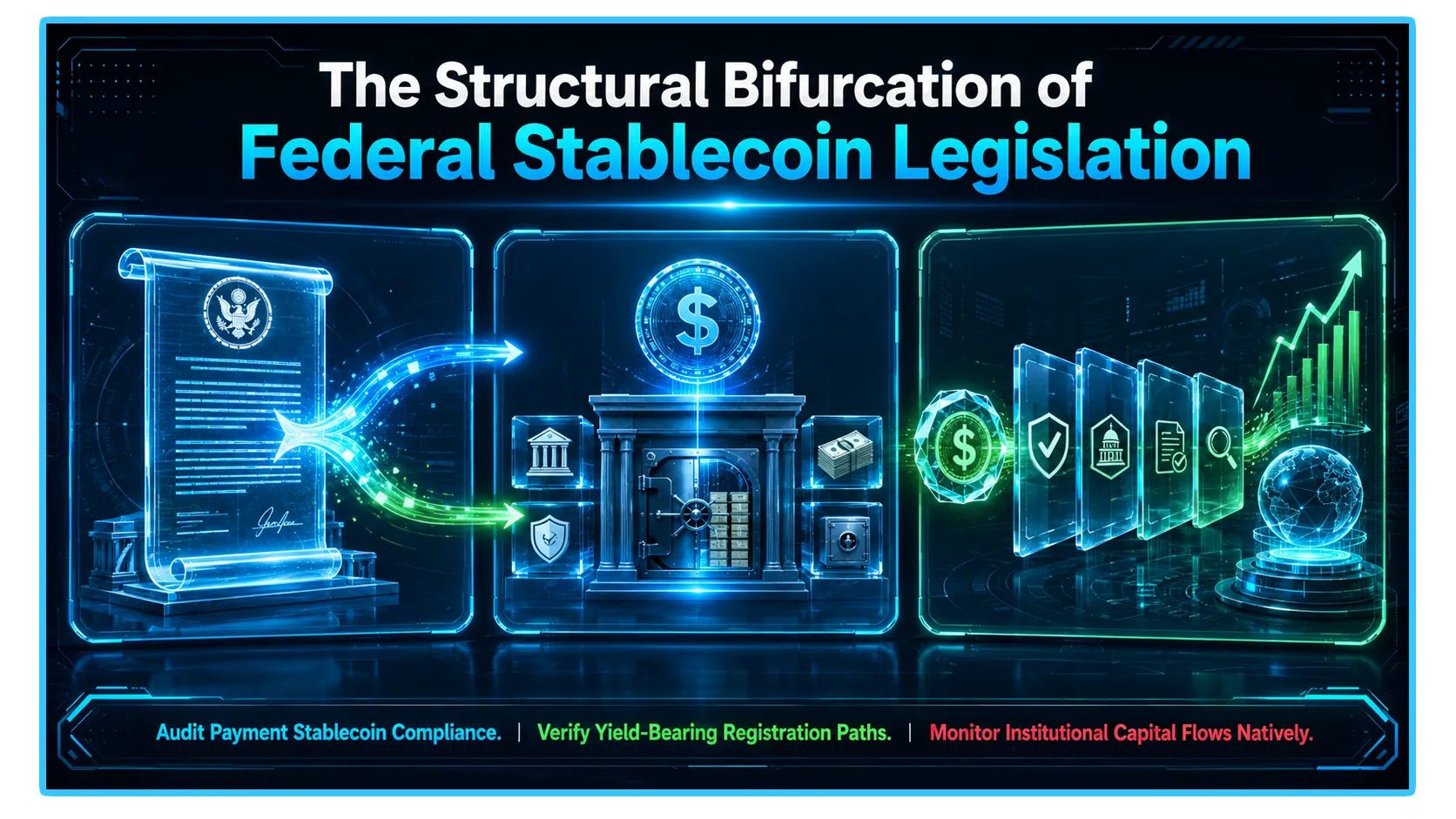
- For capital allocators utilizing yield-bearing stablecoins, the GENIUS Act introduces a fundamental structural bifurcation. This institutional analysis deconstructs the legal boundaries, compliance demands, and yield-generation constraints defining the post-legislation ecosystem.
1. The Legal Divide: Payment Stablecoins vs. Yield-Bearing Primitives
The core architecture of the GENIUS Act relies on drawing a sharp, unyielding line between standard transactional stablecoins and yield-bearing digital assets. The legislation categorizes all fiat-pegged tokens into two distinct regulatory buckets.
Payment Stablecoins
Under the Act, an authorized "Payment Stablecoin" must be backed 1:1 by high-quality liquid assets, specifically physical cash, dollar deposits, and short-term U.S. Treasury bills. Crucially, the law explicitly prohibits payment stablecoin issuers from paying interest or yield directly to end-users. Any net interest margin generated by the underlying Treasury reserves is legally retained by the corporate issuer or the banking partner. This brings assets like USDC and PYUSD under a strict, non-yielding banking compliance model.
Yield-Bearing and Synthetic Dollars
Any digital dollar primitive that programmatically passes underlying interest, basis-trading revenue, or validator rewards back to the token holder falls completely outside the payment stablecoin safe harbor. The GENIUS Act treats these yield-bearing mechanisms as alternative financial instruments, pulling them directly into the joint jurisdiction of the SEC and CFTC.
2. The Structural Realities for Yield Primitives
The enforcement of this federal framework forces yield-bearing protocols to fundamentally restructure how their asset lifecycles operate on-chain.
The Death of Native Retail Yield in the US
- Because the legislation enforces strict consumer protection and anti-money laundering overlays, offering native, automated yield to unverified retail wallets inside the United States is effectively prohibited without formal registration.
- Protocols can no longer distribute yields via automated rebasing mechanisms directly to public addresses without running afoul of unregistered securities laws. To maintain domestic compliance, yield-bearing projects must limit their yield-generating layers to accredited institutional allocators or migrate entirely out of the jurisdiction.
Strict Geofencing and the Rise of Offshore Synthetic Dollars
- In response to the legislation, top-tier synthetic dollar and yield-bearing stablecoin projects are implementing aggressive, multi-layered cryptographic geofencing.
- By actively blocking U.S. IP addresses, verified identities, and connected wallet clusters from entering their staking or value-accruing vaults, protocols can continue to offer high-efficiency funding-rate yields and real-world asset (RWA) distributions to international capital markets, operating completely under alternative international legal frameworks.
3. Operational Grid: Stablecoin Classifications Under the Act
To understand how the new legislative framework reorganizes the velocity and legality of digital assets, analyze the core structural differences across current token profiles:
| Regulatory & Financial Dimension | Approved Payment Stablecoins (e.g., USDC, USDS) | Yield-Bearing Staked Primitives (e.g., sUSDS, sUSDe, USDM) |
| Federal Legal Status | Fully sanctioned cash equivalent and payment medium | Regulated as an investment contract, derivative, or security |
| Consumer Yield Capability | Strictly 0% (Prohibited by federal statute) | Floating or fixed yield allowed for registered/offshore entities |
| Mandated Reserve Backing | 1:1 Cash, insured bank deposits, short-term T-bills | Diverse; liquid staking tokens, delta-neutral perps, RWAs |
| Primary Regulatory Oversight | Federal Reserve, OCC, and state banking regulators | SEC, CFTC, or international offshore jurisdictions |
| US Retail Wallet Access | Natively unrestricted across centralized/decentralized venues | Heavily restricted, accredited-only, or strictly geofenced |
4. Institutional Workarounds: The Wrapped Share Model
- To preserve capital efficiency without triggering severe compliance penalties under the Act, sophisticated Web3 engineering teams are increasingly deploying value-accruing share token wrappers (such as the ERC-4626 standard).
- Instead of utilizing a rebasing token standard that changes the token quantities sitting inside user wallets (an action that closely mirrors a dividend distribution) protocols utilize an isolated vault. The yield generated by the underlying asset pools is funneled directly into the core staking contract, programmatically driving up the internal token conversion multiplier over time.
- The value of the share token appreciates steadily relative to the baseline stablecoin asset. From a regulatory defense standpoint, this structural layout allows projects to argue that the asset is a simple, unified tradeable derivative share rather than an active payment stablecoin distributing illegal interest inside the domestic banking perimeter.
5. Micro-Level Telemetry and Market Diagnostics via DEXTools
- Navigating a highly transitionary compliance environment where stablecoin architectures are being aggressively re-engineered requires absolute, look-through validation of secondary market liquidity. While protocol documentation lays out the targeted legal frameworks and backing structures, verifying actual peg stability, trading volume distribution, and order book depth on decentralized venues is the only method to confirm genuine asset health.
- DEXTools provides the critical analytical data infrastructure needed to monitor these structural shifts in real-time. By utilizing advanced pair tracking, live buy/sell transaction logs, and cross-chain wallet telemetry, market participants can independently verify if an asset maintains its target dollar parity across automated market makers.
- Monitoring real-time order book depth and pool concentration ensures your capital configurations are supported by authentic economic substance, keeping your digital wealth securely insulated from sudden premium compressions, regulatory contract halts, or unexpected de-pegging anomalies.
Disclaimer: This article is for informational purposes only and does not constitute investment advice, financial advice, trading advice, or any other kind of advice. DEXTools does not recommend buying, selling, or holding any cryptocurrency or token. Users should conduct their own research and consult with a qualified financial advisor before making any investment decisions. Cryptocurrency investments are volatile and high-risk. DEXTools is not responsible for any losses incurred.