Russia Just Legalized Crypto for Cross-Border Trade and Blessed Exactly One Dollar Stablecoin: USDT. Half of It Runs on Tron
— By Tony Rabbit in Markets

Russia's Duma passed its first crypto law on July 21, legalizing crypto for cross-border trade with only Bitcoin, Ethereum and USDT approved. On-chain data: USDT is $184.1B (59.2% of all stablecoins), and $89.3B of it, nearly half, sits on Tron.
Russia's State Duma passed its first comprehensive crypto law on July 21, and buried in the framework is a detail that matters far more than the headline. The Bank of Russia will let ordinary Russians trade and settle cross-border deals in crypto, but its central bank has cleared exactly three assets to start: Bitcoin, Ethereum, and one dollar stablecoin, Tether's USDT. We pulled the on-chain numbers on what that single blessing actually channels, and the answer runs straight through Tron.
USDT is not a small pick. Reading live stablecoin data, there is $184.1 billion of USDT in circulation today, 59.2% of the entire $311 billion stablecoin market. And the striking part for a law about cross-border trade: nearly half of it, $89.3 billion, lives on Tron, the network already most associated with moving dollars across borders outside the traditional banking system.
Where the blessed dollar actually lives
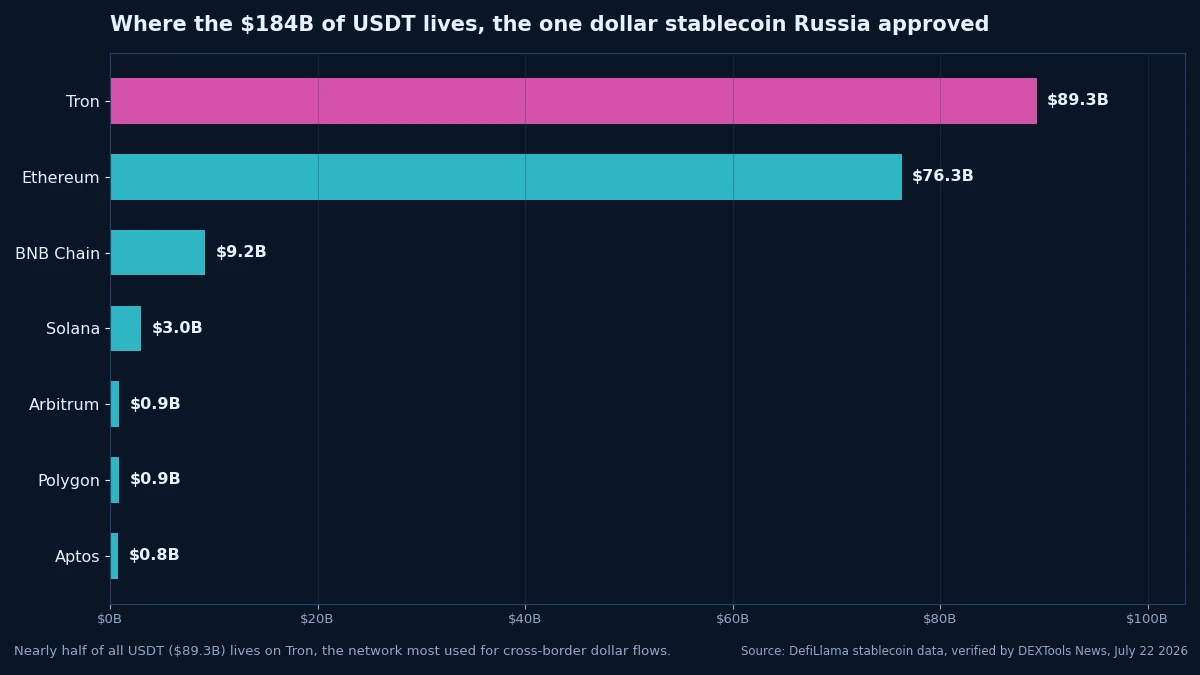
That Tron concentration is the whole point. When people talk about the "digital dollar" for cross-border commerce in places cut off from Western banking, they are overwhelmingly talking about USDT on Tron: cheap, fast, and settled outside any single government's rails. By approving USDT and legalizing crypto for cross-border trade in the same law, Russia has effectively formalized access to the exact instrument its importers and exporters were already reaching for.
What the law actually does
The bill, "On Digital Currencies and Digital Rights," passed its second and third readings in the Duma on July 21. It recognizes crypto as property with judicial protection, legalizes crypto for cross-border trade settlements, and keeps domestic payments banned, the ruble stays the sole legal tender inside Russia. Non-qualified retail buyers are capped at roughly 300,000 rubles (about $3,800) per year. Most provisions take effect September 1, 2026, and the bill still needs Federation Council approval and Vladimir Putin's signature, both considered formalities.
The geopolitics under the tokenomics
Read against the calendar, the intent is hard to miss. In April 2026 the EU moved to bar Russia-based crypto service providers as part of its sanctions regime. Three months later, Russia legalizes crypto specifically for cross-border settlement and blesses the one dollar stablecoin whose largest home, Tron, is already the default rail for sanctions-adjacent dollar flows. This is not a country embracing decentralization; it is a state channelling international trade through a single, deeply liquid dollar token it can watch, while keeping the ruble untouched at home. The choice of USDT over a Russian or a fully-compliant Western stablecoin is the tell.
Why it matters beyond Russia
Two things. First, it is another large economy concluding that the practical digital dollar is USDT, not a bank product, which reinforces Tether's position as the settlement layer for the parts of the world the dollar reaches through crypto rather than through banks. Second, it puts more scrutiny on Tron specifically: if a sanctioned economy formally routes trade through USDT-on-Tron, the pressure on that network, and on Tether's ability or willingness to freeze addresses, only grows. The $89.3 billion already sitting there is the number regulators on both sides will now be watching.
What to watch
Three things. First, whether USDT's on-chain supply, and specifically its Tron share, ticks up after the law takes effect on September 1. Second, whether Tether responds to the sanctions optics, since a formal Russian trade channel through USDT is exactly the kind of exposure that draws Western pressure to freeze. Third, whether Russia later adds its own approved stablecoin, which would signal a move away from dependence on a single foreign-issued token. The law is passed. The flows it unlocks are the story from here.
The bottom line
Russia legalized crypto for trade and, in the same breath, told the world which dollar it trusts: USDT, $184 billion of it, more than half the stablecoin market, with nearly half of that already parked on Tron. The law reads as regulation. The on-chain numbers read as a country formalizing the digital-dollar rails it was already using.
Data note. USDT circulation, its share of the stablecoin market and the per-chain breakdown were read by DEXTools News from live DefiLlama stablecoin data on July 22, 2026, and rounded. Details of the Russian bill reflect Duma reporting as of July 21-22, 2026; the law still requires Federation Council approval and a presidential signature. This article is for information only and is not financial or legal advice.