Copy Trading in Crypto: How It Works and Top Platforms

Social copy trading allows retail users to mirror professional strategists automatically. We break down the underlying API order routing and hidden slippage risks.
The Evolution of Social Trading: Democratizing Alpha or Automating Recklessness?
- The universal challenge of navigating the digital asset marketplace is the high barrier to execution edge. To extract sustainable yields from the volatile crypto market, an individual must master a broad matrix of highly specialized disciplines: analyzing macroeconomic liquidity flows, decoding order book order blocks, auditing smart contract code architectures, and maintaining strict, non-negotiable psychological risk parameters. For retail participants lacking formal institutional training or the time required to manage 24/7 terminal monitoring, attempting to actively day-trade often leads to rapid capital destruction.
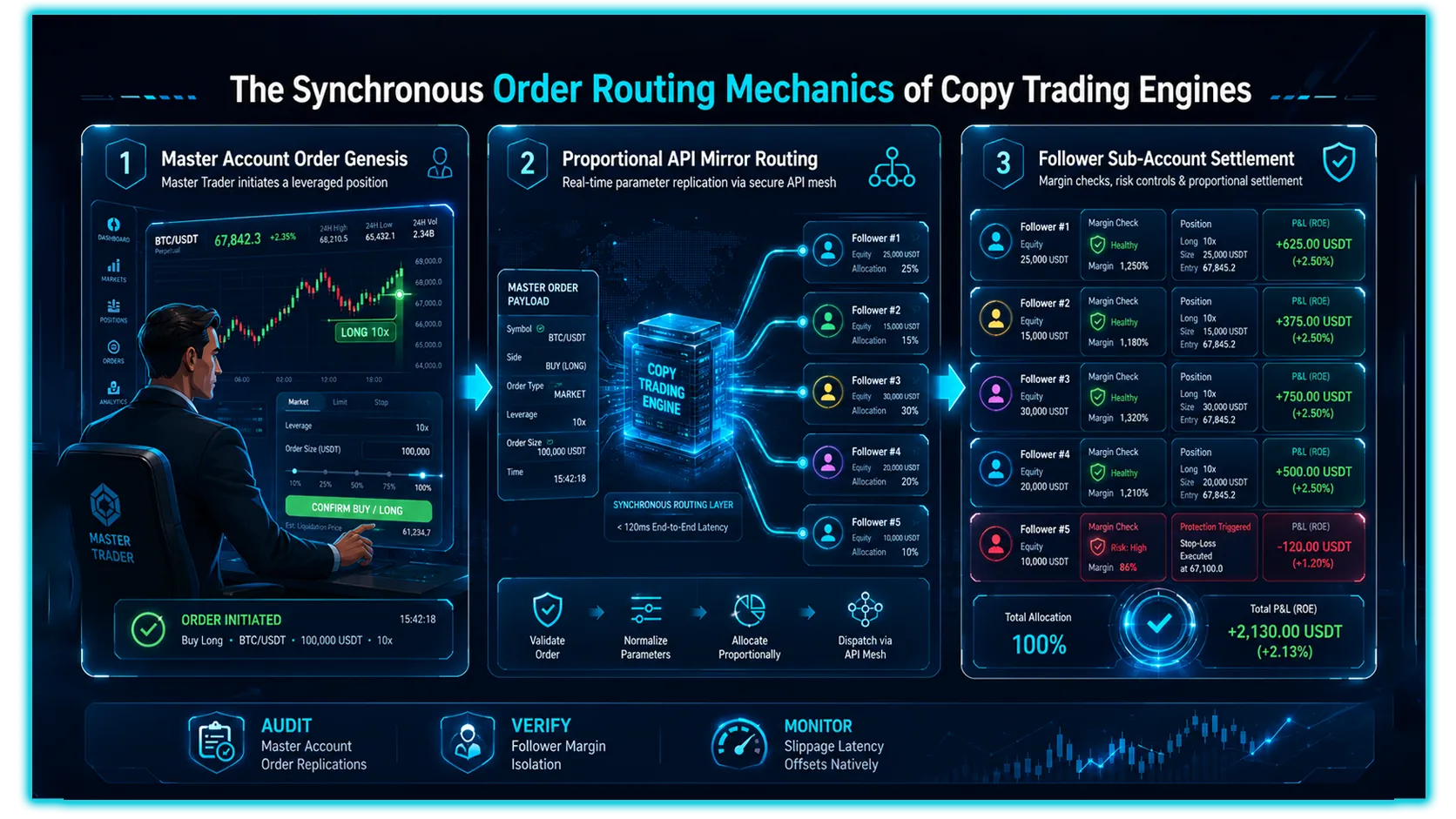
- This persistent skills deficit drove the rise of social trading, which eventually culminated in the institutionalization of Copy Trading. Operating as a synchronized API infrastructure layer embedded within major centralized trading venues, copy trading allows retail users to link their personal capital directly to the live execution desk of a professional, high-reputation strategist known as a Leader or Master Trader. The moment the Master Trader authorizes a buy or sell order, the exchange's underlying matching engine instantly replicates that exact trade parameter within the follower's sub-account.
- While this structure democratizes access to complex perpetual swap and futures execution strategies, it presents a delicate double-edged sword. If deployed without a clear understanding of order execution latency, platform-specific fee dynamics, and the psychological traps that influence leader behavior, copy trading can mutate from an automated portfolio management system into an engine that simply automates your financial ruin. This comprehensive guide pulls back the operational curtain on copy trading, breaking down its structural mechanics, fee overhead architectures, systemic leader-based risks, and the top platforms dominating the landscape.
1. Strategic Architecture: How Crypto Copy Trading Works Natively
- To navigate a copy trading ecosystem safely, you must move past the basic marketing interface and understand the low-level technical plumbing that facilitates automated trade replication. Copy trading systems are built directly into the exchange's core execution matrix, isolating user capital into specialized sub-accounts designed to mirror foreign trading instructions programmatically.
- Under this configuration, the follower's trade sizes are executed as an exact percentage ratio matching the Master Trader's relative wallet weight. If the Master Trader allocates precisely 5% of their total available portfolio balance to execute an Ethereum long position, the copy trading engine automatically calculates the follower's isolated account balance and deploys exactly 5% of their funds to open an identical position.
- This model is highly favored because it preserves the exact risk management model, leverage scale, and position-sizing strategy crafted by the strategist.
The Fixed Capital Model
- This setup allows the follower to discard proportional scaling entirely, assigning a fixed, uniform dollar margin to every replicated trade. For example, instructing the bot to deploy exactly $100 of margin per position, regardless of how large or small the Master Trader's position behaves.
- While this offers clear boundaries for small accounts, it introduces extreme risk-mismatch profiles. If a leader opens a tiny, defensive hedge position designed to protect their main wallet, a fixed-capital follower might inadvertently deploy a massively over-leveraged trade, destroying their account balance on a routine market wiggle.
The Latency and Slippage Bottleneck
- A critical technological factor that copy trading followers frequently overlook is the Execution Latency Loop. When a Master Trader triggers a high-volume market order on a perpetual swap pair, their trade executes instantly at the top of the order book. The platform's social API must then process that event, calculate the proportional sizing adjustments for thousands of individual followers, and broadcast matching sub-account orders to the matching engine sequentially.
- During periods of high market volatility, this processing queue creates a multi-millisecond delay. As a result, followers frequently experience severe slippage, buying the asset at a significantly higher price than the master trader or selling it at a lower price, which systematically degrades the follower's real-world net returns relative to the leader's public leaderboard metrics.
2. The Fee Matrix: Profit Sharing and Hidden Execution Overhead
Copy trading platforms advertise their tools as simple, low-barrier networks, but the underlying cost structure is layered with specialized fees designed to compensate the Master Trader and maximize platform revenue.
The Profit Sharing Ratio (PSR)
- Master Traders do not provide their strategical edges for free. They are compensated through a performance-based incentive fee known as the Profit Sharing Ratio. This fee typically ranges from 8% to 15% of the net profits generated within the follower's account.
- Most premium platforms manage this overhead using a strict High-Water Mark System combined with weekly or bi-weekly settlement cycles. If a follower's account generates $1,000 in gross profits during a trading week, the copy platform automatically locks up and transfers $100 (assuming a 10% PSR) straight to the Master Trader's wallet. If the follower subsequently experiences a losing week, the Master Trader cannot claim any future profit cuts until they successfully rebuild the follower's account balance back above its previous highest historical valuation milestone.
Compounded Maker and Taker Fee Markups
- Because copy trading engines rely heavily on automated market orders to guarantee immediate execution sync across thousands of accounts, followers are almost always subjected to standard Taker Fees. Taker fees are substantially more expensive than Maker fees (which apply when adding liquidity via limit orders).
- Furthermore, some platforms integrate an invisible fee markup or premium into the social trading spread to cover the heavy computational costs of running continuous multi-wallet API routing. This high fee overhead means that if a Master Trader executes a high-frequency scalping strategy: opening and closing dozens of positions a day for tiny percentage gains. The follower's capital base can be slowly eroded by the sheer accumulation of compounding transaction fees, even if the leader's net strategy remains nominally profitable.
3. The Risk-of-Leader Paradigm: Demystifying Follower Hazards
The most volatile component within the copy trading architecture is not the codebase or the exchange matching engine; it is the human psychology of the Master Trader. Followers frequently select leaders based entirely on superficial leaderboard metrics, subjecting their capital to catastrophic hidden structural risks.
The Leaderboard Illusion: High public win rates (such as a dashboard boasting a flawless 99% win history over a 90-day window) are frequently achieved by deploying highly toxic, hidden risk models that are designed to game the platform's ranking algorithms while exposing followers to extreme hidden dangers.
The Martingale Strategy Trap
- To maintain a flawless public win rate and attract thousands of paying followers, a toxic Master Trader will deploy a Martingale or "grid-averaging" risk model. When a leveraged position moves against them, rather than accepting a clean, professional loss and hitting a stop-loss gate, the leader refuses to close the position. Instead, they continually add to the losing trade at deeper intervals, lowering their average entry price while dramatically increasing their overall position weight.
- Because crypto markets experience frequent mean-reverting wiggles, this strategy often succeeds in bouncing back to profitability, allowing the leader to record another winning trade on their dashboard. However, the moment the asset enters a powerful, non-reverting macro trend breakout, the position size expands to unsustainable levels. The leader's wallet runs completely out of margin, triggering a sudden, catastrophic liquidation cascade that completely wipes out the entire follower base in a single evening, while the leader simply deletes their profile and launches a fresh account the following week.
Ego-Driven Risk Amplification
- When a Master Trader climbs to the top of a public leaderboard, they are flooded with millions of dollars in follower copy-capital. This massive influx of external scale completely distorts the leader's original risk parameters. Knowing that they are trading with massive size and capturing direct performance cuts from thousands of users can trigger psychological ego inflation.
- The strategist may begin taking irrational risks, abandoning their verified technical playbooks to chase high-leverage speculative positions on low-cap assets, or over-trading out of an emotional need to perform for their audience. This behavioral drift invariably leads to severe capital drawdowns for the passive followers who fail to monitor the leader's structural strategy shifts.
4. Institutional Venues: Top Platforms Profiled (Bybit & Bitget)
While numerous centralized exchanges offer social trading add-ons, the global copy trading market share is overwhelmingly dominated by two institutional powerhouses: Bybit and Bitget. Both platforms feature robust execution engines but cater to distinct participant archetypes.
Bitget: The Pioneer of Social Copy Networks
Bitget is widely recognized as the historical pioneer of the crypto copy trading meta, launching its specialized social architecture during the early phases of the multi-chain expansion.
The Scale of the Ecosystem: Bitget hosts one of the largest networks of registered Master Traders globally, offering deep diversification across spot trading, coin-margined perpetuals, and automated AI trading grid bots.
Advanced Protection Tools: To insulate users from Martingale traps, Bitget provides an excellent suite of follower-centric customization parameters. Followers can deploy a mandatory Copy Stop-Loss (CSL) that automatically severs the API connection and liquidates the sub-account's copy positions if the overall account drawdown hits a specific threshold, completely overriding a reckless master trader's instructions.
Bybit: The Deep Liquidity Institutional Engine
Bybit approaches copy trading with a strict focus on deep liquidity, institutional matching speeds, and tight order-book execution parameters.
Slippage Mitigation Infrastructure: Because Bybit houses massive institutional liquidity pools, its copy trading matching engine exhibits significantly lower execution latency compared to smaller venues. This optimization drastically reduces the slippage offset, ensuring that followers receive entry and exit fills that align closely with the Master Trader's actual executions.
The Master Trader Tier Framework: Bybit enforces a highly structured, strict multi-tier vetting framework for its strategists. Leaders are subjected to continuous algorithmic auditing, where parameters like maximum historical drawdown, mandatory seed capital requirements, and portfolio turnover ratios are constantly measured, filtering out low-conviction or highly reckless traders from achieving high leaderboard visibility.
Copy Trading Sizing Allocation Typologies
| Sizing Model | Operational Execution Method | Primary Structural Risk |
| Proportional Ratio | Matches exact wallet percentage scale | Dependent on leader's wallet size |
| Fixed Capital | Deploys static dollar margin per trade | Extreme leverage and risk mismatch |
Platform Infrastructure Comparison
| Exchange Venue | Operational Edge | Core Follower Protection |
| Bitget | Massive matrix of diverse traders | Advanced Copy Stop-Loss tools |
| Bybit | Deep institutional liquidity pools | Strict leader tier vetting metrics |
Telemetry Tracking & Alpha Verification Sourcing via DEXTools
As you secure your seed phrase storage and hardware wallet setup, maintaining visibility over decentralized markets remains essential. DEXTools provides advanced analytics to monitor live token behavior, liquidity pools, contract data, and market activity across public blockchain networks.
With tools like Pair Explorer, Live New Pairs, Trade Story, Top Traders, and Big Swap Explorer, traders can audit volume trends, track whale movements, review liquidity depth, and check contract safety before interacting on-chain. This helps ensure secured wallets engage only with verified and liquid market venues while private keys remain safely protected offline.
You can access DEXTools here and start trading today!
Disclaimer: This article is for informational purposes only and does not constitute investment advice, financial advice, trading advice, or any other kind of advice. DEXTools does not recommend buying, selling, or holding any cryptocurrency or token. Users should conduct their own research and consult with a qualified financial advisor before making any investment decisions. Cryptocurrency investments are volatile and high-risk. DEXTools is not responsible for any losses incurred.
Bitget Tutorial: Copy Trading and Launchpad Explained Top 5 Crypto Copy Trading Platforms in 2026 How to Calculate Position Size in Crypto Trading AMM vs Order Book DEXs: Crypto Trade Dynamics