Crypto Bridges Explained: Lock-Mint, Burn-Mint, and Native

Blockchains are sovereign digital silos unable to communicate natively. We break down the smart contract mechanics and security parameters powering cross-chain bridging.
The Interoperability Problem: Connecting Sovereign Cryptographic Silos
- Public blockchain networks are designed as strictly isolated economic systems. By default, an Ethereum smart contract cannot look inside Solana’s ledger state, and a Bitcoin UTXO cannot execute code on an EVM roll-up. While this structural isolation preserves local consensus security, it creates a highly fragmented capital web. If an investor wants to deploy capital across alternative networks, they cannot simply slide tokens over an open border; they must route their assets through specialized infrastructure known as blockchain bridges.
- Cross-chain bridging has matured into a multi-billion dollar capital pipeline. However, bridges represent some of the most complex, high-risk code running in the digital asset ecosystem. Moving value between sovereign environments requires a deep understanding of token wrapping mechanics, trust-minimized security architectures, and the divide separating basic asset routers from generalized message layers.
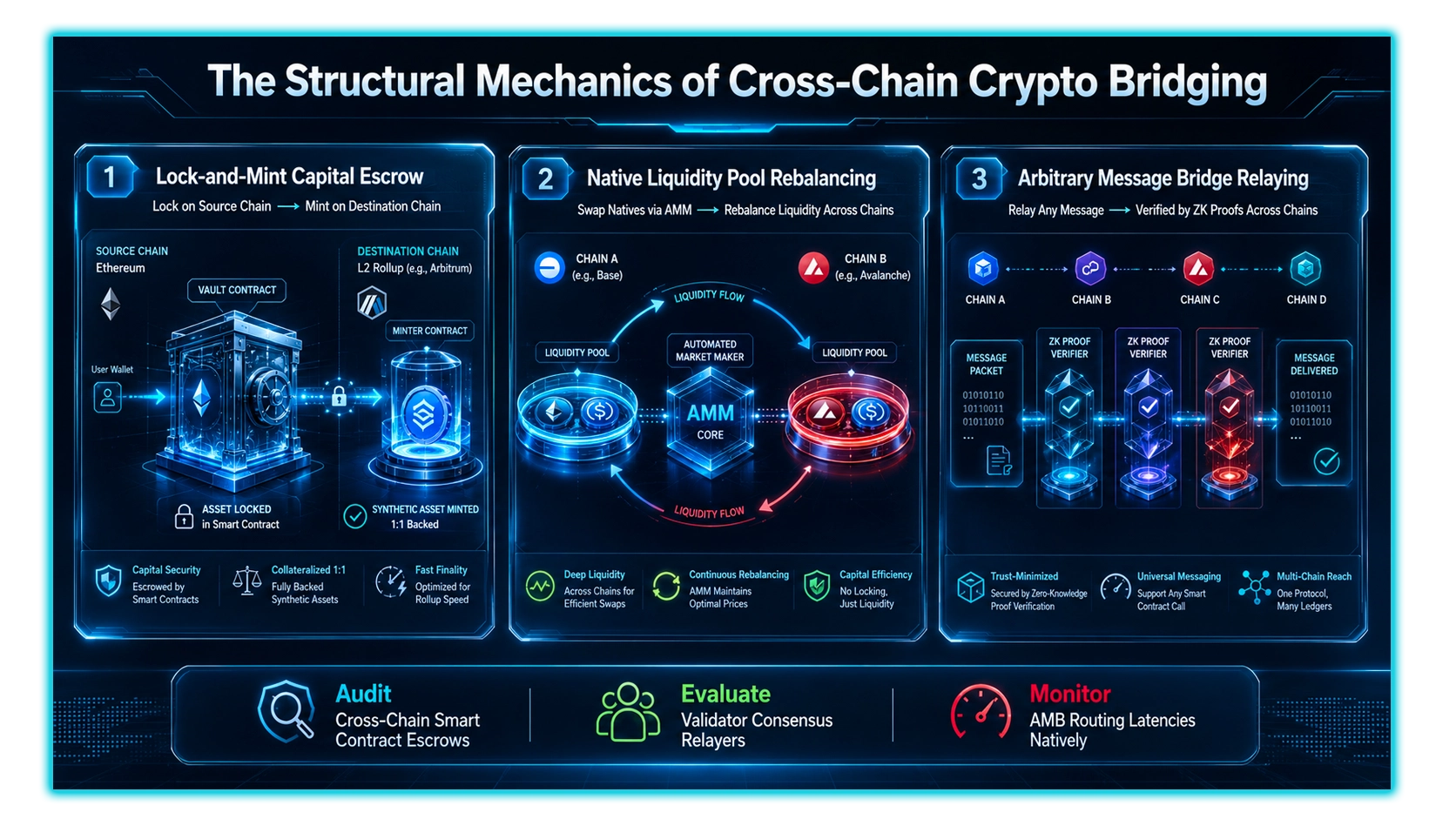
1. Core Token Mechanics: How Value Crosses Chains
Bridges do not physically transport native tokens from one hard drive to another. Instead, they manipulate ledger supplies across two distinct networks simultaneously using three primary architectural methods.
Lock-and-Mint Bridges
The most common structural model used for multi-chain token extensions is the Lock-and-Mint framework.
The Sourcing Phase: A user deposits native tokens (e.g., 10 ETH) into a designated smart contract vault on the source chain (Ethereum). The tokens are securely locked and held in escrow.
The Synthetic Phase: A tracking relayer monitors the source vault, confirms the deposit, and instructs a companion smart contract on the destination chain (e.g., Arbitrum) to mint an equivalent 1:1 synthetic representation (e.g., 10 wrapped ETH).
The Risk Factor: This mechanism creates a massive centralized honey pot of raw capital on the source chain, making lock-and-mint bridges a prime target for smart contract exploits.
Burn-and-Mint Crypto Bridges
When an application developer wants to expand a token's native supply natively across multiple chains without creating fragmented wrapped layers, they utilize Burn-and-Mint tracks.
The Execution Loop: To move assets, the user does not escrow capital. The source chain contract permanently destroys (burns) the tokens out of circulation. The bridge protocol verifies the burn state and automatically mints completely fresh, native tokens on the destination chain. This elegant design keeps the global circulating supply perfectly balanced while eliminating vulnerable, locked liquidity vaults.
Native Swap Crypto Bridges
For blue-chip tokens that already maintain deep independent liquidity across multiple distinct networks (like USDC or USDT), Native Swap bridges bypass synthetic wrapping entirely. These routers utilize balanced liquidity pools deployed across both networks. When a user bridges assets, they deposit native tokens into the source pool and receive native tokens directly out of the destination chain's pool, managed by automated rebalancing algorithms.
2. Security Models: Trusted vs. Trust-Minimized Verification
The defining metric of any cross-chain architecture is its Trust Model: the specific verification framework that proves a transaction actually occurred on the source chain before triggering actions on the destination chain.
Trusted (Centralized / Federated) Bridges
- Trusted architectures rely on an external group of humans or entities to verify transactions. This includes centralized custodial bridges (like WBTC) or federated multi-signature networks (like the legacy Ronin bridge).
- While these bridges are fast and offer cheap execution processing, they introduce a severe centralized risk vector: if a majority configuration of the multi-sig keys is compromised or colludes, the entire escrow vault can be drained.
Trust-Minimized (Decentralized) Crypto Bridges
Trust-minimized bridges replace human reputation with mathematical and cryptographic proof verification:
Light Client Bridges: Nodes on the destination chain run a mini-client that independently validates the block headers of the source chain, checking proofs directly without relying on third-party intermediaries.
Zero-Knowledge (ZK) Bridges: The bridge utilizes succint zero-knowledge proofs (like SNARKs or STARKs) to mathematically demonstrate that a source-chain state change occurred, allowing the destination chain to verify complex inputs with minimal gas overhead.
Optimistic Bridges: Operating much like an optimistic rollup, these systems process transactions instantly under the assumption that they are valid, while opening a designated challenge window where independent watchers can submit fraud proofs to slash malicious relayers and reverse fraudulent payouts.
3. Architectural Taxonomy: Canonical vs. Arbitrary Message Bridges (AMBs)
Not all bridges serve the same engineering scope. The ecosystem divides platforms based on whether they are hardcoded for single-asset expansion or built for generalized multi-chain communication.
Canonical (Native) Bridges
A Canonical Bridge is a purpose-built asset pipeline deployed natively by the core development team of a specific blockchain network, such as the Arbitrum Nitro bridge or the Optimism Standard Bridge. These platforms hold a monopoly over the creation of the network's official wrapped asset layers. Because their security parameters are directly tied to the underlying layer-2 settlement consensus code, they maintain the highest level of structural safety possible for that specific ecosystem.
Arbitrary Message Bridges (AMBs)
- When an application demands more than just shifting simple token balances (such as executing a cross-chain lending call, voting in a multi-chain governance DAO, or checking an alternate chain's profile data) it relies on an Arbitrary Message Bridge (AMB).
- Protocols like LayerZero, Axelar, and Wormhole are generalized communication backbones. They do not run isolated asset pools; instead, they pass raw payload bytes and cryptographic state data packets across different ledgers. This enables developers to deploy native omnichain applications (dApps) where a single smart contract interface can orchestrate financial logic across dozens of isolated networks simultaneously.
Cross-Chain Bridge Infrastructure Matrix
| Metric | Canonical Bridges | Arbitrary Message Bridges (AMBs) |
| Data Scope | Asset Transfers Only | Generalized Byte Data / Code Calls |
| Trust Layer | Native L2 Consensus | Distributed Relayers, Oracles, ZK |
| Asset Type | Official Wrapped Claims | Omnichain Synthetics (OFTs) |
| Key Examples | Arbitrum Bridge, OP Rollup | LayerZero, Wormhole, Axelar |
4. Monitoring Cross-Chain Analytics via DEXTools Telemetry
- As capital continuously fragments and rotates across alternative execution layers, tracking cross-chain token flows, bridge token capitalizations, and the real-time liquidity distributions of multi-chain routing pairs becomes an essential analytical priority. Sourcing analytics through advanced decentralized charting architectures like DEXTools gives market participants an essential universal platform to monitor live token behaviors, evaluate pool depths, and inspect contract parameters across all public execution networks.
- By leveraging core features like the Pair Explorer, Live New Pairs dashboard, and the integrated Trade Story or Top Traders diagnostic tools, technical traders can seamlessly audit localized volume trends, track large whale wallet capital reallocations via the Big Swap Explorer, and check automated contract safety scores before initiating any on-chain interactions, ensuring your hardened hardware setup interacts safely with verified market venues.
Disclaimer: This article is for informational purposes only and does not constitute investment advice, financial advice, trading advice, or any other kind of advice. DEXTools does not recommend buying, selling, or holding any cryptocurrency or token. Users should conduct their own research and consult with a qualified financial advisor before making any investment decisions. Cryptocurrency investments are volatile and high-risk. DEXTools is not responsible for any losses incurred.