Do You Pay Tax on a Crypto-to-Crypto Swap? IRS Rules

Many traders mistakenly believe taxes only apply when cashing out to fiat. We break down the absolute realities of crypto-to-crypto swap taxation.
Do You Pay Tax on a Crypto-to-Crypto Swap? IRS Rules for Every Trade
- One of the most persistent and expensive misconceptions lingering within the digital asset ecosystem is the "fiat safety myth." Many retail participants assume that as long as their capital remains contained within the blockchain matrix (meaning they never execute a direct cash-out to traditional government currencies like U.S. dollars) no tax liabilities are created. Under this flawed assumption, executing a swap of Bitcoin for Ethereum or converting an unstable asset into a dollar-pegged stablecoin is viewed as a tax-free portfolio adjustment.
To be completely direct: The IRS treats every single crypto-to-crypto swap as an immediate, fully taxable capital disposition.
- The federal regulatory framework does not view cryptocurrency as a sovereign currency; it classifies it explicitly as property. Therefore, clicking the "swap" button on a decentralized application or matching an exchange order book pair is legally identical to trading a piece of real estate for a corporate bond.
- The era of self-reported, opaque asset swapping has permanently concluded. This institutional guide breaks down the precise statutory rules, mathematical calculations, and modern broker reporting mechanics governing every crypto exchange.
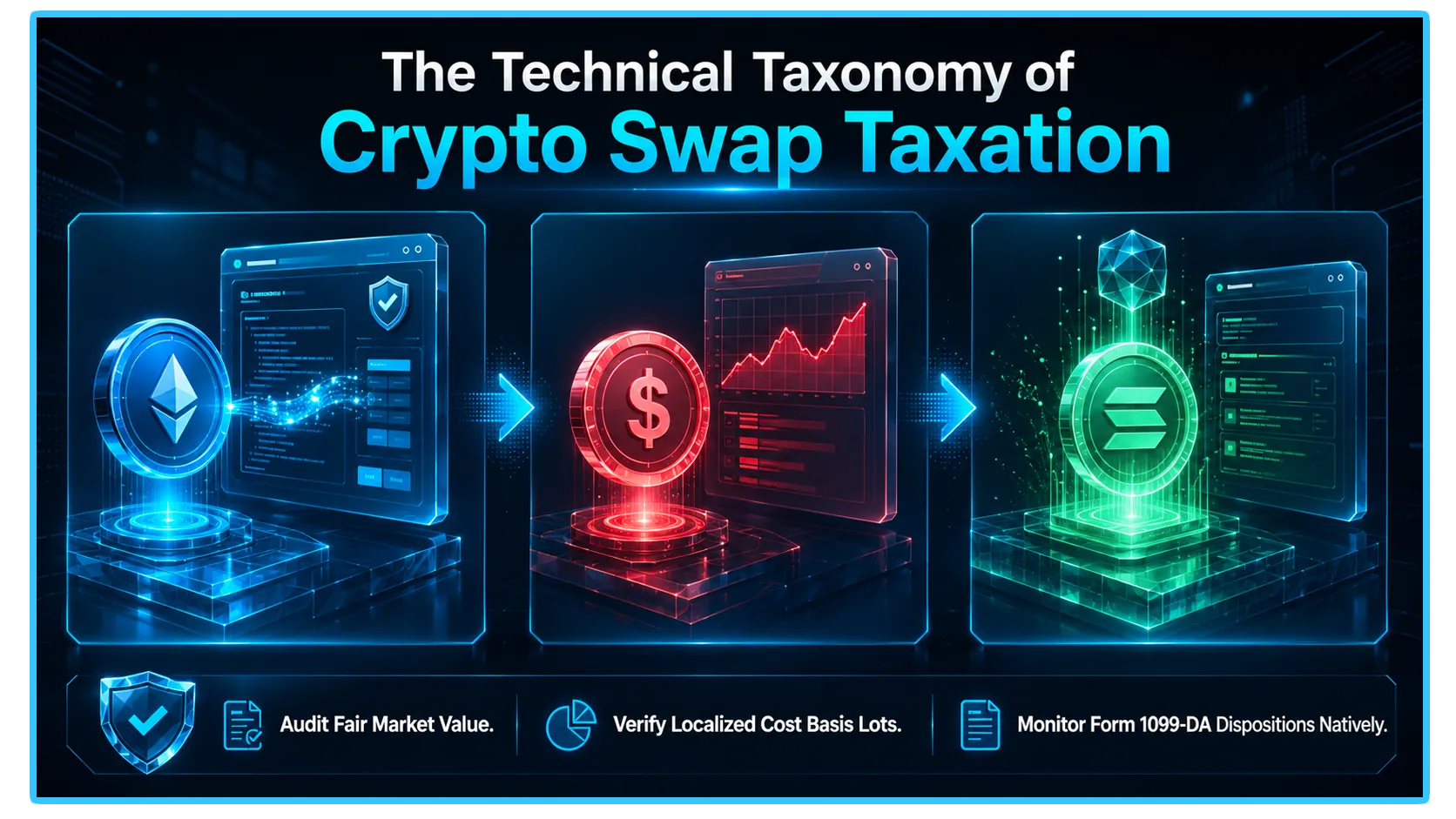
1. The Legal Reality: Why the IRS Taxes Asset Exchanges
- To understand why a token-for-token swap triggers an immediate tax obligation, you must examine the underlying structural framework established by IRS Notice 2014-21. Because virtual currencies are legally defined as property, the standard rules governing capital assets apply to every transaction.
- When you execute a crypto-to-crypto swap, the tax code treats the trade as two separate, simultaneous events occurring in the exact same block transaction.
- The IRS considers that you have legally liquidated your original asset for its immediate fair market value (FMV) in cash, and then instantly used that cash proceeds to buy the new token. Because an internal sale has technically occurred, you must immediately compute and declare the resulting capital gain or capital loss on your tax return for that specific tax year.
2. The Accounting Formula: Calculating Swap Gains and Losses
- To figure out your precise liability from a crypto swap, you must determine the difference between the asset's acquisition value and its disposal value.
- The Adjusted Cost Basis represents the total amount you originally spent in U.S. dollars to acquire the asset, including any integrated network gas fees, brokerage commissions, or processing costs.
Short-Term vs. Long-Term Tax Rates
The duration your asset sat within your localized account before the swap occurred dictates your final tax bracket:
Short-Term Capital Gains: If you held the original cryptocurrency for one year or less before executing the swap, your profit is treated as short-term gain. It is taxed identically to ordinary income, carrying standard brackets that scale from 10% to 37% based on your total annual revenue.
Long-Term Capital Gains: If you held the token continuously for more than one full year before swapping it, the transaction qualifies for preferential long-term capital gains tax brackets. These reduced rates scale through 0%, 15%, or 20%, offering significant structural protection for multi-year investors.
3. The Stablecoin Nuance: Why Even Pegged Swaps Count
- A frequent operational hazard involves transactions between volatile cryptocurrencies and dollar-denominated stablecoins (like USDT, USDC, or DAI). Because stablecoins are explicitly engineered to maintain a permanent 1:1 parity with the fiat dollar, traders assume these transactions carry an automatic tax exemption.
- While it is true that swapping one stablecoin for another rarely generates a meaningful capital gain (since both assets are worth exactly $1.00, resulting in a net profit calculation of virtually zero), the swap of a volatile asset into a stablecoin is the precise moment your historical capital gain is permanently locked.
- If you purchased an asset for $10,000 and subsequently swap it for $50,000 worth of USDC during a market expansion, you have legally completed a property disposition. You owe capital gains taxes on that full $40,000 profit block, despite your wealth remaining fully parked inside a digital stablecoin wrapper.
4. The Structural Ledger Grid: Taxable vs. Non-Taxable Actions
To ensure complete compliance across your daily on-chain operations, you must distinguish between transactions that trigger a capital event and those that are treated as simple, non-taxable asset management:
| Cryptocurrency Action Structure | Taxable Status | Core IRS Regulatory Treatment |
| Trading One Crypto for Another (Swap) | Yes (Taxable) | Treated as a property sale at Fair Market Value; triggers capital gains or losses. |
| Selling Crypto for Fiat Currency (Cash) | Yes (Taxable) | Standard capital disposition; gain or loss calculated against USD proceeds. |
| Spending Crypto to Buy Goods/Services | Yes (Taxable) | Treated as a property liquidation; your gain is calculated based on the item's value. |
| Moving Crypto Between Your Own Wallets | No (Non-Taxable) | Simple self-transfer; no change in legal ownership. Transfer fees adjust the asset's cost basis. |
| Buying Crypto Natively with Cash/Fiat | No (Non-Taxable) | Establishes your original cost basis lot; no realized event occurs until future disposal. |
| Depositing Crypto as Loan Collateral | No (Non-Taxable) | Non-taxable asset locking; becomes taxable only if a default occurs and collateral is liquidated. |
5. Modern Data Tracking: The Form 1099-DA Infrastructure
- The capability for traders to hide or misreport their token-to-token swap history has been structurally dismantled. Centralized cryptocurrency exchanges, digital asset brokers, and hosted custodial systems are legally mandated to transmit transaction data using Form 1099-DA (Digital Asset Proceeds From Broker Transactions).
- Form 1099-DA records the precise timestamp, token signatures, blockchain transaction hashes, and gross fair market value proceeds of every swap you execute. Under the accompanying per-wallet cost basis rules, these transactions are isolated within the specific account where the trade occurs.
- Because the IRS receives an exact carbon copy of your Form 1099-DA proceeds metadata, failing to declare these swaps line-by-line on IRS Form 8949 will flag your account for automated matching audits, triggering immediate penalties and interest.
6. Advanced Historical Valuation via DEXTools Telemetry
- Accurately reporting your historical crypto-to-crypto swaps requires accessing immutable look-through data telemetry. Because the IRS mandates that every swap's proceeds and cost basis must be calculated using the exact fair market value in U.S. dollars at the precise minute the trade finalized, tracking historical price spikes across decentralized liquidity networks is an absolute requirement for defensible accounting.
- DEXTools provides the critical analytical infrastructure required to perform these audits. By leveraging real-time pair explorers, multi-chain historical order book records, and advanced token telemetry, market participants can independently verify the historical exchange rates of their assets during on-chain conversions.
- Cross-referencing your personal swap logs with authentic blockchain data ensures your capital gains calculations are legally solid, protecting your portfolio from arbitrary exchange estimates while preserving your active capital efficiency.
You can access DEXTools here and start trading today!
Form 1099-DA: Why Crypto Cost Basis Fails What Is Cost Basis in Crypto? Tax Guide (2026) Crypto Tax Loss Harvesting: Sell Low, Rebuy Legally Does the Wash Sale Rule Apply to Crypto? (2026)Disclaimer: This article is for informational purposes only and does not constitute investment advice, financial advice, trading advice, or any other kind of advice. DEXTools does not recommend buying, selling, or holding any cryptocurrency or token. Users should conduct their own research and consult with a qualified financial advisor before making any investment decisions. Cryptocurrency investments are volatile and high-risk. DEXTools is not responsible for any losses incurred.