Donating Crypto: Avoid Capital Gains and Claim a Deduction

Why sell your appreciated crypto and pay a massive tax bill when you can donate it directly? Discover the ultimate double-tax advantage of cryptographic philanthropy.
Donating Crypto to Charity
- The explosive appreciation of digital assets has minted a fresh generation of on-chain wealth. However, with massive capital expansion comes an equally massive tax liability. If you decide to take profits on your highly appreciated tokens to support philanthropic causes, navigating standard retail off-ramps can severely degrade your financial efficiency.
Fortunately, tax codes offer a powerful legal mechanism designed to reward direct on-chain philanthropy: the double-tax advantage of crypto donations.
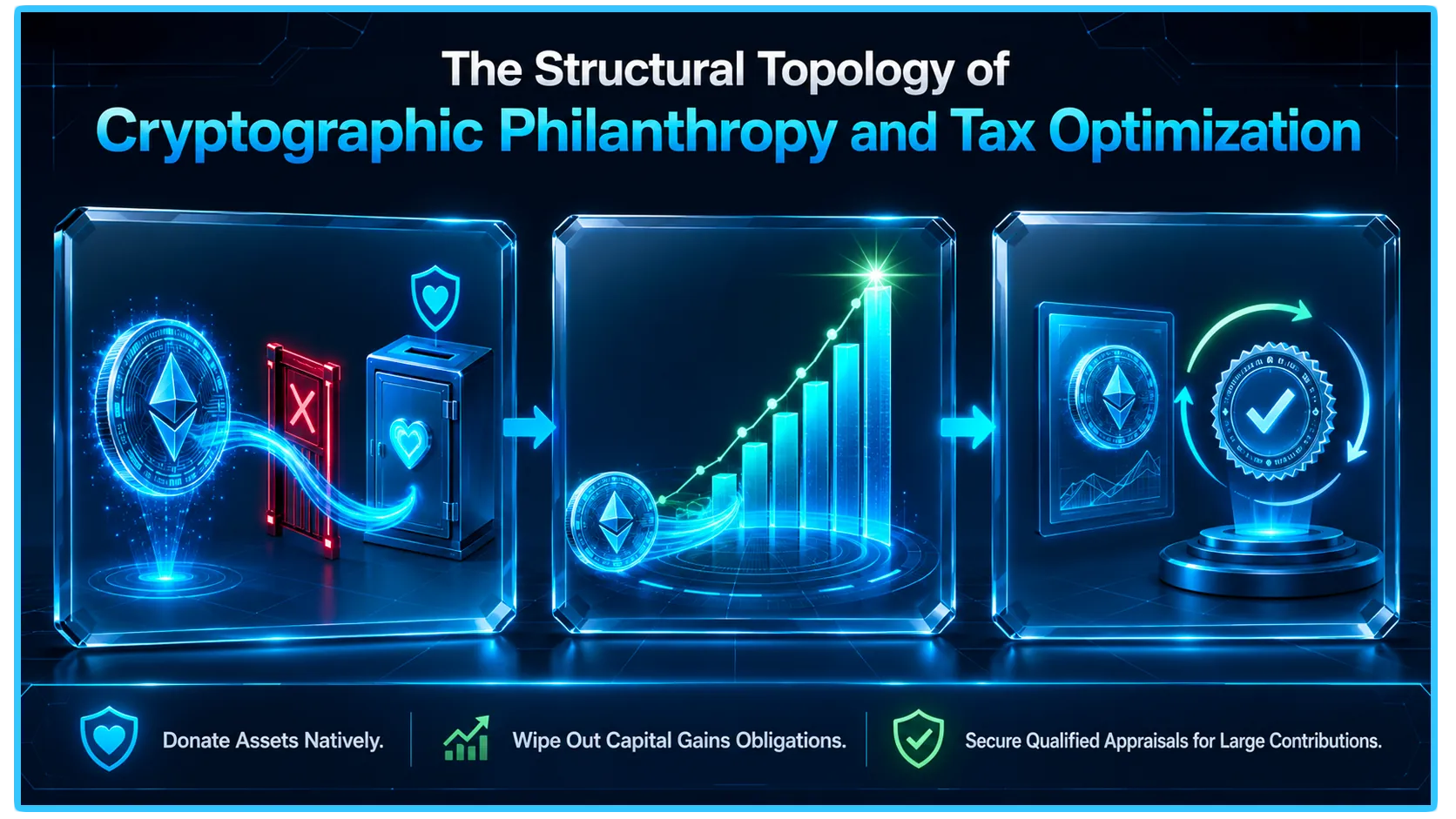
- By donating your digital assets directly to a qualified charitable organization instead of liquidating them first, you can legally bypass capital gains taxes while writing off the full fair market value of the assets. This guide breaks down the structural mechanics of cryptographic giving, holding period rules, and critical IRS appraisal guardrails you must follow to secure your deduction.
1. The Double Tax Advantage: How It Works
To optimize your portfolio’s tax footprint, you must understand how the IRS classifies charitable contributions of digital assets. Because the IRS defines cryptocurrency as property rather than fiat currency, donating crypto functions exactly like donating appreciated stock or real estate.
This classification unlocks a highly lucrative, dual-action tax shield:
Eliminate Capital Gains Liability: When you transfer appreciated tokens directly to a qualified charity's wallet, the transaction is not considered a taxable disposal event. You realize exactly $0 in capital gains, entirely avoiding the 15% to 20% tax hit you would have faced by selling the tokens.
Claim a Fair Market Value Deduction: In addition to wiping out the capital gains bill, you are legally entitled to claim a federal income tax deduction for the Fair Market Value (FMV) of the donated cryptocurrency on the exact date and time of the contribution.
2. The Critical Holding Period: Long-Term vs. Short-Term
Your tax savings depend entirely on how long the donated cryptocurrency sat in your wallet before you initiated the transfer. The IRS draws a rigid line between short-term and long-term holding periods:
Long-Term Assets (Held > 1 Year): To unlock the full double-tax benefit, you must hold the asset for more than one year. Under this regime, you can deduct the full FMV of the tokens (up to 30% of your Adjusted Gross Income, or AGI) and owe nothing on the appreciation.
Short-Term Assets (Held ≤ 1 Year): If you donate tokens held for one year or less, your tax deduction is strictly limited to the lesser of your cost basis (what you originally paid to acquire the tokens) or the current FMV. You still avoid paying capital gains tax, but your write-off is severely capped.
3. The Substantiation Trap: Form 8283 and the $5,000 Appraisal Rule
- While the tax code is incredibly generous to crypto donors, the IRS actively polices these deductions to prevent artificial valuation inflation. Failing to follow standard reporting protocols can result in your entire deduction being disallowed.
If the total value of your non-cash contributions exceeds $500, you are legally required to attach IRS Form 8283 to your tax return.
- However, the real trap lies at the $5,000 threshold. Under IRS Chief Counsel Advice (CCA 202302012), any cryptocurrency donation valued at $5,000 or more requires a Qualified Appraisal conducted by a certified independent appraiser.
- Many donors assume that because a token has an easily verifiable, public exchange spot price, they can skip the appraisal and simply print out an exchange screenshot. The IRS has explicitly rejected this defense, declaring that cryptocurrency does not meet the definition of a "publicly traded security". If you claim a deduction over $5,000 without a signed, qualified appraisal on Form 8283 Section B, the IRS will disallow your write-off.
4. The Diagnostic Grid: Crypto Donation Rules
To maintain a clean, compliant tax strategy, use this ultra-brief reference grid to map your donation parameters:
| Donation Profile | Tax Rules & Filing Requirements |
| Short-Term (< 1 Year) | Deduction limited strictly to asset cost basis. |
| Long-Term (> 1 Year) | Deduct full Fair Market Value; $0 capital gains. |
| Value Over $500 | IRS Form 8283 non-cash filing is mandatory. |
| Value Over $5,000 | Qualified independent appraisal is mandatory. |
5. Step-by-Step Playbook: Executing Your On-Chain Donation
Step 1: Verify the Charity's 501(c)(3) Status
Ensure the receiving organization is a legally recognized, tax-exempt charity under IRS code 501(c)(3). You can verify their standing using the IRS Tax Exempt Organization Search tool.
Step 2: Transfer Directly, On-Chain
Request the charity's public wallet address or utilize a verified cryptographic donation platform. Send the tokens directly from your self-custody wallet or exchange account to the charity's wallet. Do not sell the crypto yourself; the charity must take direct ownership of the asset.
Step 3: Secure Your Receipts and Appraisals
Obtain a formal contemporaneous written acknowledgment from the charity stating the date of the donation, the token ticker, and the exact amount received. If the value exceeds $5,000, immediately contract a qualified digital asset appraiser to execute and sign your Form 8283 before your tax filing deadline.
6. The Candor Check: The Liquidate-First Blunder
Let's speak with absolute, unvarnished peer-to-peer candor. One of the most heartbreaking mistakes made by well-meaning crypto philanthropists is the "liquidate-first" blunder.
The Liquidate-First Trap: Many investors decide to donate, log onto their exchange, sell their highly appreciated tokens for USD, and then wire that cash to the charity's bank account.
The moment you click "sell," you have triggered a permanent, legally binding capital gains event. Even if you donate 100% of the cash minutes later, you still owe the government capital gains tax on the sale. You have essentially thrown away up to 20% of your donating power.
To avoid this, always donate the native tokens directly, or use a Donor-Advised Fund (DAF) to handle the liquidation tax-free on your behalf.
7. Real-Time Telemetry and Pre-Donation Planning via DEXTools
- Timing your cryptographic donation is critical to maximizing the value of your tax write-off. Because crypto markets are highly volatile, you want to execute your on-chain transfer when the token is trading at a premium valuation, locking in a higher Fair Market Value deduction on your tax sheets.
- DEXTools provides the real-time analytical telemetry needed to identify these pricing peaks before you execute your transaction. By pasting your target asset's contract address straight into the advanced DEXTools Pair Explorer, you can analyze live pool depth, monitor order-book stability, and track precise pricing candles. This ensures you execute your philanthropic transfer at optimal market heights, safely maximizing both your charitable impact and your tax write-offs.
The No Bid Moment: When a DEX Token Has a Price but No Real BuyersFake Tokens With the Same Name: How to Verify You're Buying the Real ContractThe Dead Candle Theory: Why Some Tokens Stop Being Markets Before They Stop TradingMemecoin Trading Strategy: When to Take Profits