The No Bid Moment: When a DEX Token Has a Price but No Real Buyers
— By Whatsertrade in Tutorials

A token can still show a price and still have no real market behind it. This is one of the most dangerous situations in DeFi trading. A chart may still update.
A token can still show a price and still have no real market behind it.
This is one of the most dangerous situations in DeFi trading. A chart may still update. Small swaps may still appear. The pair may still exist on chain. But when real buyers disappear, the token enters what traders can call the no bid moment.
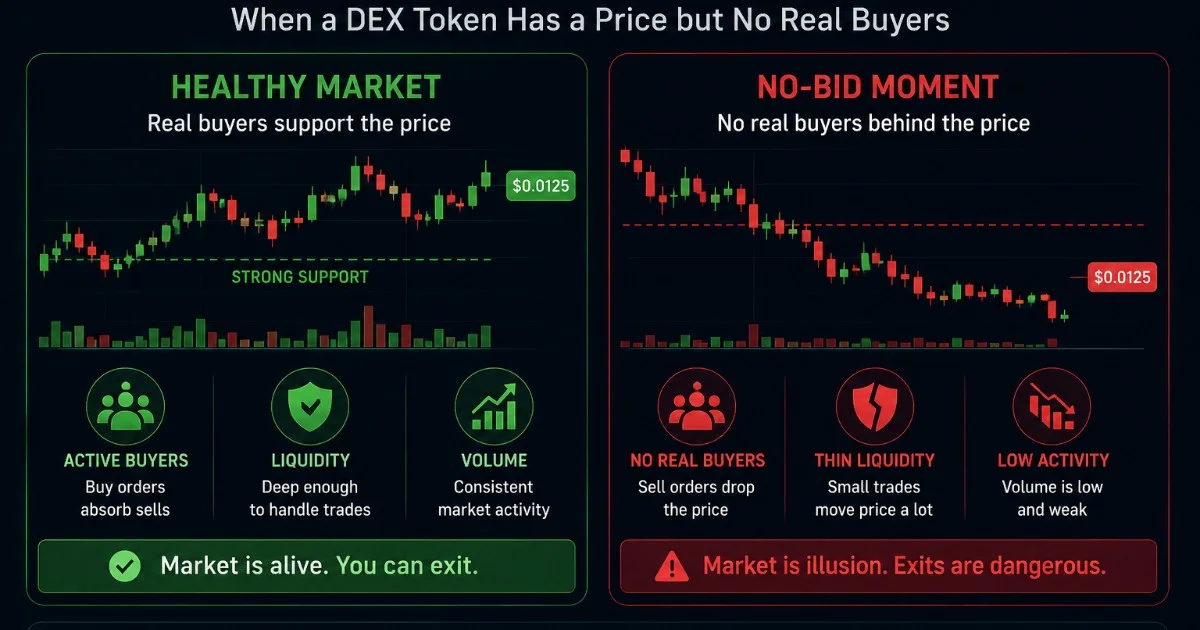
The no bid moment happens when there is a visible price but little or no meaningful demand. It is the point where sellers may still want to exit, but buyers are no longer willing to absorb the supply.
For traders, this is a critical warning sign. A token does not need to crash to zero to become risky. It only needs to lose the buyer support that makes exits possible.
What Is the No Bid Moment?
The no bid moment is the stage where a token technically trades, but demand becomes too weak to support normal selling.
In a healthy market, buyers and sellers constantly interact. Buyers step in when price drops. Sellers take profit when price rises. This creates a living market with tension, reaction, and liquidity.
In a no bid market, that balance disappears. Sellers remain, but buyers fade. Price may still move, but the movements become fragile. A small sell can create a large drop because there are not enough buyers waiting on the other side.
On DEX charts, this can look confusing. The token may still print candles, but those candles may not represent healthy trading interest.
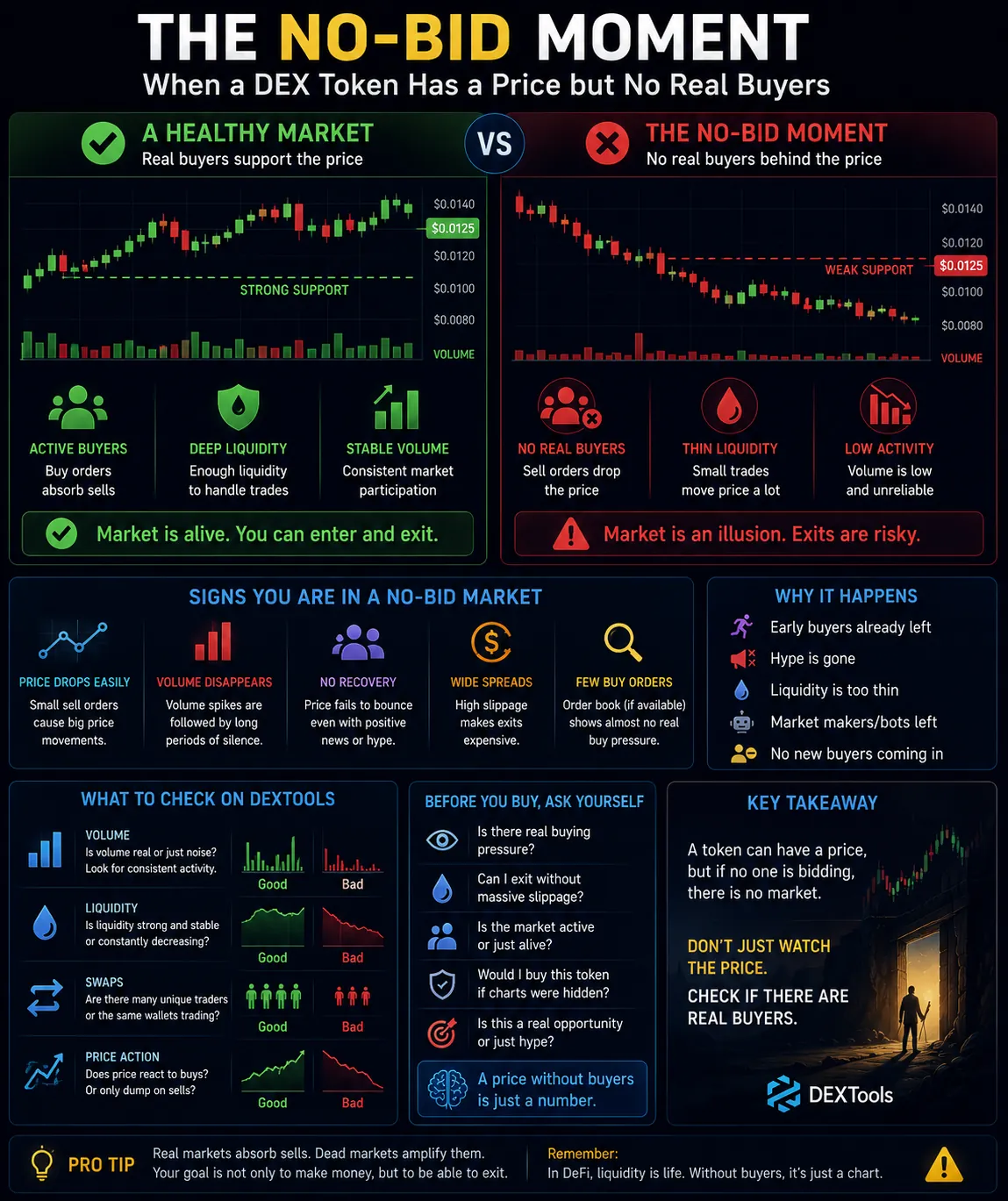
Why a Live Price Can Be Misleading
Many traders assume that if a token has a live price, it has a real market. That is not always true.
On decentralized exchanges, a token price can continue to exist as long as there is a pool and some trading activity. But that does not mean the market is strong. A token can show a price while liquidity is thin, volume is weak, and buyer demand is almost gone.
This is why price alone is not enough. Traders need to look at volume, swaps, liquidity, holder behavior, and market response.
DEXTools can help traders compare these signals instead of relying only on the chart.
Signs of a No Bid Market
One clear sign is weak volume after a strong decline. If price falls and buyers do not return, the market may be losing demand.
Another sign is large price movement from small sells. If a modest sell damages the chart heavily, the pool may not have enough depth or buyer support.
A third warning sign is a lack of recovery after bullish activity. If a token gets attention, news, or community promotion but price barely reacts, the market may be tired.
Traders should also watch liquidity. If liquidity is shrinking while price remains visible, exits may become more difficult.
Why the No Bid Moment Is Dangerous
The no bid moment is dangerous because it creates an illusion of exit potential.
A trader may look at the chart and believe they can still sell near the displayed price. But if buyer demand is weak, the actual exit may be much worse than expected. Slippage can increase. Price impact can become severe. A position that looks liquid on screen may be difficult to close in practice.
This is especially risky in small tokens, memecoins, and pairs with low pool depth.
How Traders Can Avoid the Trap
Before entering a token, traders should ask a simple question.
If I need to sell, who is likely to buy?
That question changes the way traders look at a chart. Instead of focusing only on upside, they start thinking about exit quality. They check whether buyers are still active, whether volume is organic, whether liquidity is stable, and whether the market reacts to selling pressure.
A good market does not only move up. It also absorbs pressure.
Final Thoughts
The no bid moment is the point where a token still appears tradable, but the real buyer base has weakened or disappeared.
In DeFi, visible price is not the same as real demand. A token can look alive while becoming increasingly difficult to exit.
Smart DEX traders do not only ask, "What is the price?"
They ask, "Is there still a real buyer on the other side?"
That question can help traders avoid markets that are alive on the chart but empty underneath.
Holder Inflation: Why More Wallets Does Not Always Mean More Believers Median Trade Size vs Trade Count: Why Small Swaps Can Inflate DEX Activity Exit Liquidity Mapping: Who Might Sell Into You Before You Buy? Apparent Liquidity vs Executable Liquidity: Why a Large Pool Can Still Give You a Bad EntryFrequently Asked Questions
Q: Is a DEX token with a price but no buyers still valuable?
A: A token's value is often tied to its utility and market demand. Without real buyers, the listed price may not reflect actual market sentiment or liquidity.
Q: Can a DEX token still gain buyers if it has no real buyers currently?
A: Yes, market conditions, project developments, or increased awareness can attract buyers over time. However, this is not guaranteed and depends on various factors.
Q: What does it mean if a DEX token is 'still' listed but has no real buyers?
A: It typically means the token has been deployed on a decentralized exchange, but there is insufficient demand to create active trading or price discovery based on actual transactions.
Q: Are there risks to holding a DEX token that 'still' has no real buyers?
A: Risks include illiquidity, potential for significant price drops if any selling occurs, and difficulty in exiting the position. The listed price may be largely theoretical.
Q: How can I assess if a DEX token 'still' has potential buyers despite current low demand?
A: Evaluate the project's fundamentals, development roadmap, community engagement, and real-world utility. These factors can indicate future interest, but market demand remains unpredictable.