Exchange Inflows vs Outflows: What They Really Mean
— By AliceOnChain in Tutorials

Tracking asset movements between private wallets and centralized exchanges is a cornerstone of on-chain analysis. Discover how exchange inflows and outflows signal shifts in liquidity, volatility, and market sentiment.
Exchange Inflows vs Outflows: What They Really Mean
In traditional finance, tracking the exact movement of capital behind closed doors is nearly impossible for the average investor. You see the price tick up or down on a screen, but the structural mechanics remain hidden. Blockchains change this dynamic entirely. Every transaction, from a micro-swap to a multi-million-dollar institutional transfer, is recorded on a public ledger.
For traders transitioning from basic technical analysis to advanced on-chain strategies, understanding the macro-flow of assets is crucial. Specifically, monitoring exchange inflows outflows provides a direct window into supply elasticity and shifting market psychology.
When millions of dollars in crypto move from a private, self-custodial wallet to a centralized exchange (CEX), it sends a completely different structural signal than when those same assets are pulled off an exchange into cold storage. This guide breaks down how to interpret these data points, analyze their relationship with price action, and utilize DEXTools to bridge the gap between centralized flows and decentralized liquidity.
The Core Mechanics of On-Chain Flows
To accurately read market sentiment, we must first define what these metrics represent on a mechanical level. On-chain analytics platforms monitor the known, tagged wallets of centralized exchanges (such as Binance, Coinbase, or Kraken) to calculate net capital movement.
Understanding Exchange Inflows
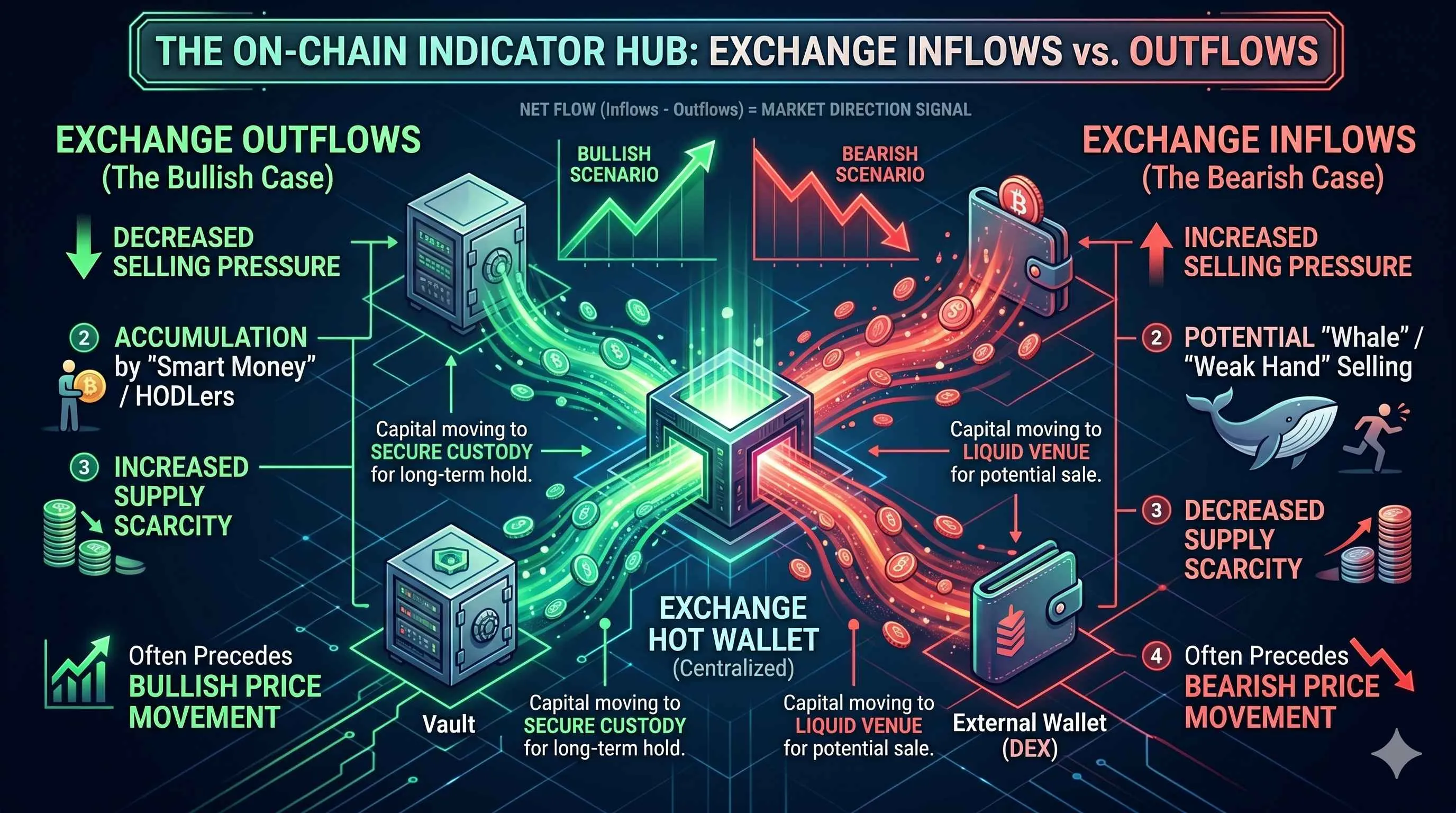
An exchange inflow occurs when an asset moves from an external address into an exchange-controlled wallet.
Because centralized platforms are the primary venues for converting crypto into fiat or alternate digital assets, large inflows historically correlate with an intent to sell. When large-scale holders, often referred to as whales, move tokens onto an exchange, they increase the immediate circulating supply available on order books. If this supply outpaces current demand, it can exert downward pressure on price.
Understanding Exchange Outflows
Conversely, an exchange outflow represents the migration of tokens away from exchange wallets into private custody or smart contracts.
This behavior typically reflects an accumulation phase. When market participants withdraw their assets to cold storage, they effectively remove supply from the immediate market. This contraction in liquid supply means that if buying pressure remains constant or increases, price may appreciate more rapidly due to scarcity.
Decoding Market Signals: The Inflow/Outflow Framework
Interpreting exchange inflows outflows is rarely as simple as assuming "inflows mean sell" and "outflows mean buy." Context dictates the validity of the signal. To avoid false positives, advanced traders synthesize flow data with specific market indicators.
Volatility Management and Liquidity Clues
A sudden spike in inflows during a period of low volatility often acts as a leading indicator of upcoming price action. It suggests that large holders are positioning themselves for liquidity. If a token has been consolidating tightly at a known resistance level and exchange inflows spike sharply, it may indicate that distribution is occurring, capping potential upside.
Price Action and RSI Divergence
On-chain flows gain significant analytical weight when paired with technical indicators like the Relative Strength Index (RSI). For instance:
Bearish Divergence Scenario: If a token's price hits a new local high while the RSI displays a lower high (a standard bearish divergence), a concurrent spike in exchange inflows adds probabilistic weight to a potential trend reversal. It signals that whales are actively taking advantage of the high prices to deposit and potentially liquidate holdings.
Bullish Accumulation Scenario: If price is testing a major support level, the RSI indicates an oversold condition, and exchange outflows are escalating significantly, it suggests strong structural buying. Market participants are absorbing the available supply and moving it offline, reinforcing the validity of the support floor.
Whale Activity and Holder Distribution
The behavior of retail traders rarely shifts macro market structures. Instead, analysts focus on concentration—specifically, the distribution of holders and the actions of high-net-worth entities.
When assessing a token ecosystem, tracking the concentration of supply across top wallets is an essential risk management step. If a small percentage of addresses controls a massive portion of the liquid supply, any localized inflow from those specific addresses into an exchange amplifies the risk of sudden volatility.
Tracking these movements requires looking at both centralized exchanges and decentralized protocols, as whales frequently shift assets between both environments depending on where the deepest liquidity resides.
Bridging Centralized Flows with DeFi: The DEXTools Approach
While macro exchange inflows outflows track the behavior of centralized entities, the modern crypto landscape is deeply interconnected with decentralized finance (DeFi). Capital moving out of a centralized exchange often directly enters the DeFi ecosystem to chase yield, provide liquidity, or accumulate early-stage assets.
Traders can leverage the DEXTools ecosystem to monitor how these capital shifts impact decentralized markets in real time.
1. Monitoring Liquidity Tracking and Pair Explorer
When outflows from centralized exchanges occur, a portion of that capital frequently migrates to decentralized exchanges (DEXs) like Uniswap or PancakeSwap. By utilizing the DEXTools Pair Explorer, you can actively observe whether this capital is entering specific liquidity pools.
An increase in a pair's Total Value Locked (TVL) improves depth, reducing slippage for traders and creating a healthier environment for sustained price action.
2. Deep Dive with Holder Analysis and Bubblemaps
To understand if a decentralized asset is subject to heavy whale concentration, the Holder Analysis tool on DEXTools is invaluable. It maps out the distribution of a token's supply, allowing you to see if a few wallets dominate the asset.
Integrating this with Bubblemaps provides a visual representation of wallet clusters. This helps identify if seemingly separate wallets are actually linked, giving you a clearer picture of whether a sudden movement of funds could mimic an exchange inflow event on a decentralized scale.
3. Tracking Smart Money via Top Traders
Just as CEX analysts track whale wallets, DeFi traders can use the Top Traders feature on DEXTools to audit the most profitable addresses interacting with a specific pool. If the highest-performing wallets are consistently accumulating an asset and holding, it mirrors the macro "outflow to cold storage" sentiment within a decentralized framework.
4. Precision Execution with Price Alerts
On-chain flows tell you when volatility is brewing; technical structures tell you where it will likely resolve. By setting up customized Price Alerts on DEXTools charts near critical support and resistance lines, you ensure that you are notified the moment macro on-chain distribution or accumulation forces a breakout or breakdown.
A Step-by-Step Tutorial Framework for Analyzing Asset Flows
To integrate exchange flow analysis into an active trading workflow, consider the following probabilistic framework:
Step 1: Establish the Macro Trend
Review aggregate exchange flow data across major data providers to determine if the broader market is in a net-inflow or net-outflow regime. Net-outflows suggest a broader environment of accumulation, while sustained net-inflows dictate caution.
Step 2: Validate Against Volume and Volatility
Look for anomalies. A baseline level of inflows is normal market noise. You are looking for standard deviation spikes—instances where inflows or outflows double or triple their 30-day moving average. Ensure this volume aligns with structural changes on the price chart.
Step 3: Analyze the DEX Ecosystem
If macro data shows high outflows for assets like Ethereum or wrapped stablecoins, open DEXTools to see where that liquidity is landing. Are stablecoin reserves climbing in major decentralized pools? If stablecoins are flooding into DEX pools, it often signals an unexpressed intent to buy native DeFi tokens.
Step 4: Map Localized Holder Risk
Before entering a position based on positive macro flows, run the token contract through DEXTools' Holder Analysis. Ensure that the decentralization of the token's supply protects you from a single whale reversing the macro trend by dumping localized holdings back onto an exchange.
Conclusion
Tracking exchange inflows outflows offers a highly systematic method for reading market sentiment, managing volatility, and understanding supply dynamics. Large-scale inflows often serve as a warning sign of potential distribution, while consistent outflows highlight institutional or retail accumulation.
However, on-chain metrics should never be viewed in isolation. Successful market participants treat inflows and outflows as weight-of-evidence tools. By pairing macro exchange data with technical indicators, localized volume analysis, and decentralized tools like DEXTools' Pair Explorer and Holder Analysis, you can build a comprehensive, probabilistic view of market structure that protects your capital across both centralized and decentralized landscapes.
CEX Deposit Pressure: How Exchange Inflows Can Signal Future SellingDEX Net Inflows vs. Trading Volume: Capital Rotation?
Is On-Chain Data Replacing Technical Analysis in Crypto?
DEXTools Pair Explorer for Early Liquidity Signals
Disclaimer: This article is for informational purposes only and does not constitute investment advice, financial advice, trading advice, or any other kind of advice. DEXTools does not recommend buying, selling, or holding any cryptocurrency or token. Users should conduct their own research and consult with a qualified financial advisor before making any investment decisions. Cryptocurrency investments are volatile and high-risk. DEXTools is not responsible for any losses incurred.