How to Bridge ETH to Optimism Safely in 2026: Full Guide
— By Tony Rabbit in Tutorials

Learn how to bridge ETH to Optimism safely in 2026: native bridge vs Across, Hop, and Stargate, plus fees, withdrawal times, and fault proofs explained.
To bridge ETH to Optimism, users typically move their Ethereum from the mainnet to the Optimism Layer 2 network. This process unlocks access to Optimism's economy, where transaction costs are significantly lower. Choosing the right bridging method is crucial for future interoperability within the Superchain ecosystem, which includes chains like Base and World Chain.
Bridging ETH to Optimism is one of the most common moves in decentralized finance (DeFi) because it unlocks a full Layer 2 economy where transactions cost cents instead of dollars. The question is no longer whether to bridge, but which route to take, how long withdrawals really take, and whether the new Superchain interoperability layer changes the calculus in 2026.
Optimism is no longer the only chain on the OP Stack. Base, World Chain, Unichain, and a growing list of rollups now share the same fault-proof system and, increasingly, the same bridging fabric. That means the decision you make when you bridge ETH today affects how easily that ETH can flow across the entire Superchain tomorrow. Picking the right path matters more than ever.
This guide ranks every major bridge route from the Optimism Native Bridge to Across, Hop, Stargate, Squid, deBridge, Synapse, and Circle's CCTP. You will learn the exact MetaMask setup, the seven day challenge period explained through fault proofs, how Across compresses withdrawals to roughly ten seconds, fee comparison tables, security models, and a clean checklist for moving your ETH safely in 2026.
What Is Bridging ETH to Optimism?
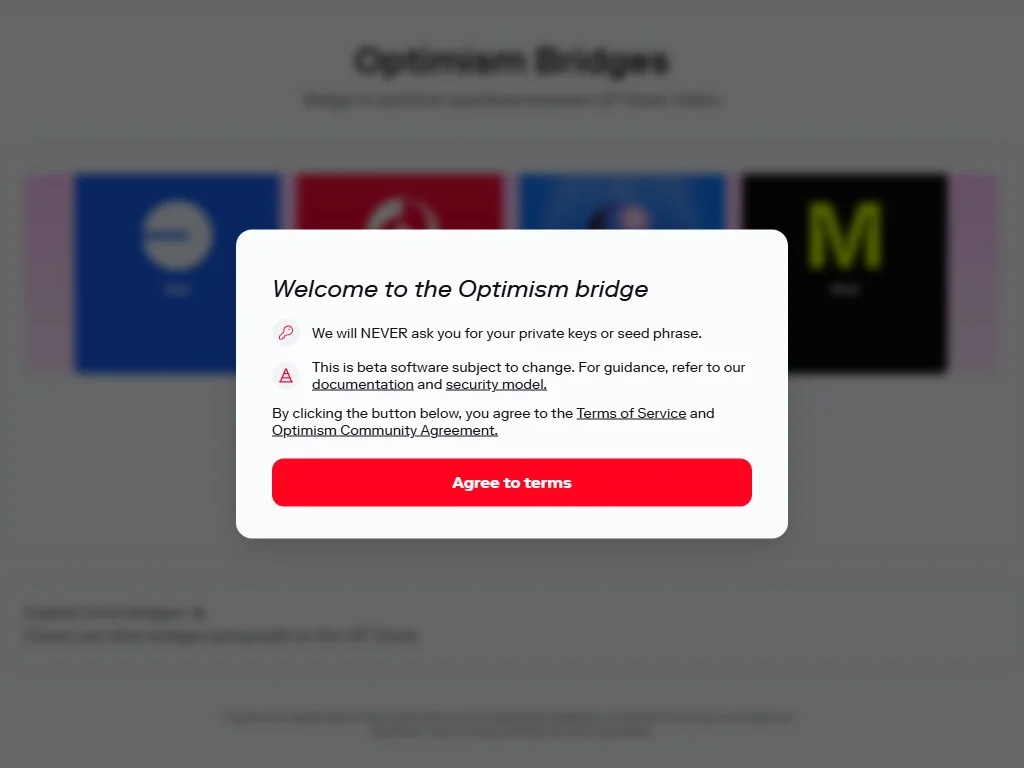
Bridging ETH to Optimism is the process of moving Ethereum's native asset from Ethereum mainnet (Layer 1) to Optimism (Layer 2) so it can be used for gas, swaps, and DeFi activity on OP Mainnet. The bridge either locks ETH on Layer 1 and mints a 1:1 representation on Layer 2 (canonical model), or uses fast relayers who front the ETH on Optimism and reclaim it from Ethereum later (intent-based model). Both models result in spendable ETH on Optimism that pays gas natively.
Because ETH is the native gas token on Optimism, the moment your bridged ETH arrives, you can immediately interact with Velodrome, Sonne Finance, Uniswap V4, Aave V3, Synthetix, Worldcoin, or any other Optimism dApp without first acquiring a separate gas token. That single fact makes ETH the simplest asset to bridge onto an OP Stack rollup.
Quick answer
- Use the Optimism Native Bridge when security matters most and you can wait seven days for withdrawals.
- Use Across when you need fast withdrawals (roughly ten seconds) and accept a small relayer fee.
- Use CCTP if you are bridging USDC instead of ETH for native, slippage-free transfers.
- Always confirm your wallet has Optimism added (chain ID
10) before initiating any transfer.
Why Bridge ETH to Optimism in 2026?
Optimism is the second largest Ethereum Layer 2 by total value locked and the original OP Stack rollup. Its DeFi economy is mature, deep, and increasingly interoperable with the rest of the Superchain. Bridging ETH there gives you access to lending markets, decentralized exchanges, perpetuals platforms, and identity protocols that would cost ten to fifty times more in gas if accessed directly on Ethereum mainnet.
The most active Optimism dApps include Velodrome (the canonical ve(3,3) DEX of the OP ecosystem), Sonne Finance (Compound-style lending fork tailored for OP), Aave V3 (one of the largest deposit pools outside mainnet), Synthetix (perpetuals and synthetic assets, originally an Optimism native), and Worldcoin (the identity protocol that anchors World ID on World Chain, an OP Stack rollup). Bridging ETH is the on-ramp to all of them.
Top Optimism dApps That Need Bridged ETH
Supply ETH for yield or borrow stablecoins against it, with one of the deepest pools outside mainnet.
Native perpetuals and synthetic asset markets, originally launched on Optimism.
A Compound v2 fork optimised for OP, with kinked rate models and OP incentives.
Identity protocol whose World Chain rollup sits inside the OP Superchain.
Synthetix-powered perps frontends with leverage, stop losses, and OP staking rewards.
A Short History of the Optimism Bridge
Optimism launched the OP Mainnet in December 2021 with a canonical bridge that locked ETH on Layer 1 and minted Layer 2 ETH at a 1:1 ratio. From day one, withdrawals took seven days because the system relied on a one week challenge window during which any honest verifier could submit a fraud proof contesting an invalid state transition. In practice, the proof system was not yet live, so the seven days served as a safety buffer rather than an active dispute window.
The most important change in the bridge's history landed in mid 2024 when Optimism activated permissionless fault proofs on OP Mainnet. For the first time, the seven day window became a real dispute period where anyone, not just whitelisted operators, could challenge an invalid output root. This moved Optimism closer to the trust minimised ideal of an Ethereum rollup and made the canonical bridge meaningfully safer.
Around the same time, the Superchain vision crystallised. Base (Coinbase), World Chain (Worldcoin), Unichain (Uniswap), Mode, Zora, and other OP Stack rollups began sharing the same bridging contracts, security stack, and eventually a unified interoperability layer. That meant ETH bridged into Optimism could increasingly move sideways into Base or Unichain without round tripping back to Ethereum mainnet.
How Bridging ETH to Optimism Actually Works
There are two fundamental bridge architectures in 2026, and every route you can pick today is some variation of one of them. Understanding the difference is the single biggest unlock for picking the right bridge.
The first model is the canonical lock-and-mint bridge. When you deposit ETH on Ethereum, the Optimism Portal contract holds it. The OP Stack sequencer then credits the same amount of ETH to your address on Optimism. Deposits finalise in roughly one to three minutes because they only need to be observed and processed by the L2 sequencer. Withdrawals, however, require proving the L2 transaction back on L1 and then waiting out the seven day challenge window before the ETH can be claimed on Ethereum.
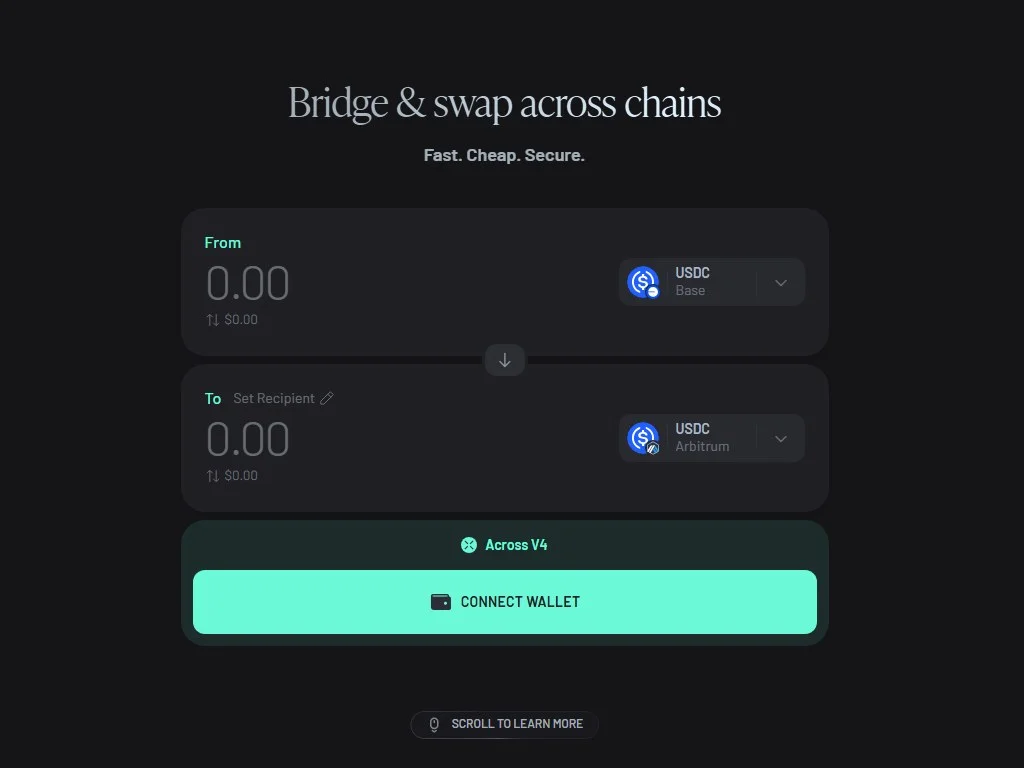
The second model is the intent-based or liquidity bridge. Protocols like Across, Hop, Stargate, and Squid pre-fund liquidity pools on both Ethereum and Optimism. When you "bridge" with one of these, you are really paying a liquidity provider on Optimism to release their ETH to you immediately, while a relayer separately settles the equivalent ETH on Ethereum. The user experience is fast (roughly ten seconds for Across) because no one is waiting for the canonical seven day clock.
Canonical vs Intent-Based Bridges
- Deposits land in 1 to 3 minutes
- Withdrawals take 7 days
- Secured by Ethereum L1 only
- No liquidity tax, but high gas
- Best for very large transfers
- Deposits land in ~10 seconds
- Withdrawals also seconds to minutes
- Secured by relayer bonds + L1 settlement
- Small relayer fee replaces wait time
- Best for everyday DeFi moves
Bridge Options Ranked: The 2026 Shortlist
Not every bridge is equal. The list below ranks every major route by the practical combination of security, speed, fees, and ETH liquidity depth on Optimism. Use it as a decision matrix rather than a strict ranking.
1. Optimism Native Bridge (Canonical)
The official bridge maintained by the Optimism Foundation. Deposits to Optimism are nearly instant (sequencer-side credit in roughly one to three minutes). Withdrawals require a two step process: a withdrawal initiation on L2, a seven day challenge period, and then a final claim transaction on L1. Security is maximal because the only trust assumption is Ethereum itself plus the now-active fault proof system. Use it for very large transfers where the seven day wait is acceptable and trust assumptions need to be minimised.
2. Across Protocol (Intent-Based, Fastest)
Across uses an intent-based model where relayers compete to fill your bridge order on Optimism instantly, then claim back from Ethereum after the canonical messaging finalises. Typical fill times are around ten seconds. Fees scale with the asset and amount but are usually a few basis points for ETH. Across is the de facto standard for fast, cheap ETH withdrawals from Optimism and has become the largest intent bridge by volume.
3. Hop Protocol
Hop pioneered the "bonder" model: independent operators front liquidity on the destination chain and reclaim it from the source chain after canonical messaging settles. It supports ETH and major stablecoins with native pools on Optimism. Hop is reliable, battle tested, and still one of the cleanest UX experiences for moving ETH between Ethereum, Optimism, Arbitrum, and other EVM L2s.
4. Stargate (LayerZero)
Stargate runs on the LayerZero messaging layer and offers unified liquidity pools so bridges go directly from native asset to native asset, with no wrapped intermediary token. ETH transfers from Ethereum to Optimism settle in roughly one to three minutes. Stargate is especially attractive for users already operating on multiple LayerZero chains and for transfers that need to land on less common destinations.
5. Squid Router (Axelar)
Squid is the swap-and-bridge router built on Axelar's general message passing layer. It is the right tool when you want to send ETH from Ethereum and receive a different asset (or the same asset on a non-EVM chain). Squid uses Axelar validators for security and integrates with Coral Network and several aggregators.
6. deBridge
deBridge focuses on intent-based, validator-secured liquidity transfers and zero-slippage swaps across many chains, including Solana. It is competitive for ETH to Optimism transfers and especially strong when bridging from Optimism back into non-EVM ecosystems.
7. Synapse Protocol
Synapse uses a canonical bridge plus a stable swap layer to offer fast finality and low slippage on common pairs. It is mature, multi-chain, and historically one of the highest volume bridges between Ethereum and Optimism.
8. Circle CCTP (For USDC Only)
The Cross-Chain Transfer Protocol is Circle's own native USDC bridge. It burns USDC on Ethereum and mints fresh USDC on Optimism (or any supported chain), eliminating the liquidity pool tax entirely. If you are bridging USDC rather than ETH, CCTP is the cleanest and safest route. It does not transfer ETH, but it is included here because many users bridge ETH and USDC in parallel.
Bridge Fee & Speed Comparison Table
Step-By-Step: Bridging ETH With the Optimism Native Bridge
The native bridge is the highest security route. Use it when you are moving a meaningful amount of ETH and you can wait out the seven day window on withdrawals. Deposits going INTO Optimism remain fast, so the seven day rule only applies to withdrawals back to Ethereum.
Deposit ETH from Ethereum to Optimism
- Open
app.optimism.io/bridgein a hardware-wallet protected browser session. - Connect your wallet (MetaMask, Rabby, Frame, Ledger Live) and switch to Ethereum mainnet.
- Select ETH as the asset, enter the amount, and confirm the destination address is your own Optimism address.
- Review the quoted gas, accept the bridge terms, and sign the deposit transaction.
- Wait for the Ethereum transaction to confirm (one to two blocks).
- Switch your wallet to Optimism (chain ID
10) and watch the balance arrive in roughly one to three minutes.
Withdraw ETH from Optimism to Ethereum (slow path)
- Initiate the withdrawal on the same bridge UI from the Optimism side.
- Sign the L2 burn transaction. This costs roughly $0.05 in gas.
- Wait roughly one hour for the L2 state root to be published on L1.
- Sign a prove transaction on Ethereum (this opens the seven day challenge window).
- Wait the full seven days for the dispute period to elapse.
- Return to the bridge, click finalise, and sign the L1 claim transaction to receive your ETH.
Step-By-Step: Bridging ETH With Across (Fast Withdrawals)
For 95% of real users moving ETH off Optimism, the seven day wait is too long. Across is the de facto solution. It uses intent based settlement where competing relayers race to fill your bridge order on the destination chain, then reclaim from the source chain after canonical messaging settles. The user experience is roughly ten seconds end to end.
Bridge ETH via Across in ~10 seconds
- Open
app.across.toand connect your wallet. - Choose source chain (Optimism or Ethereum) and destination chain.
- Select ETH as the asset and enter the amount.
- Review the quoted relayer fee (typically a few basis points) and the estimated fill time.
- Sign the deposit transaction on the source chain.
- Watch a relayer fill the order on the destination chain in roughly ten seconds.
Across is also the recommended path when you need to consolidate ETH from multiple OP Stack chains (Base, World Chain, Unichain) back to Ethereum or to another L2, because relayers operate across all of them.
Adding Optimism to MetaMask (Chain ID 10)
Before any bridge run, confirm that your wallet can actually see Optimism. Most modern wallets auto-detect the chain when a bridge UI prompts the switch, but knowing the parameters by heart is essential if anything goes wrong.
Optimism network parameters
- Network name: Optimism (OP Mainnet)
- Chain ID:
10 - RPC URL:
https://mainnet.optimism.io - Currency symbol: ETH
- Block explorer:
https://optimistic.etherscan.io
If your wallet does not auto-add Optimism, head into Settings, Networks, Add a network, and paste the parameters above manually. The network name does not affect functionality, but using the exact chain ID is mandatory because that is how every dApp identifies the chain.
Gas Considerations: You Need ETH on Optimism
On Optimism, ETH is the native gas asset, the same way it is on Ethereum mainnet. That means if you bridge USDC, USDT, or any other ERC-20 to Optimism without also having a small amount of ETH on Optimism, you will not be able to send a single transaction. The L2 will accept the asset but reject any transaction attempt because there is no ETH to pay gas with.
The rule of thumb is to keep roughly $5 to $10 worth of ETH on Optimism at all times as a gas buffer. That is enough for hundreds of swaps because Optimism transactions cost a fraction of a cent each. If you are bridging stablecoins, bridge a small amount of ETH first or use a bridge that supports a built-in gas drop, which front-funds a few cents of ETH on the destination for you.
For deeper context on how gas pricing works under the hood, see our guide to gas price and gwei on Ethereum. Optimism inherits the same EIP-1559 mechanics but with much lower L2 fees.
The Seven Day Challenge Period Explained
The seven day withdrawal window on the canonical bridge is the single most misunderstood feature of Optimism. Many users think it is arbitrary friction. It is not. It is the dispute window that gives Optimism's fault proof system time to detect and challenge invalid state transitions before withdrawals finalise on Ethereum.
Here is the mechanism in plain terms. Every batch of Optimism transactions is summarised into an output root that is posted on Ethereum. That output root claims, "at block N on Optimism, the state was X." Once posted, the seven day clock starts. During that window, any honest verifier can run the same computation locally and, if they get a different answer, submit a fault proof. The proof triggers an interactive dispute game on Ethereum that ultimately decides which output root is correct. If the disputed root loses, the corresponding withdrawals are rejected.
If no one challenges within seven days, the output root is considered final and withdrawals associated with it become claimable. This is why withdrawals require both an initial prove transaction (which anchors them to a specific output root) and a final finalise transaction (which can only succeed after the window elapses).
Fault Proofs Activation in 2024
For most of Optimism's history, the seven day window existed without an actual functioning fault proof system behind it. The seven days were a placeholder safety buffer. In mid 2024, that changed: permissionless fault proofs went live on OP Mainnet. From that point forward, the seven day clock became a real, enforceable dispute window where any participant could challenge invalid state transitions.
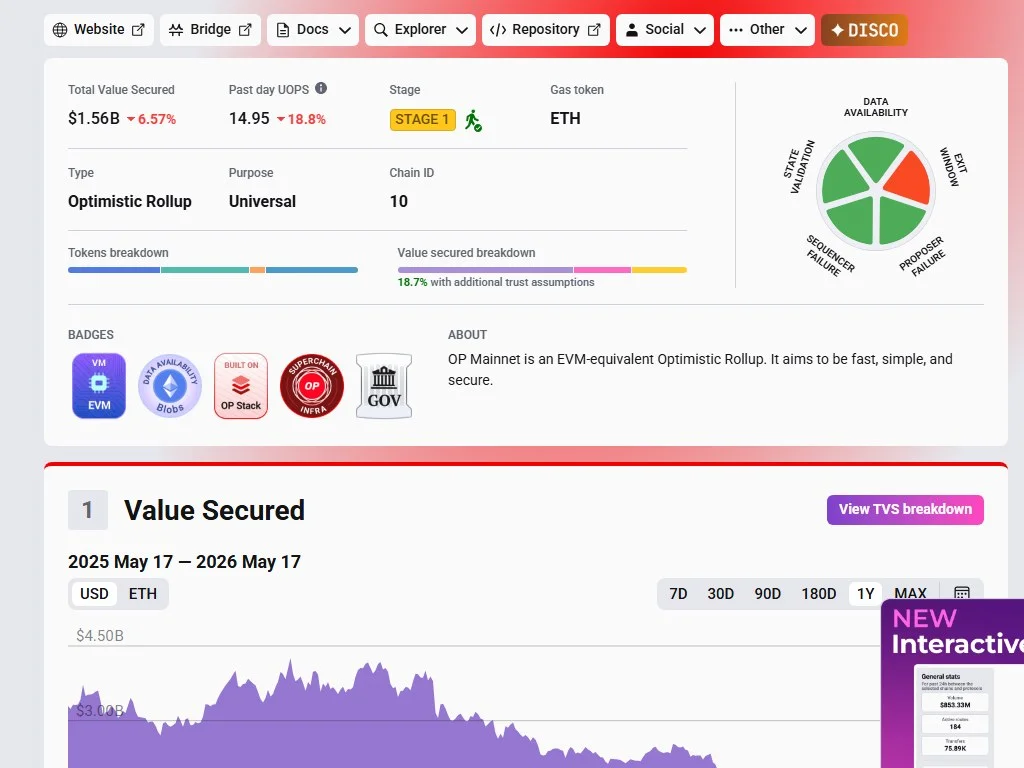
This activation pushed Optimism into what the L2BEAT classification calls a Stage 1 rollup, meaning it has a functioning trust-minimised fraud proof system with limited training-wheel controls. The remaining centralisation surface (such as sequencer ordering and certain emergency multisigs) is now the primary roadmap item for reaching Stage 2.
For end users, fault proofs do not change the bridging UX much. Deposits still arrive in minutes, withdrawals still take seven days. What changed is the underlying security guarantee: the seven days are now a real check, not just a delay.
Withdrawal Acceleration: How Across and Hop Skip the Seven Days
If the canonical bridge enforces seven days, how can Across, Hop, and Stargate move ETH from Optimism back to Ethereum in seconds? The trick is that they do not actually wait. They use third party relayers who are willing to advance you the ETH on Ethereum immediately, in exchange for a small fee, and then reclaim the canonical withdrawal seven days later for themselves.
From your wallet's perspective, you get ETH on Ethereum in seconds. From the relayer's perspective, they are running a working capital business: lock up ETH on Ethereum, get paid a small fee for the fast service, wait seven days for the canonical withdrawal to release back to them, recycle the capital. It is the same financial primitive as factoring or invoice discounting in traditional finance.
The security tradeoff is that you now trust the relayer (or, more precisely, the bonding and dispute system that backs them) for the duration of the bridge. That is a meaningful additional assumption versus the pure canonical path, but in practice the largest intent bridges have years of clean track record and meaningful capital at risk in their bond pools.
Finality Times and Security Models Compared
The right way to compare bridges is to look at finality (when can the destination ETH be considered irreversible) and the trust model (who has to behave honestly for the bridge to work). The canonical bridge finalises on Ethereum, so its security is identical to Ethereum's own. Intent bridges finalise as soon as the relayer fills the order on the destination chain, but their security is bounded by the bond and dispute system the bridge uses.
For small to medium ETH transfers (think under $50k), intent based bridges are almost always the right tool. The fee is tiny compared to the time saved, and the trust model is well within acceptable limits. For very large transfers, especially institutional flows, the canonical bridge is the conservative default because it inherits Ethereum's own security with no third party in the loop.
A useful mental model: canonical finality answers "when is this transaction irreversible on Ethereum itself?" Intent bridge finality answers "when does this relayer-funded transaction become an obligation that is backed by economic bonds and dispute mechanisms?" Both are valid notions of finality, but they assume different things. Canonical assumes only Ethereum. Intent assumes Ethereum plus the bridge's own bonding and adjudication system. Once you internalise that distinction, picking a bridge becomes a simple question of how much you value pure base layer trust versus everyday user experience.
OP Stack Ecosystem and the Superchain
The OP Stack is no longer just Optimism. Base (Coinbase), World Chain (Worldcoin), Unichain (Uniswap), Mode, Zora, Lisk, and dozens more rollups all run the same codebase and share the same security and governance lineage. Together they form the Superchain, an interoperable cluster of OP Stack L2s.
For bridging, the practical implication is that the same bridge providers (Across, Hop, Stargate, deBridge) typically support every Superchain rollup. ETH bridged into Optimism today can move sideways into Base or Unichain tomorrow using the same bridge UIs, often with deeper liquidity than a typical isolated L2 enjoys.
Superchain Interop Preview
The Superchain interoperability upgrade is rolling out across OP Stack chains. The headline feature is native message passing between Superchain rollups without round tripping through Ethereum. In practice, that means ETH moves from Optimism to Base or Unichain in roughly one block instead of needing a third party bridge. End users will continue to see bridge UIs, but the underlying messaging layer becomes shared infrastructure rather than a separate trust assumption per route.
ETH Bridge vs USDC CCTP: When To Use Which
Not every cross chain transfer should be done with the same primitive. If you are bridging USDC rather than ETH, Circle's CCTP is the cleanest path: it burns USDC on the source chain and mints fresh USDC on the destination, so there is no liquidity pool spread and no wrapped asset risk. If you are bridging ETH, use one of the intent bridges (Across or Hop for everyday transfers, the canonical bridge for very large amounts).
Many advanced users bridge both: ETH via Across for gas and DeFi participation, plus USDC via CCTP for stable-denominated working capital. That combination minimises both speed cost and slippage cost while keeping trust assumptions clean.
For stablecoin background, see our guide to Tether USDT and the broader stablecoin landscape. If you are evaluating which stablecoin to bridge alongside ETH, that context matters.
Common Errors and How To Fix Them
Bridging is mature enough in 2026 that most errors are user-side, not protocol-side. The list below covers the issues we see most often.
Top bridge failures and fixes
Your wallet is probably still pointed at Ethereum. Switch to chain ID 10 and refresh. If still missing, paste your address into optimistic.etherscan.io and confirm the balance.
You bridged a token but not ETH. Bridge a small amount of ETH via Across to cover Optimism gas, or use a bridge that supports gas drop.
Check whether you have signed both the prove and finalise transactions. The first opens the seven day window. The second must be sent after the window elapses.
Your wallet is out of sync. See our guide on nonce errors in crypto for a clean reset.
Always navigate to bridges by typing the URL or using a verified bookmark. Phishing clones of Across, Hop, and the Optimism bridge are constant.
Security Checklist Before Bridging
The bridge is only as safe as the practices around it. Run through this checklist every single time, especially for transfers above $10k.
Pre bridge safety checklist
- Verify the bridge URL letter by letter (no homoglyph attacks).
- Confirm chain ID 10 on the destination side.
- Send a small test transaction first if it is your first time using a route.
- Keep a small ETH gas buffer on Optimism at all times.
- Use a hardware wallet for any transfer above your loss tolerance threshold.
- Read transaction simulation output before signing. See our explainer on transaction simulation.
- If you reuse the same Optimism address across many dApps, follow our wallet security tips.
- Use a fresh burner wallet for unknown bridge frontends, as covered in our burner wallet guide.
- Beware of fake "support" DMs after a bridge. Address poisoning is rampant, see our address poisoning guide.
Pros and Cons of Bridging ETH to Optimism
- Cheap transactions (often under $0.01)
- Direct access to Velodrome, Aave, Synthetix
- Active fault proof system since 2024
- Multiple competing bridge providers
- Native ETH gas token, no extra asset needed
- Superchain interop unlocks cross L2 mobility
- Canonical withdrawals take 7 days
- Ethereum mainnet gas still applies to deposits
- Intent bridges add small relayer fees
- Phishing bridge clones are common
- Sequencer remains a centralised actor (Stage 1)
- USDC needs separate CCTP route for cleanest UX
Frequently Asked Questions
Q Q Q How long does it take to bridge ETH to Optimism?
Deposits from Ethereum to Optimism take roughly one to three minutes on the canonical bridge and about ten seconds on Across. Withdrawals from Optimism back to Ethereum take seven days on the canonical bridge or seconds to minutes on Across, Hop, and Stargate.
Q Q Q Why does the Optimism canonical bridge take seven days for withdrawals?
Optimism uses an optimistic rollup design with a seven day challenge window. During that period, anyone running a verifier can submit a fault proof to dispute an invalid state transition. Since fault proofs went live in 2024, the seven day window is now an active dispute period rather than a placeholder buffer.
Q Q Q Can I avoid the seven day withdrawal wait?
Yes. Use an intent based bridge like Across, Hop, or Stargate. These bridges have relayers who advance ETH to you on Ethereum immediately and reclaim through the canonical bridge themselves seven days later. Typical fast withdrawal times are about ten seconds to two minutes.
Q Q Q How much does it cost to bridge ETH to Optimism?
The cost is Ethereum mainnet gas for the source transaction (typically a few dollars to a few tens of dollars depending on congestion) plus any bridge-specific relayer fee. Across and Hop charge around 0.04 to 0.05 percent of the bridged amount. The Optimism canonical bridge charges no fee beyond gas.
Q Q Q What is Optimism's chain ID?
Optimism's chain ID is 10. The RPC URL is https://mainnet.optimism.io and the native currency is ETH. Most modern wallets recognise Optimism automatically, but you can add it manually using these parameters.
Q Q Q Do I need ETH on Optimism for gas?
Yes. ETH is the native gas token on Optimism, the same as on Ethereum. If you bridge USDC or another token without ETH, your wallet will not be able to send any transactions. Keep a small ETH balance on Optimism, around $5 to $10 worth, as a gas buffer.
Q Q Q What is the Superchain and why does it matter for bridging?
The Superchain is the cluster of OP Stack rollups including Optimism, Base, World Chain, and Unichain. They share the same security stack and, increasingly, a unified interoperability layer. For bridging, this means ETH bridged into Optimism can move sideways into Base or Unichain without round tripping through Ethereum, often using the same bridge UIs.
Q Q Q Should I use the Optimism native bridge or Across?
For deposits going into Optimism, both finish in minutes and the native bridge is fine. For withdrawals back to Ethereum, use Across (or Hop or Stargate) for fast settlement unless you are moving a very large amount and prefer the pure canonical security with the seven day wait.
Q Q Q Is bridging USDC different from bridging ETH?
Yes. For USDC, use Circle's CCTP, which burns USDC on the source chain and mints fresh USDC on the destination with no liquidity pool tax. For ETH, use Across or the canonical bridge. Many advanced users bridge ETH and USDC in parallel using both routes.
Q Q Q Are fault proofs really active on Optimism?
Yes. Permissionless fault proofs went live on OP Mainnet in 2024. The seven day withdrawal window is now an active dispute period where any verifier can challenge an invalid state transition, rather than just a placeholder safety buffer. This moves Optimism into Stage 1 rollup status under common security classifications.
Q Q Q Can I bridge directly from an exchange to Optimism?
Many major exchanges (Coinbase, Binance, Kraken, OKX) now support direct ETH withdrawals to Optimism. If your funds are already on a supporting exchange, that is usually simpler and cheaper than bridging manually. Always select Optimism as the network and double check the destination address.
Q Q Q What if my bridged ETH does not appear on Optimism?
First, make sure your wallet is switched to Optimism (chain ID 10) and refresh. Second, paste your address into optimistic.etherscan.io to confirm the balance on chain. If the deposit transaction is confirmed on Ethereum but the L2 balance has not arrived after 30 minutes, contact the bridge support channel.
Conclusion: Pick the Right Bridge, Move ETH With Confidence
Bridging ETH to Optimism is one of the simplest and most rewarding moves in DeFi. The key in 2026 is choosing the right route for the job. Use the Optimism Native Bridge when security is paramount and you can wait seven days for withdrawals. Use Across for nearly all everyday transfers because it compresses the canonical wait into roughly ten seconds. Use CCTP if you are moving USDC alongside ETH. And keep a small ETH gas buffer on Optimism so you can transact the moment you land.
The activation of fault proofs in 2024 made the canonical seven day window a real security feature rather than a placeholder. The rise of intent based bridges turned the canonical wait into an optional UX choice rather than a hard constraint. And the Superchain interop upgrade is starting to make ETH genuinely portable across Optimism, Base, World Chain, and Unichain without round tripping through Ethereum at all.
Before any bridge run, verify the URL, confirm chain ID 10, send a test transaction if it is your first time on a route, and use a hardware wallet for meaningful amounts. The bridges themselves are mature, but bridge phishing is the single most common attack vector on Layer 2 users. Treat URLs the way you treat seed phrases: with full attention every single time.
Related reading
Disclaimer: This article is for educational purposes only and does not constitute investment, tax, or legal advice. Bridge routes, fees, and withdrawal times can change over time. Always verify the live chain, route, and destination address before moving funds.