Crypto Funding Rate Strategy: The Cash-and-Carry Guide
— By AliceOnChain in Tutorials

An advanced guide to executing delta-neutral cash-and-carry trades in the crypto market by leveraging funding rates, on-chain liquidity, and advanced volume analysis.
Funding Rate Strategy: Cash and Carry on Crypto
The volatile nature of the cryptocurrency market frequently creates structural inefficiencies between spot and derivatives markets. For intermediate traders and decentralized finance (DeFi) participants, navigating these inefficiencies requires moving beyond simple trend-following strategies. One of the most historically reliable institutional frameworks adapted for the digital asset space is the cash-and-carry trade, executed via a systematic funding rate strategy.
By understanding the mechanics of perpetual futures contracts and combining them with deep on-chain data, market participants can identify market states where capital can be deployed under a delta-neutral framework. This guide explores the quantitative mechanics of funding rates, details a step-by-step execution model, and examines how to mitigate structural risks using on-chain tracking tools.
Understanding Perpetual Futures and Funding Rates
Unlike traditional futures contracts that feature a fixed expiration date, perpetual futures (perps) run indefinitely. To prevent the price of the perpetual contract from drifting permanently away from the underlying asset’s actual spot price, derivatives exchanges utilize a mechanism known as the funding rate.
The funding rate is a periodic payment exchanged directly between long and short traders, typically occurring every one to eight hours depending on the platform's architecture.
Positive Funding Rates: When the perpetual contract trades at a premium relative to the spot price, the funding rate turns positive. In this environment, long position holders pay short position holders. This mechanism disincentivizes aggressive buying on leverage and encourages arbitrageurs to open short positions, driving the perp price back down toward the spot price.
Negative Funding Rates: Conversely, when the perpetual contract trades at a discount relative to the spot price, the funding rate turns negative. Here, short position holders pay long position holders, incentivizing buyers to step in and narrow the price gap.
A funding rate strategy capitalizes on prolonged imbalances in market sentiment. During extended bullish periods, funding rates can remain highly positive for days or even weeks as retail leverage builds up, offering a recurring yield to traders willing to take the counter-side of that leverage without directional exposure.
The Mechanics of a Delta-Neutral Cash-and-Carry Trade
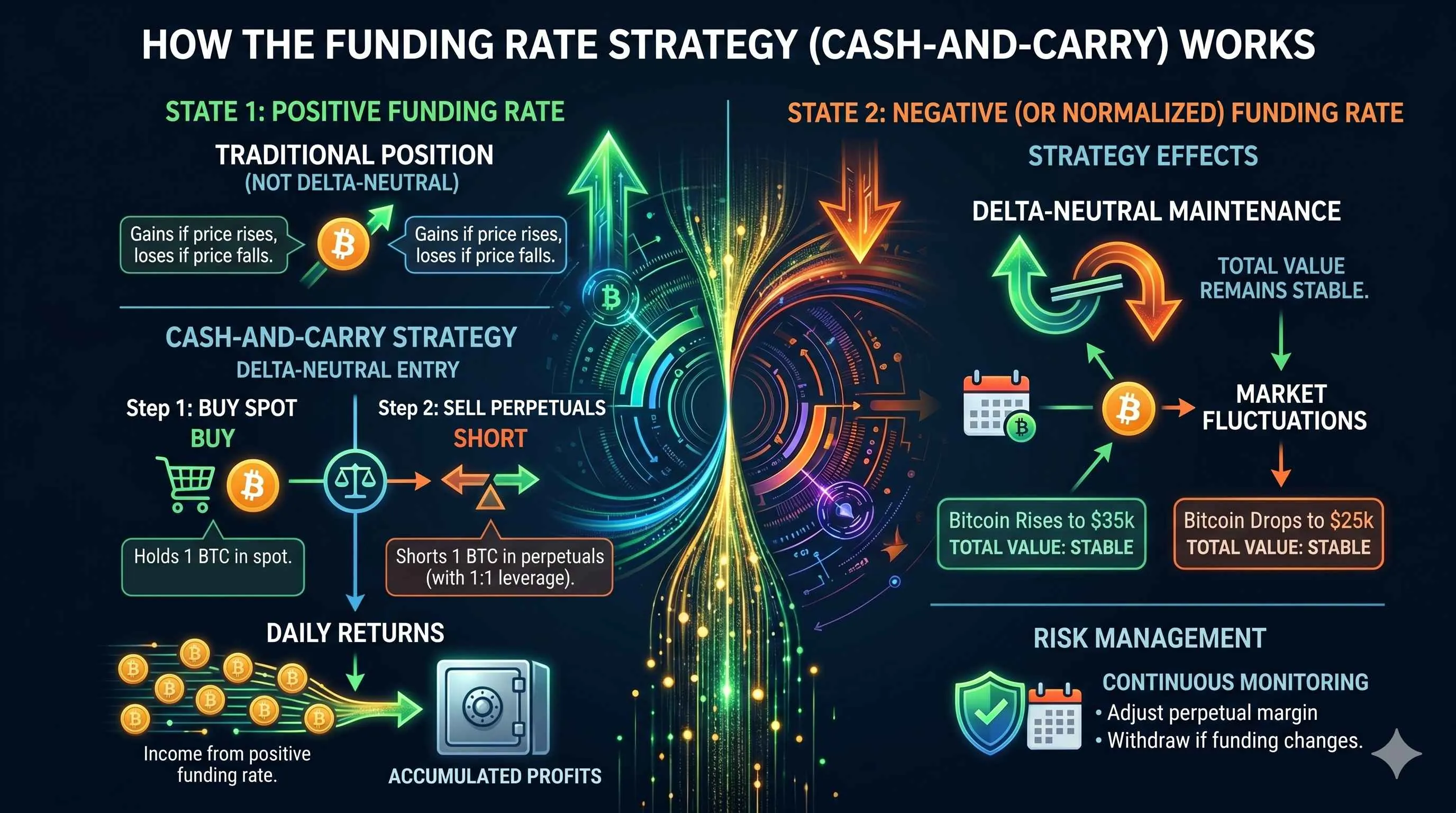
The core objective of a cash-and-carry trade is to capture the premium built into the perpetual futures contract while maintaining a delta-neutral position. Being delta-neutral means the overall value of your portfolio remains unaffected by the directional price action of the underlying asset. If the price goes up, the gains on one side of the trade offset the losses on the other.
To establish this position, a trader simultaneously executes two trades:
The Cash Leg: Purchasing the physical crypto asset on the spot market.
The Carry Leg: Opening an identical, equally sized short position on the perpetual futures market.
For instance, if a trader observes a high positive funding rate on an asset, they buy a specific amount of the token on a spot exchange or decentralized exchange (DEX) and immediately open a short position for the exact same amount of tokens using a perpetual platform. Because the long spot position and the short perp position perfectly counteract each other, the trader is shielded from market crashes or sudden pumps. Their primary return comes from collecting the recurring funding payments distributed by the short contract.
Step-by-Step Execution Framework Using On-Chain Data
Successfully running a funding rate strategy involves more than just looking at a derivatives dashboard. Crypto derivatives do not exist in a vacuum; they are heavily influenced by spot market liquidity, whale activity, and sudden shifts in volume across decentralized protocols.
Step 1: Identifying Market Asymmetry and Sentiment
Before deploying capital, it is critical to confirm that high funding rates are backed by genuine market momentum rather than a momentary liquidity squeeze. Traders often monitor technical indicators such as relative strength index (RSI) divergences on higher timeframes. A bearish RSI divergence alongside a skyrocketing funding rate can signal that while the futures market is aggressively buying on leverage, the underlying spot momentum may be slowing down. This provides a potentially sustainable environment for a short-perp, long-spot setup.
Step 2: Evaluating Spot Liquidity and Pair Mechanics
Executing the spot leg of the trade requires careful consideration of slippage and pool depth, particularly when dealing with mid-cap tokens or assets native to decentralized networks. Utilizing the DEXTools Pair Explorer allows traders to verify the actual depth of the spot market across multiple automated market makers (AMMs).
Analyzing the available liquidity ensures that entering and exiting the spot position will not incur severe slippage that eats into the projected funding rate yield. A high funding rate on a perpetual platform is unusable if the corresponding spot asset lacks the depth required to deploy capital efficiently.
Step 3: Assessing Volume and Token Distribution
A sustainable funding rate strategy requires constant validation of token velocity. Sharp, organic spikes in volume on spot markets generally point to broader network adoption or real accumulation, whereas volume concentrated solely on derivatives platforms suggests speculative, high-leverage trading.
Furthermore, conducting a holder analysis is vital. Reviewing token distribution via on-chain data sheds light on whether a small concentration of addresses controls a massive portion of the circulating supply. If a whale decides to dump their spot holdings, it can trigger massive liquidations on the derivatives side, leading to extreme volatility that can cause execution friction during your exit phase.
Step 4: Tracking Whale Activity and Wallets
Monitoring large-scale movements provides early indicators of shifts in funding trends. Utilizing tools like Bubblemaps within your research workflow helps visualize the relationships between major holding clusters. If significant quantities of a token are moving from private wallets onto centralized or decentralized exchanges, it often signals an impending increase in spot supply, which could rapidly compress the futures premium and normalize the funding rate.
Managing Structural Risks and Volatility
While delta-neutral strategies are designed to mitigate directional price risk, they are not completely risk-free. A professional approach to the funding rate strategy requires strict volatility management and an understanding of the following operational risks.
Liquidation Risk on the Perpetual Leg
Even though a trader holds the equivalent asset in spot, the short position on the perpetual exchange requires collateral (margin). If the price of the asset aggressively pumps, the short position will accumulate unrealized losses and approach its liquidation price.
Traders must actively manage their margin ratios. Setting up automated system notifications, such as DEXTools Price Alerts, ensures that if an asset breaks past major resistance levels, the trader is prompted to rebalance their capital by shifting funds from the spot asset to the derivatives exchange to maintain adequate collateral.
Funding Rate Reversal
Market sentiment can shift instantly. A strategy deployed during a highly positive funding regime can quickly lose efficacy if the market turns bearish, causing the funding rate to turn negative. If this occurs, the short position shifts from receiving payments to making payments to long traders. Traders must establish clear exit rules based on funding rate thresholds to ensure they close out both legs before the accumulated fees erode their earlier gains.
Smart Contract and Protocol Vulnerabilities
In DeFi environments, executing a cash-and-carry trade introduces smart contract risk. When capital is deployed across lending protocols, AMMs, or decentralized perpetual platforms, traders are exposed to potential exploit risks or liquidity lockups within those specific protocols. Diversifying execution across audited protocols and constantly tracking live liquidity metrics can help mitigate systemic smart contract exposure.
Conclusion and Strategic Takeaways
The crypto funding rate strategy offers a sophisticated method for intermediate traders to extract value from structural market imbalances without taking on directional price exposure. By executing a delta-neutral cash-and-carry trade, participants switch their focus from predicting price movements to managing market sentiment and capital efficiency.
However, the success of the strategy depends heavily on the quality of your pre-trade research and ongoing risk management. Verifying on-chain liquidity, assessing holder concentrations, analyzing spot volume structures, and monitoring sudden shifts in whale behaviors are necessary steps to protect capital. In the digital asset ecosystem, efficiency is dynamic; utilizing data-driven analysis is the most consistent path toward navigating these changing market conditions safely.
Perpetual Futures: Funding, Mark Price & Liquidations7 On-Chain Data Signals That Help Identify High-Growth Crypto Assets
Top 5 Whale Tracking Tools in 2026
Fake Volume vs Real Demand: How to Spot Artificial Momentum in DeFi Trading
Disclaimer: This article is for informational purposes only and does not constitute investment advice, financial advice, trading advice, or any other kind of advice. DEXTools does not recommend buying, selling, or holding any cryptocurrency or token. Users should conduct their own research and consult with a qualified financial advisor before making any investment decisions. Cryptocurrency investments are volatile and high-risk. DEXTools is not responsible for any losses incurred.