How Polymarket and Prediction Market Winnings Are Taxed

Resolving a high-volume prediction market contract triggers a clear-cut federal tax obligation. We deconstruct the on-chain data footprints and competing tax structures of Polymarket.
How Polymarket and Prediction Market Winnings Are Taxed in the US
- The explosive macroeconomic expansion of decentralized forecasting protocols has transformed information aggregation into a high-stakes financial sector. Driven by unmatched volume surges across political, regulatory, and cultural resolution pools, platforms like Polymarket have evolved past niche Web3 novelties to establish themselves as dominant institutional sentiment gauges. For active market participants, speculating on real-world outcomes delivers an unparalleled tool for hedging or capitalizing on information velocity.
- However, as billions of dollars in volume route through on-chain binary contracts, the Internal Revenue Service (IRS) is paying close attention. A common and highly dangerous myth floating through social channels suggests that because prediction markets operate via non-custodial wallets on secondary layer-2 networks, winnings are magically exempt from federal tax tracking.
- To be entirely candid: Every dollar cleared from a resolved prediction market contract is a fully reportable taxable event in the United States. Because these contracts settle natively in crypto assets like USDC, resolving a position triggers a definitive paper trail. This institutional guide breaks down the competing tax classifications, on-chain tracing realities, and reporting rules governing your forecasting portfolios.
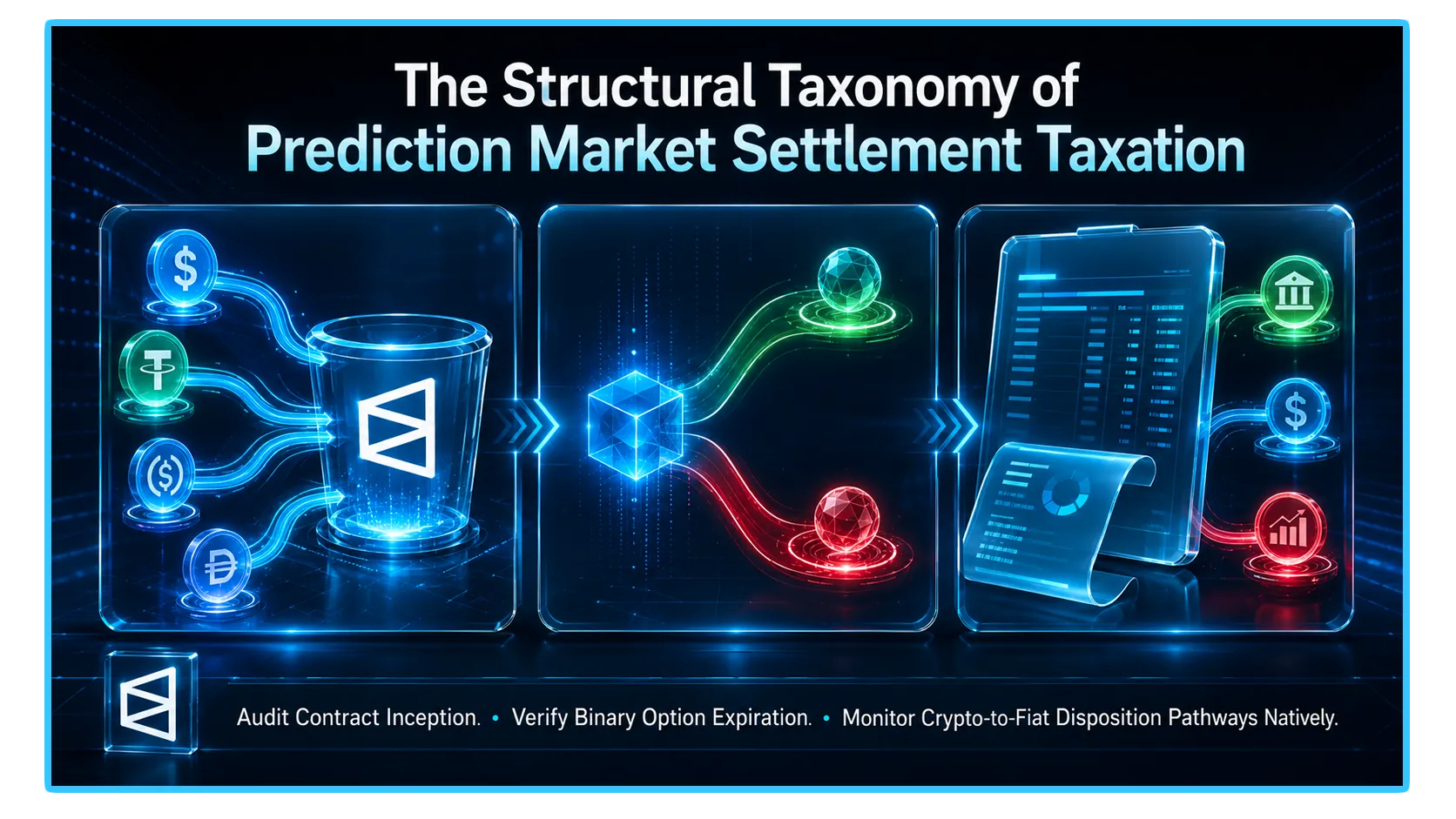
1. The Legal Dilemma: Gambling Income vs. Capital Derivatives
The primary structural hurdle facing prediction market allocators is the total absence of a hyper-specific, dedicated IRS code explicitly naming decentralized forecasting contracts. Consequently, tax professionals analyze Polymarket positions through two competing legal frameworks, depending on the trader's net volume and structural execution style.
Approach 1: The Gambling and Wagering Framework
Traditional federal tax guidelines often view prediction markets through the lens of wagering contracts. Under this interpretation, buying a share of a "Yes" or "No" outcome is treated legally as a standard wager.
The Income Treatment: Every winning contract that resolves at full dollar parity must be declared as ordinary miscellaneous income directly on Schedule 1 (Form 1040), Part I. It is taxed at your standard marginal tax brackets (up to 37%).
The Massive Loss Disadvantage: If categorized as gambling, your losses are subjected to highly restrictive deduction barriers. You cannot use prediction market losses to directly offset your standard capital gains from stocks or crypto. Instead, losses can only be claimed as an itemized deduction on Schedule A, and only up to the exact total amount of your declared winnings, leaving net-negative traders completely exposed.
Approach 2: The Capital Asset / Binary Option Framework
Alternatively, because Polymarket contracts feature a floating market price that fluctuates dynamically between 0.01 and 0.99 based on supply, demand, and probability telemetry, many quantitative tax firms treat them as binary options or general capital assets.
The Realization Mechanics: Under this framework, entering a position establishes your initial cost basis, and contract resolution or secondary market liquidation triggers a standard capital realization event reported on Form 8949.
The Net Offsetting Advantage: If treated under capital asset guidelines, your gains and losses are fully integrated into your broader crypto portfolio. Your prediction market losses can be deployed to completely offset short-term capital gains across your entire digital asset ledger, with any excess net loss reducing up to $3,000 of ordinary income before carrying forward into future tax cycles.
2. The Dual Tax Layers: The USDC Ledger Factor
No matter which overarching classification your CPA deploys, navigating prediction markets requires tracking two independent layers of taxation that execute simultaneously on the public ledger.
Layer 1: The Contract Resolution Event
This layer evaluates the net profitability of the prediction market contract itself. If you purchase 10,000 shares of a "Yes" outcome at $0.40 per share (an initial capital allocation of $4,000) and the market resolves in your favor at exactly $1.00 per share, you receive $10,000 in gross proceeds. This triggers an immediate taxable realization event on your net profit block of $6,000, regardless of whether you withdraw that capital to a bank or keep it parked on-chain.
Layer 2: The Crypto Disposition Layer
- Because Polymarket operates completely on-chain using stablecoins like USDC, every transactional movement is a property transaction under IRS Notice 2014-21.
- If you convert Ethereum or alternative volatile tokens to secure the USDC required to fund your prediction wallet, that initial conversion is a fully taxable crypto-to-crypto swap. Symmetrically, while a healthy dollar-pegged stablecoin rarely deviates from a flat $1.00 value, any micro-fluctuations in the fair market value of USDC during the execution of your trades must be logged and reconciled on your final capital gains balance sheets.
3. The Myth of Opaque Ledgers: Form 1099-DA Infrastructure
The assumption that non-custodial web3 architectures insulate forecasting winnings from federal oversight is an absolute compliance illusion. The implementation of Form 1099-DA (Digital Asset Proceeds From Broker Transactions) has fundamentally upgraded the tracking capabilities of the IRS.
While a decentralized smart contract factory cannot natively issue a tax information form, your interaction with that contract requires a fiat-to-crypto or cross-chain on-ramp:
The On-Ramp Capture: The centralized exchanges, compliance gateways, and integrated fiat-processing nodes you deploy to fund your Polygon network addresses are legally classified as digital asset brokers.
These entities track your public wallet destinations and broadcast your transaction signatures directly to the IRS via automated database transfers. Furthermore, federal audit networks routinely run advanced blockchain data-mining subgraphs that isolate massive capital flows routing into and out of primary prediction market execution routers. Failing to report these volume movements line-by-line on your tax forms will automatically flag an account for immediate mismatch audits.
4. Operational Comparison: Tax Classifications Side-by-Side
To map out your portfolio optimization parameters, analyze how the two primary tax routes handle your forecasting activity:
| Financial Accounting Dimension | Gambling Income Routing (Schedule 1) | Capital Derivative Routing (Form 8949) |
| Tax Rate Structure | Ordinary Marginal Brackets (Up to 37%) | Short or Long-Term Capital Rates (0% to 20%) |
| Loss Deductibility Limits | Restricted; only deductible on Schedule A | Flexible; offsets unlimited capital gains |
| Ordinary Income Offsetting | Zero capability to reduce ordinary income | Can reduce up to $3,000 of ordinary income |
| Reporting Forms Required | Schedule 1, Part I, Line 8b | Form 8949 and Schedule D |
| Accounting Documentation | Chronological logs of every winning event | Comprehensive cost basis and lot-level tracking |
5. Advanced Market Telemetry via DEXTools
- Formulating an unassailable tax defense strategy while navigating high-velocity prediction contracts requires absolute visibility into live blockchain data. While your prediction market dashboard displays flat profit metrics based on a stable dollar target, tracking the live transaction logs, aggregate pool depth, and cross-chain velocity of the base stablecoin assets across alternative layers is the only method to verify your exact cost-basis data points accurately.
- DEXTools provides the critical analytical data infrastructure needed to monitor these movements in real-time. By utilizing advanced pair tracking, live buy/sell order visualization, and comprehensive wallet telemetry, market participants can independently audit their historical conversion price ticks against live blockchain data.
Disclaimer: This article is for informational purposes only and does not constitute investment advice, financial advice, trading advice, or any other kind of advice. DEXTools does not recommend buying, selling, or holding any cryptocurrency or token. Users should conduct their own research and consult with a qualified financial advisor before making any investment decisions. Cryptocurrency investments are volatile and high-risk. DEXTools is not responsible for any losses incurred.