How to Build a Token Research SOP for Repeatable Decisions
— By Whatsertrade in Tutorials
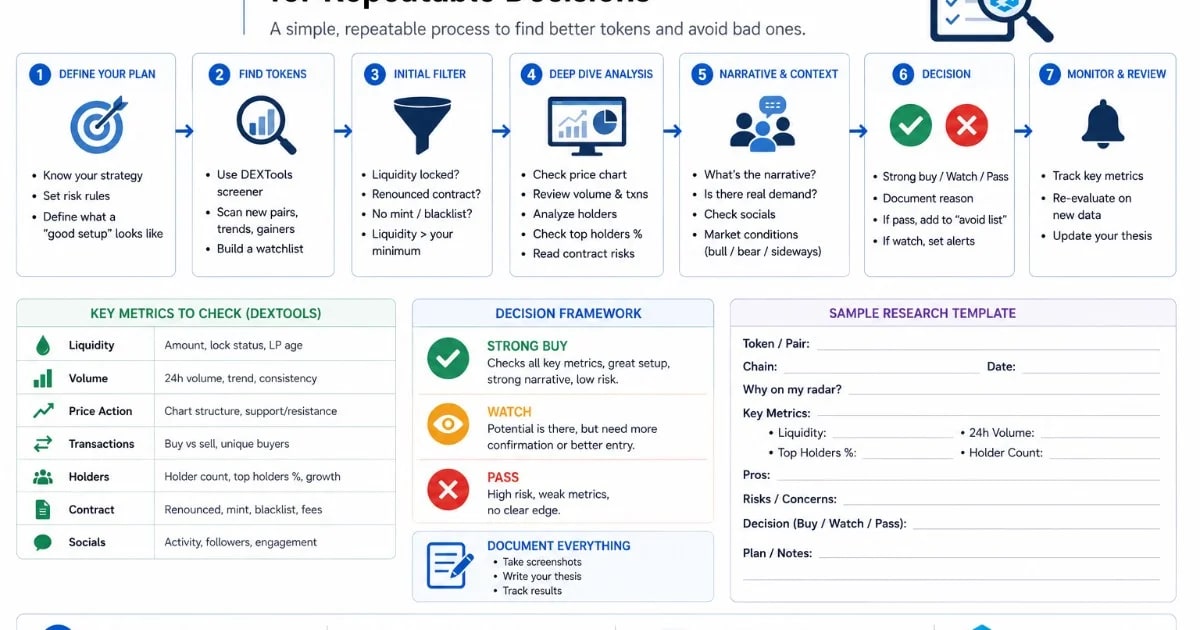
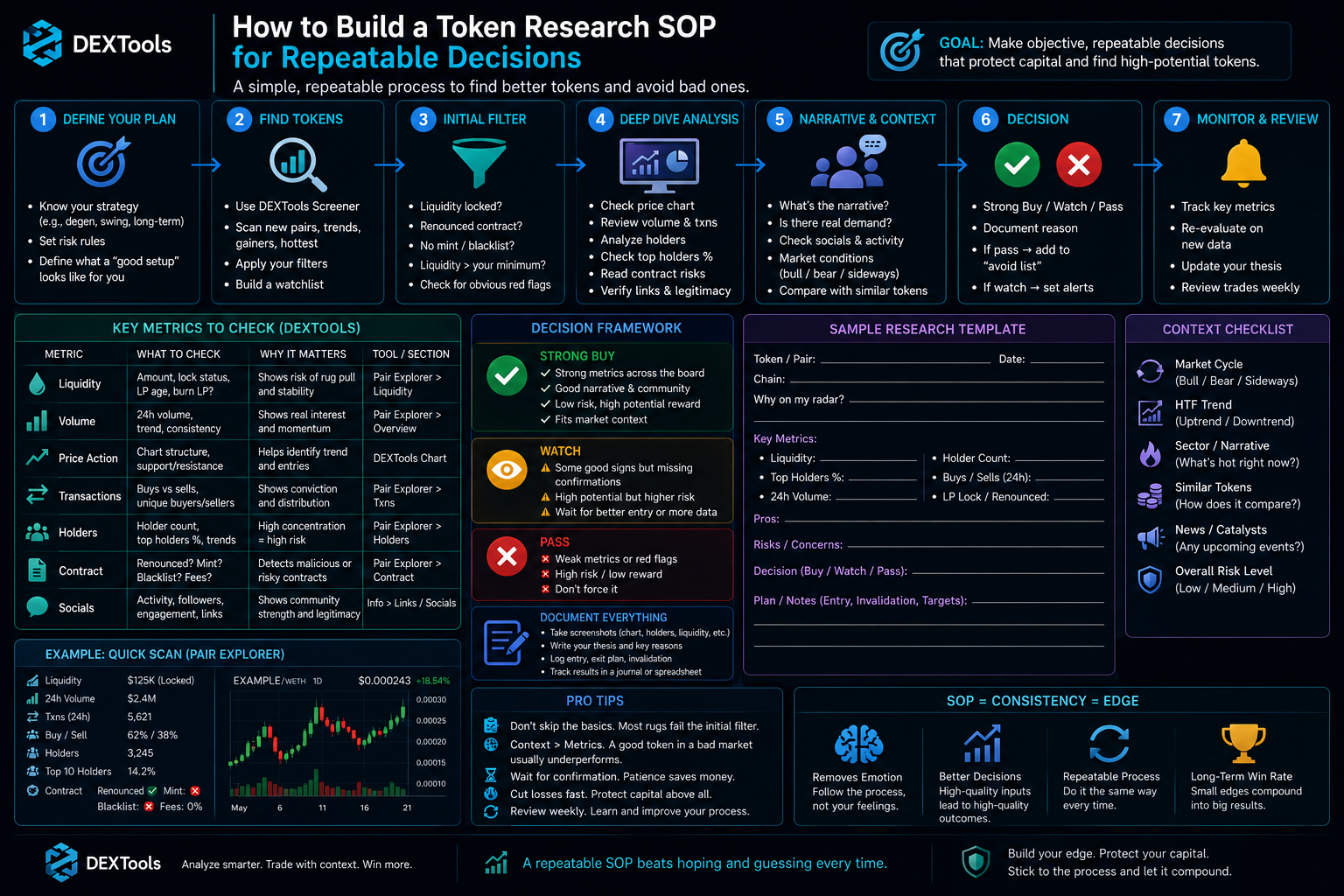
Learn how to build a token research SOP using DEXTools to create a repeatable process for reviewing liquidity, volume, holders, charts, and risk.
A strong trader does not rely on random research. They use a repeatable process.
A Token Research SOP is a standard operating procedure for reviewing tokens the same way every time. It helps traders reduce emotion, avoid skipped steps, and make more consistent decisions.
Using DEXTools, traders can build an SOP for reviewing liquidity, volume, transactions, holders, chart structure, and risk signals.
What Is a Token Research SOP?
An SOP is a step by step process that can be repeated.
In token research, an SOP answers:
What do I check first?
What makes me reject a token?
What makes me wait?
What makes me research deeper?
What data do I record?
What decision labels do I use?
The goal is consistency.
Why Traders Need an SOP
Without a process, traders often change their research based on emotion.
They may check liquidity on one token but skip it on another. They may study holders when they are cautious but ignore holders when they are excited.
An SOP prevents this.
It helps traders:
Research faster.
Avoid skipped checks.
Reduce bias.
Compare tokens fairly.
Improve over time.
A repeatable process creates repeatable learning.
Step 1: Define Your Research Order
Start with a fixed order.
Example:
Basic pair information.
Liquidity.
Volume and transactions.
Holders and wallets.
Chart structure.
Risk signals.
Thesis.
Final decision.
This order keeps research organized.
Step 2: Define Rejection Rules
Your SOP should include conditions that make you stop.
Examples:
Liquidity too thin.
Volume not supported by buyers.
Large wallets selling heavily.
Holder concentration too high.
Chart overextended with no consolidation.
Risk signals unacceptable.
Unclear thesis.
Rejection rules protect your attention and capital.
Step 3: Define Watch Conditions
Some tokens are not ready but still interesting.
Your SOP should define when a token goes into a watch or Maybe Later list.
Examples:
Liquidity acceptable but needs improvement.
Volume growing but inconsistent.
Chart needs consolidation.
Holders growing but distribution needs review.
Narrative strong but data not confirmed.
This prevents premature entries.
Step 4: Define Research Deeper Conditions
A token should earn deeper research.
Examples:
Liquidity is stable.
Volume is consistent.
Transactions show real participation.
Holders are growing naturally.
Chart structure is healthy.
Risk signals are manageable.
Thesis is clear.
When multiple conditions align, deeper research becomes justified.
Step 5: Record the Decision
Every SOP should end with a decision label.
Use:
Reject.
Watch.
Research deeper.
Enter with plan.
Walk away.
Record the reason in one sentence. This makes future review easier.
Step 6: Review and Improve the SOP
Your SOP should evolve.
Review it weekly or monthly and ask:
Which rules protected me?
Which rules were too loose?
Which checks did I skip?
Which signals misled me?
What should I add?
A good SOP improves with experience.
Final Thoughts
A Token Research SOP helps traders make repeatable decisions in fast DEX markets. It turns scattered research into a clear process.
DEXTools provides the data. The SOP provides the structure.
Good traders do not reinvent their process on every token. They build a system, follow it, and improve it over time.
How to Build a Token Research Routine in 10 Minutes a Day The DEXTools Evidence Map: How to Connect Data Into One Clear Thesis How to Check Token Holders on DEXTools How to Review a Token Without Looking at Price First