How to Build a Token Research Routine in 10 Minutes a Day
— By Whatsertrade in Tutorials
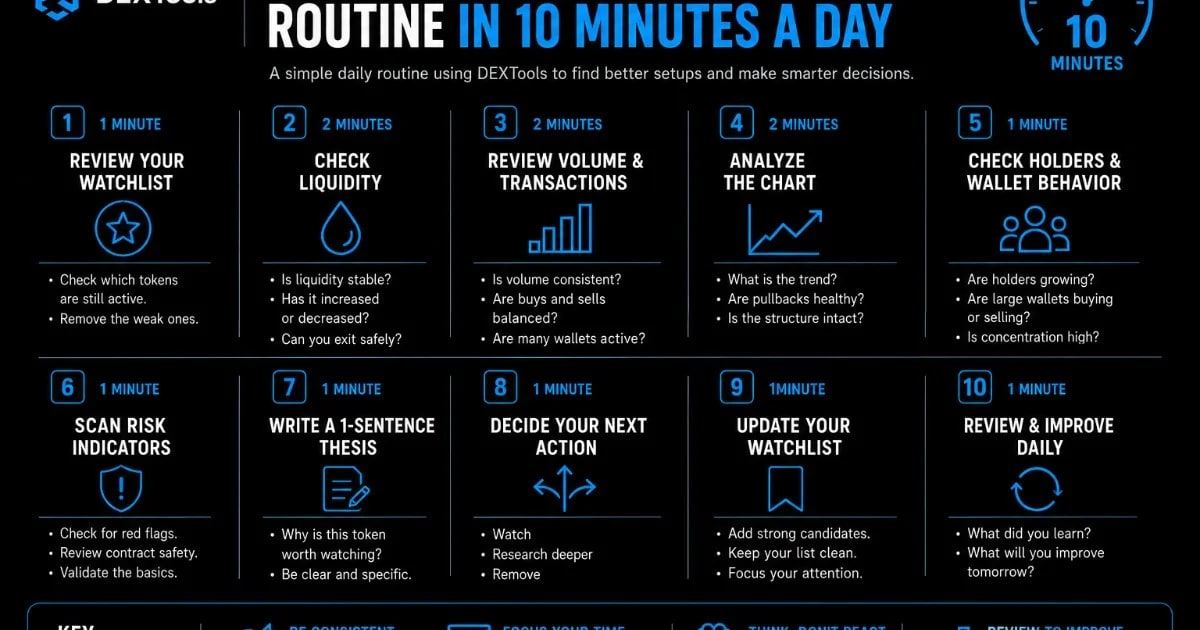
Learn how to build a simple 10 minute daily token research routine using DEXTools to review liquidity, volume, holders, charts, and risk before trading.
Crypto markets move fast, but good research does not need to be complicated. Many traders lose time jumping from one token to another without a clear process. They check charts, read social posts, follow hype, and end up making rushed decisions.
A daily token research routine can solve this problem.
Key Takeaways
Using DEXTools, traders can create a simple 10 minute workflow to review the market, filter weak tokens, and focus only on setups that deserve more attention. The goal is not to find a perfect trade every day. The goal is to build consistency.
Why a Daily Token Research Routine Matters
A routine helps traders avoid emotional decisions. Instead of reacting to every pump, you start each day with a clear structure.
A good routine helps you:
Find tokens with improving data.
Avoid weak or risky setups.
Track narratives without chasing them.
Keep your watchlist clean.
Make better decisions under pressure.
In DEX trading, attention is limited. A daily routine helps you spend that attention wisely.
Minute 1: Review Your Watchlist
Start with the tokens you already follow. Open your DEXTools watchlist and quickly check which pairs are still active.
Look for:
Tokens with fresh movement.
Tokens with volume returning.
Tokens with liquidity changes.
Tokens that have lost momentum.
Tokens that no longer fit your thesis.
Your first task is not to buy. Your first task is to decide what still deserves attention.
Minutes 2 and 3: Check Liquidity
Liquidity is one of the most important parts of token research. Before studying the chart, check whether the token has enough liquidity to support trading.
Ask yourself:
Is liquidity stable?
Has liquidity increased or decreased?
Is the pool too thin for the current volume?
Would exiting the trade be difficult?
If liquidity looks weak, the token may not deserve deeper research.
Minutes 4 and 5: Review Volume and Transactions
Next, review activity. Volume can show interest, but transaction quality matters too.
Look at whether activity is consistent or only based on one sudden spike. Check if buys and sells are balanced. See whether many wallets are trading or only a small group.
High volume is more useful when it comes with healthy transactions, stable liquidity, and real buyer participation.
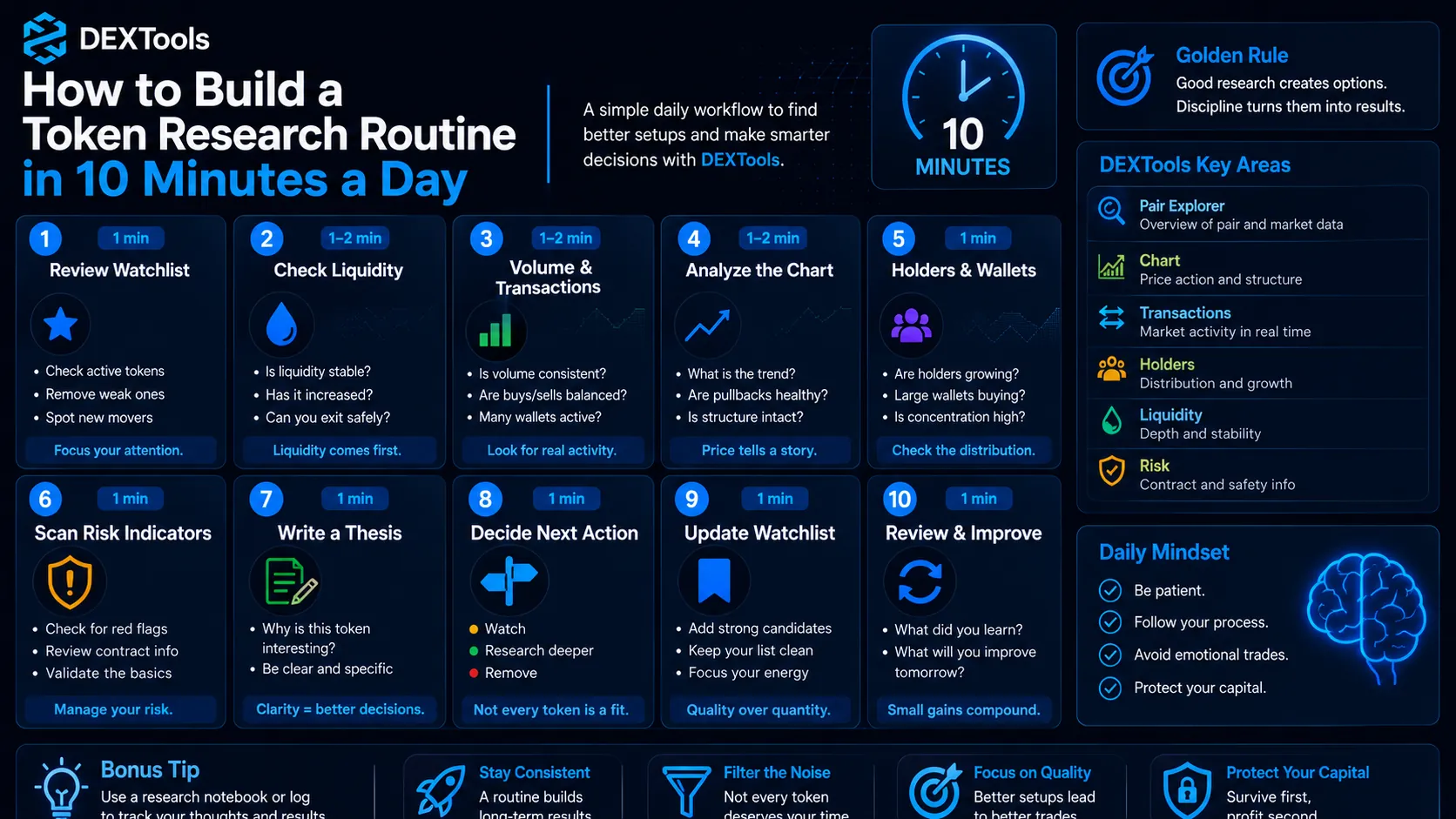
Minutes 6 and 7: Study the Chart Structure
Now look at the chart. Avoid focusing only on the last candle.
Ask:
Is the token trending, consolidating, or breaking down?
Are pullbacks controlled?
Is price holding important areas?
Has the token already moved too far?
A healthy chart usually shows structure. A risky chart often depends on one vertical move.
Minute 8: Check Holders and Wallet Behavior
Holder growth can help you understand whether attention is spreading. But do not read holder count alone.
Look for:
Steady holder growth.
Large wallet activity.
Top holder concentration.
Signs of accumulation or selling.
If small holders are increasing while large wallets are selling, be careful.
Minute 9: Write a One Sentence Thesis
Before adding a token to your active list, write one sentence:
“This token is worth watching because…”
This forces clarity. If you cannot explain the setup in one sentence, you probably do not understand it yet.
Example:
“This token is worth watching because liquidity is improving, volume is consistent, and the chart is consolidating after a strong move.”
Minute 10: Decide the Next Action
End your routine with one of three decisions:
Watch: The token is interesting but not ready.
Research deeper: The token deserves more time.
Remove: The token no longer fits your criteria.
This keeps your workflow clean and focused.
Final Thoughts
A 10 minute token research routine can improve the way you use DEXTools. Instead of reacting to hype, you start each day with a structured process.
Review your watchlist, check liquidity, study volume, analyze the chart, review holders, and write a simple thesis. Over time, this habit can help you separate real opportunities from market noise.
Good trading starts before the trade. It starts with routine.
Why Real Time Data Matters for DEX Traders The No Bid Moment: When a DEX Token Has a Price but No Real Buyers Liquidity Velocity: Why Fast LP Changes Matter More Than Total Liquidity The Attention Decay Curve: How to Know When a Trending Token Is Losing Power