How to Separate Signal, Noise and Narrative in DEX Trading
— By Whatsertrade in Tutorials
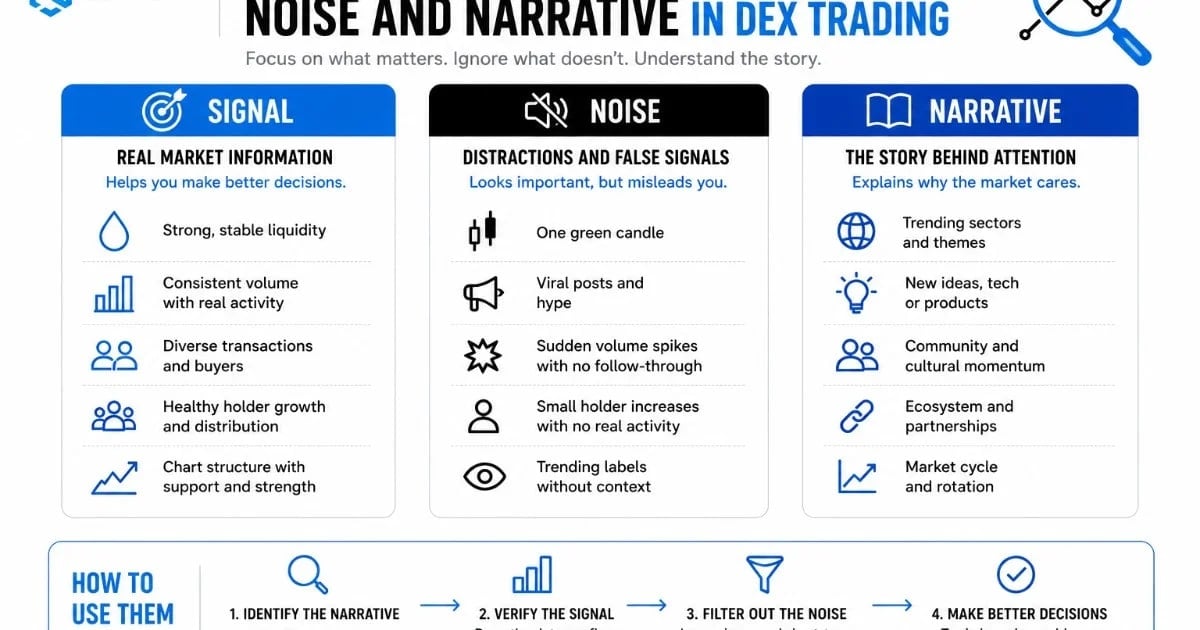
Learn how to separate real trading signals from market noise and crypto narratives using DEXTools data before making token decisions.
DEX trading is full of information. Charts move, volume changes, wallets trade, social media reacts, and narratives appear quickly. For many traders, the hardest part is not finding information. It is knowing what information matters.
To trade better, you need to separate three things: signal, noise, and narrative.
Key Takeaways
- What Is Signal?
- What Is Noise?
- What Is Narrative?
- How to Identify Real Signal
- How to Filter Out Noise
- How to Use Narrative Without Getting Trapped
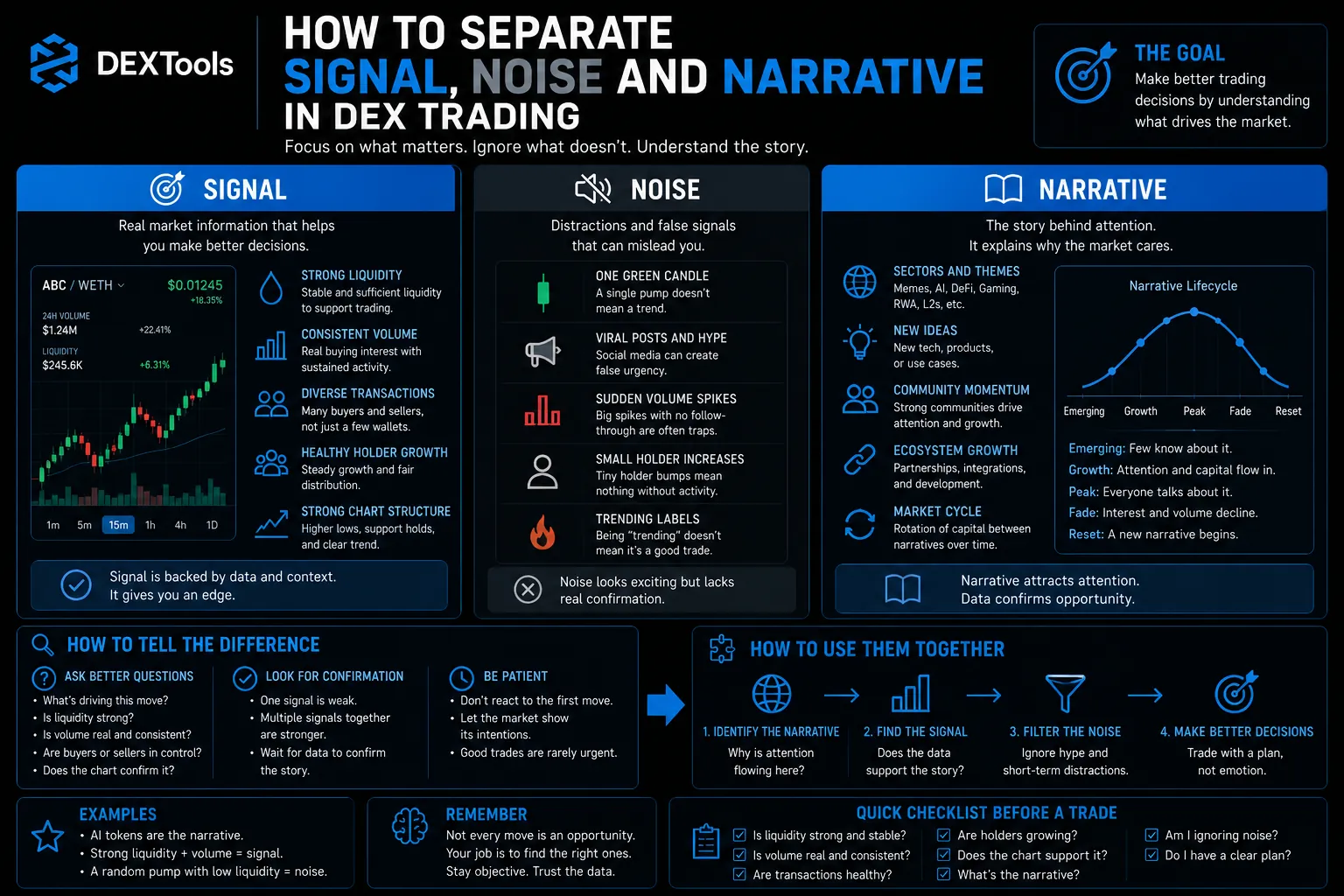
Signal is useful market information. Noise is activity that distracts or misleads. Narrative is the story that explains why traders may be paying attention.
DEXTools helps traders study all three, but the key is knowing how to use them together.
What Is Signal?
A signal is data that improves your understanding of a token.
Examples of useful signals include:
Stable or improving liquidity.
Consistent buyer interest.
Healthy transaction diversity.
Controlled chart structure.
Lower sell pressure after pullbacks.
Signals are not magic predictions. They are pieces of evidence that support or weaken a trading idea.
A strong signal is usually confirmed by other data. A weak signal stands alone.
What Is Noise?
Noise is information that creates reaction without improving decision quality.
Examples of noise include:
One random green candle.
A viral social media post.
A sudden but unsupported volume spike.
A temporary holder increase.
A trending label without deeper analysis.
Noise can feel urgent. It often makes traders act quickly. But acting on noise can lead to poor entries.
DEXTools helps reduce noise by showing whether the market data supports the excitement.
What Is Narrative?
Narrative is the story behind market attention. It can be a sector, trend, meme, chain ecosystem, product idea, or community theme.
Narratives matter because traders often move capital toward stories. But narrative alone is not enough.
A token can have a strong story and weak data. It can also have strong data before the story becomes popular.
The best opportunities often appear when narrative and data support each other.
How to Identify Real Signal
To identify signal, look for consistency across different data points.
Ask:
Does liquidity support the move?
Is volume consistent?
Are transactions diverse?
Are holders growing naturally?
Is the chart holding structure?
Are large wallets helping or hurting the trend?
The more independent confirmations you find, the stronger the signal becomes.
How to Filter Out Noise
Noise usually has one common feature: it does not last.
A sudden spike in volume may look exciting, but if it fades quickly, it may not mean much. A large green candle may attract attention, but if the next candles fail, the signal weakens.
To filter noise, wait for confirmation.
Do not react instantly. Check whether the data remains strong after the first move.
How to Use Narrative Without Getting Trapped
Narratives can be useful discovery tools. They help traders understand where attention is flowing.
But do not buy only because a token belongs to a popular narrative.
Ask:
Is this token actually benefiting from the narrative?
Is volume improving?
Are holders increasing?
Is liquidity strong enough?
Is the chart early or already overextended?
Narrative should support the data, not replace it.
A Simple Signal, Noise and Narrative Framework
Use this three step process:
First, identify the narrative. Why are traders paying attention?
Second, verify the signal. Does DEXTools data confirm real activity?
Third, remove the noise. Which parts of the move are only hype or short term reaction?
This creates a clearer decision process.
Final Thoughts
DEX trading becomes easier when you understand the difference between signal, noise, and narrative.
Signal helps you make decisions. Noise pushes you into emotion. Narrative explains attention, but it must be confirmed by data.
DEXTools gives traders the tools to compare these layers. The advantage comes from slowing down, checking the full picture, and trusting evidence over excitement.
In crypto, not every loud move is meaningful. The best traders learn to hear the signal through the noise.
7 On-Chain Data Signals That Help Identify High-Growth Crypto Assets Community vs Hype: Spot Real Token Support Healthy vs Toxic DEX Volume Explained When DEXTools Signals Disagree: How to Make Sense of Conflicting Token Data