Narrative Decay: How Hot Crypto Trends Lose Liquidity Over Time
— By Whatsertrade in Tutorials

Explore the phenomenon of narrative decay in crypto markets, revealing how trends lose momentum and liquidity over time, impacting traders' strategies.
Crypto markets move through narratives. Memecoins, AI tokens, RWA, gaming, restaking, privacy, BTCFi, and other trends can dominate attention for weeks or months. When a narrative is hot, liquidity moves quickly toward related tokens.
But no narrative stays hot forever.
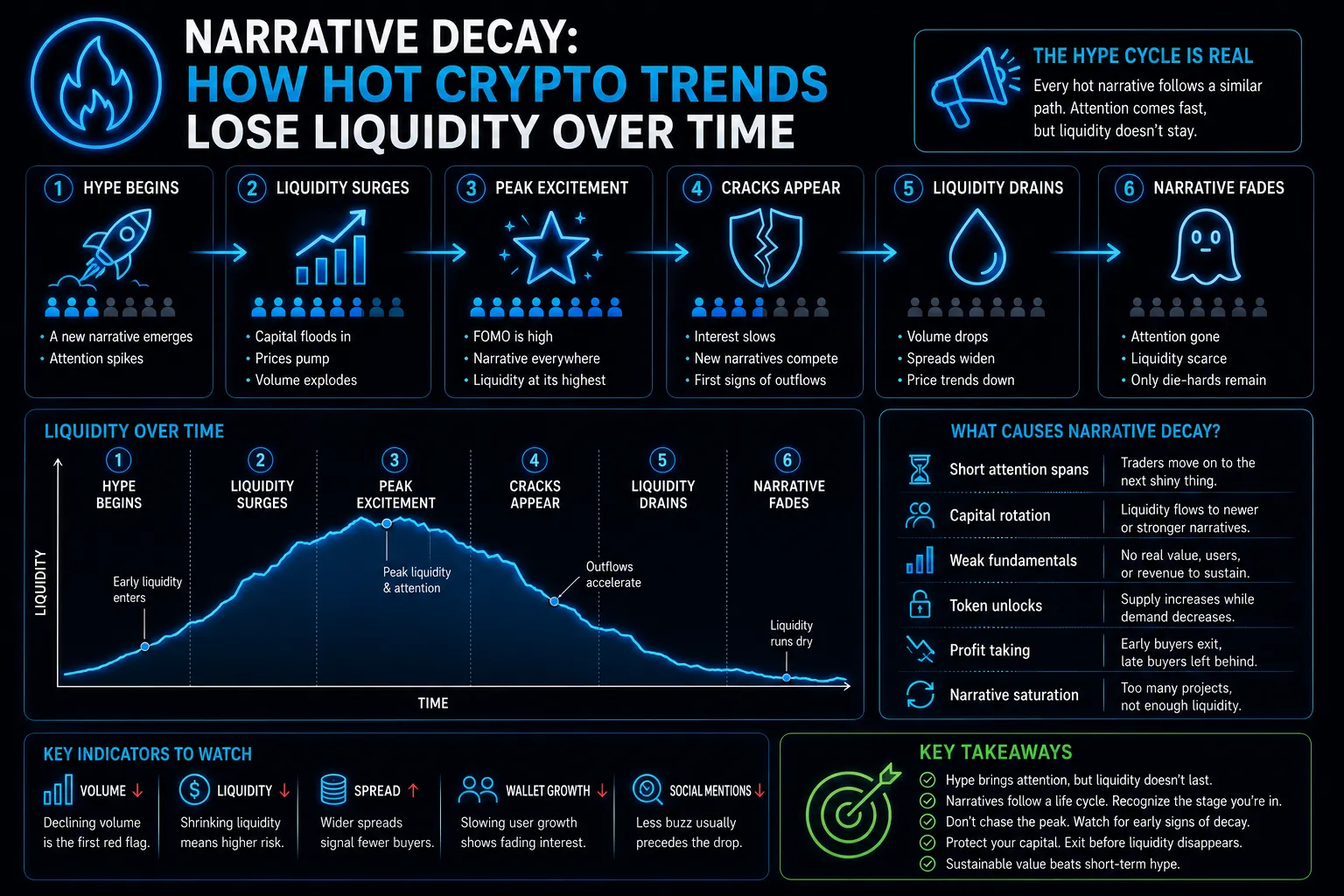
Narrative decay happens when attention, volume, liquidity, and buyer interest slowly leave a trend. It does not always happen overnight. Often, the first signs appear while prices still look strong.
Understanding narrative decay helps traders avoid entering late.
What Is Narrative Decay?
Narrative decay is the process by which a once popular crypto trend loses momentum. The story may still exist, but the market no longer rewards it with the same liquidity.
At first, the trend attracts early buyers and strong volume. Then copycat tokens appear. Attention becomes diluted. New launches perform worse. Liquidity rotates somewhere else.
By the time everyone notices the narrative is fading, many tokens may already be down heavily.
Early Signs of Narrative Decay
Traders can watch several signals:
- New tokens in the narrative pump less
- Volume declines across related pairs
- Liquidity stops growing
- Influencer attention shifts
- Strong tokens stop making new highs
- Copycat launches fail faster
- Holders stop increasing
- The trend needs bigger news to move price
A healthy narrative creates momentum naturally. A decaying narrative needs constant promotion.
Liquidity Rotation
Crypto liquidity is mobile. When traders lose interest in one sector, they often rotate into another. This is why one narrative can fade while another begins to rise.
Liquidity rotation may move from memecoins to AI, from AI to RWA, from RWA to stablecoin yield, or from one chain ecosystem to another.
Traders who watch liquidity can often detect rotation before social media fully catches up.
Why Late Buyers Get Trapped
Late buyers often enter when the narrative is already mature. They see past gains, viral posts, and strong historical charts. But they may miss the fact that new money is slowing down.
At that stage, early buyers may be using remaining hype to exit.
The risk is buying the story after the liquidity has already left.
How to Track Narrative Health
A practical narrative watchlist can include:
- Leading tokens in the sector
- New launches in the same theme
- Liquidity growth or decline
- Volume consistency
- Holder growth
- Cross-chain activity
- Social attention
- Performance compared with other narratives
If the leaders are weak and new launches are failing, the narrative may be decaying.
Can Narratives Recover?
Yes. Some narratives return after cooling down. A major catalyst, new product, regulatory change, or market rotation can revive interest.
But a recovery should show real liquidity returning, not just social noise.
A revived narrative usually has stronger volume, new buyers, and better performance across multiple tokens.
Final Thoughts
Narratives drive crypto markets, but narratives also decay.
The best traders do not only ask which story is popular. They ask whether liquidity is still supporting that story.
When attention fades, liquidity follows. When liquidity leaves, the narrative becomes dangerous for late buyers.
The Liquidity Decay Curve: How Token Markets Lose Depth Before They Lose Price Liquidity Rotation: How Capital Moves Between Tokens Inside the Same Narrative The Silent LP Exit: How Liquidity Providers Leave Before Traders Notice Exit Liquidity Signals: Spot Late Entry Risks