Is the Crypto Wash Sale Rule Real?

The 61-day wash sale window is a staple of stock investing, but spot digital assets operate under alternative tax rails. We dissect the 2026 crypto tax landscape.
Crypto Wash Sale Rule. What Traders Can Still Do in 2026
- The intersection of decentralized asset trading and federal tax compliance has reached its most transparent era yet. With the implementation of comprehensive broker data tracking protocols, every transaction log, wallet-to-wallet migration, and decentralized execution is systematically mapped for regulatory review. Yet, amid this heightened compliance landscape, one of the most persistent debates among digital asset allocators remains centered on tax-loss optimizations: Is the crypto wash sale rule actually real?
- For traditional equity and bond investors, the wash sale rule under Internal Revenue Code (IRC) Section 1091 is a rigid barrier. It explicitly prohibits an investor from claiming a capital loss on a security if they purchase a "substantially identical" security within a 61-day window, specifically 30 days before the sale, the date of the sale itself, and 30 days after. If a stock investor dumps an asset at a loss on December 30 and repurchases it on January 2, their tax deduction is legally disallowed and deferred into the cost basis of the new position.
- In the cryptocurrency market, the landscape is entirely different. Despite ongoing legislative threats and widespread misconceptions, the traditional wash sale rule does not explicitly apply to spot cryptocurrency transactions in 2026. This structural exemption creates a significant financial optimization loop known as the crypto tax-loss harvesting loophole. This analysis breaks down the underlying statutory logic, the critical divide between alternative asset wrappers, and the strategic guardrails defining crypto tax planning today.
1. The Statutory Underpinnings: Why Crypto Is Exempt
- To understand why cryptocurrency remains immune to standard Section 1091 constraints, you must look directly at how the Internal Revenue Service (IRS) defines digital assets. Under foundational guidance (rooted in IRS Notice 2014-21 and maintained continuously through current tax updates), the IRS classifies virtual currency explicitly as property, not as stock or securities.
- Just as an investor can sell a piece of real estate or a precious metal block at a loss and immediately acquire a similar asset without triggering a wash-sale disallowance, a cryptocurrency trader can legally execute a same-day liquidation and repurchase loop.
The Optimization Loop in Action
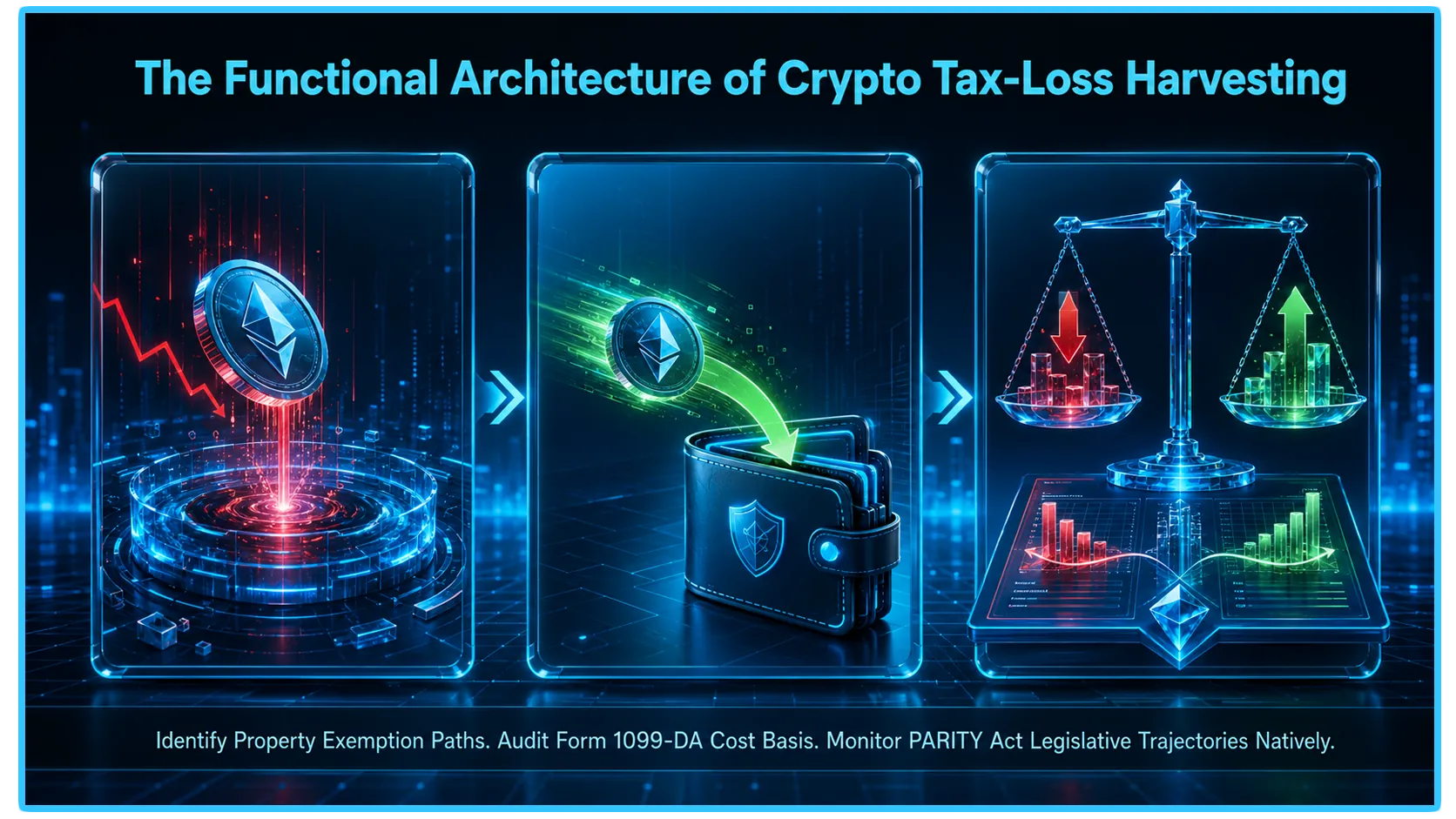
- If a trader purchased Bitcoin at $90,000 and the market corrects down to $65,000, they are sitting on an un-realized loss of $25,000. Under current 2026 rules, the trader can execute a market order to sell their Bitcoin at $65,000, instantly capturing a $25,000 realized capital loss. They can then immediately route that exact capital back into the market to repurchase the same quantity of Bitcoin at $65,000.
- The trader has successfully locked in a massive tax deduction to offset their capital gains while maintaining their exact market exposure and portfolio configuration.
2. The Split Reality: Spot Assets vs. Crypto Equities
While the property exemption provides immense flexibility for spot market participants, investors utilizing traditional financial wrappers to gain crypto exposure face a strict split tax reality. The moment digital asset exposure is packaged into an institutional security, it is pulled directly into the Section 1091 dragnet.
The Structural Compliance Split Matrix
| Asset Category | Underlying Token Layer | IRS Classification | Wash Sale Status (Section 1091) |
| Spot Cryptocurrency | Direct holdings (BTC, ETH, SOL in Web3 wallets) | Property | Exempt (Losses recognized immediately) |
| Spot Crypto ETFs | Institutional exchange-traded funds (IBIT, ETHA) | Security | Subject to Rule (Losses disallowed if bought within 61 days) |
| Crypto Equities | Public proxy stocks (COIN, MSTR, MARA) | Security | Subject to Rule (Losses disallowed if bought within 61 days) |
| DeFi Derivatives | Synthetic on-chain options and perp contracts | Complex Property / Options | High-Risk Gray Area (Subject to straddle rules) |
An allocator who manages their wealth across both Web3 native applications and traditional brokerage accounts must navigate this divide carefully. Selling a Spot Bitcoin ETF at a loss and buying it back within 30 days will result in an automatically disallowed loss reported directly by your broker. Executing the identical economic swap utilizing raw spot tokens on an exchange or decentralized protocol remains entirely permissible.
3. Enhanced Telemetry: The Form 1099-DA Era
- A common point of confusion among modern traders is the belief that because the wash sale rule doesn't apply to crypto, the IRS cannot see or track their transaction loops. This assumption is a dangerous miscalculation.
- The broker reporting landscape undergoes its most significant upgrade with the mandatory distribution of Form 1099-DA (Digital Asset Transactions). Centralized cryptocurrency exchanges, digital asset brokers, and hosted wallet providers are required to provide both the taxpayer and the IRS with explicit data summaries detailing digital asset transactions.
- Form 1099-DA tracks the exact timestamp of purchases and sales, gross transaction proceeds, and highly calibrated cost-basis metrics. While the form will not flags transactions as "disallowed wash sales" for spot property, it delivers total transparency to federal audit algorithms, making precise, defensible accounting an absolute requirement for every active participant.
4. The Hidden Trap: The Economic Substance Doctrine
- The absolute absence of explicit Section 1091 language for digital assets does not grant traders a license to abuse the system. The IRS possesses a powerful fallback mechanism known as the Economic Substance Doctrine (codified under IRC Section 7701(o)).
- Under this doctrine, the IRS retains the legal authority to disallow any tax benefit or deduction resulting from a transaction that lacks a real economic purpose outside of pure tax reduction.
The Audit Red Flag: If a trader employs high-frequency algorithmic bots to mechanically sell and rebuy identical crypto positions hundreds of times a day solely to manufacture millions in paper losses while their net economic exposure remains entirely unchanged, an IRS auditor can invalidate those deductions under the substance-over-form rule.
To protect your portfolio optimization framework from getting caught in an economic substance audit, adhere to these tactical boundaries:
Incorporate Execution Delays: Avoid immediate, same-second algorithmic buybacks. Introducing a meaningful temporal buffer (such as waiting several hours or a full day) demonstrates exposure to real market execution risk.
Execute Correlated Diversification: Instead of buying back the exact same token asset signature immediately, consider swapping the depreciated asset for a highly correlated alternative primitive (e.g., selling stETH to capture a loss and instantly buying native ETH or an alternative liquid staking asset).
Maintain Meticulous Cost Basis Logs: Ensure your sub-accounting methods (FIFO, LIFO, or Specific Identification) are completely consistent across all integrated Web3 data tracking platforms.
5. The 2026 Legislative Horizon: The PARITY Act
- The crypto wash sale loophole is an active target for congressional budget balancing. In the current legislative cycle, lawmakers are actively reviewing bipartisan tax reform frameworks, most notably the updated Digital Asset PARITY Act.
The PARITY Act is engineered to completely modernize digital asset tax tracking, seeking to officially close the property loophole by expanding Section 1091 wash sale and Section 1259 constructive sale guidelines directly to all digital assets matching the broker reporting definitions. Symmetrically, the act contemplates introducing significant structural benefits to offset this regulatory tightening, including:
Mark-to-Market Accounting Elections: Allowing high-volume professional digital asset traders to elect Section 475 treatment, converting capital items to ordinary status to completely bypass the standard $3,000 net capital loss deduction ceiling.
Staking and Mining Deferrals: Offering a multi-year income recognition deferral for native validation rewards, shifting taxation exclusively to the moment the accrued rewards are liquidated.
Stablecoin De Minimis Exemptions: Eliminating gain-or-loss tracking friction for everyday micro-transactions and stablecoins that maintain tight parity with the fiat dollar.
6. Advanced Market Verification via DEXTools
- Executing complex tax-loss harvesting maneuvers across hyper-volatile asset classes requires deep, look-through visibility into live secondary market liquidity data. While a trader's internal exchange dashboard tracks historical cost basis values, evaluating the real-time order book depth, automated market maker reserves, and transaction velocity on decentralized venues is the only method to execute structural asset swaps without suffering massive execution slippage.
DEXTools provides the critical analytical infrastructure necessary to monitor these market dynamics in real-time. By utilizing advanced pair tracking, cross-chain volume visualization, and large-scale whale wallet telemetry, market participants can verify whether the tokens they intend to harvest for losses maintain sufficient liquidity depth to support immediate, low-slippage reinvestments. Monitoring these real-time data metrics ensures your tax-loss maneuvers are executed against genuine economic depth, keeping your capital efficient and insulated from unexpected on-chain pricing anomalies.
You can access DEXTools here and start trading today!
Disclaimer: This article is for informational purposes only and does not constitute investment advice, financial advice, trading advice, or any other kind of advice. DEXTools does not recommend buying, selling, or holding any cryptocurrency or token. Users should conduct their own research and consult with a qualified financial advisor before making any investment decisions. Cryptocurrency investments are volatile and high-risk. DEXTools is not responsible for any losses incurred.