Post-MiCA Liquidity Watch: How European Crypto Regulation Could Reshape Stablecoin Trading
— By Whatsertrade in Tutorials

Explore how European regulations are set to transform stablecoin trading and liquidity dynamics in the crypto market.
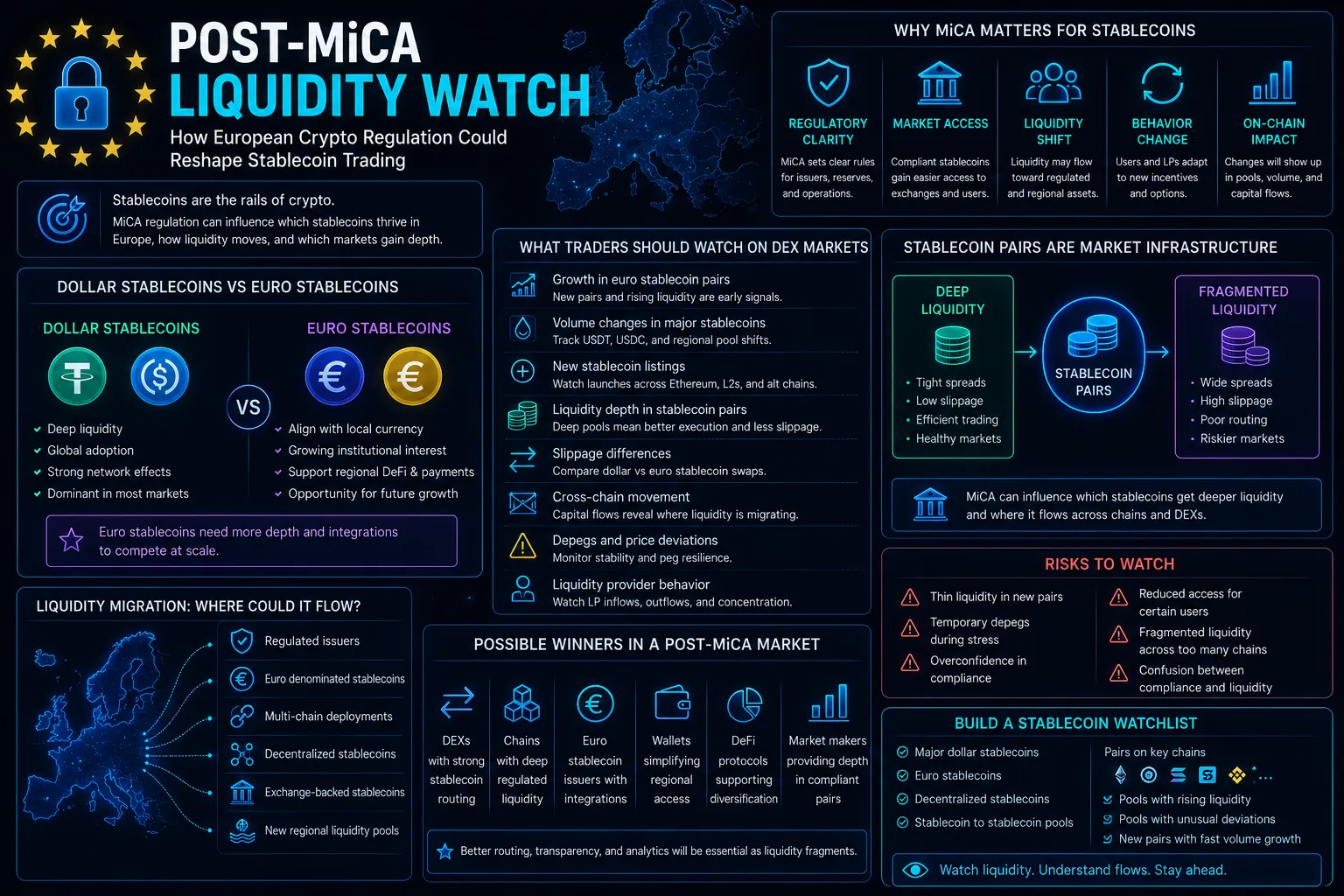
Stablecoins are the base layer of crypto trading. They are used to enter positions, exit volatility, move capital across chains, price assets, and provide liquidity. For many traders, stablecoins are not just another category of tokens. They are the rails that connect the entire market.
As European crypto regulation matures under MiCA, stablecoin liquidity may become one of the most important areas to watch. Regulation can influence which stablecoins exchanges support, how issuers operate, where liquidity moves, and whether traders begin using more regional alternatives such as euro denominated stablecoins.

For decentralized markets, the key question is not only which stablecoins remain available. The deeper question is how liquidity behavior changes after regulation becomes part of the market structure.
Why MiCA Matters for Stablecoins
MiCA creates a clearer regulatory framework for crypto assets in the European Union. Stablecoins are one of the most important parts of that framework because they touch payments, trading, reserves, issuer obligations, and market access.
For traders, the direct impact may appear through liquidity. If certain stablecoins become easier or harder to access in Europe, trading pairs can change. Liquidity providers may adjust their positions. Exchanges may promote compliant assets. Users may shift between dollar based and euro based stablecoins depending on availability, fees, confidence, and utility.
This does not mean one stablecoin will immediately replace another. Crypto liquidity is sticky. Traders use what is deep, fast, trusted, and widely accepted. But regulation can slowly change incentives, and those changes can become visible on-chain.
The Stablecoin Liquidity Question
The most important metric after regulatory changes is not the announcement itself. It is liquidity migration.
Traders can watch whether stablecoin liquidity moves toward:
- Regulated issuers
- Euro denominated stablecoins
- Multi chain stablecoin deployments
- Decentralized stablecoins
- Exchange backed stablecoins
- New regional liquidity pools
A stablecoin may remain popular globally while losing or gaining relevance in specific regions. Europe could become a test case for how local regulation affects global on-chain liquidity.
Dollar Stablecoins vs Euro Stablecoins
Dollar based stablecoins dominate crypto trading because most markets are priced in dollars. They offer deep liquidity, broad integrations, and strong network effects.
Euro stablecoins, however, may gain more attention in a post MiCA environment. European users, institutions, and businesses may prefer assets that match their local currency exposure. If euro stablecoins become more liquid, they could support new trading pairs, payment flows, and regional DeFi products.
The challenge is depth. Traders usually follow liquidity. A euro stablecoin can be compliant and useful, but it still needs enough volume, integrations, and market maker support to become a serious trading asset.
This creates a potential opportunity: watching early euro stablecoin liquidity before it becomes obvious to the wider market.
What Traders Should Watch on DEX Markets
DEX traders can monitor several signals to understand how stablecoin liquidity is evolving:
- Growth in euro stablecoin pairs
- Volume changes in USDT, USDC, and regional stablecoin pools
- New stablecoin listings across major chains
- Liquidity depth in stablecoin to stablecoin pairs
- Slippage differences between dollar and euro stablecoin swaps
- Cross chain stablecoin movement
- Depeg events or unusual price deviations
- Changes in liquidity provider behavior
The best signals will likely appear gradually. Liquidity migration rarely happens all at once. It often begins with new pools, higher volume, better routing, and tighter spreads.
Stablecoin Pairs as Market Infrastructure
Stablecoin pairs are more than trading pairs. They are infrastructure.
When stablecoin liquidity is deep, traders can move in and out of positions more efficiently. When it is fragmented, trading becomes more expensive. Slippage increases, routing becomes more complex, and smaller tokens can become harder to price.
If MiCA changes which stablecoins European participants prefer, it may also affect how liquidity is distributed across chains and DEXs. Some chains may attract more regulated stablecoin liquidity. Others may remain more dependent on offshore or decentralized alternatives.
This could create differences in trading quality between networks.
Possible Winners in a Post-MiCA Market
The biggest winners may not be only individual stablecoin issuers. They may also include ecosystems that attract compliant liquidity and make it easy to use.
Potential winners include:
- DEXs with strong stablecoin routing
- Chains with deep regulated stablecoin liquidity
- Euro stablecoin issuers with real integrations
- Wallets that simplify regional stablecoin access
- DeFi protocols that support stablecoin diversification
- Market makers providing depth in compliant pairs
The more stablecoin liquidity becomes fragmented, the more valuable good routing and transparent analytics become.
Risks to Watch
A post MiCA stablecoin market may also create risks.
Liquidity fragmentation can make trading less efficient. Smaller stablecoins may experience shallow pools and higher slippage. Some assets may look stable but lack real depth during stress. Traders may also underestimate regional differences in access and liquidity.
Important risks include:
- Thin liquidity in new stablecoin pairs
- Temporary depegs during market stress
- Overconfidence in compliance as a substitute for liquidity
- Reduced access to certain pairs for some users
- Fragmented liquidity across too many chains
- Confusion between regulated status and trading quality
A regulated stablecoin is not automatically the most liquid stablecoin. A popular stablecoin is not automatically the safest in every jurisdiction. Traders need to evaluate both structure and market behavior.
How to Build a Stablecoin Watchlist
A practical stablecoin watchlist can include:
- Major dollar stablecoins
- Euro stablecoins
- Decentralized stablecoins
- Stablecoin to stablecoin pools
- Stablecoin pairs on Ethereum, Base, Solana, BNB Chain, Arbitrum, and other active networks
- Pools with rising liquidity
- Pools with unusual price deviations
- New pairs with fast volume growth
The goal is to detect where liquidity is moving before it becomes a mainstream narrative.
Final Thoughts
MiCA may not change stablecoin trading overnight, but it can reshape incentives. Over time, regulation may influence which stablecoins gain trust, which pairs attract liquidity, and which ecosystems become more important for European crypto users.
For traders, the opportunity is to watch liquidity itself. Headlines matter, but pools reveal behavior.
A post MiCA market may reward traders who understand not only which stablecoins are compliant, but which stablecoins are actually liquid, usable, and growing on-chain.
Euro Stablecoins and MiCA: A Guide for EU Traders Liquidity Velocity: Why Fast LP Changes Matter More Than Total Liquidity USDT Faces Its Biggest Test in the Stablecoin Trust War Stablecoin Market Cap vs On-Chain Liquidity GuideFrequently Asked Questions
What is crypto liquidity?
Crypto liquidity refers to the ease with which a cryptocurrency can be converted into cash or another cryptocurrency without significantly affecting its price.
How do regulations impact liquidity?
Regulations can influence liquidity by imposing new compliance requirements, potentially increasing operational costs for market participants and affecting trading volumes.
What is MiCA?
MiCA, or Markets in Crypto-Assets, is a comprehensive regulatory framework in the European Union designed to govern crypto assets, including stablecoins.
How could MiCA affect stablecoin liquidity?
MiCA introduces specific rules for stablecoin issuers and service providers, which could lead to changes in stablecoin issuance, trading venues, and overall market depth.
What is the role of market makers in liquidity?
Market makers provide liquidity by continuously offering to buy and sell cryptocurrencies, narrowing the spread between bid and ask prices and facilitating smoother trading.