Soulbound Tokens (SBTs) Explained: Identity on Chain
Digital assets have mastered wealth signaling, but fail to track human trust. We break down the code logic, social recovery loops, and credential verification systems behind Soulbound Tokens.
The Financialized Blindspot: Beyond Wealth Signaling in Web3
- The architecture of early decentralized ecosystems was built almost entirely around transferability, speculation, and fluid liquid assets. While permissionless token trading successfully catalyzed decentralized finance (DeFi), it simultaneously created a glaring cultural blindspot: blockchain networks became exceptional at tracking financial wealth, but fundamentally incapable of proving human trust, personal merit, or institutional reputation. On a standard block explorer, a wallet containing a million dollars looks identical whether that capital was earned through deep scientific research, or skimmed via a high-frequency algorithmic exploit.
- Soulbound Tokens (SBTs) solve this structural limitation. Formally introduced in the landmark whitepaper "Decentralized Society: Finding Web3's Soul" by Ethereum co-founder Vitalik Buterin, Glen Weyl, and Puja Ohlhaver, SBTs establish a non-transferable, non-financialized digital identity layer.
- This guide breaks down the code-level architecture of permanent tokens, the mechanics of on-chain social recovery, and the foundational use cases driving the tokenized web of trust.
Soulbound Tokens: What is a "Soul"?
- To understand Soulbound Tokens, you must first define the concept of a Soul. In the architecture of a decentralized society, a Soul is simply a public blockchain wallet or smart contract account that acts as an individual's digital passport.
- Soulbound Tokens are the permanent, unalterable stamps, achievements, and credentials issued directly into that passport by other verified entities. Users can maintain multiple specialized Souls (such as a "Medical Soul" for health history or a "Credential Soul" for professional backgrounds) allowing them to granularly segment different aspects of their public and private digital lives.
1. Code-Level Architecture: Eliminating the Sell Function
Technically, Soulbound Tokens share structural roots with standard Non-Fungible Tokens (NFTs), but their underlying execution logic is fundamentally inverted.
[Standard NFT Smart Contract] ---> Has Active transferFrom() ---> Token Sold/Traded
[Soulbound SBT Smart Contract] ---> Rejects transferFrom() ---> Token Locked to Soul
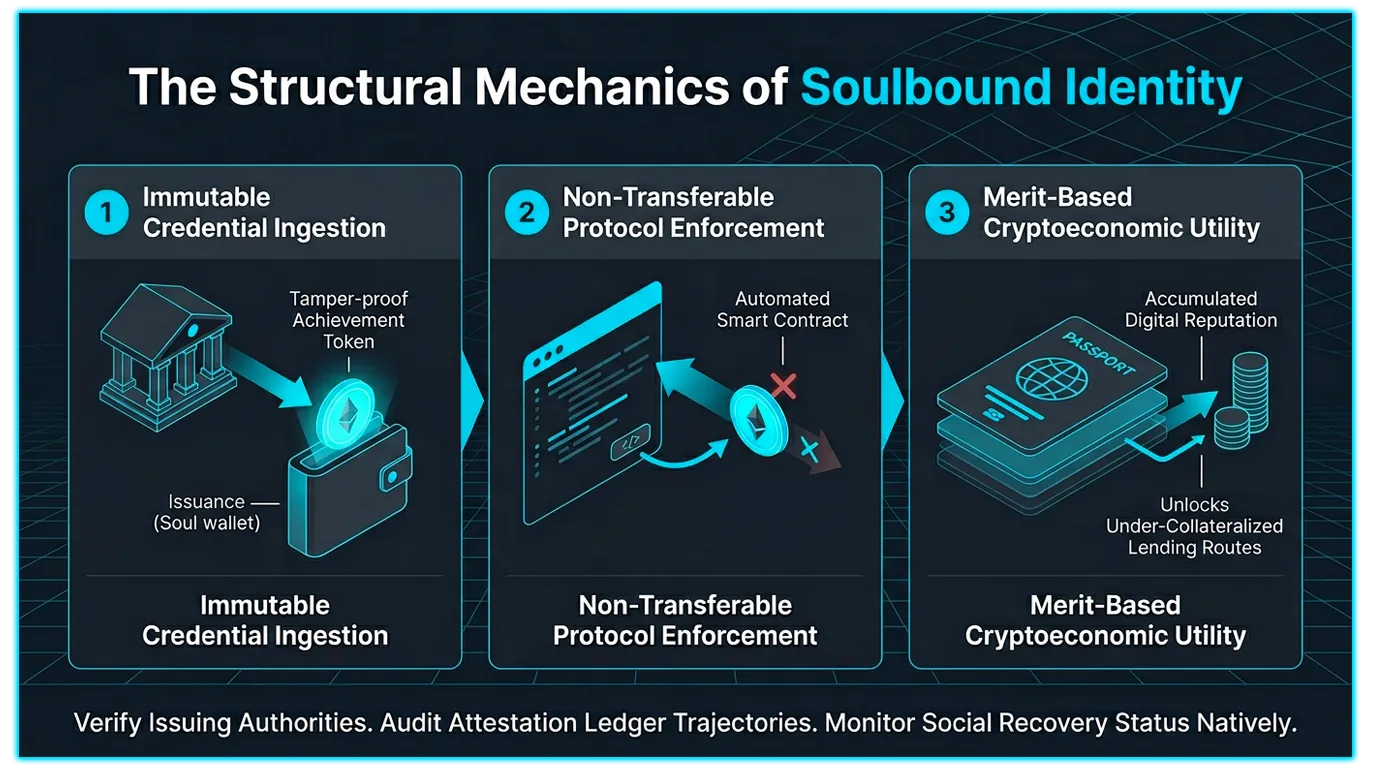
In a traditional NFT contract, functions like transferFrom or safeTransferFrom allow users to buy, sell, or donate assets freely. In an SBT smart contract, these transfer functions are explicitly hardcoded to throw an execution error and fail. Once a token is minted and received by a specific target wallet address, it is programmatically bound to that account permanently.
Revocation and Administrative Upgrades
Because real-world credentials are not always static, an unbending lock can create operational bottlenecks. Modern SBT implementations include programmatic administrative overrides. If a professional certification expires, an educational institution issues an asset to the wrong recipient, or a driver's license is suspended, the original issuing Soul retains the explicit right to trigger a burn function, programmatically deleting or updating the token without requiring authorization from the token holder's wallet.
2. The Lost Wallet Paradox and Social Recovery Models
The permanent nature of Soulbound Tokens creates a critical systemic risk: The Lost Wallet Paradox. If an investor loses the private keys to a standard cryptocurrency wallet, they lose capital; if they lose access to a Soul wallet, they lose their entire verifiable digital identity, including irreplaceable academic degrees, credit histories, and employment credentials.
To insulate users from identity devastation, the SBT framework relies heavily on Social Recovery Models.
The Guardian Architecture: Rather than depending on a single vulnerable seed phrase, a Soul wallet designates a distributed group of "Guardians", which can include trusted family members, institutional issuers, or decentralized autonomous organizations (DAOs).
If a user loses their private keys, a majority consensus among these designated guardians can sign an on-chain transaction that programmatically migrates the underlying SBT record blocks from the compromised wallet straight to a newly generated public address, safely restoring the user's digital identity.
3. Core On-Chain Use Cases: Credentials, Credit, and Governance
By shifting the focus of digital assets from wealth signaling to historical merit, SBTs enable powerful, fraud-resistant applications across Web3.
Sybil-Resistant Governance: Traditional DAOs allocate voting weights based on the raw volume of tokens held, allowing wealthy capital pools to easily outvote active contributors. By distributing non-transferable SBTs to users based on verified project contributions, organizations can implement fair "one-person, one-vote" models or weight voting power purely by historical community merit.
Reputation-Based Under-Collateralized Lending: DeFi lending typically requires borrowers to post excessive collateral to back a loan, which limits capital efficiency. SBTs track on-chain credit behaviors, storing verifiable records of successfully repaid loans, employment consistency, and historical financial compliance. This decentralized credit score allows protocols to confidently extend under-collateralized loans based on reputation rather than raw financial leverage.
Tamper-Proof Verification: Educational institutions and employers use SBTs to issue digital diplomas and skill certifications. Because these tokens cannot be traded or bought, they form a reliable, un-falsifiable digital resume that third parties can audit instantly on-chain without contacting centralized registries.
Asset Class Architecture Comparison Matrix
| Feature | Traditional NFTs | Soulbound Tokens (SBTs) |
| Transfer Vector | Open Market / Tradable | Hardcoded / Permanent Block |
| Core Value | Speculation & Scarcity | Verifiable Merit & Credentials |
| Use Case | Digital Art & In-Game Gear | Identity, Voting, Credit Scores |
Navigating Ecosystem Governance via DEXTools
- Navigating the emerging web of trust requires deep visibility to analyze the momentum of accompanying governance protocols. Sourcing analytics through advanced decentralized charting architectures like DEXTools gives digital asset allocators a definitive, universal command center to track real-time token performance, evaluate exchange pool depths, and audit contract settings across multiple public networks.
- By digging into core features like the Pair Explorer, the Live New Pairs scanner, or reviewing historical behavior inside the Trade Story and Top Traders logs, market participants can dissect localized volume metrics. Furthermore, reviewing institutional distribution flows via the Big Swap Explorer enables traders to verify automated contract safety rankings before executing trades, keeping your secure hardware setup safely insulated from unverified venues.
Disclaimer: This article is for informational purposes only and does not constitute investment advice, financial advice, trading advice, or any other kind of advice. DEXTools does not recommend buying, selling, or holding any cryptocurrency or token. Users should conduct their own research and consult with a qualified financial advisor before making any investment decisions. Cryptocurrency investments are volatile and high-risk. DEXTools is not responsible for any losses incurred.
Related Guides
- What Is Unstoppable Domains: Web3 Domains, Identity and Digital Ownership (2026)
- What Is KYC in Crypto? Identity Verification Guide (2026)
- What Is ENS: Ethereum Name Service, Wallet Names and Web3 Identity (2026)
- What Is Decentralized Identity (DID): Complete Web3 Identity Guide (2026)
- Zapper Tutorial: Navigate DeFi Dashboards and Manage Multi-Chain Portfolios (2026)
Frequently Asked Questions
What are soulbound tokens (SBTs)?
Soulbound tokens are tokens that are generally non-transferable and tied to a specific wallet or identity. They are proposed as a way to represent credentials, memberships or achievements onchain.
How are soulbound tokens different from regular NFTs?
Regular NFTs can be bought, sold and transferred between wallets, while soulbound tokens are designed to stay with the wallet they are issued to. This non-transferability is what makes them suited to identity and reputation use cases.
What can soulbound tokens be used for?
Potential uses include representing credentials, certifications, memberships and other verifiable attributes linked to an identity. Because they are non-transferable, they can signal that the holder genuinely earned or was granted something.
What is onchain identity?
Onchain identity refers to representing aspects of a person's or entity's identity and reputation using blockchain records. Soulbound tokens are one proposed building block for this kind of verifiable, persistent identity.