Stablecoin Depegs: Causes and How to Protect Yourself
When digital dollars break their peg, portfolio safety vanishes. Learn the underlying mechanics of stablecoin depegs and how to split your risk effectively.
Causes, Mechanics, and Risk Mitigation Strategies
- The decentralized finance ecosystem relies on stablecoins as its absolute unit of account, collateral layer, and portfolio safe haven. When market volatility forces volatile assets into a downward spiral, investors routinely migrate capital into digital dollars to preserve purchasing power. However, the foundational assumption of this ecosystem (that a stablecoin will always equal exactly 1.00 USD) is not a cryptographic guarantee. It is the result of continuous, fragile economic equilibrium.
- When a stablecoin loses its one-to-one conversion rate with its reference currency, a depeg occurs. For crypto users, a depeg event is one of the most structurally disruptive tail-risks in Web3, capable of triggering cascading liquidations across lending protocols and erasing principal capital in minutes. Understanding the mechanics behind these market anomalies and implementing robust defense frameworks is mandatory for long-term capital preservation.
1. The Core Mechanics: Why Stablecoins Lose Their Peg
A stablecoin depeg is rarely a random software glitch; it is an economic breakdown of supply, demand, and structural arbitrage incentives.
Liquidity Inbalance and AMM Skew
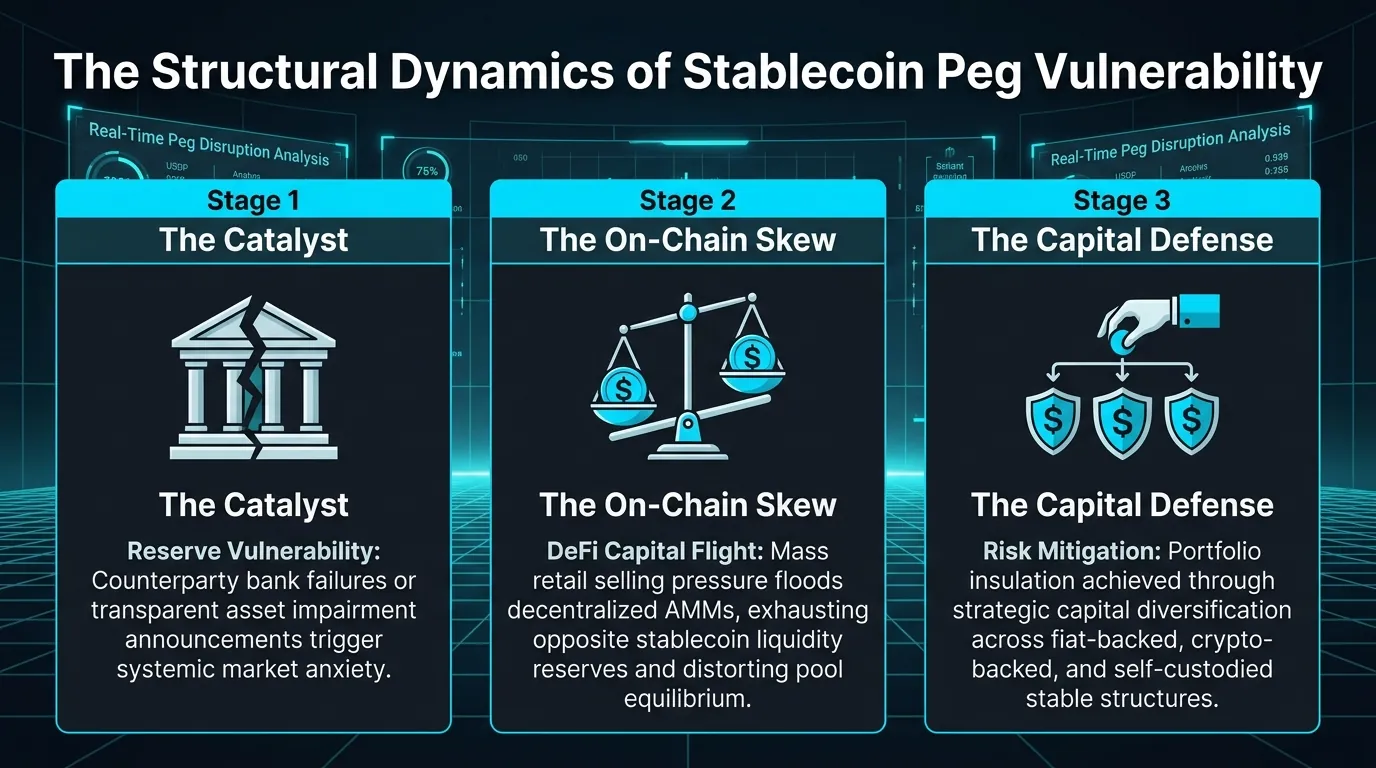
- In decentralized finance, stablecoins are traded primarily through Automated Market Makers (AMMs) like Uniswap or Curve. Under normal market conditions, liquidity pools maintain a balanced ratio of stablecoin pairs (e.g., 50% USDC and 50% USDT).
- When localized panic occurs, market participants flood the pool to swap the "suspect" stablecoin for a safer alternative. If the selling pressure outpaces the available liquidity, the pool becomes heavily skewed. The automated pricing algorithms of the AMM respond by lowering the price of the asset being dumped, causing a localized depeg on-chain.
The Breakdown of the Arbitrage Loop
- The primary mechanism keeping a fiat-backed stablecoin at 1.00 USD is the primary market arbitrage loop. If a stablecoin drops to 0.98 USD on the open market, institutional arbitrageurs buy the cheap token on-chain and redeem it directly with the issuer (like Circle or Tether) for a full 1.00 USD in cash, pocketing a 2% profit. This buying pressure pushes the price back up.
- A permanent or prolonged depeg happens when this primary redemption loop breaks. If the issuer pauses redemptions, faces banking restrictions, or lacks the liquid assets to fulfill withdrawals, the arbitrage loop fails, and the market price plummets.
2. Historical Precedents: Case Studies in Volatility
Evaluating historical depeg events reveals that vulnerabilities can emerge from both compliant, centralized systems and opaque offshore reserves.
The USDC March 2023 Banking Shock
In March 2023, USD Coin (USDC), widely considered the gold standard of regulated, compliant stablecoins, suffered a severe depeg, dropping to roughly 0.88 USD across major decentralized execution venues.
The Root Cause: The sudden collapse of Silicon Valley Bank (SVB), a major traditional financial institution in the United States. Circle, the issuer of USDC, disclosed that 3.3 billion USD of its cash reserves were held inside the insolvent bank.
The Market Reaction: Panic spread instantly. Fearing that a portion of USDC's backing was permanently lost, users rushed to dump the token.
The Resolution: The depeg was resolved only when the U.S. Federal Reserve intervened to guarantee all deposits at SVB. Once it became clear that Circle would recover 100% of its cash reserves, the primary redemption pipeline resumed operations, and the arbitrage loop brought USDC back to its 1.00 USD peg.
The Persistent Tether (USDT) FUD Dynamics
Tether (USDT) has spent nearly a decade navigating consistent Fear, Uncertainty, and Doubt (FUD) regarding its reserve composition, legal jurisdiction, and lack of a traditional, top-four accounting audit.
Historical Deviations: During major market panics, such as the collapse of the Terra ecosystem in 2022, USDT has experienced brief open-market depegs, occasionally dipping to 0.95 USD on specific exchanges as retail capital fled toward USDC.
The Structural Moat: Despite persistent media skepticism, Tether has consistently met every real-world redemption request, even processing over 10 billion USD in withdrawals over a single week during historical panics. Tether's extensive reserve accumulation (holding billions in U.S. Treasury bills) has established a deep capital buffer that has preserved its peg through every market cycle, demonstrating that real-world liquidity often trumps narrative transparency during a crisis.
3. Defensive Architectures: How to Protect Your Capital
Relying entirely on a single digital asset for portfolio preservation is a structural vulnerability. To mitigate the impact of an unexpected depeg, you must implement defensive risk-management frameworks.
The Multi-Asset Bucket Strategy (Hedging via Diversification)
Never maintain 100% of your stable capital allocations within a single stablecoin. A robust capital preservation strategy spreads risk across different stablecoin architectures:
The Regulated Bucket (e.g., USDC, PYUSD): Fully backed by onshore U.S. cash and short-term Treasuries, offering high regulatory compliance but carrying localized banking risks.
The Operational Bucket (e.g., USDT, FDUSD): Possesses the deepest global liquidity and exchange trading volume, acting as an efficient tool for rapid market execution despite offshore custody frameworks.
The Decentralized Over-Collateralized Bucket (e.g., USDS/DAI): Backed by on-chain crypto assets and real-world assets via transparent smart contracts, removing single-issuer corporate counterparty risk.
- By splitting your stablecoin capital across these separate models, a catastrophic depeg in one asset will only impact a fraction of your overall net worth, giving you the liquidity needed to navigate the crisis.
Maintaining Self-Custody Access
- If you leave your stablecoin reserves on a centralized exchange during a depeg event, you are subject to the exchange's operational rules. Centralized exchanges routinely freeze trading pairs, halt deposits/withdrawals, or experience server crashes during extreme volatility.
- Keeping your stable assets in a self-custodial hardware wallet or passkey-secured smart account ensures you maintain the ability to swap out of a failing asset via decentralized protocols at a moment's notice.
Technical Trade-offs and Market Realities
Stablecoin Architecture Risk Matrix
| Stablecoin Type | Core Backing Model | Primary Depeg Catalyst | Structural Mitigant |
| Fiat-Backed (Centralized) | Cash deposits, short-term treasury bills in bank custody. | Custodian bank insolvency; regulatory asset freezing. | Independent monthly attestations; segregated trust legal structures. |
| Crypto-Backed (Decentralized) | Over-collateralized volatile crypto positions (ETH/BTC). | Extreme market gaps outpacing automated liquidation engines. | Protocol-level stability modules; automated debt auction keepers. |
| Synthetic (Delta-Neutral) | Spot long crypto holdings balanced by equal short futures positions. | Prolonged negative derivatives funding rates; exchange counterparty defaults. | Dynamic insurance funds; multi-exchange yield diversification. |
4. Real-Time On-Chain Telemetry via DEXTools
When market panic begins to surface and a stablecoin drifts away from its 1.00 USD anchor, waiting for centralized media reports or delayed oracle feeds can result in heavy execution losses. Deep liquidity pools on decentralized exchanges provide the rawest, unedited reflection of market behavior.
Traders navigate volatile depegging events by tracking live on-chain metrics directly on www.dextools.io:
Monitoring the Pair Explorer: Instead of checking generic exchange prices, use the platform's detailed charting interface to track specific stable-to-stable pairs (such as USDC/USDT or USDS/USDC) across multiple blockchain layers to capture real-time price deviations.
Rist Tracking with the Big Swap Explorer: During a potential stablecoin crisis, audit the high-volume transaction ledger to verify if institutional whales are actively dumping large blocks of the asset, or if sophisticated arbitrageurs are stepping in to buy the discount, providing critical directional context before you execute a trade.
Auditing Cross-Chain Liquidity Depth: Verify the absolute depth of automated market maker pools before executing an emergency exit swap, allowing you to optimize your routing and prevent severe slippage penalties.
Disclaimer: This article is for informational purposes only and does not constitute investment advice, financial advice, trading advice, or any other kind of advice. DEXTools does not recommend buying, selling, or holding any cryptocurrency or token. Users should conduct their own research and consult with a qualified financial advisor before making any investment decisions. Cryptocurrency investments are volatile and high-risk. DEXTools is not responsible for any losses incurred.