Stargate vs. Synapse vs. Hop: The Cross-Chain Comparison

Traditional cross-chain bridges trap users in slow validation windows and fragmented capital. We break down the automated market makers and RFQ solvers powering top liquidity bridges.
The Cross-Chain Liquidity Trilemma: Asset Routing
- Cross-chain protocols have evolved past simple data-passing layers. In decentralized finance, the core challenge is moving massive blocks of capital across isolated networks without exposing users to heavy transaction gas fees, systemic smart contract exploits, or localized price slippage. When an application or trading desk executes a multi-chain swap, the quality of the underlying liquidity pool directly determines transaction viability.
- Stargate Finance, Synapse Protocol, and Hop Protocol represent distinct technical eras and structural frameworks, within their own cross-chains liquidity pool landscapes. Navigating this ecosystem requires an analysis of their active network coverages, structural slippage risks, and core protocol fee matrices.
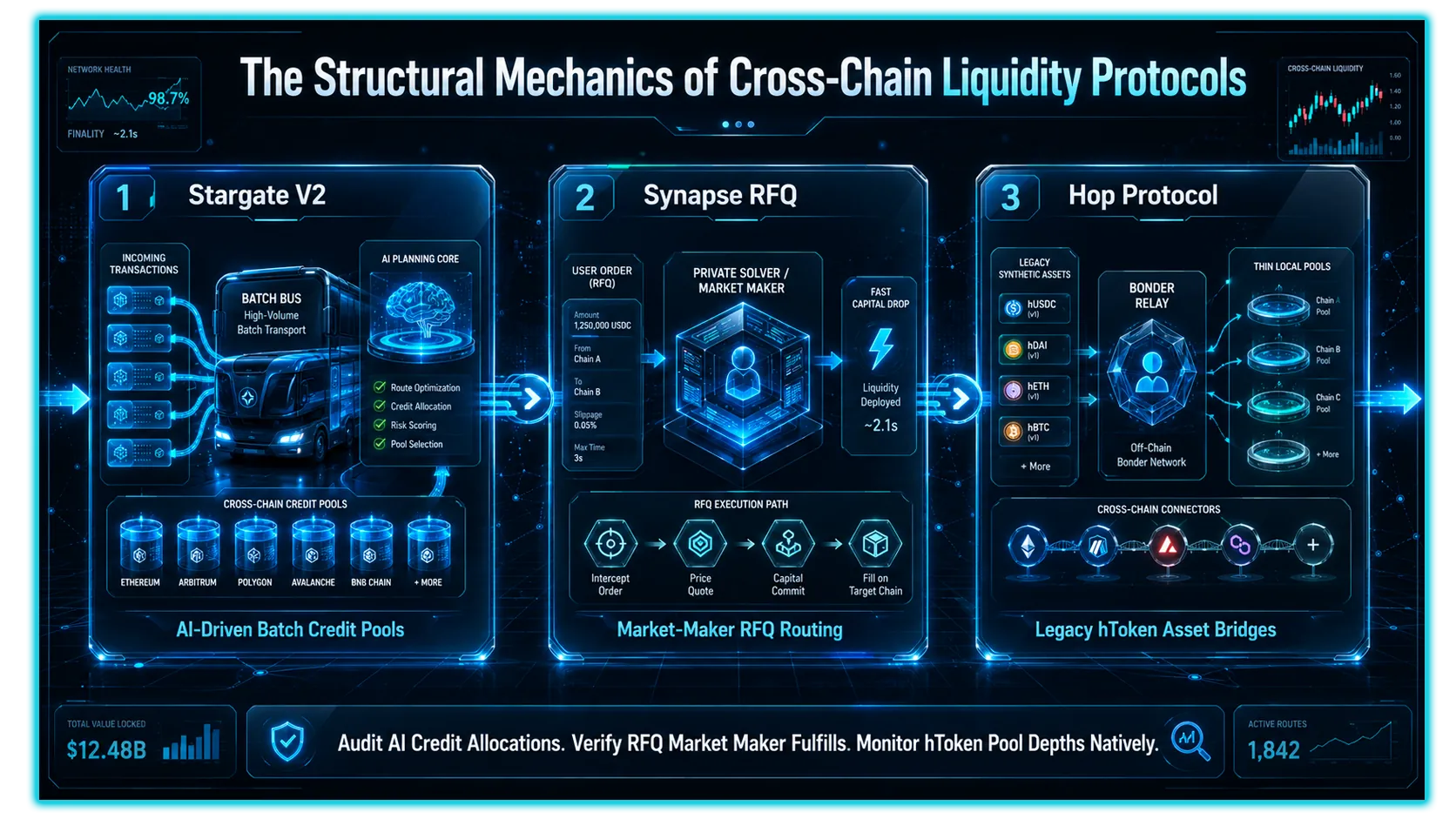
1. Stargate Finance (V2): Institutional Scale Engine
Operating on top of LayerZero 's underlying transport rails, Stargate has processed over $70 billion in cumulative volume. Following its structural acquisition by the LayerZero Foundation, the protocol deployed its comprehensive Stargate V2 upgrade framework, discarding its legacy static Delta algorithm for an off-chain, predictive credit-allocation model.
Stargate V2 manages capital efficiency and transaction costs using two primary speed tracks and a modular scaling protocol:
The Stargate Bus Layer: Designed for cost-sensitive transfers, this mechanism batches multiple user transactions into a single, unified data payload. This aggregates messaging costs across users, lowering individual transaction processing fees.
The Stargate Taxi Layer: For high-velocity allocators requiring immediate execution, this track bypasses the batching queue to settle transactions directly on the destination endpoint, bound solely by native source-chain finality constraints.
The Hydra BaaS System: To expand liquidity without fracturing assets, Stargate deploys Hydra (Bridging-as-a-Service). This framework locks core assets natively on established ledgers and issues light, Hydra-wrapped versions on newer, emerging chains, providing them with immediate access to Stargate's primary liquidity pools.
2. Synapse Protocol: Hybrid Messaging & RFQ Network
Synapse coordinates cross-chain interactions through a generalized messaging framework secured by an optimistic verification topology. Rather than tying its utility to a single routing path, Synapse implements a hybrid architecture that runs three separate bridging pipelines: Cross-Chain AMM Liquidity Pools, Canonical Asset Wrapping, and its modernized Synapse RFQ (FastBridge V2) system.
The core operational strength of the platform centers on its Request for Quote (RFQ) infrastructure:
Private Solver Auctions: When a user initiates a transfer, the Synapse RFQ router completely bypasses standard automated market maker (AMM) liquidity pools. Instead, it broadcasts an open off-chain request to an elite network of private market makers and solvers.
Zero Pool Exposure: The winning solver intercepts the order and fronts their own native capital directly on the target network, delivering sub-minute transaction finality while insulating the core protocol from smart contract pool manipulation or bad-debt drains.
3. Hop Protocol: The Rollup Pioneer in Retreat
Hop Protocol pioneered Ethereum Layer 2 scalability by establishing an automated system to bypass the standard 7-day fraud-proof withdrawal windows enforced by optimistic rollups. The system achieves cross-chain routing by creating intermediate, protocol-native synthetic tokens called hTokens (e.g., hETH, hUSDC) paired with localized AMM swap pools (the Hop Exchange) on individual subnets.
The protocol relies on off-chain liquidity agents known as Bonders:
The Capital Advance Loop: When a user transfers capital between rollups, the transaction destroys the asset on the source side. A Bonder instantly verifies the event, locks up corresponding collateral on Ethereum Layer 1, and mints matching hTokens on the destination rollup to fulfill the request.
The Liquidity Constraint: While technically innovative during the early L2 expansion phase, Hop's reliance on static AMM pools has led to a severe structural contraction. As modern intent-based bridges and competitive RFQ solvers captured the market, Hop's Total Value Locked (TVL) shrank to roughly $3 million. This thin liquidity profile introduces high slippage risks, restricting its practical coverage to small retail transfers across Ethereum Layer 1 and a handful of legacy L2 instances like Arbitrum, Optimism, Base, and Polygon.
Ecosystem Architecture & Coverage Matrix
| Protocol | Base Architecture | Active Chain Coverage |
| Stargate V2 | LayerZero Credit Layer | 16+ Core Chains & Hydra Spokes |
| Synapse | Hybrid Messaging / RFQ | 16+ EVM & Solana Ecosystems |
| Hop Protocol | Legacy hToken AMM Pools | Ethereum L1 & Main L2s Only |
Slippage Protection & Protocol Fee Matrix
| Protocol | Average Transfer Fee | Slippage Protection |
| Stargate V2 | Ultra-Low (Bus Mode) | Guaranteed Finality (Zero Slippage) |
| Synapse | Moderate (Competitive RFQ) | Minimal (Market-Maker Backed) |
| Hop Protocol | Variable (Bonder Premium) | High Slippage (Thin Liquidity) |
Universal Market Telemetry Sourcing via DEXTools
- As liquidity rotates across alternative execution layers, tracking cross-chain token flows, bridge token capitalizations, and the real-time liquidity distributions of multi-chain routing pairs is an essential analytical priority. Sourcing analytics through advanced decentralized charting architectures like DEXTools gives market participants an essential universal platform to monitor live token behaviors, evaluate pool depths, and inspect contract parameters across all public execution networks.
- By leveraging core features like the Pair Explorer, Live New Pairs dashboard, and the integrated Trade Story or Top Traders diagnostic tools, technical traders can seamlessly audit localized volume trends, track large whale wallet capital reallocations via the Big Swap Explorer, and check automated contract safety scores before initiating any on-chain interactions, ensuring your hardened hardware setup interacts safely with verified market venues.
Disclaimer: This article is for informational purposes only and does not constitute investment advice, financial advice, trading advice, or any other kind of advice. DEXTools does not recommend buying, selling, or holding any cryptocurrency or token. Users should conduct their own research and consult with a qualified financial advisor before making any investment decisions. Cryptocurrency investments are volatile and high-risk. DEXTools is not responsible for any losses incurred.