What is LayerZero (ZRO)? Omnichain Protocol Explained

Traditional cross-chain bridges trap users in expensive middlechains and risky wrapped assets. We break down the decentralized verifier networks and gas abstractions powering LayerZero's omnichain endpoints.
The Liquidity Fragmentation Paradox: Eliminating Middlechains
- Traditional cross-chain architectures generally rely on one of two flawed systems: centralized multi-sig bridges that create multi-billion-dollar security honeypots, or specialized intermediary blockchains ("middlechains") that force every transaction to route through an independent consensus layer. These approaches introduce extra security assumptions, increase transaction latency, and fragment liquidity into restrictive, wrapped asset types.
- LayerZero bypasses these compromises entirely. Operating as an immutable, censorship-resistant, and permissionless omnichain interoperability protocol, LayerZero functions as a low-level messaging transport layer. Instead of processing computations on a middlechain, LayerZero embeds lightweight, non-upgradeable smart contracts called Endpoints natively across more than 165 public networks. This architectural shift enables any application to pass arbitrary data, execute remote contract calls, and move native assets across chain boundaries with absolute security autonomy.
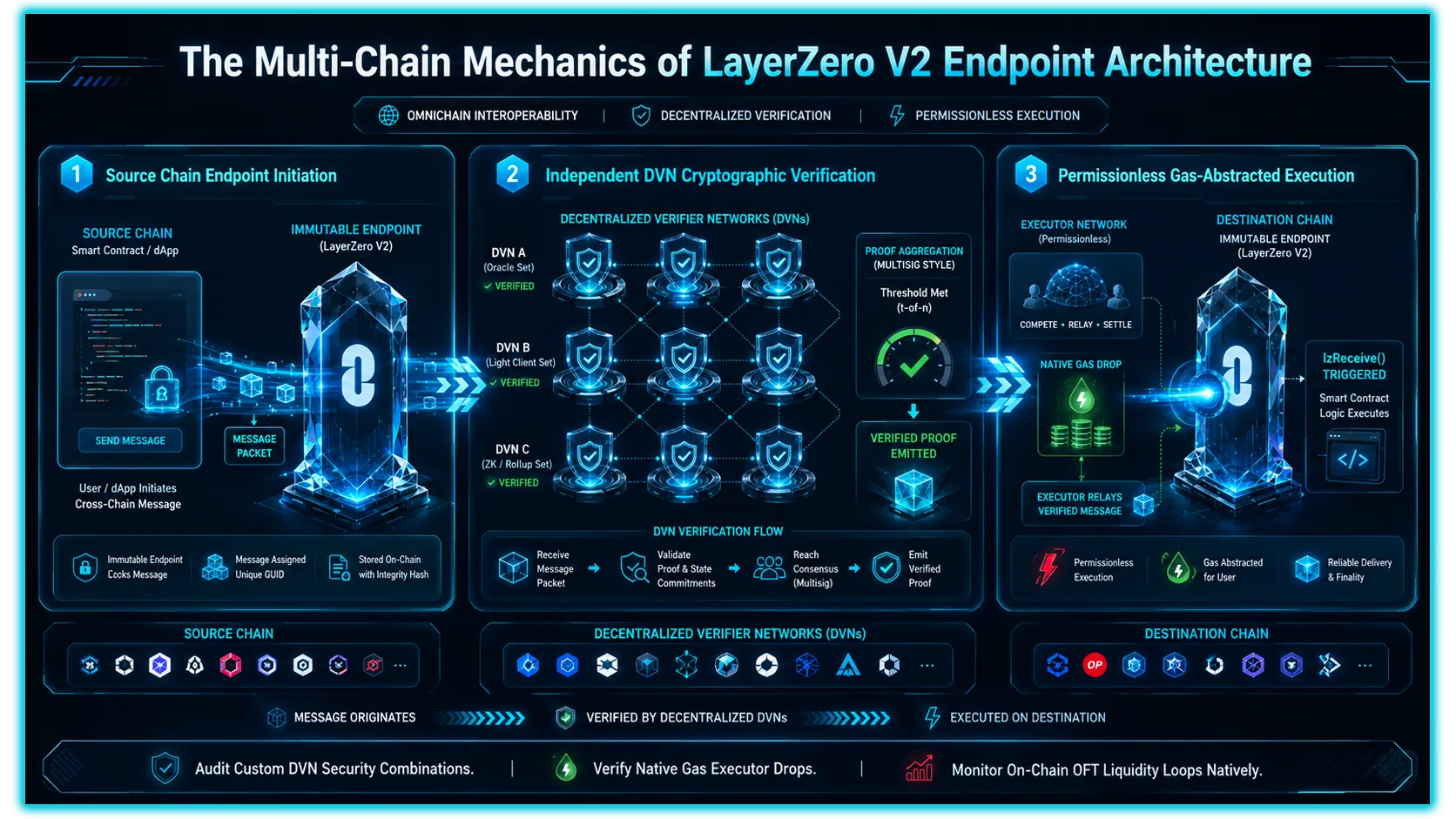
1. The Security Layer: Decentralized Verifier Networks (DVNs)
With the deployment of LayerZero V2, the protocol retired the legacy Oracle model, transitioning to a highly customizable security framework steered by Decentralized Verifier Networks (DVNs).
DVNs are independent, off-chain entities tasked with examining cross-chain messages and confirming that the source data is accurate.
Configurable Application Security: Rather than forcing every application to accept a single, protocol-wide security setup, LayerZero places security control entirely in the hands of the individual application (OApp).
Multi-Sig Verification Tiers: A developer can construct a custom security stack requiring a consensus split across multiple distinct DVNs (e.g., demanding a 2-of-3 signature pattern from Google Cloud, Blockdaemon, and an internal company node). If the cryptographic proofs provided by these separate networks do not align perfectly, the destination chain rejects the payload, removing single points of institutional failure.
2. The Execution Layer: LayerZero Executors and Gas Abstraction
LayerZero structurally separates the verification of a message from its physical execution on the destination chain. Once the chosen DVNs write their verified cryptographic approvals to the endpoint, the payload enters the hands of Executors.
Executors provide Execution as a Service for omnichain messages:
Permissionless Automation: Anyone can act as an Executor. They monitor the confirmed state changes and call the
lzReceiveorlzComposemethods on the destination blockchain endpoint, triggering the target application's local smart contract logic.Gas Token Abstraction: Executors dramatically streamline the cross-chain user experience. A user executing an action pays for the entire multi-chain transaction loop up-front on the source chain using that network's native gas asset. The Executor automatically receives this payment, handles the cross-chain routing, and provisions the correct destination gas asset on the user's behalf to settle the transaction.
3. Asset Universality: The Omnichain Fungible Token (OFT) Standard
- To eliminate the systemic de-peg and smart contract risks introduced by traditional wrapped tokens, LayerZero pioneered the Omnichain Fungible Token (OFT) standard.
- The OFT framework treats an asset as a single, unified primitive that moves natively across multiple independent ledgers without wrapping or intermediate chain escrows. This burn-and-mint equilibrium keeps the global supply perfectly balanced.
- The OFT standard has achieved massive institutional dominance, supporting over $87 billion in active multi-chain assets across 750+ token implementations. Highly scalable projects -including Ethena (USDe), PayPal USD (PYUSD), and Tether's USDT0- utilize the OFT pipeline as their foundational cross-chain asset distribution infrastructure.
4. Tokenomics: The Evolution of the ZRO Asset
The economic architecture of the native ZRO token (featuring a fixed total supply of 1 billion) transformed following critical community governance referendums.
Originally acting as a simple voting asset, ZRO has evolved into a value-capturing utility token. Under this updated framework, ZRO serves three primary network roles:
The Fee Switch Deflation Matrix
Activated by governance, the LayerZero Fee Switch turns ZRO into a deflationary asset. A baseline protocol fee is charged on cross-chain messaging verification and execution actions. These collected fees are automatically channeled into an open-market buyback and burn mechanism, systematically reducing the circulating floating supply as global application volume scales.
The Zero Blockchain Gas Frontier
LayerZero's tokenomics will expand further with the upcoming launch of Zero, an institutional-grade Layer 1 blockchain optimized alongside major financial powerhouses like Citadel Securities, DTCC, and Intercontinental Exchange (ICE). Slated for release in late 2026, the Zero network utilizes zero-knowledge execution zones where ZRO functions as the exclusive native gas token for priority transactions, tips, and network validations.
Interoperability Infrastructure Comparison Matrix
| Metric | Middlechain Bridges (e.g., Axelar) | LayerZero Protocol (V2 Architecture) |
| Trust Topology | Third-Party Chain Validators | App-Isolated DVNs (Decentralized) |
| Execution Path | Forces Middlechain Routing | Direct Peer-to-Peer Endpoints |
| Gas Management | Multi-Token Manual Handling | Automated Executor Abstraction |
| Asset Identity | Wrapped / Derivative Assets | Native Omnichain Fungible Tokens (OFT) |
Monitoring Omnichain Data via DEXTools Telemetry
- As application architectures transition into fully native omnichain models and route assets across expanding networks, keeping constant track of localized liquidity pool depths, transfer volumes, and smart contract health scores is a vital analytical requirement. Sourcing analytics through advanced decentralized charting architectures like DEXTools gives market participants an essential universal platform to monitor live token behaviors, evaluate pool depths, and inspect contract parameters across all public execution networks.
- By leveraging core features like the Pair Explorer, Live New Pairs dashboard, and the integrated Trade Story or Top Traders diagnostic tools, technical traders can seamlessly audit localized volume trends, track large whale wallet capital reallocations via the Big Swap Explorer, and check automated contract safety scores before initiating any on-chain interactions, ensuring your hardened hardware setup interacts safely with verified market venues.
Disclaimer: This article is for informational purposes only and does not constitute investment advice, financial advice, trading advice, or any other kind of advice. DEXTools does not recommend buying, selling, or holding any cryptocurrency or token. Users should conduct their own research and consult with a qualified financial advisor before making any investment decisions. Cryptocurrency investments are volatile and high-risk. DEXTools is not responsible for any losses incurred.