The Anti-FOMO Guide to DEXTools
— By Whatsertrade in Tutorials
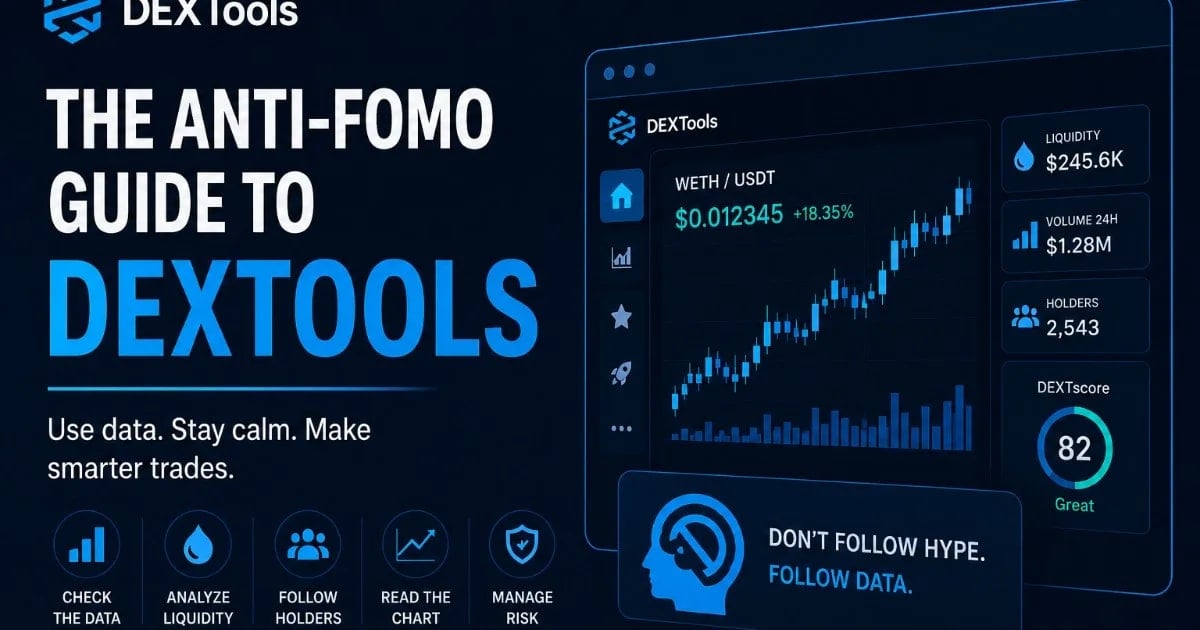
Master emotional trading with DEXTools. Learn to analyze market signals and make informed decisions in decentralized exchanges.
FOMO is one of the most expensive emotions in crypto trading. A token starts pumping, social media becomes loud, the chart turns green, and suddenly it feels like there is no time to think. Many traders enter because they are afraid of missing the move, not because the data supports the trade.
DEXTools can help traders slow down. It gives access to charts, liquidity, transaction activity, holders, and other market signals that can turn emotional trading into structured analysis.
Key Takeaways
The purpose of this guide is simple: use DEXTools as an anti-FOMO tool before entering any decentralized exchange trade.
Why FOMO Is So Dangerous in DEX Trading
Decentralized markets move quickly. New tokens can launch and pump within minutes. Low liquidity can create huge percentage moves. Influencer posts can attract sudden attention. Trending lists can make a token look stronger than it really is.
The problem is that FOMO often appears at the worst possible moment. Many traders buy after the easiest part of the move has already happened. They enter when early buyers are preparing to sell.
DEXTools cannot eliminate risk, but it can help traders ask better questions before they click buy.
1. Do Not Buy Just Because a Token Is Trending
Trending tokens attract attention, but attention is not the same as safety. A token can trend because of real demand, but it can also trend because of short term speculation, artificial volume, or coordinated buying.
Before buying a trending token, open the chart and study the market structure. Is the price moving in a controlled way, or is it already vertical? Is there real trading depth, or does liquidity look weak? Are holders increasing naturally, or does activity appear concentrated?
A trending token deserves analysis, not automatic trust.
2. Compare the Current Price With the First Move
One common FOMO mistake is buying after a token has already made a massive move. When a chart is up several hundred percent in a short time, the risk of a pullback can be high.
Using DEXTools, traders can review the early candles and compare the current entry point with the first accumulation area. If the token has moved too far too quickly, it may be better to wait for consolidation instead of chasing.
A good trade does not need to be forced. Sometimes the best decision is to wait.
3. Watch the Sell Pressure
FOMO focuses on buys. Smart analysis also studies sells.
Look at the transaction feed. Are large wallets selling into the pump? Are early buyers taking profit? Is every green candle followed by heavy selling? If sellers are becoming aggressive, the upside may be weaker than it appears.
A token can still rise while sellers are active, but consistent sell pressure should make traders more cautious.
4. Check Liquidity Before Volume
Volume can look exciting, but liquidity is what supports real trading. A token with high volume and low liquidity may move violently in both directions.
Before entering, compare volume with available liquidity. If the liquidity is too thin, even a small sell can create a large drop. This is especially important for new tokens and low market cap pairs.
FOMO makes traders focus on how much they can gain. Liquidity analysis reminds traders how difficult it may be to exit.
5. Study Holder Distribution
Holder data can help traders understand concentration risk. If a small number of wallets control a large amount of supply, the token may be vulnerable to sudden selling.
A growing holder base can be positive, but it should be combined with other signals. Healthy growth usually includes diverse buyers, stable liquidity, and reasonable price action.
Do not assume that more holders automatically means lower risk. Always look deeper.
6. Use a Personal Entry Rule
DEXTools is most powerful when used with a clear process. Before entering a trade, define your own rules.
For example:
I will not buy after a vertical candle without waiting for a pullback.
I will not enter if liquidity is too low.
I will not buy if the same few wallets dominate the activity.
I will not chase a token only because it appears on a trending list.
I will review transactions before making a decision.
Rules protect traders from emotional decisions. They create distance between the chart and the buy button.
7. Wait for Confirmation
In fast markets, waiting feels uncomfortable. But confirmation can prevent bad entries.
Confirmation may include stable liquidity, controlled consolidation, repeated buyer interest, reduced sell pressure, or organic holder growth. Instead of buying the first candle, traders can wait to see whether the market supports the move.
Missing one trade is not failure. Entering every pump without analysis is the real danger.
8. Build a Watchlist Instead of Chasing
One of the best ways to reduce FOMO is to create a watchlist. When a token looks interesting, it does not always need to become an immediate trade.
Add it to a watchlist, monitor liquidity, review the chart, and watch how holders and transactions develop. This turns impulse into observation.
A watchlist helps traders move from reaction to preparation.
Final Thoughts
DEXTools is not only a tool for finding tokens. It can also be a tool for avoiding bad decisions.
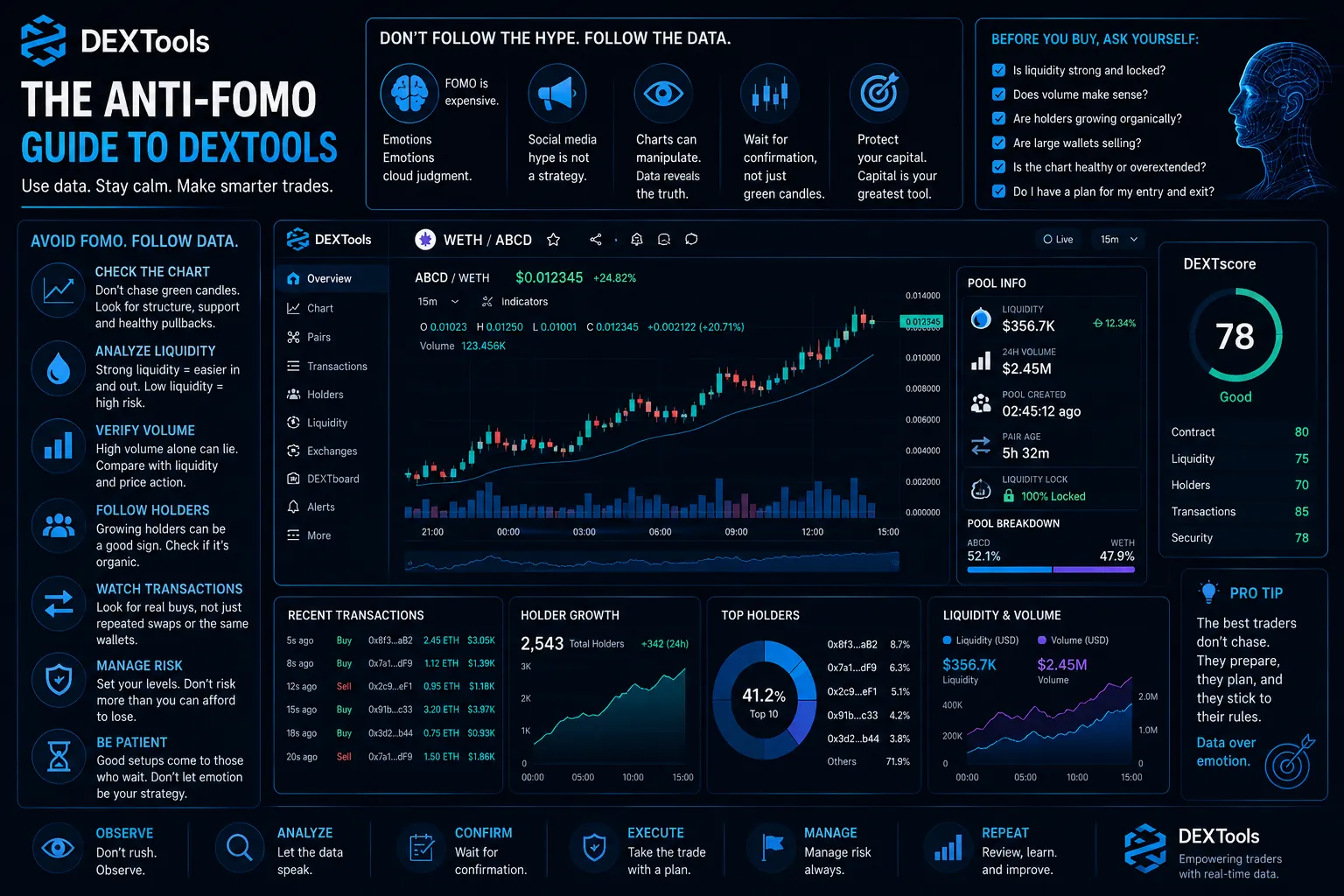
The anti-FOMO approach is based on patience, structure, and data. Before entering a trade, check the chart, liquidity, volume, holders, and transactions. Ask whether the move is supported by real market behavior or only by emotion.
In crypto, the loudest opportunities are not always the best ones. Sometimes the smartest trade is the one you do not take.
The First 60 Minutes After a Token Launch: What to Watch on DEXTools Fake Volume vs Real Demand: How to Spot Artificial Momentum in DeFi Trading How to Find New Tokens on DEXTools Before They Trend When Not to Trade: 12 Red Flags Every DeFi Trader Should Know