The First 15 Minutes of a Token Launch: What DEXTools Data Really Tells You
— By Whatsertrade in Tutorials

Discover how to leverage DEXTools for insights during the initial moments of a token launch and make informed trading decisions in decentralized markets.
The first 15 minutes of a token launch can be exciting, chaotic, and dangerous. Prices move fast, candles print quickly, and traders often rush in because they fear missing the next big opportunity. But in decentralized markets, speed alone is not enough. The real advantage comes from knowing what to look at before the crowd makes a decision.
DEXTools can help traders understand what is happening during the earliest stage of a token launch. Instead of relying only on hype, social media posts, or a fast moving green chart, traders can use real time data to evaluate the quality of the launch.
Key Takeaways
- Why the First 15 Minutes Matter
- 1. Check the Liquidity First
- 2. Watch the First Transactions
- 3. Compare Volume With Liquidity
- 4. Look at Holder Growth
- 5. Study the Candle Shape
This article explains what DEXTools data can reveal in the first 15 minutes of a token launch and how traders can use that information to make more informed decisions.
Why the First 15 Minutes Matter
The beginning of a token launch often sets the tone for the rest of the market cycle. In this short window, traders can observe the first signs of demand, liquidity behavior, wallet activity, and price structure.
A strong launch does not always mean a safe launch. A token can pump aggressively and still be risky. On the other hand, a slower launch with steady volume, stable liquidity, and organic wallet growth may be healthier than a sudden vertical move.
The goal is not to predict the future perfectly. The goal is to avoid entering blindly.
1. Check the Liquidity First
Before looking at price, traders should look at liquidity. Liquidity tells you how easy it is to buy or sell a token without causing extreme price movement.
In the first minutes of a launch, low liquidity can create dramatic candles. A small buy can make the chart look explosive, but that does not always mean real demand exists. It may simply mean the pool is too thin.
When using DEXTools, check whether liquidity is growing, stable, or being removed. Stable or increasing liquidity can be a positive sign. Sudden liquidity removal, extreme imbalance, or very thin liquidity should be treated carefully.
A healthy launch usually has enough liquidity to support trading activity without making every transaction move the price aggressively.
2. Watch the First Transactions
The transaction feed can tell a deeper story than the chart. In the first 15 minutes, traders should look at the rhythm of buys and sells.
Are there many different buyers, or only a few wallets creating most of the activity? Are buys followed by immediate sells? Are there repeated small transactions that look artificial? Are large wallets accumulating or exiting quickly?
A launch with diverse wallet participation may suggest broader interest. A launch dominated by only a few wallets can be more fragile.
The chart shows the result. The transaction feed shows the behavior behind the result.
3. Compare Volume With Liquidity
High volume looks impressive, but volume alone can be misleading. A token may show large trading activity while still having weak liquidity. This can create a dangerous environment where traders enter easily but struggle to exit without heavy slippage.
A useful question is: does the volume make sense compared to the liquidity?
If a token has very high volume but extremely low liquidity, traders should be cautious. It may indicate unstable trading conditions, aggressive speculation, or possible artificial activity.
A better signal is balanced growth: volume increasing together with stable liquidity and expanding wallet participation.
4. Look at Holder Growth
Early holder growth can help traders understand whether interest is spreading. A launch with only a few holders may be easier to manipulate. A launch where holders increase steadily may suggest more organic participation.
However, holder count should not be read alone. A large number of holders does not automatically mean safety. Some launches may distribute tokens across many wallets before trading begins.
The key is to combine holder growth with transaction behavior, liquidity, and chart structure.
5. Study the Candle Shape
Many traders see a huge green candle and feel pressure to enter. But the shape of the first candles can provide useful information.
A vertical candle followed by immediate selling pressure may suggest early buyers are taking quick profits. A more controlled move with periods of consolidation may indicate a healthier market structure.
In the first 15 minutes, traders should avoid judging a launch only by how fast it moves. Speed can create opportunity, but it can also create traps.
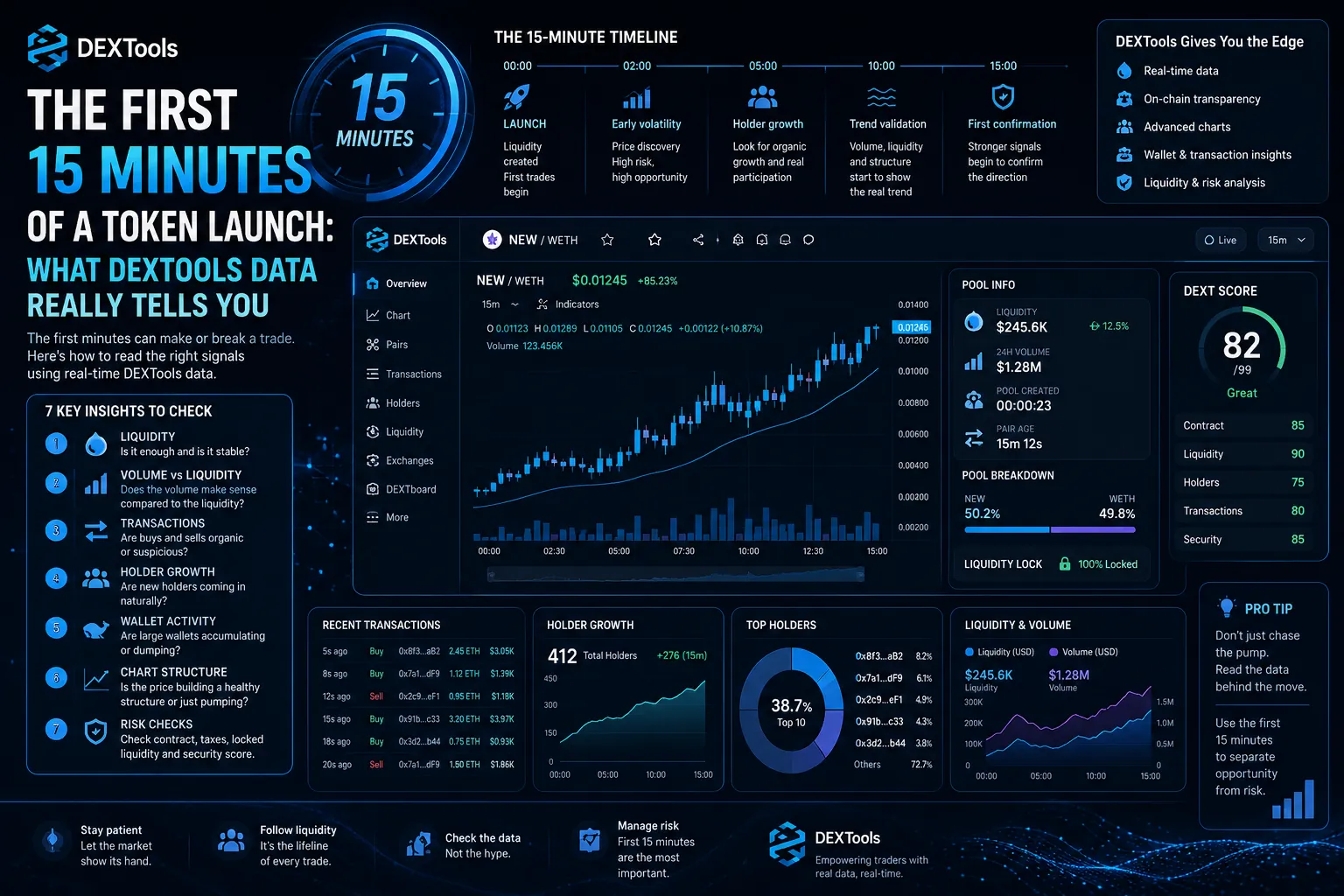
6. Check for Repeated Wallet Patterns
Some launches show repeated behavior from the same wallets. For example, one wallet may buy multiple times to create momentum. Another may sell into every pump. Several wallets may trade in a pattern that looks coordinated.
DEXTools can help traders observe these patterns through transaction data. While this does not prove manipulation, it can help identify behavior that deserves extra caution.
When wallet activity looks too concentrated, the launch may be less organic than it appears.
7. Do Not Ignore the Contract and Token Details
A strong chart does not replace basic token checks. Traders should still review available token information, contract details, trading permissions, and any risk indicators shown on the platform.
A token can have a beautiful chart and still carry serious risks. Early trading data should be used together with contract awareness and risk management.
A Simple 15 Minute Launch Checklist
Before entering a new token launch, ask these questions:
Is liquidity stable or increasing?
Does the volume look natural compared to liquidity?
Are different wallets buying, or is activity concentrated?
Are large wallets selling immediately?
Is holder growth organic?
Is the chart moving in a healthy way or only pumping vertically?
Are there warning signs in the token information?
This checklist will not remove risk, but it can reduce emotional decisions.
Final Thoughts
The first 15 minutes of a token launch are not just about speed. They are about interpretation. DEXTools gives traders access to real time market data, but the advantage comes from reading that data correctly.
Instead of asking, “Is this token pumping?” traders should ask, “Why is it pumping, who is buying, how strong is the liquidity, and what happens when selling starts?”
That mindset can make the difference between chasing hype and making a calculated decision.
Crypto launches are high risk, especially in decentralized markets. But with the right process, traders can move from emotional reactions to data driven analysis.
The First 60 Minutes After a Token Launch: What to Watch on DEXTools Healthy vs Unstable Token Launch Patterns: Key Insights Whale Buy or Exit Liquidity? How to Read Big Swaps Without Blindly Copying Whales How to Check a Liquidity Pool Before Buying a Token 2026