Vote Delegation Explained: How to Delegate or Become a Delegate
— By AliceOnChain in Tutorials
Vote delegation allows cryptocurrency holders to transfer their voting rights to a trusted representative without relinquishing token ownership. This advanced guide breaks down how governance decisions impact market liquidity, volume, and price action, providing a step-by-step framework to participate or lead within decentralized autonomous organizations (DAOs).
Vote Delegation: How to Delegate in DeFi
Decentralized governance serves as the backbone of the Decentralized Finance (DeFi) ecosystem, but managing constant protocol updates requires significant time. Vote delegation solves this friction by allowing token holders to transfer their voting rights to a trusted representative without relinquishing control of their assets. When protocols issue governance tokens, they grant users the right to shape the platform’s future through parameter adjustments, treasury allocations, and protocol upgrades. By utilizing vote delegation, market participants can actively guide Decentralized Autonomous Organization (DAO) decisions while maintaining focus on broader market strategies and portfolio management.
For many retail traders and on-chain analysts, keeping up with dozens of weekly proposals is mathematically and practically challenging. This friction historically leads to low voter turnout, which may allow highly concentrated entities to dominate a protocol's direction. This guide analyzes the technical mechanics of vote delegation, explains how to navigate the process, and explores how tracking governance dynamics on-chain can reveal broader shifts in market sentiment and underlying liquidity.
What is Vote Delegation in DeFi?
Vote delegation is a smart contract mechanism within DAOs where a governance token holder transfers their voting power to another entity, known as a delegate. The delegate can then vote on active proposals using the combined weight of their personal tokens and the tokens delegated to them by the community.
It is critical to understand that delegation does not equal asset transfer. Most modern governance tokens utilize standards similar to the ERC-20Votes extension, which separates the financial balance of a token from its voting weight.
No Loss of Custody: Your assets remain securely within your non-custodial wallet. You retain full utility of the tokens, meaning you can transfer, sell, or provide them as liquidity at any moment.
Instant Revocation: If a delegate acts against your strategic expectations, goes offline, or alters their governance platform, you can instantly revoke the delegation or reassign your voting power to a different network participant.
Proportional Weight Adjustments: The smart contract dynamically tracks your wallet balance. If you sell twenty percent of your tokens, the voting power currently assigned to your delegate automatically decreases by that exact margin.
From an analytical perspective, major governance shifts frequently correlate with changes in broader market structures. Monitoring the DEXTools Pair Explorer during a heated governance cycle can help identify whether shifting voting power aligns with fluctuations in trading volume or sudden adjustments in automated market maker (AMM) pools.
Why Vote Delegation Matters for Market Analytics
Governance decisions are not merely administrative events; they maintain a direct, measurable relationship with market dynamics, including holder distribution, price action, and protocol revenue models. Understanding vote delegation provides a distinct edge in anticipating market movements.
Liquidity and Volatility Management
Many DAO proposals dictate critical financial parameters, such as token emission schedules, yield farming incentives, or accepted collateral types. A proposal to redirect treasury rewards away from a specific liquidity pool can trigger a rapid, large-scale capital reallocation.
Before a major vote concludes, analyzing Liquidity Tracking metrics often reveals whether large liquidity providers are proactively removing their capital to avoid impermanent loss or anticipated volatility spikes. If a prominent delegate with substantial backing signals a specific voting intent on a controversial proposal, the market frequently prices in that outcome well before the proposal officially passes.
Accumulation and Whale Activity
Large-scale vote delegation often involves institutional players, protocol founders, venture capital firms, or well-known community figures. Tracking the wallet addresses of prominent delegates can provide early indicators of shifting market sentiment.
Using Holder Analysis tools and visual frameworks like Bubblemaps helps reveal whether voting power is truly decentralized or heavily clustered within a few interconnected entities. A sudden concentration of delegated power into a single cluster can signal a governance takeover attempt. Historically, this type of centralization introduces higher asset volatility, as the market attempts to calculate the new risk profile of the protocol under unilateral control. Furthermore, observing the Top Traders board during an active voting phase may indicate whether whales are accumulating tokens purely to influence an outcome before immediately dumping them post-vote.
How to Delegate Your Voting Power: A Step-by-Step Framework
If you choose to utilize vote delegation, the process is generally uniform across the majority of Web3 protocols, utilizing platforms like Snapshot for off-chain, gasless signaling, or native DAO interfaces for direct on-chain execution.
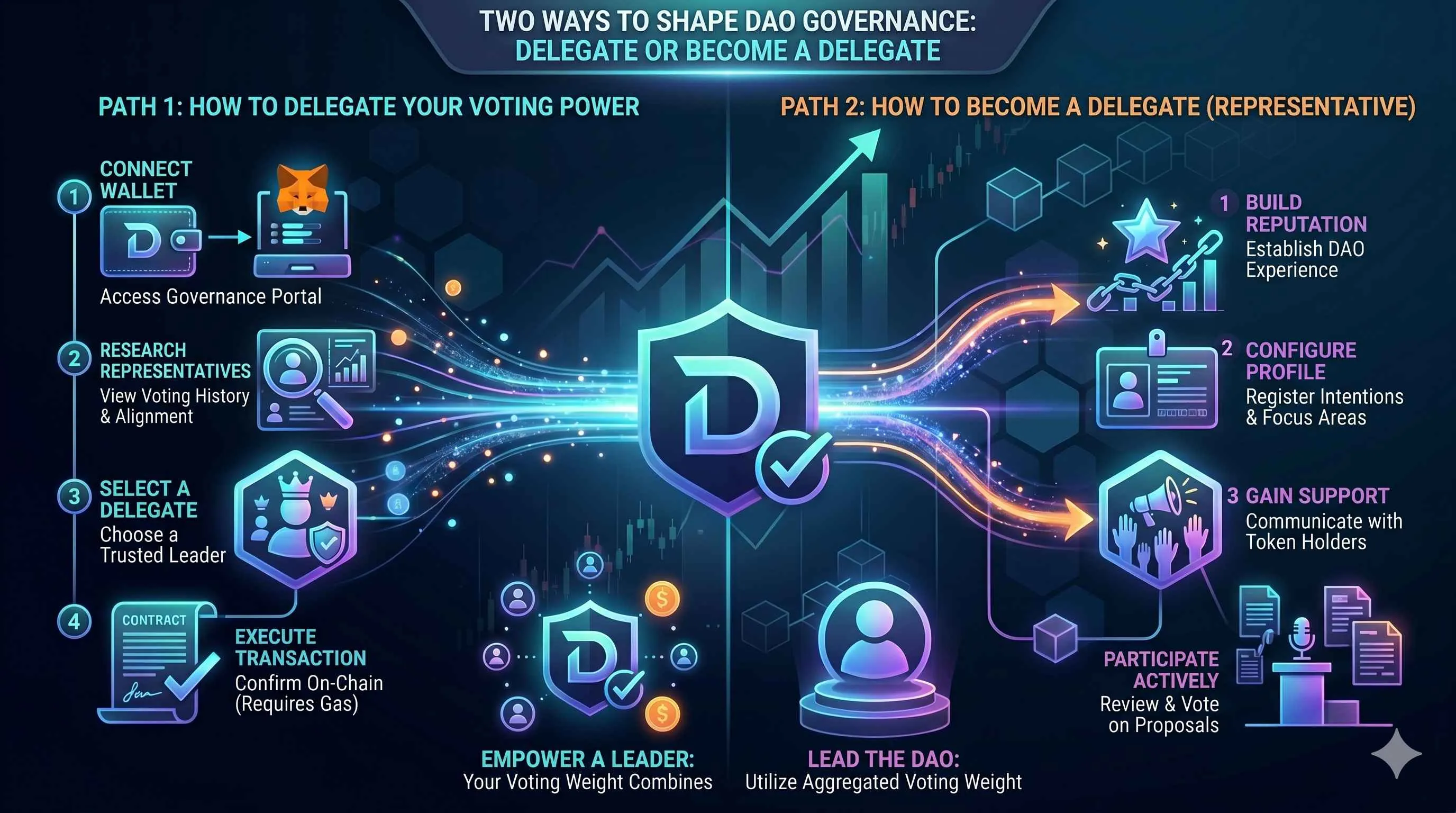
Step 1: Research and Select a Representative
Choosing a delegate requires diligent research. Look for individuals, groups, or DAOs with a proven track record of constructive participation, aligned long-term visions, and transparent communication. Most DAOs feature dedicated governance forums where potential delegates post their platforms, values, and historical voting rationale. Look for delegates who clearly explain their technical understanding of the protocol's architecture.
Step 2: Connect via the Official Governance Portal
Navigate to the protocol’s official governance dashboard (such as Tally, Snapshot, or the platform's proprietary Web3 interface). Ensure your wallet is connected to the correct blockchain network where the governance token resides.
Security Reminder: Always verify the application URL through official protocol documentation or audited resource hubs to avoid sophisticated phishing attempts and malicious smart contract approvals.
Step 3: Execute the Delegation Transaction
Locate the "Delegate," "Voting Power," or "Governance" section of the dashboard. Input the exact public wallet address or Ethereum Name Service (ENS) domain of your chosen representative. This action requires interacting with a smart contract. Review the required gas fees and confirm the transaction in your wallet. Once confirmed on-chain, your delegate will seamlessly hold and exercise your voting weight in future proposals.
How to Become a Delegate in a DAO
Becoming a recognized delegate allows you to shape protocol development directly, represent retail community interests, and potentially earn delegate compensation if the DAO allocates treasury funds for governance leadership. It requires consistency and a deep understanding of DeFi mechanics.
Step 1: Establish Your Governance Profile
To attract vote delegation from both retail holders and larger entities, you must clearly articulate your strategic platform. Create a comprehensive profile on the protocol's governance forum detailing your background, technical expertise, and specific views on risk management, treasury diversification, and future product updates. A strong delegate focuses on long-term protocol sustainability rather than short-term token price inflation.
Step 2: Register on the Governance Platform
Most mature decentralized organizations require delegates to officially register their addresses on indexing platforms like Tally or the native protocol dashboard. This process indexes your wallet address, making it visible to the public when users search the directory for available representatives to back.
Step 3: Maintain Active Communication and Transparency
Retaining delegated power requires continuous, proactive engagement. Successful delegates frequently publish voting rationale reports, explaining clearly why they voted for or against specific technical or financial proposals. If your voting pattern shifts unexpectedly without a clear public explanation, delegators may quickly revoke their power, which can dramatically alter the protocol's political landscape overnight.
Analyzing Governance Shifts with On-Chain Metrics
Experienced market participants do not observe vote delegation and governance in a vacuum. Instead, they cross-reference voting trends with technical indicators and raw market data to identify emerging trends and manage portfolio risk.
Volume and Price Action
When a highly contested or highly anticipated proposal is introduced, token trading volume often surges. If the market views a proposal favorably—such as a fee-switch implementation that directs protocol revenue back to token holders—increased buying pressure may establish clear support levels on the DEXTools Charts.
Conversely, if a controversial delegate utilizes their acquired vote delegation to push through unfavorable changes—such as drastically inflating the token supply to fund an unvetted project—it often coincides with heavy distribution. This selling pressure can cause the asset to break below historical support zones as investors lose faith in the protocol's leadership.
RSI Divergence and Market Sentiment
During extended governance battles, price action can become detached from underlying technical realities due to emotional or narrative-driven trading. Monitoring oscillators like the Relative Strength Index (RSI) alongside governance milestones can help spot potential trend reversals.
For instance, if a token's price is making higher highs driven purely by the narrative of an upcoming vote, but the RSI is printing lower highs, this bearish divergence may indicate that the buying momentum is exhausting itself. This historically suggests caution, signaling that a "sell the news" event may occur immediately after the vote delegation and voting process concludes.
Setting Up Alerts for Volatility
Because governance outcomes can cause rapid, algorithmic shifts in market dynamics, utilizing Price Alerts can assist in managing capital risk. Configuring alerts around critical technical levels during the final hours of a major DAO vote allows you to respond efficiently to sudden market movements. This ensures you are notified if a controversial proposal passes and triggers a sell-off, without needing to constantly monitor the charts manually.
Conclusion and Risk Management
Vote delegation is a highly effective tool for scaling decentralized governance, allowing the collective capital and wisdom of the community to be executed through informed, dedicated representatives. Whether you choose to assign your voting power to save time or step up as a delegate to guide a protocol's fundamental architecture, active participation strengthens the resilience and decentralization of the DeFi network.
However, entering the governance space requires a strict, unwavering focus on risk management. Governance outcomes can alter a protocol's risk profile in a matter of hours. Always maintain a comprehensive view of the market by tracking liquidity changes, holder concentration, and volume trends alongside active proposals. By combining an understanding of vote delegation with robust on-chain analytics, market participants can navigate the volatile decentralized finance landscape with greater precision and strategic clarity.
Governance Quorum vs Whale Voting: How DAO Control Risk Affects TokenholdersTop DAOs by Treasury and Activity in 2026: On-Chain Guide
How Do DAOs Work? Governance, Treasury and Voting Explained
DAO Governance Models: Token, Quadratic & Conviction Voting
Disclaimer: This article is for informational purposes only and does not constitute investment advice, financial advice, trading advice, or any other kind of advice. DEXTools does not recommend buying, selling, or holding any cryptocurrency or token. Users should conduct their own research and consult with a qualified financial advisor before making any investment decisions. Cryptocurrency investments are volatile and high-risk. DEXTools is not responsible for any losses incurred.