What is FUD, FOMO, and HODL? Crypto Slang Decoded

Digital asset networks run 24/7 on raw crowd psychology. We break down the structural origins and behavioral traps hidden behind the industry's most famous slang.
The Raw Human Variable: Trading the Mind, Not Just the Chart
- Traditional stock and bond markets operate within highly insulated institutional boundaries, heavily managed by corporate earnings reports, economic data schedules, and slow settlement banking cycles. The digital asset ecosystem, by contrast, runs on a 24/7/365 global liquidity network driven by real-time human psychology. Because blockchain ledgers process value instantly across decentralized borders, market cycles are accelerated, turning collective human emotions into sudden, massive capital movements.
- To navigate this volatile landscape, the Web3 community developed its own distinct cultural lexicon. Terms like FUD, FOMO, and HODL are not generic internet memes; they are shorthand descriptions for specific, powerful psychological states that directly influence market order books. Understanding this slang allows you to decode crowd behavior, avoid emotional trading traps, and analyze market cycles with clarity.
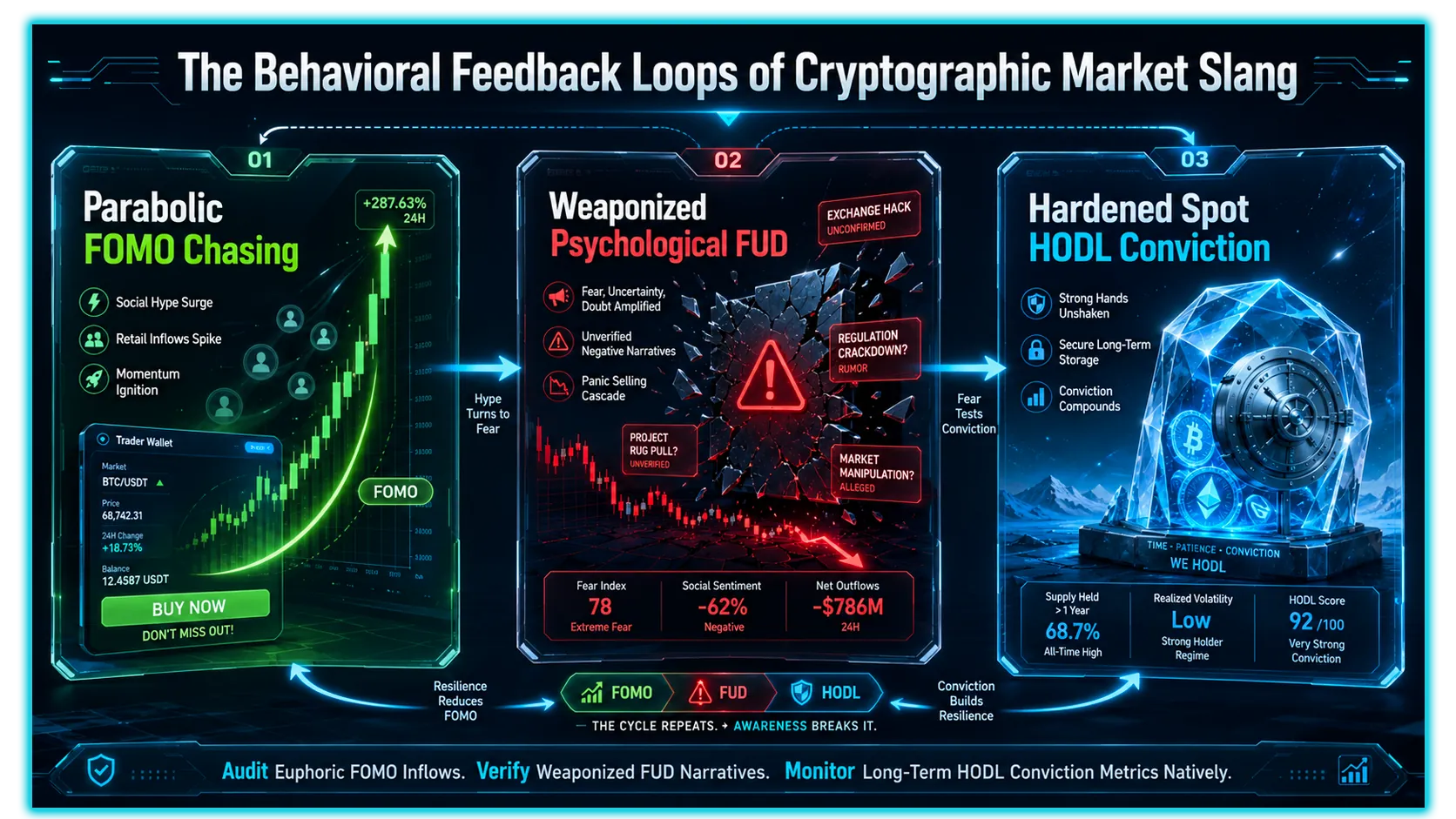
1. FUD: Fear, Uncertainty, and Doubt
FUD represents the negative side of market psychology. It refers to the systematic spread of pessimistic, unverified, or intentionally misleading information designed to induce panic and trigger massive asset sell-offs.
There are actually two Fuds. FUD manifests itself at two main operational levels.
FUD manifests across two primary operational layers:
The Psychological State: For individual participants, FUD is the overwhelming anxiety that a portfolio or a specific network is on the verge of total collapse. This emotional pressure regularly causes retail traders to lock in steep financial losses by selling their assets at the absolute bottom of a price correction.
The Weaponized Narrative: In institutional arenas, FUD is deployed strategically by short-sellers, competing protocols, or media entities. By broadcasting exaggerated rumors regarding regulatory crackdowns, smart contract bugs, or developer abandonment, malicious actors intentionally manipulate spot prices to accumulate assets at a deep discount.
2. FOMO: Fear of Missing Out
The opposite of FUD is FOMO: the intense, emotional impulse that drives individuals to buy into an asset classes after its price has already experienced a massive vertical rally.
The Euphoria Blindspot: FOMO completely bypasses traditional risk management. When a retail participant watches an asset shoot up day after day, greed overrides logic, compelling them to buy the absolute peak of a market cycle out of fear that the asset will continue upward without them.
FOMO is the primary fuel that powers unsustainable parabolic bubbles. It triggers irrational herd behavior, where participants ignore missing fundamentals, unaudited smart contracts, and overextended token distributions, simply to chase short-term momentum. This behavior inevitably traps late-stage buyers when institutional market makers begin taking profit, reversing the trend.
3. HODL: Hold On for Dear Life
The ultimate baseline defense framework used to neutralize both FUD and FOMO is the philosophy of HODL.
Originating from a famous, alcohol-fueled typo in a 2013 BitcoinTalk forum post titled "I AM HODLING," the word rapidly evolved from a simple spelling mistake into a fundamental market pillar. While it serves as a cultural battle cry, the community later back-ronymed the term to stand for Hold On for Dear Life.
HODL strategy rejects short-term active trading in favor of long-term conviction:
Ignoring the Noise: A true "HODLER" completely ignores multi-month downcycles, weaponized media FUD, and sudden 50% asset drawdowns. They maintain an un-yielding belief that the underlying protocol architecture possesses generational value.
The Cold Storage Standard: To execute this strategy safely, participants remove their assets from volatile centralized exchanges and lock them inside secure hardware wallets, transforming volatile short-term trading units into permanent generational equity.
Crypto Psychology Slang Matrix
| Slang Term | Core Human Emotion | Typical Market Action |
| FUD | Fear & Despair | Irrational Panic Selling |
| FOMO | Greed & Anxiety | Chasing Parabolic Peaks |
| HODL | High Conviction | Passive Long-Term Storage |
Psychological Traps & Rational Mitigations
| Behavioral Trap | Systemic Risk | Tactical Solution |
| Green Candle Chasing | Buying overextended tops | Strict Dollar-Cost Averaging |
| Panic Exit Dumping | Locking in bottom losses | Verify on-chain ledger metrics |
| Exchange Dependency | Vulnerable counterparty risk | Secure hardware self-custody |
Separating Crowd Noise from Data via DEXTools Telemetry
- The most effective way to immunize your execution strategy against the toxic cycle of FUD and FOMO is to stop trading based on social media sentiment and start trading based on real-time on-chain data. Sourcing analytics through advanced decentralized charting architectures like DEXTools gives market participants an essential universal platform to monitor live token behaviors, evaluate pool depths, and inspect contract parameters across all public execution networks.
- By leveraging core features like the Pair Explorer, Live New Pairs dashboard, and the integrated Trade Story or Top Traders diagnostic tools, technical traders can seamlessly audit localized volume trends, track large whale wallet capital reallocations via the Big Swap Explorer, and check automated contract safety scores before initiating any on-chain interactions. This ensures you can verify real, raw transaction data natively, distinguishing authentic accumulation from artificial panic or manufactured hype cycles.
You can access DEXTools here and start trading today!
Fake Volume vs Real Demand: How to Spot Artificial Momentum in DeFi TradingWhale Buy or Exit Liquidity? How to Read Big Swaps Without Blindly Copying WhalesSpot Real Demand vs Hype: On-Chain Metrics GuideLiquidity Rotation: How Capital Moves Between Tokens Inside the Same Narrative
Disclaimer: This article is for informational purposes only and does not constitute investment advice, financial advice, trading advice, or any other kind of advice. DEXTools does not recommend buying, selling, or holding any cryptocurrency or token. Users should conduct their own research and consult with a qualified financial advisor before making any investment decisions. Cryptocurrency investments are volatile and high-risk. DEXTools is not responsible for any losses incurred.