Render Network Token Structure, Liquidity and GPU Market Guide (2026)
— By AliceOnChain in Tutorials

A narrower Render guide focused on token structure, market liquidity, GPU marketplace mechanics and how to read RENDER on-chain in 2026.
Where this page fits: This page is the market-structure angle. It focuses on Render token structure, liquidity and GPU marketplace mechanics. For the broader beginner explainer, read our main Render guide.
What is Render (RENDER)? Decentralized GPU Network
The convergence of artificial intelligence (AI), spatial computing, and blockchain technology has generated an unprecedented demand for high-performance computing power. Traditional centralized cloud infrastructure providers face systemic supply constraints, long lead times, and rising operational costs. The Render Network addresses this global computational deficit by establishing a decentralized, peer-to-peer marketplace for Graphics Processing Unit (GPU) resources.
For on-chain analysts and market participants looking to answer the fundamental question-what is Render RENDER and how does it fit into a broader portfolio-the asset requires a dual perspective. One must evaluate its fundamental utility as a leader in the Decentralized Physical Infrastructure Networks (DePIN) sector while mastering the quantitative on-chain tools required to track its liquidity, velocity, and market structure. This tutorial breaks down the technical architecture of the network and demonstrates how to utilize advanced DEXTools features to analyze RENDER market dynamics.
Understanding the Core Architecture of Render
To accurately assess the asset's market behavior, traders must first grasp the core mechanics of the network. So, what is Render RENDER from an operational standpoint? The protocol functions as a multi-tier marketplace linking creators who require immense rendering power with node operators who possess idle GPU capacity. Originally launched on the Ethereum blockchain by OTOY and later migrating its core infrastructure to Solana to leverage high throughput and lower transaction costs, the network democratizes access to computational power.
The Supply and Demand Dynamic
Creators (Demand Side): Digital artists, AI developers, architectural firms, and space-computing engineers submit rendering or machine-learning training jobs to the network. These payloads require massive parallel processing capabilities.
Node Operators (Supply Side): Individuals or enterprise data centers connect their idle GPUs to the Render Network. In exchange for allocating their hardware resources to compute these workloads, operators receive compensation denominated in the network's native utility token.
This decentralized framework mitigates the inefficiencies of traditional server farms. By distributing workloads across a global topology of individual nodes, the network reduces single points of failure and significantly lowers the capital expenditure typically associated with high-fidelity digital rendering and artificial intelligence model training.
The RENDER Token Economics and Utility
When evaluating a digital asset, sophisticated market participants always ask: what is Render RENDER trying to achieve with its tokenomics? The RENDER token serves as the primary medium of exchange, governance, and collateralization within the ecosystem. The network implements a Burn-and-Mint Equilibrium (BME) model, which balances supply inflation against operational demand.
Under the BME architecture, creators pay for rendering tasks using fiat currency or RENDER tokens. If a payment is made in fiat, the underlying protocol automatically converts the capital into RENDER tokens via liquid market pairs. These tokens are subsequently burned, reducing the aggregate circulating supply. Concurrently, new tokens are minted and distributed to node operators as compensation for their verified computational contributions.
This mechanism ensures that if demand for GPU processing power outpaces token issuance, deflationary pressure may exert an upward influence on the asset's microeconomic structure. For traders monitoring the asset on DEXTools, evaluating the relationship between actual network utility (on-chain job execution) and token velocity is a vital component of structural trend analysis.
On-Chain Analysis: Tracking RENDER with DEXTools
Trading infrastructure tokens within the DePIN and AI narratives requires more than a basic understanding of technical chart patterns. When assessing what is Render RENDER in terms of trade execution, volatility management in decentralized markets demands a thorough examination of liquidity depths, smart-contract health, and holder concentration. DEXTools provides the exact analytical architecture required to parse this data in real time.
Assessing Liquidity and Volume via Pair Explorer
When analyzing RENDER pools across decentralized exchanges (DEXs) like Uniswap or Raydium, the DEXTools Pair Explorer offers critical metrics that precede raw price action.
Liquidity Depth vs. Daily Volume: A high trading volume accompanied by thin pool liquidity often yields severe price slippage, rendering the pair highly volatile. Analysts evaluating what is Render RENDER liquidity setups look for deep, locked liquidity pools to confirm structural support during localized market sell-offs.
DEXT Score: This proprietary metric evaluates the underlying reliability of a token pair based on contract verification, liquidity configuration, and community consensus. A low DEXT Score may indicate smart-contract anomalies or unsecured pool parameters, signaling heightened risk.
Evaluating Holder Distribution and Whale Activity
Large capital allocations, commonly referred to as whale activity, introduce distinct volatility vectors into utility token markets. Tracking holder distribution helps determine whether an asset is decentralized across thousands of retail wallets or concentrated among early seed investors and institutional entities.
Through the DEXTools Holder Analysis interface and integrated Bubblemaps, traders can visually audit wallet relationships. This feature maps interconnected addresses to determine if seemingly separate wallets are controlled by a single entity. If a small cluster of interconnected wallets controls a significant percentage of the circulating supply, a coordinated liquidation event may occur, inducing sudden downside price action. Conversely, a highly fragmented holder base often implies steady accumulation and broader structural stability.
Advanced Risk Management in High-Volatility Environments
Whether navigating established computing tokens like RENDER or tracking emerging high-risk micro-cap pairs across DeFi ecosystems, disciplined risk management is the differentiator between sustainable capital preservation and total equity depletion. A key part of managing risk is recognizing what is Render RENDER doing relative to broader market trend structures.
Identifying Divergences and Support Zones
On-chain price action frequently reflects shift patterns through Volume-Weighted Average Price (VWAP) and Relative Strength Index (RSI) metrics. When the price of an asset forms a higher high on the daily chart while the RSI registers a distinct lower high, an RSI divergence occurs. In many cases, this setup signals an exhausting trend, warning traders to adjust their stop-loss parameters or secure profits.
Using DEXTools Charts, traders can plot historic horizontal support and resistance zones based on decentralized volume concentration rather than just centralized exchange order books. Identifying the specific price levels where high-volume nodes reside helps establish precise invalidation zones for active positions.
Utilizing Price Alerts for Executing Exit Strategies
Market participants frequently succumb to cognitive biases when an asset experiences rapid upward momentum. To mitigate emotional decision-making, setting automated Price Alerts within the DEXTools interface allows traders to step away from the order book.
Configuring alerts at pre-determined technical resistance zones enables a systematic, tiered profit-taking approach. For instance, scaling out of a position by capturing 25% increments at specific macro-Fibonacci extensions ensures that a trader secures realized gains rather than letting capital revert into a drawdown during a swift market correction.
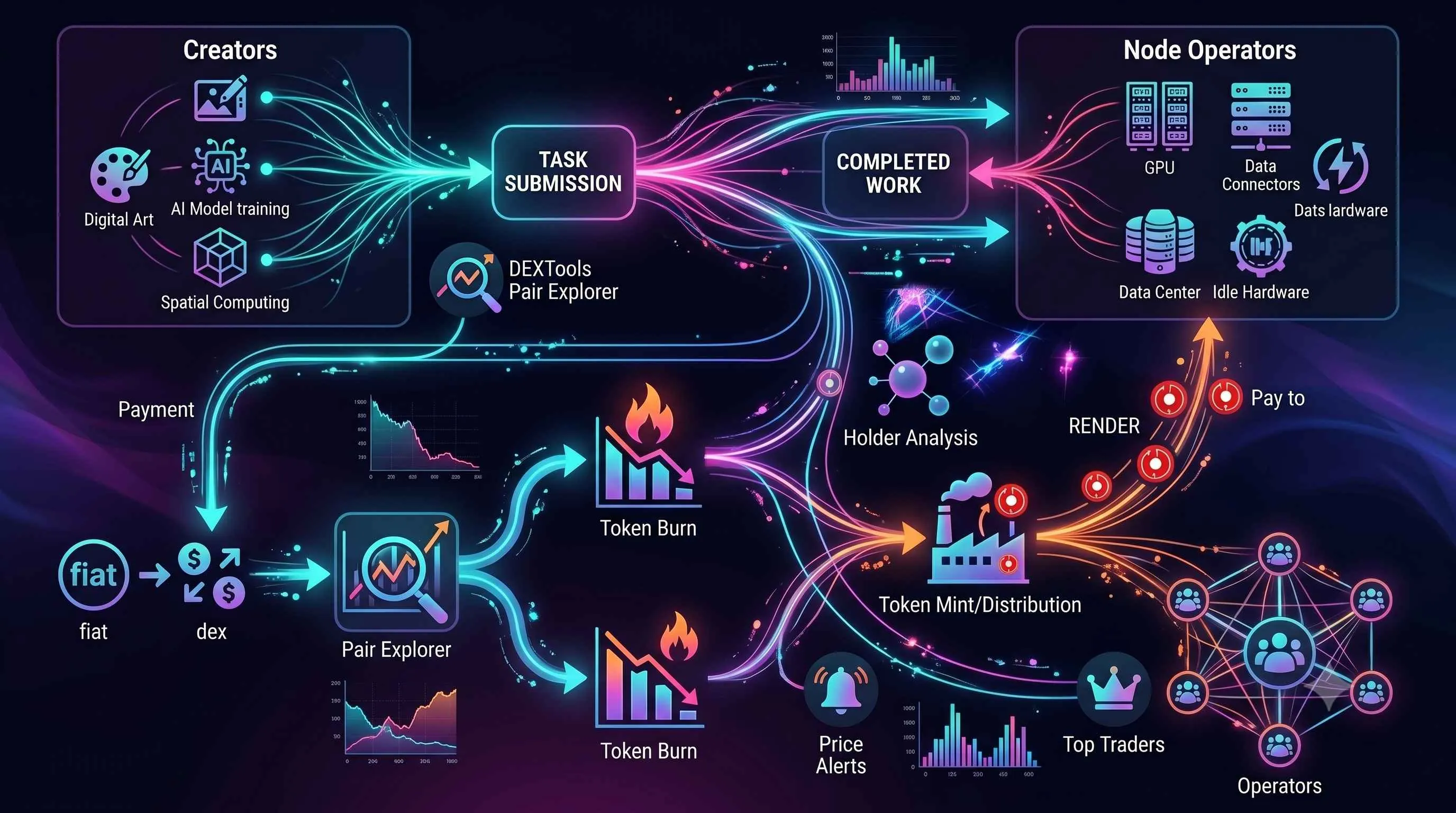
Conclusion: The Role of Analytics in Decentralized Infrastructure
In summary, when defining what is Render RENDER, it represents a profound shift in how global computing infrastructure is provisioned, utilized, and monetized. As the demand for AI training and complex 3D rendering expands, RENDER remains positioned at the epicenter of the DePIN ecosystem.
However, fundamental utility does not eliminate market volatility. For retail traders and institutional market participants alike, executing a successful strategy requires merging macro fundamental perspectives with micro on-chain data. By leveraging DEXTools to audit liquidity pools, track volume velocity, monitor holder distribution patterns, and automate execution triggers through price alerts, traders can successfully navigate the complexities of the decentralized computing market.
- What Is Render Network (RNDR/RENDER)? Decentralized GPU DePIN Guide 2026
- What Is io.net? The Decentralized GPU Network Powering AI on Solana in 2026
- Liquidity Velocity: Why Fast LP Changes Matter More Than Total Liquidity
- Pair Explorer Data Trend Reversals: A Pro Trading Guide
Disclaimer: This article is for informational purposes only and does not constitute investment advice, financial advice, trading advice, or any other kind of advice. DEXTools does not recommend buying, selling, or holding any cryptocurrency or token. Users should conduct their own research and consult with a qualified financial advisor before making any investment decisions. Cryptocurrency investments are volatile and high-risk. DEXTools is not responsible for any losses incurred.
The Nuance of Render's Multi-Tiered Compute Marketplace
Beyond the foundational understanding of Render as a decentralized GPU network, a deeper dive reveals a sophisticated multi-tiered compute marketplace designed to optimize resource allocation and pricing. This isn't merely about matching supply and demand; it's about segmenting the market to cater to diverse rendering needs, from high-stakes cinematic VFX to rapid prototyping and AI model training. This stratification ensures that both high-performance, specialized GPUs and more commodity-grade hardware can find their optimal use cases and corresponding price points within the network.
The system intelligently routes rendering jobs based on factors such as required GPU power, memory, network latency, and the specific software or libraries needed. This dynamic allocation mechanism prevents a "race to the bottom" on pricing for premium hardware and conversely ensures that less powerful GPUs remain economically viable for less demanding tasks. For DEXTools users tracking RENDER, understanding these underlying market dynamics provides crucial context for interpreting volume shifts and liquidity movements, as different tiers may experience varying demand cycles.
Optimizing for Diverse Rendering Demands
- Job complexity and specific software requirements dictate the tier a rendering task falls into, influencing the price and speed.
- Node operators can specialize their hardware offerings, targeting specific tiers to maximize their earnings potential.
- Dynamic pricing algorithms adjust based on real-time network congestion, available compute power, and job queue length.
- The network incentivizes both high-end professional GPUs and more common consumer-grade hardware to participate, broadening the supply pool.
- This tiered approach helps to balance supply and demand across a wide spectrum of rendering needs, from urgent, high-fidelity projects to batch processing.
Related Guides
- What Is Render Network (RNDR/RENDER)? Decentralized GPU DePIN Guide 2026
- What Is io.net? The Decentralized GPU Network Powering AI on Solana in 2026
- What is io.net? Decentralized GPU for AI Workloads Guide
- What Is Aethir (ATH)? The Decentralized GPU Cloud Powering AI and Gaming in 2026
- What Is Theta Network (THETA + TFUEL)? Decentralized Video Streaming Guide 2026
- What Is Sonic Network
- What Is Sahara AI (SAHARA)? Decentralized AI Blockchain Guid
Frequently Asked Questions
What is the Render Network?
Render is a decentralized network that connects users who need GPU rendering and compute power with providers who have spare GPU capacity. It coordinates this marketplace using a blockchain based token system.
What is Render used for?
Render is associated with GPU intensive tasks such as graphics rendering and increasingly other compute workloads. It allows demand for processing power to be matched with distributed supply.
How does the RENDER token fit into the network?
The token is used within the network to pay for and reward GPU work, aligning incentives between those who need compute and those who provide it. Token design influences how value moves through the ecosystem.
Why do traders track on chain data for Render?
On chain analytics can show liquidity, trading activity, and holder behavior for the token, helping traders assess interest and risk. This is most useful when paired with research into actual network usage.