What Are Pudgy Penguins (PENGU)? NFT Collection + Token Guide 2026
— By Whatsertrade in Tutorials
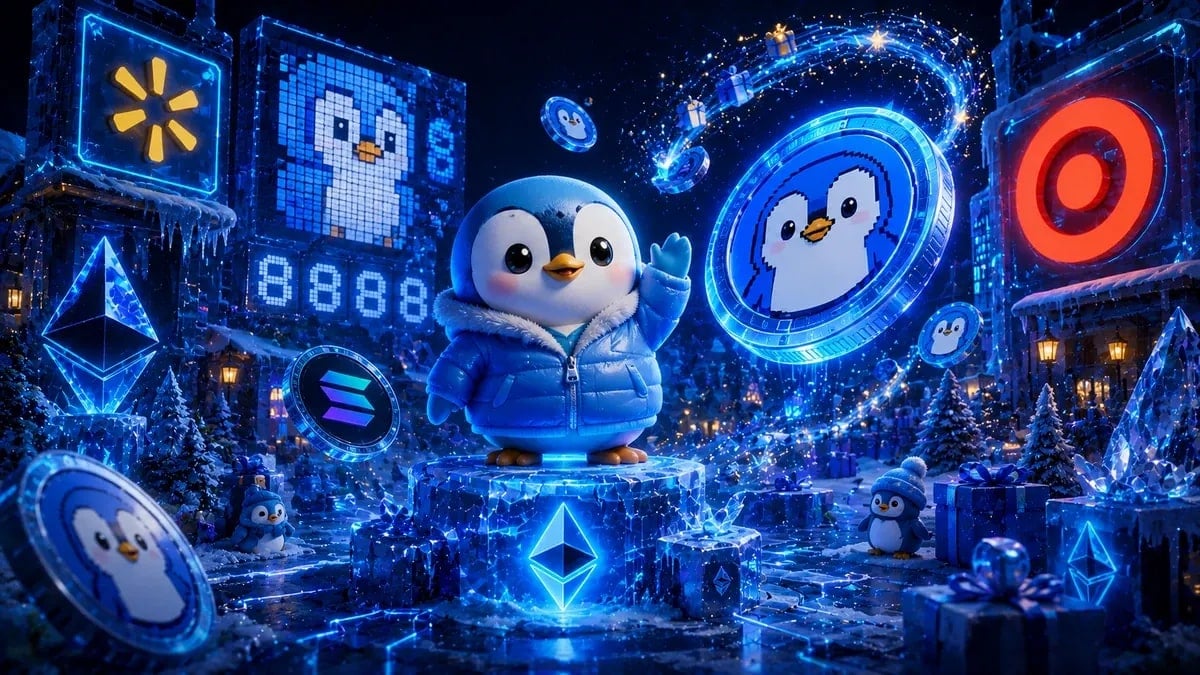
Pudgy Penguins is the 8,888 Ethereum NFT collection turned multi-chain consumer brand that briefly overtook Bored Ape Yacht Club in 2025 and launched the PENGU token on Solana in December 2024 with one of the largest airdrops in NFT history. Full 2026 guide: 2021 mint origin, Luca Netz turnaround since April 2022, Walmart and Target retail distribution, Pudgy World social game, Vegas Sphere holiday campaign, PENGU tokenomics, 1.7 million PENGU per NFT holder airdrop, floor 4.79 ETH May 2026, comparison vs BAYC, Azuki and Milady, plus the real risks.
What Are Pudgy Penguins (PENGU)? NFT Collection + Token Guide 2026
In August 2021, a Canadian college student named Cole Villemain minted 8,888 cartoon penguins onto the Ethereum blockchain and watched them sell out within twenty minutes. Three years later, those same penguins were sitting on Walmart shelves as plush toys, headlining a holiday campaign on the Las Vegas Sphere, and serving as the centerpiece of one of the largest token airdrops in NFT history. By the time the PENGU token launched on Solana in December 2024, the Pudgy Penguins brand had completed one of the most improbable transformations in crypto, from a near-dead NFT project on the verge of collapse in 2022 to a multi-chain consumer brand with retail distribution, billions of dollars in cumulative token volume, and a floor price that briefly overtook Bored Ape Yacht Club in 2025.
The story is not just a price story. It is a turnaround story, an intellectual property licensing story, and a story about how a small group of cartoon penguins escaped the gravitational pull of crypto-native speculation and crossed over into mainstream commerce. The pivotal moment came in April 2022, when entrepreneur Luca Netz bought the project from its original founders for roughly 750 ETH after a community-led campaign to remove the team. Netz inherited a brand worth a fraction of what it had been, a frustrated community, and no clear roadmap. What he built from there is now the most cited example of how an NFT project can be operated like a consumer brand rather than as a JPEG speculation vehicle.
This evergreen guide explains, in plain language, what Pudgy Penguins is in 2026, how the 8,888 Ethereum NFT collection became a multi-chain ecosystem, what the PENGU token does, why the December 2024 airdrop gave roughly 1.7 million PENGU to each NFT holder worth more than one hundred thousand dollars at the all-time high, how the Walmart and Target toy distribution works, and what investors and collectors should know before buying either the NFTs or the token. We cover the Luca Netz turnaround, the Abstract chain expansion, the Pudgy World social game, the Vegas Sphere holiday campaign, and the realistic comparison against Bored Ape Yacht Club, Azuki, and Milady.
Featured Snippet
Pudgy Penguins is a collection of 8,888 cartoon penguin NFTs launched on Ethereum in August 2021 and now anchoring a multi-chain consumer brand led by CEO Luca Netz since April 2022. The ecosystem includes the PENGU token launched on Solana in December 2024, the Pudgy World browser social game, physical toy distribution in Walmart and Target, and a holiday campaign on the Las Vegas Sphere in 2025. Each Ethereum NFT holder received approximately 1.7 million PENGU at airdrop, worth more than one hundred thousand dollars at the token's all-time high. The collection's floor price reached 4.79 ETH in May 2026 and briefly overtook Bored Ape Yacht Club in 2025.
Before we go deeper, it is worth clarifying what Pudgy Penguins actually is and is not. It is not a single asset. It is a brand and an ecosystem composed of an Ethereum NFT collection, a Solana token, a network of derivative collections, a consumer products business, a browser game, and a cross-chain expansion into the Abstract layer-two network. Each piece has its own market dynamics, its own holder base, and its own risk profile. Treating them as one undifferentiated asset is the most common mistake new participants make. If you are new to the broader NFT category, our explainer on what an NFT actually is and how it works gives the foundation that the rest of this guide builds on.
The Pudgy Penguins story spans two chains in 2026, Ethereum for the original 8,888 NFTs and Solana for the PENGU token. If you need a refresher on either base layer, our companion pieces on how Ethereum works for beginners and how Solana works for beginners set up the rest of the discussion.

What Exactly Is The Pudgy Penguins NFT Collection
Strip away the brand work for a moment. As a piece of code, the original Pudgy Penguins collection is an ERC-721 smart contract deployed on Ethereum in July and August 2021 that mints exactly 8,888 unique non-fungible tokens, each pointing to a cartoon penguin image with various traits including background colors, headwear, eyewear, body styles, and special accessories. ERC-721 is the standard that defines how individual, unique tokens work on Ethereum, in contrast to ERC-20 fungible tokens like USDC or PENGU. If you want the technical specifics, our breakdown of what ERC-721 is and how it differs from ERC-20 covers the smart contract layer.
The original mint price was 0.03 ETH per penguin, around ninety dollars at August 2021 prices. The collection sold out in under twenty minutes. Within months, floor prices climbed past 2 ETH during the 2021 NFT bull market before retreating through 2022. By the time Luca Netz acquired the project in April 2022, the floor had fallen back near 0.5 ETH.
In 2026 Pudgy Penguins trades on OpenSea, Blur, and Magic Eden's Ethereum extension. The floor is the lowest current ask across all 8,888 tokens, the most commonly cited valuation metric. Rare trait combinations trade for many multiples of floor. As of May 2026 that floor sits at approximately 4.79 ETH, several multiples above where it traded when Netz took over. If you are new to buying NFTs, our walkthrough on how to use OpenSea to buy and sell NFTs covers the mechanics.
The Original 2021 Launch And The Near-Death Experience
To understand the turnaround you have to understand how close the project came to dying in early 2022. The founding team, led by Cole Villemain and three other young Canadian collaborators, launched during the peak of the first NFT bull market. The artwork was charming, the community formed quickly, and CryptoPunks holder 9x9x9 famously called Pudgy Penguins a top blue-chip NFT. By late summer of 2021 it was a top-ten OpenSea collection by volume.
Trouble started in late 2021 and early 2022. The founders made a series of communications missteps including roadmap delays and unclear treasury management. The community grew openly hostile through Discord and Twitter, and in January 2022 holders organized a vote to remove the founders. The vote passed overwhelmingly and the founders agreed to exit in exchange for a sale of the brand and smart contract control.
That sale closed in April 2022. The buyer was Luca Netz, a young serial entrepreneur best known at the time for direct-to-consumer e-commerce ventures. Netz reportedly paid 750 ETH, roughly 2.5 million dollars at the time, for full ownership of the brand and treasury. He inherited a frustrated holder base, a fallen floor price, and no product roadmap. What he did over the following three years is the reason the project is discussed in 2026 not as a footnote but as a case study.
The Luca Netz Turnaround Playbook
Netz approached Pudgy Penguins as a consumer brand problem, not a crypto problem. His framing has been consistent since 2022. The collection is the cap table. The holders are early investors in a media and consumer products company. The CEO's job is to build a brand that generates revenue outside of NFT secondary trading and to compound the value of the underlying IP over many years. That framing was unusual in 2022.
The first major external proof point came in 2023 when Netz secured a distribution deal with Walmart to stock physical Pudgy Penguins toys, including plushies and articulated figures, in roughly two thousand Walmart stores. That deal was followed by Target distribution and additional retail partners. By 2024 and 2025 Pudgy Toys had moved millions of units, with the company disclosing meaningful retail revenue and brand presence that extended well beyond the NFT-collecting audience.
The second proof point was the launch of Pudgy World, a browser-based social game that lets NFT holders and casual users interact with their penguin characters, collect items, and join seasonal events. It is a lightweight Web2-style social experience designed to onboard non-crypto users and give holders a reason to engage with their NFTs as functional characters rather than static profile pictures.
Pudgy Penguins Timeline From 2021 Mint To 2026 Brand
Cole Villemain and a small team of Canadian college students design the original Pudgy Penguins collection and prepare the Ethereum ERC-721 contract for launch.
The 8,888 Pudgy Penguins mint sells out in under twenty minutes at 0.03 ETH each. Within weeks, the collection enters the top ten on OpenSea by trading volume.
Holder frustration with the original team peaks. A community-led vote calls for removal of the founders. The vote passes overwhelmingly and a sale process for the project begins.
Luca Netz acquires Pudgy Penguins for approximately 750 ETH, taking over the brand, the treasury, and the IP rights. He installs himself as CEO and outlines a consumer brand strategy.
Pudgy Toys launches in Walmart stores. Physical plushies and figures reach mainstream retail shelves, generating revenue independent of NFT secondary trading.
Pudgy World browser social game enters wider release. Target and additional retail partners stock Pudgy Toys. The brand begins teasing a token launch and the Abstract chain expansion.
PENGU token launches on Solana through one of the largest airdrops in NFT history. Each of the 8,888 Pudgy Penguins NFT holders receives approximately 1.7 million PENGU, worth over one hundred thousand dollars at the token's all-time high.
Pudgy Penguins floor price briefly overtakes Bored Ape Yacht Club in ETH terms, marking a symbolic shift in NFT category leadership. A holiday season campaign on the Las Vegas Sphere puts Pudgy Penguins in front of millions of mainstream viewers.
PENGU posts a 283 million dollar daily trading volume in April. Floor price hovers around 4.79 ETH. The Abstract chain expansion adds a third venue for the broader Pudgy ecosystem alongside Ethereum and Solana.
What Is The PENGU Token And How Did The Airdrop Work
PENGU launched in December 2024 as an SPL token on Solana, accompanied by one of the largest airdrops in NFT history. The structure was deliberately broad. Allocations went to Ethereum Pudgy Penguin NFT holders, holders of derivative collections such as Lil Pudgys and Pudgy Rods, community contributors, and a wider list of eligible wallets identified through on-chain engagement and Pudgy World activity. The marquee number that drew most of the headlines was the allocation to original NFT holders, approximately 1.7 million PENGU per Pudgy Penguin.
At the token's all-time high in the weeks following launch, that per-NFT allocation was worth more than one hundred thousand dollars. Holders who had bought a Pudgy Penguin for a fraction of an ETH in 2022 found themselves with airdropped tokens that exceeded their cost basis by many multiples, in addition to still holding the underlying penguin. That kind of holder reward is rare in NFT history.
PENGU as an SPL token is technically simple. The Solana Program Library standard defines fungible tokens on Solana, and PENGU is a vanilla implementation with fixed maximum supply, transparent on-chain distribution, and immediate listing on Raydium and Orca. Within days of launch, centralized exchange listings followed including Binance, Coinbase, Bybit, and others, giving PENGU one of the fastest CEX onboarding paths of any 2024 launch.

PENGU Tokenomics In Plain Language
PENGU has a fixed total supply of approximately 88.88 billion tokens, a deliberate echo of the 8,888 number that defines the original NFT collection. The distribution is split across several buckets, including the community airdrop allocation, the project treasury controlled by Pudgy Penguins, ecosystem incentives, exchange and liquidity allocations, and team and advisor allocations. The full breakdown was published at launch and remains publicly verifiable on-chain. The community allocation is the single largest bucket, which is consistent with the project's framing of PENGU as a community token rather than a venture-backed launch.
From a holder perspective, several aspects of the tokenomics matter. First, vesting schedules apply to team, advisor, and certain ecosystem allocations, which means the circulating supply will increase over time as locked tokens unlock. That is normal for a structured token launch, but holders should be aware of the unlock cadence because incremental supply hitting the market can create selling pressure during specific windows. Second, the community airdrop allocation was distributed in full at launch with no claim cliff or vesting, which produced both the initial price discovery rally and the subsequent volatility as airdrop recipients made individual decisions about whether to sell, hold, or accumulate more.
Liquidity for PENGU is exceptionally deep by SPL token standards. The token trades on Raydium, Orca, and Solana aggregators with sufficient depth to absorb significant size, and centralized exchange volume on Binance, Coinbase, Bybit, OKX, and Upbit adds another layer of depth and cross-venue arbitrage. As of April 2026, daily trading volume averaged around 283 million dollars, placing PENGU among the most actively traded SPL tokens on the chain. That liquidity profile is one of the most important practical differentiators between PENGU and lower tier memecoin alternatives.
The Walmart, Target, And Retail Distribution Story
One of the most distinctive elements of the story is physical retail distribution. In 2023 Pudgy Toys launched in approximately two thousand Walmart stores with a line of plush penguins and small figures. The logic was direct. Walmart shoppers are not necessarily NFT collectors, and the toys do not require blockchain knowledge to enjoy. Each toy includes a code redeemable in Pudgy World for in-game items, creating an optional bridge from physical purchase into the digital ecosystem.
The Walmart deal was followed by Target distribution and additional retail expansion. By 2024 and 2025 Pudgy Toys had sold millions of units, with disclosures indicating the toys business generated meaningful standalone revenue. That revenue stream is the closest thing in the NFT category to a traditional brand cash flow, and it is the single most important reason Pudgy Penguins is discussed as a consumer brand rather than as a JPEG collection in 2026. Most NFT collections, including BAYC and Azuki, generate value primarily through secondary trading, derivatives, and licensing. Pudgy Penguins adds a physical retail channel that does not depend on crypto market conditions.
The Vegas Sphere Holiday Campaign And Mainstream Reach
In late 2025 Pudgy Penguins ran a holiday-themed campaign on the Las Vegas Sphere, the massive spherical LED venue on the Vegas strip that has become one of the most coveted advertising surfaces in the world. The Sphere is roughly 366 feet tall and 516 feet wide, with exterior animations visible across the strip and to millions of visitors and television viewers. The campaign turned the exterior into a winter scene featuring the penguins, with seasonal animations and brand imagery.
The placement put Pudgy Penguins in the same advertising tier as F1, U2's residency, and major film studios, a level of mainstream visibility no other NFT project has matched. It signaled to consumer brand observers that the project was operating with a marketing budget consistent with a real brand. From a holder perspective the campaign does not mechanically lift floor or token price. What it does is reinforce the brand thesis, which depends on continually reaching new audiences who do not currently care about crypto.
Multi-Chain Expansion To Abstract
In 2024 and 2025 Pudgy Penguins expanded into the Abstract layer-two ecosystem, a chain designed for consumer applications and lower-friction onboarding. Ethereum remains the home of the 8,888 original NFTs and most derivative collections. Solana remains the home of PENGU. Abstract serves as a third venue oriented around consumer apps and lighter-weight on-chain interactions with cheaper transaction costs. The Ethereum collection is the cultural anchor. The Solana token gives the brand exposure to the largest consumer token audience on a single chain. Abstract gives a consumer-app-friendly environment for new experiments without disturbing either anchor chain.
Pudgy Penguins Compared With Bored Ape Yacht Club, Azuki, And Milady
To understand where Pudgy Penguins sits in the broader NFT landscape, it helps to compare it directly to three other top-tier profile picture collections that defined the 2021 to 2026 NFT cycle. None of these comparisons are price predictions. They simply help you place Pudgy Penguins inside the right category.
Bored Ape Yacht Club, often abbreviated BAYC, is the most-cited blue chip of the cycle. Created by Yuga Labs and launched in April 2021, the collection of 10,000 stylized apes carried the highest floor in NFTs for most of 2021 through 2024, with major celebrity holders, a token launch in ApeCoin, and high-profile brand partnerships. For most of that period, comparing Pudgy Penguins to BAYC would have felt asymmetric. By 2025, the comparison had inverted briefly. Pudgy Penguins' floor in ETH terms briefly exceeded BAYC's floor, marking a symbolic moment that crypto media covered extensively. Our full breakdown of that collection is in our Bored Ape Yacht Club complete guide.
Azuki is the anime-styled collection launched in January 2022 by the studio Chiru Labs, which became the most-cited example of artistic ambition in profile picture NFTs. The collection has built out an extensive narrative universe, multiple companion collections including Beanz and Elementals, and a strong cultural footprint in East Asian markets. Azuki and Pudgy Penguins represent two different strategic playbooks. Azuki leans on world-building, art direction, and a serialized narrative. Pudgy Penguins leans on consumer products, retail distribution, and broad mainstream brand reach. Both are coherent strategies and both have committed holder bases. Our full breakdown is in the Azuki anime NFT collection guide.
Milady Maker is the smaller, more crypto-native collection that achieved cult status through a distinctive aesthetic, internet-native humor, and a closely-knit community. Milady's strategic approach is closer to a niche brand cultivating a specific subculture than to a mass-market consumer brand. Milady and Pudgy Penguins occupy almost opposite corners of the NFT brand strategy space. Pudgy Penguins is the consumer-mainstream play. Milady is the crypto-native subculture play. Both have produced durable communities, but they appeal to very different participants and price differently as a result.
Pudgy Penguins
Consumer brand strategy with Walmart and Target retail distribution, PENGU token on Solana, Pudgy World social game, Vegas Sphere campaign reach. 8,888 supply on Ethereum. Floor 4.79 ETH May 2026.
Bored Ape Yacht Club
Yuga Labs flagship with ApeCoin token, celebrity holders, and extensive licensing footprint. 10,000 supply on Ethereum. Briefly overtaken by Pudgy Penguins in ETH floor terms during 2025.
Azuki
Anime-styled collection by Chiru Labs with extensive narrative universe, Beanz and Elementals companion drops, and strong East Asian footprint. 10,000 supply on Ethereum.
Milady Maker
Crypto-native subculture collection with distinctive aesthetic, internet humor, and a closely-knit holder base. Smaller and more niche than the other three, with strong cultural staying power.

Floor Price History And What It Actually Means
The floor price has traveled a long path since the August 2021 mint. The launch floor was effectively 0.03 ETH, the mint price. Within weeks secondary market activity pushed it past 1 ETH and during the late 2021 NFT bull market it peaked above 3 ETH. Through the 2022 bear and leading up to the Netz acquisition the floor declined toward 0.5 ETH. From 2023 through 2025, as the consumer brand strategy delivered, the floor recovered steadily, eventually climbing above 4 ETH and peaking in 2025 around the same period that the brand briefly overtook BAYC in ETH floor terms.
As of May 2026 the floor sits at approximately 4.79 ETH. That number deserves caveats. The floor is the lowest current ask, the price the most motivated seller will accept, not the price at which most NFTs would trade if they all hit the market simultaneously. It is denominated in ETH, so dollar-equivalent floor moves with ETH price. And it ignores rare traits, which can trade for many multiples of floor. For real-time data, NFT Price Floor and OpenSea provide canonical references for floor history, volume, listed percentage, and trait rarity.
Pudgy World, Lil Pudgys, And The Wider Pudgy Ecosystem
The Pudgy ecosystem includes more than the 8,888 originals and PENGU. Lil Pudgys is the larger companion collection of smaller penguin characters, designed to give broader audiences a more accessible entry point. Pudgy Rods is a separate collection with a fishing rod theme. Pudgy Present and other limited drops layer seasonal content into the franchise. Each collection has its own market dynamics but they connect through the broader brand and through holder benefits within Pudgy World.
The relationship between the original 8,888 and the derivative collections matters. The originals are positioned as the cap table, with the implications of scarcity, status, and historical anchoring. Derivative collections are participation vehicles for a broader audience with lower price points. PENGU is the liquid asset that ties the ecosystem together through a single token any participant can hold regardless of NFT exposure. That layered structure is more sophisticated than most NFT projects attempt.
Real Risks NFT And Token Holders Should Take Seriously
Pudgy Penguins is one of the more durable brand stories in the NFT category, but the asset itself, both the NFTs and the PENGU token, carries meaningful risks that holders should understand before sizing positions. The fact that the brand has delivered on multiple fronts since 2022 does not eliminate the underlying volatility or category-wide structural risks.
The first risk is correlation with the broader NFT market. Pudgy Penguins' floor price does not move in isolation. When BAYC, Azuki, Milady, and the rest of the top-tier NFT cohort sell off, Pudgy Penguins typically sells off with them. The brand strategy can produce relative outperformance during category-wide rallies and softer drawdowns during category-wide selloffs, but it does not produce immunity. Holders who size positions assuming the brand will protect them through a deep bear cycle are setting expectations that the historical data does not support.
The second risk is concentration. The 8,888 supply is small in absolute terms, which means a handful of large holders can move the floor meaningfully by listing or delisting. Wallet concentration is visible on-chain and through analytics dashboards, but the structural risk does not disappear by being measurable. PENGU has a different concentration profile, with the airdrop having distributed broadly but with some large allocations to early backers, team, and treasury that vest over time. Token unlock schedules should be tracked.
The third risk is execution. The Pudgy Penguins thesis depends on continued brand growth, continued retail expansion, continued product launches, and continued cultural relevance. Any consumer brand can stall, lose momentum, or face competitive pressure from new entrants. Crypto-native execution risk also remains, including the operational complexity of running a multi-chain ecosystem across Ethereum, Solana, and Abstract. Holders should evaluate execution risk on an ongoing basis rather than assuming the 2022 to 2025 turnaround momentum continues indefinitely.
The fourth risk is operational and is sometimes underestimated. NFT holders and SPL token holders are heavy targets for phishing, wallet drainer scams, fake mint websites, and address poisoning attacks. The high public profile of Pudgy Penguins makes the project a frequent subject of scam attempts. Our guide on how to avoid crypto address poisoning scams is required reading for anyone holding significant Pudgy Penguins or PENGU positions.
Pudgy Penguins Pros And Cons At A Glance
PROS
Mainstream retail distribution through Walmart and Target generating revenue independent of NFT market conditions.
Demonstrated turnaround execution under Luca Netz since April 2022, with consistent strategic delivery over multiple years.
Multi-chain footprint across Ethereum, Solana, and Abstract provides exposure to three different consumer audiences.
PENGU token provides liquid exposure to the ecosystem for participants who cannot or do not want to buy an NFT.
Mainstream marketing reach through campaigns like the Las Vegas Sphere broadens the brand beyond crypto-native audiences.
CONS
Floor price remains correlated with the broader NFT category and exposed to category-wide drawdowns.
PENGU token unlock schedules will gradually increase circulating supply over time, creating periodic selling pressure.
Multi-chain complexity increases operational risk for holders managing positions across Ethereum, Solana, and Abstract.
Brand-dependent thesis requires continued execution and cultural relevance which is not guaranteed.
High profile makes the project a frequent target for phishing, fake mint, and wallet drainer scams.
Best Practices For Anyone Buying Pudgy Penguins Or PENGU
If, after weighing the story and the risks, you decide to allocate capital to Pudgy Penguins NFTs or to PENGU, a few discipline rules separate sustainable participation from impulsive collecting. None of this is investment advice. It is operational hygiene.
Decide which asset matches your thesis. If your thesis is on the brand, the NFTs are the closest analog to equity in the franchise. If your thesis is on liquid exposure with the ability to enter and exit in any size at any time, PENGU is the better instrument. Holders sometimes hold both, but understanding which asset is which is the first step. The original NFTs are illiquid, status-anchored, and concentrated by trait. PENGU is liquid, denominated in dollars or SOL, and tracks much broader market sentiment.
Verify every contract and listing before you commit. Imposter Pudgy Penguins listings appear regularly on every major marketplace. Always cross-reference the official contract address on OpenSea, on the verified DEXTools page for PENGU, and on at least one major analytics dashboard before approving any transaction. Our walkthrough on how to verify tokens and pairs on DEXTools covers the workflow for the PENGU token specifically. For NFT marketplaces, our OpenSea complete walkthrough covers the verification workflow on the NFT side.
Use a dedicated wallet for NFT and high-frequency token activity. Wallets that interact with many contracts accumulate signature approvals, some of which can carry residual risk if a connected contract is later exploited. Hardware wallets remain the right home for large positions and long-term holdings. Hot wallets are for active trading and minting, and they should never hold concentrated value.
Plan for taxes from the start. Both NFT trades and token swaps trigger taxable events in most jurisdictions, and the multi-chain complexity of Pudgy Penguins makes record-keeping non-trivial. Tools like CoinTracker, Koinly, and TokenTax can ingest Ethereum and Solana activity automatically, but you should configure them early in your participation rather than scrambling at year-end. Tax treatment of NFT sales versus token swaps versus airdrops differs, and getting professional advice is appropriate if your activity is meaningful.
Stay aware of correlation across the ecosystem. Pudgy Penguins NFT floor, PENGU token price, and the broader NFT and Solana memecoin categories are not independent. When one moves sharply, the others typically follow. Holders who think they have diversified by holding both an NFT and the token are taking two highly correlated bets on the same underlying brand, not two independent positions.
Frequently Asked Questions About Pudgy Penguins And PENGU
1. What are Pudgy Penguins in one sentence?
Pudgy Penguins is a collection of 8,888 cartoon penguin NFTs launched on Ethereum in August 2021 and now anchoring a multi-chain consumer brand that includes the PENGU token on Solana, the Pudgy World social game, and physical toy distribution in Walmart and Target.
2. Who is Luca Netz and what did he do for the project?
Luca Netz is the CEO of Pudgy Penguins. He bought the project for approximately 750 ETH in April 2022 after a community-led campaign removed the original founding team. Under his leadership the brand expanded into physical retail, launched Pudgy World, executed the PENGU token launch in December 2024, and ran the Las Vegas Sphere holiday campaign in 2025.
3. What is the PENGU token?
PENGU is an SPL token launched on Solana in December 2024 as part of one of the largest airdrops in NFT history. It provides liquid exposure to the broader Pudgy Penguins ecosystem and has a fixed total supply of approximately 88.88 billion tokens. It is listed on major centralized exchanges including Binance, Coinbase, Bybit, and OKX, as well as Solana decentralized exchanges.
4. How much PENGU did each Pudgy Penguin NFT holder receive?
Each of the 8,888 original Pudgy Penguins NFT holders received approximately 1.7 million PENGU at the December 2024 airdrop. At the token's all-time high in the weeks following launch, that allocation was worth more than one hundred thousand dollars per NFT.
5. What is the current floor price of Pudgy Penguins?
As of May 2026, the floor price sits at approximately 4.79 ETH. Floor price moves over time and should be verified through canonical sources like OpenSea or NFT Price Floor at the moment of purchase. The 2025 peak briefly placed Pudgy Penguins floor above Bored Ape Yacht Club in ETH terms.
6. How are Pudgy Penguins different from Bored Ape Yacht Club or Azuki?
Pudgy Penguins is structured as a consumer brand with major retail distribution through Walmart and Target, in addition to its NFT and token presence. BAYC is centered on its Yuga Labs ecosystem, ApeCoin, and celebrity-driven licensing. Azuki centers on serialized narrative content and an anime-inspired universe. All three are blue-chip collections but they pursue different strategic playbooks.
7. What is Pudgy World?
Pudgy World is a browser-based social game that lets NFT holders and casual users interact with penguin characters, collect items, and participate in seasonal events. It is designed as a Web2-style onboarding experience that does not require deep crypto knowledge, while giving NFT holders functional benefits inside the game.
8. Where can I buy Pudgy Penguins NFTs and PENGU?
Pudgy Penguins NFTs trade on OpenSea, Blur, and other major Ethereum NFT marketplaces. PENGU trades on Binance, Coinbase, Bybit, OKX, Upbit and other centralized exchanges, plus Solana decentralized exchanges such as Raydium and Orca. Always verify the official contract address through a trusted source before any transaction.
9. What is the total supply of PENGU?
PENGU has a fixed total supply of approximately 88.88 billion tokens, deliberately echoing the 8,888 number that defines the original NFT collection. The distribution is split across community airdrop, project treasury, ecosystem incentives, exchange and liquidity, and team and advisor allocations, with vesting applying to certain buckets.
10. What is the Pudgy Penguins Las Vegas Sphere campaign?
In late 2025, Pudgy Penguins ran a holiday-themed exterior animation campaign on the Las Vegas Sphere, the massive spherical LED venue on the Las Vegas strip. The campaign placed the brand in front of millions of mainstream viewers and signaled to consumer brand observers that Pudgy Penguins was operating at the same advertising tier as major global brands.
11. What are the main risks of buying Pudgy Penguins or PENGU?
Main risks include correlation with the broader NFT and crypto markets, concentration in early wallets, PENGU token unlock schedules adding to circulating supply over time, execution risk on the consumer brand strategy, multi-chain operational complexity for holders, and persistent phishing and wallet drainer scam attempts targeting high-profile NFT projects.
12. Are Pudgy Penguins or PENGU a good investment in 2026?
Both are speculative assets with significant volatility. Whether either suits any specific person depends on risk tolerance, time horizon, position sizing, and overall portfolio context. Pudgy Penguins is one of the most institutionally credible NFT brands in 2026, but that does not make it a guaranteed appreciator. This guide is informational and not financial advice.
Final Thoughts On Pudgy Penguins Heading Into The Rest Of The Cycle
Pudgy Penguins is one of the most instructive case studies in the entire NFT category. The project began as a charming college student art experiment, nearly collapsed under the weight of original team mismanagement, was rescued through a community-led acquisition in April 2022, and has since been rebuilt into a multi-chain consumer brand with retail distribution, a major token launch, and mainstream marketing reach. That arc is rare in crypto and rarer still in NFTs specifically. Most projects that hit trouble do not recover. Most projects that recover do not produce a billion dollar token airdrop three years later. Most projects that produce a billion dollar token launch do not also land in Walmart and on the Las Vegas Sphere.
For new participants approaching the Pudgy Penguins ecosystem in 2026, the right frame is to recognize what each asset actually is. The 8,888 original NFTs are the historical anchor, the status object, and the closest analog to equity in the brand. PENGU is the liquid token that lets anyone hold ecosystem exposure regardless of NFT pricing. The derivative collections and Pudgy World are participation and engagement vehicles for a broader audience. None of these are the same asset, and none of them are guaranteed appreciators. Treated as informed exposure to a real consumer brand experiment, Pudgy Penguins can be a coherent allocation. Treated as a guaranteed multiplier, it remains subject to the same volatility, concentration, and execution risks as every other position in the category. Do the homework, verify contracts, track holder distribution, and remember that the durability of this brand in 2030 will depend on what Luca Netz and the team do in 2026 and 2027, not on what they have already done.
Related Guides
- What Is Azuki (ANIME)? Anime NFT Collection + Token Ecosystem Guide 2026
- What Is UPEG? Unipeg Token Explained, From Ethereum Liquidity to the NFT Angle
- What Is an NFT Whitelist: Complete Mint Pass Guide (2026)
- What Is Milady (CULT)? Remilia NFT + Cult Coin Ecosystem Guide 2026
- What Are Bitcoin Stamps (SRC-20)? The Permanent NFT Protocol on Bitcoin Explained in 2026
- What Is Abstract Chain? The Pudgy Penguins Consumer Layer 2