RocketSwap Explained: Anubis Chain's MEV-Resistant Native DEX (2026)
— By Tony Rabbit in Tutorials
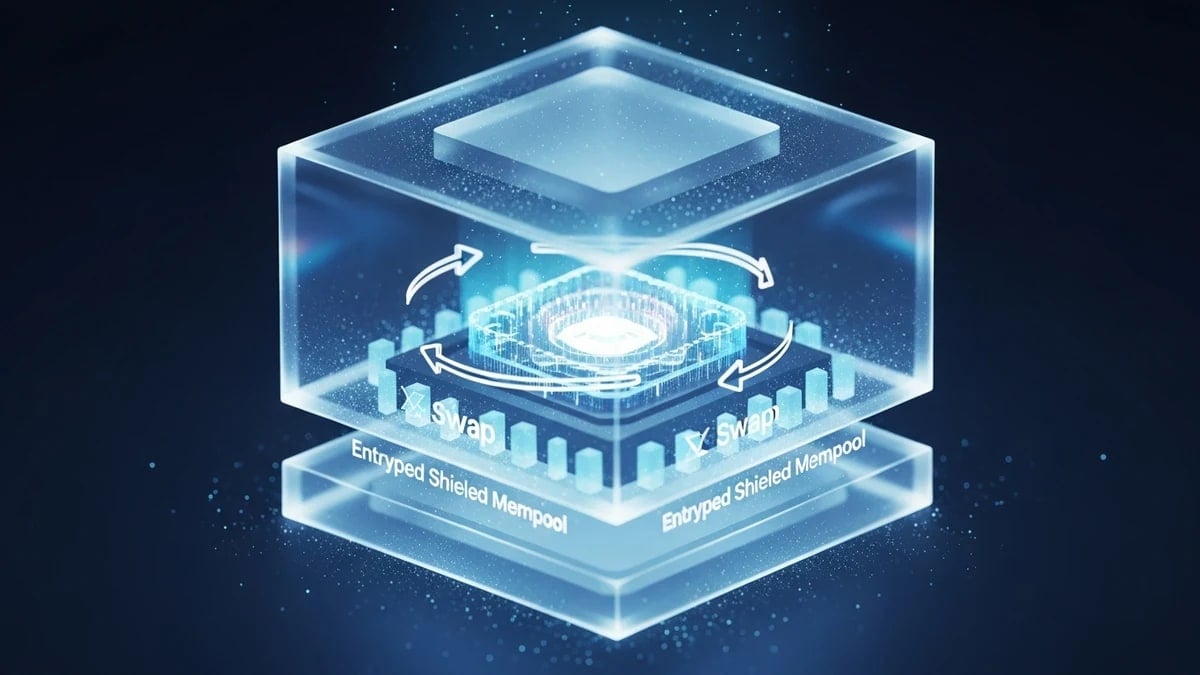
RocketSwap is Anubis Chain's native DEX: a threshold-encrypted mempool for MEV resistance, optional shielded LP positions, and a dynamic fee matrix.
RocketSwap is the native decentralized exchange of Anubis Chain, the EVM-compatible privacy Layer 1. Because it ships inside the chain core, it reads from a threshold-encrypted mempool, which removes the visible order flow that powers sandwich and back-running attacks. It also supports shielded liquidity positions and a dynamic fee matrix that adapts to volatility and pool depth.
- Native DEX built into the Anubis Chain core stack
- MEV resistance from a threshold-encrypted mempool
- Shielded LP positions hide individual deposit size
- Dynamic fee matrix reacts to volatility and depth
- Hosts the deepest pools, including DAI/LGNS
Most decentralized exchanges are bolted on top of a public mempool, which is exactly why traders lose money to sandwich bots. RocketSwap takes a different path. It is the native DEX of Anubis Chain, the EVM-compatible privacy Layer 1, and it is built directly into the chain core. That position lets it tap features ordinary DEXs cannot reach, starting with an encrypted view of pending transactions. This guide explains how RocketSwap works, why it resists MEV, and what shielded liquidity actually means for traders and liquidity providers.
What Is RocketSwap?
RocketSwap is the decentralized exchange that ships as part of the Anubis Chain core stack. On most Layer 1 networks the leading DEX is a third-party contract deployed on top of the chain. RocketSwap is the opposite: it sits closer to the protocol itself, with direct access to two chain-level capabilities that third-party DEXs do not have, the threshold-encrypted mempool and the shielded-balance precompiles. Those two hooks are what make its trading and liquidity model different.
How RocketSwap Resists MEV
Maximal extractable value, or MEV, is the profit bots earn by reordering, inserting, or front-running transactions. The classic example is the sandwich attack: a bot sees your pending swap in the public mempool, buys ahead of you, lets your trade push the price up, then sells into it. The entire attack depends on one thing, the attacker being able to read your transaction before it settles.
RocketSwap removes that precondition. Because pending swaps are encrypted before they are ordered, the searcher infrastructure that profits from sandwich and back-running attacks has no readable order flow to act on. The trade is only revealed after its place in the block is fixed, so there is no window to front-run it.
- Encrypt then order. Swaps enter the mempool encrypted, so their contents are hidden during ordering.
- No readable flow. Bots cannot see what to front-run, which neutralizes sandwich and back-running strategies.
- Reveal after sequencing. Transaction details surface only once the block order is locked.

Shielded Liquidity Positions
RocketSwap also lets liquidity providers deposit into shielded pools. A shielded position hides the size of an individual provider's stake while keeping the pool's aggregate reserves verifiable. In other words, the market can still confirm how deep a pool is, but it cannot single out who holds what. For large providers that is meaningful, because a visible position can itself become a target for predatory trading.
The Dynamic Fee Matrix
Rather than a single flat swap fee, RocketSwap uses a fee matrix that responds to market conditions. Fees adjust based on volatility and pool depth, a design built to insulate freshly listed tokens from speculative cascades while keeping costs reasonable for deep, stable pairs. The practical effect is that a thin, volatile new pool and a deep stablecoin pair are not treated identically.

What Trades on RocketSwap
As the native venue, RocketSwap hosts the deepest pools on Anubis Chain. The anchor market is the DAI/LGNS pair from AWAKE, the chain's first genesis ecosystem project, which launched in May 2026 with a $163 million liquidity pool. Bitget Wallet and OKX Wallet were supported through the RocketSwap interface from that launch.
- Connect a supported wallet. Bitget Wallet and OKX Wallet work with RocketSwap on Anubis Chain (Chain ID 6714).
- Fund with stablecoins. Gas is paid in the DAI-pegged gasDAI unit, so DAI is the natural on-ramp.
- Verify the pair. Confirm token contracts on the official Anubis Chain explorer before swapping.
MEV Explained: The Three Main Attacks
Maximal Extractable Value (MEV) refers to the profit validators or miners can make by reordering, censoring, or inserting transactions within a block. This often comes at the expense of regular users, who might experience worse execution prices or failed transactions. The transparency of a public mempool, where all pending transactions are visible, is the primary enabler for these predatory strategies.
Searchers, specialized bots that monitor the mempool, identify profitable opportunities and submit their own transactions with higher gas fees to influence transaction ordering. This race to front-run or sandwich user transactions is a constant battleground in the decentralized finance (DeFi) landscape.
These attacks highlight a fundamental challenge in public blockchain design: the trade-off between transparency and user protection. While transparency allows for auditing and decentralization, it also creates an environment ripe for predatory MEV extraction.
What Is an Encrypted (Threshold) Mempool?
An encrypted mempool is a crucial innovation designed to combat MEV by obscuring the content of pending transactions from searchers. In a traditional public mempool, transactions are broadcast in plaintext, allowing anyone to see and react to them before they are confirmed. This visibility is what enables front-running and sandwich attacks.
A threshold-encrypted mempool takes a different approach. When a user submits a transaction, it is encrypted using a cryptographic scheme. This encrypted transaction then enters the mempool. Validators or a distributed network of key-share holders collectively possess the decryption key, but no single entity can decrypt the transaction on its own. The "threshold" refers to the minimum number of participants required to reconstruct the key.
By preventing searchers from seeing the details of transactions before they are confirmed, an encrypted mempool levels the playing field, ensuring that transactions are processed based on their intended order and gas fees, rather than being manipulated for external profit.
AMMs 101: What RocketSwap Builds On
Automated Market Makers (AMMs) are a foundational technology in decentralized finance, enabling permissionless and automatic trading of digital assets without traditional order books. Instead of matching buyers and sellers, AMMs use mathematical formulas and liquidity pools to determine asset prices and facilitate swaps.
The most widely adopted AMM model, popularized by Uniswap V2, is the constant-product market maker. This model is governed by the simple equation: x * y = k, where 'x' and 'y' represent the quantities of two tokens in a liquidity pool, and 'k' is a constant product. When a user swaps one token for another, the quantities of 'x' and 'y' in the pool adjust, but their product 'k' must remain the same. This mechanism automatically adjusts prices based on supply and demand within the pool.
- Liquidity Pools. These are smart contracts holding reserves of two or more tokens. Users who deposit tokens into these pools are called liquidity providers (LPs).
- LP Tokens. In return for providing liquidity, LPs receive special tokens (LP tokens) that represent their share of the pool. These tokens can be staked or used in other DeFi protocols.
- Slippage. This refers to the difference between the expected price of a trade and the actual execution price. Large trades can significantly impact the pool's ratio, leading to higher slippage, especially in pools with low liquidity.
RocketSwap, being a Uniswap V2 style AMM, leverages these core principles to facilitate token swaps. However, it enhances this model with privacy features, such as shielded LP positions, to protect users from the predatory practices common in public AMMs.
Shielded Liquidity: Benefits vs Trade-offs
Shielded liquidity refers to the privacy-enhancing feature where the details of liquidity provider (LP) positions are kept confidential. In a typical public AMM, anyone can view the addresses of LPs, the size of their positions, and their activity. This transparency, while beneficial for auditing, can expose LPs to various forms of targeted exploitation, including MEV attacks or even social engineering.
The primary benefit of shielded LP positions is enhanced privacy. By obscuring the identities and holdings of LPs, these positions protect providers from predatory targeting. This can deter strategies designed to exploit large liquidity providers, such as "just-in-time" liquidity provision or other forms of market manipulation that rely on knowing the exact composition of a pool's liquidity.
However, these benefits come with trade-offs. Shielded liquidity introduces additional cryptographic complexity, which can sometimes impact performance or make the underlying mechanisms harder to audit for those without specialized knowledge. Furthermore, as a newer innovation compared to fully public AMMs, the long-term implications and robustness of shielded liquidity solutions are still being explored.
Who Benefits Most from RocketSwap
RocketSwap's unique combination of a threshold-encrypted mempool and shielded LP positions creates a trading environment that particularly benefits specific user personas within the decentralized finance ecosystem. Its design directly addresses some of the most pressing challenges faced by participants on public blockchains.
Active swappers, especially those executing large trades, stand to gain significantly. Without the threat of front-running or sandwich attacks, these users can expect more predictable and favorable execution prices, reducing the hidden costs often associated with high-value transactions on public AMMs. The encrypted mempool ensures their intentions remain private until confirmed, protecting them from predatory bots.
Large liquidity providers (LPs) also find a more secure haven on RocketSwap. Shielded LP positions protect their capital from being targeted by sophisticated strategies that exploit publicly visible liquidity. This privacy can lead to a more stable and less stressful experience for those contributing substantial capital to pools. Finally, privacy-conscious traders, who value confidentiality in their financial activities, will appreciate the inherent privacy protections offered by both the encrypted mempool and shielded liquidity. This makes RocketSwap a compelling platform for those who prioritize security and discretion in their on-chain interactions, particularly for use cases like RWA tokenization and institutional payments where privacy is paramount.
Frequently Asked Questions
What is RocketSwap?
RocketSwap is the native decentralized exchange of Anubis Chain. It ships as part of the chain core stack, which gives it direct access to the threshold-encrypted mempool and shielded-balance precompiles that third-party DEXs cannot use.
How does RocketSwap stop MEV?
Pending swaps are encrypted before they are ordered, so bots cannot read the order flow that sandwich and back-running attacks depend on. Trade details are only revealed after the block order is fixed, leaving no window to front-run.
What are shielded liquidity positions?
Shielded positions let a liquidity provider hide the size of their individual stake while the pool's total reserves remain verifiable. The market can confirm pool depth without identifying who holds each position.
How are RocketSwap fees calculated?
RocketSwap uses a dynamic fee matrix that adjusts based on volatility and pool depth, rather than a single fixed fee. This is designed to insulate newly listed tokens from speculative cascades.
What can I trade on RocketSwap?
RocketSwap hosts the deepest pools on Anubis Chain, including the DAI/LGNS pair from the AWAKE genesis project. Bitget Wallet and OKX Wallet were supported from launch.