What is TVL? Total Value Locked Explained
— By AliceOnChain in Tutorials

Total Value Locked (TVL) is one of the most critical metrics in Decentralized Finance (DeFi). This comprehensive guide explains what TVL is, how it impacts market dynamics, and how savvy on-chain traders combine TVL with DEXTools to identify sustainable market opportunities.
What is TVL? Total Value Locked Explained
Decentralized Finance (DeFi) fundamentally changed how market participants interact with capital, making many traders ask: what is TVL and why does it dictate market movements? In traditional banking, an institution's health is often measured by assets under management (AUM). In the Web3 ecosystem, a parallel metric serves as the bedrock for evaluating the adoption, security, and overall health of protocols: Total Value Locked, or TVL.
For on-chain analysts and retail traders alike, understanding what is TVL in crypto is not merely an academic exercise. It is a practical necessity for evaluating decentralized platforms. When navigating decentralized exchanges (DEXs), lending platforms, or yield aggregators, this core metric acts as a primary indicator of capital commitment, revealing exactly how much liquidity is backing a project's ecosystem.
This guide provides a comprehensive Total Value Locked explained framework, breaks down the core mechanics of the metric, explores why it matters for risk management and strategy execution, and demonstrates how to cross-reference these liquidity data points with real-time tools on DEXTools to make data-driven decisions.
Understanding the Fundamentals of TVL
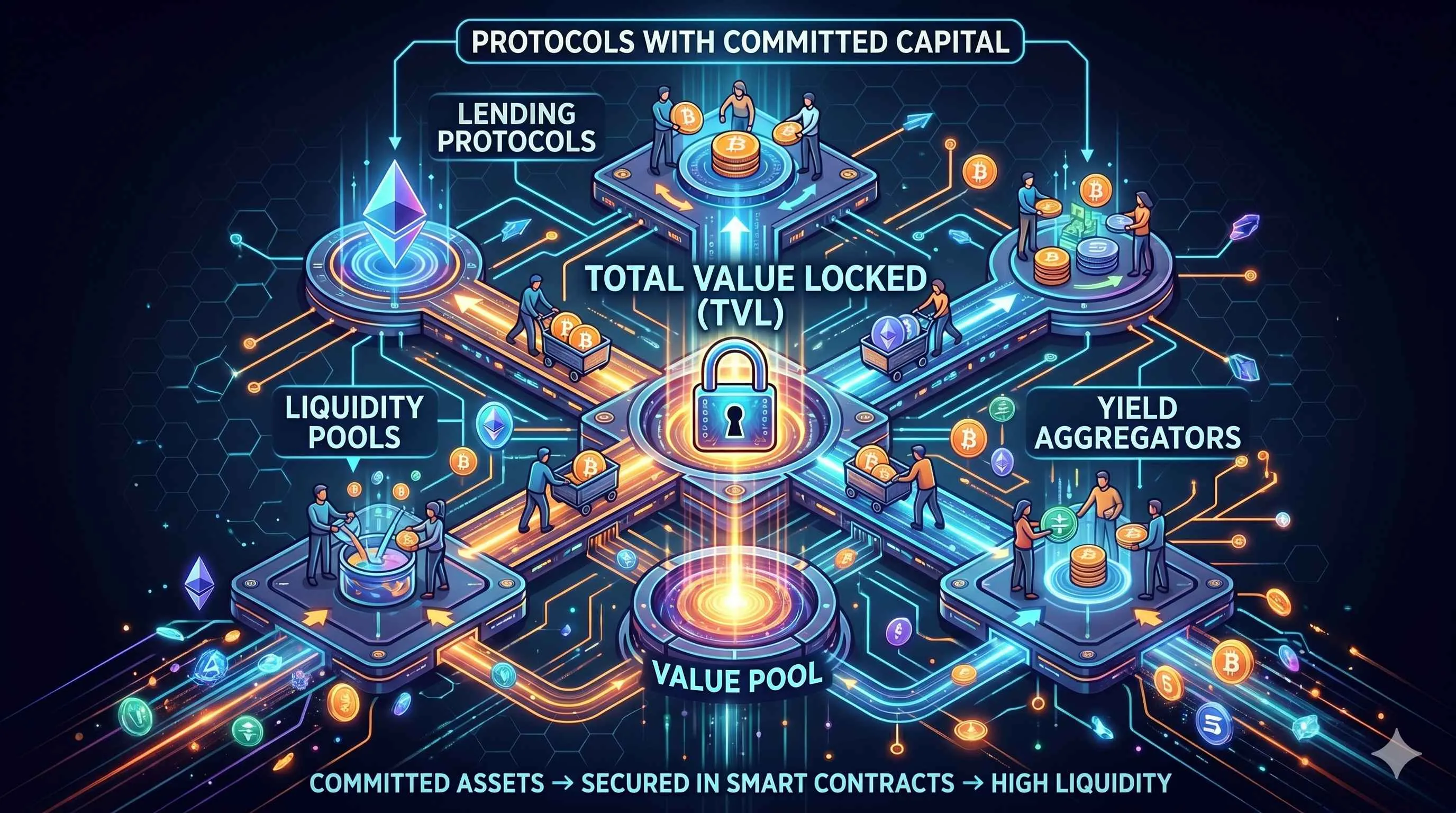
To grasp the true crypto TVL meaning, one must understand that it represents the cumulative value of all digital assets deposited, staked, or currently held within a specific decentralized application's (dApp) smart contracts. These assets fulfill various functional roles depending on the protocol's architecture.
In a lending protocol, the locked value consists of the collateral deposited by borrowers and the capital supplied by lenders. In a decentralized exchange operating via Automated Market Makers (AMMs), it is represented by the tokens committed to liquidity pools, enabling traders to swap assets with minimal slippage. Whenever you evaluate DeFi protocols, looking at this baseline concentration of capital helps you determine if the platform has the structural depth to support heavy trading activity.
How TVL is Evaluated and Measured
To calculate this metric, analysts determine the total quantity of every specific token held within the protocol's smart contracts and multiply each amount by its current fiat market price, aggregating the results into a single USD value.
However, the underlying reality is often more complex than a simple aggregate number. A protocol's total metrics can change due to two distinct and independent variables:
Inflows and Outflows: Users actively depositing or withdrawing assets. This dynamic reflects genuine changes in protocol adoption, user confidence, and market share.
Asset Volatility: Fluctuations in the market price of the locked tokens themselves. If Ethereum drops 10% in price, a protocol holding primarily ETH will see its total dollar value decrease by 10%, even if no user withdrew a single token from the smart contracts.
To filter out market noise, seasoned on-chain analysts look closely at token-denominated volume alongside USD-denominated value. This distinction helps determine what is TVL growth driven by-is a protocol genuinely growing its capital base through user acquisition, or is it simply riding a macro market rally that inflates token prices?
Why TVL Matters in On-Chain Analysis
This baseline metric serves as an implicit gauge of market sentiment and trust. Because smart contracts are transparent yet immutable, depositing funds into a protocol requires a calculated risk assessment by capital allocators. A high concentration of locked capital suggests that the smart contracts are viewed as battle-tested and that the economic incentives provided by the protocol are sufficiently competitive.
Liquidity and Slippage Mitigation
For daily traders using the DEXTools Pair Explorer, understanding what is TVL in relation to a specific pool translates directly into liquidity availability. When trading highly volatile tokens or memecoins, the size of the underlying liquidity pool dictates the price impact of a trade.
When a liquidity pool has a low amount of capital locked, even moderate buy or sell orders can cause significant price slippage, forcing traders to execute at less-than-ideal prices. Conversely, deep liquidity pools with robust capital allocations can absorb larger order flows while maintaining stable price action, allowing for more predictable execution of support and resistance strategies. DEXTools liquidity tracking simplifies this process by showing you the exact depth of these pools in real time.
Assessing Protocol Valuation: The Market Cap-to-TVL Ratio
Much like traditional finance uses the Price-to-Earnings (P/E) ratio to evaluate equities, crypto analysts utilize specific DeFi liquidity metrics like the Market Cap-to-TVL ratio to assess whether a DeFi token is overvalued or undervalued relative to its actual utility.
Ratio Below 1.0: The protocol's native token market capitalization is lower than the value of the assets locked within its ecosystem. This can suggest that the token is potentially undervalued, assuming the protocol's fundamentals are sound.
Ratio Well Above 1.0: The market capitalization significantly exceeds the value of assets locked. This often indicates a high speculative premium, where the asset's price is driven by future growth expectations rather than current operational utility.
Advanced TVL Dynamics: Looking Beyond the Surface
While a high baseline metric is generally a positive indicator, treating it as a foolproof sign of safety is a common mistake. For a complete Total Value Locked explained overview, we must examine the internal composition of a protocol's locked value to ensure it isn't artificial.
The Risk of Governance Token Inflation
Some protocols artificially inflate their capital metrics by offering aggressive, high-emission rewards paid out in their native governance tokens. This structure can attract temporary liquidity providers who deposit capital solely to farm the native token and sell it immediately on the open market.
When the emission rates drop, this "mercenary capital" leaves as quickly as it arrived, causing rapid asset degradation and sharp downward pressure on price action. This is why asking what is TVL composed of is often more important than looking at the headline number itself.
Capital Rehypothecation and Liquid Staking Derivatives
Modern DeFi relies heavily on composability-the ability for different protocols to interact with one another. This gives rise to a phenomenon known as capital rehypothecation, or "double counting," which complicates the true crypto TVL meaning.
For instance, if a user deposits ETH into a liquid staking protocol, they receive a liquid staking token (LST) in return. If they then take that LST and deposit it into a lending protocol, that capital is effectively counted toward the metrics of both platforms. On-chain analysts must account for these layers of leverage when they evaluate DeFi protocols to protect themselves from systemic liquidity shocks.
How to Combine TVL Analysis with DEXTools
Successful on-chain trading requires verifying macro metrics like protocol assets with micro-level on-chain behavior. DEXTools offers a suite of features that allow you to cross-examine liquidity and token health dynamically.
Verifying Liquidity with the Pair Explorer
When you identify a project with an appealing asset growth trajectory, the first step is to analyze the specific trading pairs on the DEXTools Pair Explorer. Look at the balance of the liquidity pool. Is the liquidity locked, or can it be pulled unilaterally by the deployer? DEXTools displays lock status and contract audit scores prominently, allowing for efficient DEXTools liquidity tracking alongside your broader macro analysis.
Monitoring Whale Activity and Holder Distribution
A massive pool of capital concentrated in only a few wallets presents a structural risk. If a single "whale" decides to remove their liquidity, the pool could collapse, causing severe price volatility.
By utilizing the Holder Analysis tab and the integrated Bubblemaps feature on DEXTools, you can visually inspect the distribution of token ownership. A decentralized, highly fragmented distribution of holders is generally healthier and less prone to systemic liquidation events than a pool dominated by interconnected wallet clusters, giving deeper context to what is TVL safety.
Volatility Management via Real-Time Tools
When capital flows rapidly out of a protocol, the total locked value drops, and volatility typically spikes. To protect your capital from sudden market shifts, you can set custom Price Alerts within DEXTools. Monitoring volume anomalies alongside price action allows you to see if a drop in assets is accompanied by heavy distribution or if it is merely a minor rebalancing of capital by market participants.
Conclusion: Integrating TVL into a Comprehensive Strategy
Answering what is TVL thoroughly requires looking past a single number and analyzing how capital moves across the blockchain. Total Value Locked remains an indispensable metric for evaluating Web3 projects, acting as a direct reflection of utility, liquidity, and economic activity. However, relying on this metric in isolation is a common pitfall. A holistic analytical framework requires looking at locked assets alongside trading volume, structural tokenomics, holder distribution, and smart contract health.
By combining macro insights with the real-time granular data provided by DEXTools charts, liquidity tracking, and holder analysis, you can separate speculative hype from sustainable on-chain value. Maintain a disciplined approach to risk management, keep a close eye on liquidity compositions, and always let data guide your execution.
- Liquidity Turnover vs TVL: How to Know If a DeFi Pool Is Active or Idle
- Why Real Time Data Matters for DEX Traders
- Fake Volume vs Real Demand: How to Spot Artificial Momentum in DeFi Trading
Disclaimer: This article is for informational purposes only and does not constitute investment advice, financial advice, trading advice, or any other kind of advice. DEXTools does not recommend buying, selling, or holding any cryptocurrency or token. Users should conduct their own research and consult with a qualified financial advisor before making any investment decisions. Cryptocurrency investments are volatile and high-risk. DEXTools is not responsible for any losses incurred.