Arbitrage Delay: Why Same Token Price Gaps Stay Open Longer Than Traders Expect
— By Whatsertrade in Tutorials

Many crypto traders assume that if the same token trades at different prices in two places, arbitrage will fix the gap immediately. In theory, this makes sense.
Many crypto traders assume that if the same token trades at different prices in two places, arbitrage will fix the gap immediately.
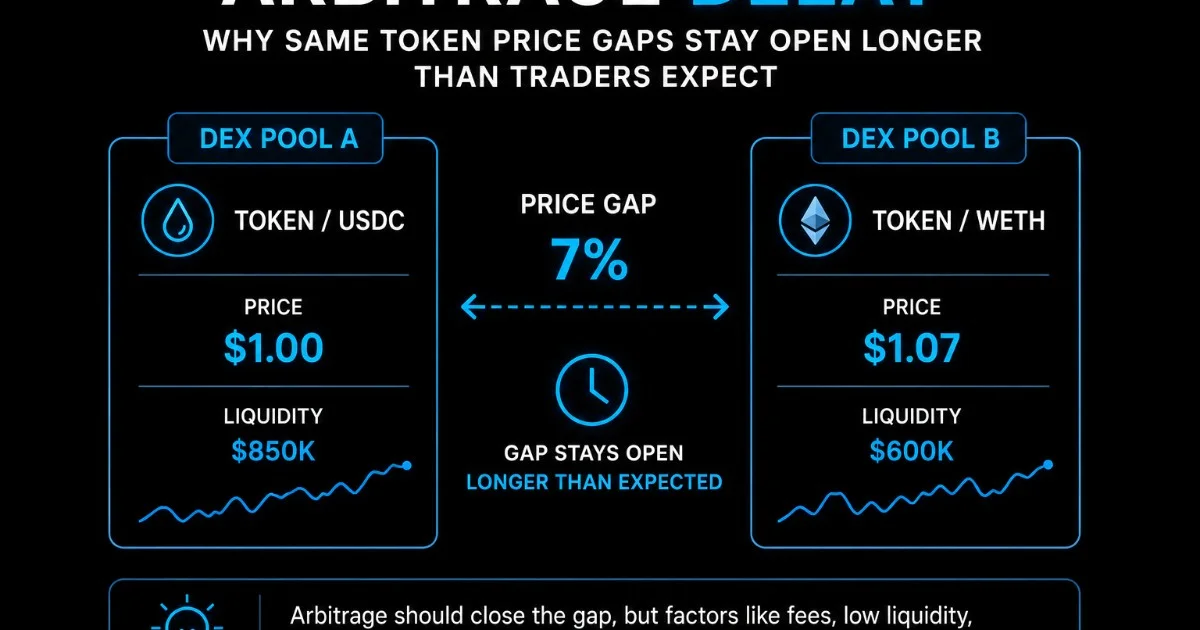
In theory, this makes sense.
Traders buy where the token is cheaper and sell where it is more expensive. That activity closes the price gap.
But in real DEX markets, price gaps do not always disappear quickly.
Sometimes, the same token can trade at different prices across pools, DEXs, or chains for longer than expected. This is known as arbitrage delay.
Understanding arbitrage delay can help traders avoid misleading charts, bad entries, and false assumptions about market efficiency.
What Is Arbitrage Delay?
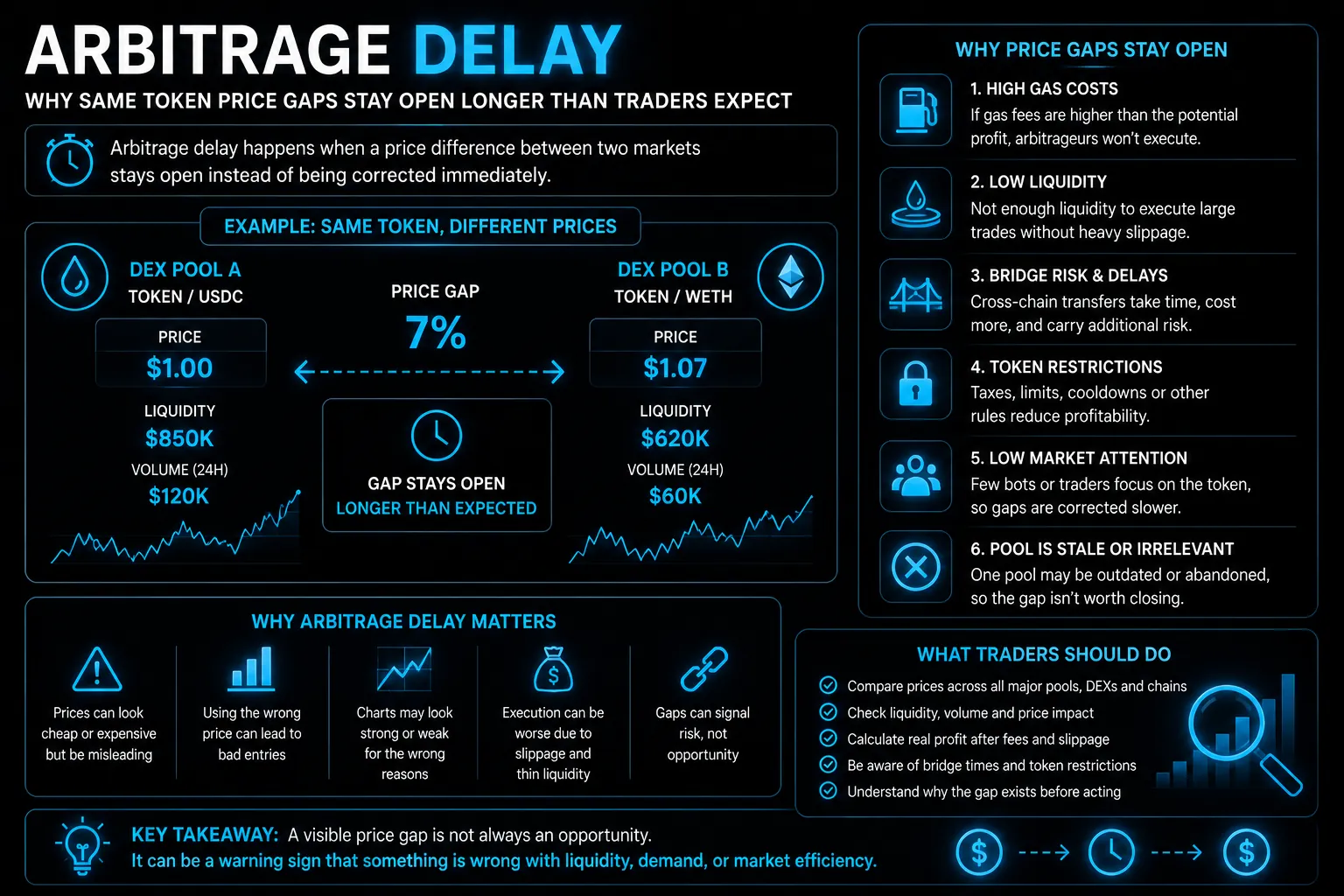
Arbitrage delay happens when a price difference between two markets stays open instead of being corrected immediately.
For example, a token may trade at $1.00 in one pool and $1.07 in another. In an efficient market, arbitrage traders would usually close the gap. But if barriers exist, the difference may remain visible for longer.
This can happen across:
- Two pools on the same DEX
- Two different DEXs
- Two different chains
- A DEX and a CEX
- Old and new token contracts
- Low liquidity pairs
A price gap is not always an opportunity. Sometimes, it is a warning sign.
Why Price Gaps Stay Open
Several factors can prevent arbitrage from closing quickly.
1. Gas Costs Are Too High
If the profit from arbitrage is smaller than the gas cost, traders may ignore the gap.
This is common during network congestion or when the price difference is too small to justify execution.
2. Liquidity Is Too Thin
A price gap may look profitable, but the pool may not have enough liquidity to execute the trade.
Once slippage is included, the opportunity may disappear.
3. Bridge Risk Exists
Cross chain arbitrage is more complex.
Moving assets between chains can take time, include extra fees, and expose traders to bridge risk. Because of this, price gaps between chains can stay open longer than expected.
4. Token Restrictions Reduce Profitability
Some tokens include transfer fees, trading limits, cooldowns, or other restrictions.
A visible price gap may remain because traders cannot move or trade the token efficiently enough to profit.
5. The Token Has Low Market Attention
If few traders care about the token, arbitrage bots may not prioritize it.
Low attention can lead to slower price correction, especially in small or inactive markets.
6. One Pool Is No Longer Relevant
Sometimes a price gap exists because one pool is stale or abandoned.
In that case, the gap is not a clean trading opportunity. It may simply mean that one pool no longer reflects the real market.
Why Arbitrage Delay Matters for Traders
Arbitrage delay can confuse traders who rely on a single chart.
A token may look cheaper in one pool, but that does not always mean it is undervalued. The cheaper price may reflect weak liquidity, poor execution, or market isolation.
A token may also look stronger in a smaller pool because one buy pushed the price sharply upward. Without enough arbitrage activity, that inflated price may stay visible longer than expected.
In both cases, the trader risks making decisions based on distorted data.
How to Identify Arbitrage Delay
Traders can watch for several signs:
- The same token shows different prices across pools
- Price gaps remain visible for longer than normal
- One pool has much lower liquidity than another
- One chart moves sharply while another stays stable
- Volume is concentrated in only one market
- Cross chain versions show persistent differences
- Large trades create price moves that do not sync elsewhere
When these signs appear, traders should compare markets before acting.
Arbitrage Delay vs Real Opportunity
Not every price gap is tradable.
A real arbitrage opportunity requires enough liquidity, low costs, fast execution, and manageable risk.
A visible price gap without those conditions may be a trap.
For most traders, the goal is not always to trade the gap. The better goal is to understand what the gap says about market quality.
A persistent price gap can reveal:
- Weak liquidity
- Low arbitrage interest
- Poor pool relevance
- Cross chain fragmentation
- Execution risk
- Market inefficiency
These insights can help traders avoid bad entries.
Final Thoughts
Crypto markets are not always perfectly efficient.
Price gaps can stay open longer than traders expect, especially in low liquidity, cross chain, or fragmented markets.
Arbitrage delay is a reminder that price is not just a number. It depends on liquidity, execution, venue, chain, costs, and market attention.
Before buying a token because it looks cheaper in one pool, traders should ask: is this a real opportunity, or is the market warning me that something is wrong?
How to Bridge Crypto Between Chains: Complete Cross-Chain Tutorial 2026 How to Use 1inch: Complete DEX Aggregator Swap Tutorial (2026) How to Use OKX Web3 Wallet: Multi-Chain DeFi Hub Guide (2026)Frequently Asked Questions
What causes arbitrage delays in crypto?
Arbitrage delays in crypto often stem from network congestion, transaction processing times, and liquidity differences across various exchanges. These factors can prevent immediate execution of trades to capitalize on price discrepancies.
How does network congestion impact arbitrage opportunities?
Network congestion slows down transaction confirmation times, making it difficult for arbitrageurs to execute trades quickly enough to profit from fleeting price differences. By the time a transaction is confirmed, the price gap may have closed.
Why do different exchanges show varying prices for the same token?
Price variations across exchanges can be due to differences in trading volume, liquidity, and the order books of each platform. Supply and demand dynamics on individual exchanges contribute to these discrepancies.
What role does liquidity play in arbitrage delay?
Low liquidity on an exchange can make it challenging to buy or sell large amounts of a token without significantly impacting its price. This can limit the size of an arbitrage trade and increase the time it takes to execute.
Are arbitrage delays more common with certain types of cryptocurrencies?
Arbitrage delays can be more pronounced with less liquid or newer cryptocurrencies, as they may have fewer trading pairs and be listed on fewer exchanges. Highly volatile assets can also present greater challenges for timely arbitrage.
Related Guides
- What Is Crypto Arbitrage? Complete Trading Guide (2026)
- Liquidity Velocity: Why Fast LP Changes Matter More Than Total Liquidity
- Bridge Inflows vs Local DEX Volume: Does Capital Stay on the Chain?
- Liquidity Rotation: How Capital Moves Between Tokens Inside the Same Narrative
- Is Ripple the Same as XRP? Key Differences Explained (2026)