Authorized Participants in Crypto ETFs

The plumbing of the ETF market relies on specialized financial institutions. We break down the mechanics of the creation/redemption loop and how it prevents price decoupling.
The Liquidity Engine Behind Crypto ETFs
- In the sophisticated architecture of exchange-traded products, the public sees the daily price fluctuations of shares, but the structural integrity of the fund is managed by a group of highly specialized financial entities known as Authorized Participants.
- While the ETF issuer manages the fund’s strategy, it is the Authorized Participants who facilitate the actual settlement process, ensuring that the market price of the ETF share never deviates significantly from the value of the underlying Bitcoin or Ethereum. Understanding their role is essential for any participant looking to grasp the true nature of institutional digital asset liquidity.
Authorized Participants: the Creation and Redemption Engine
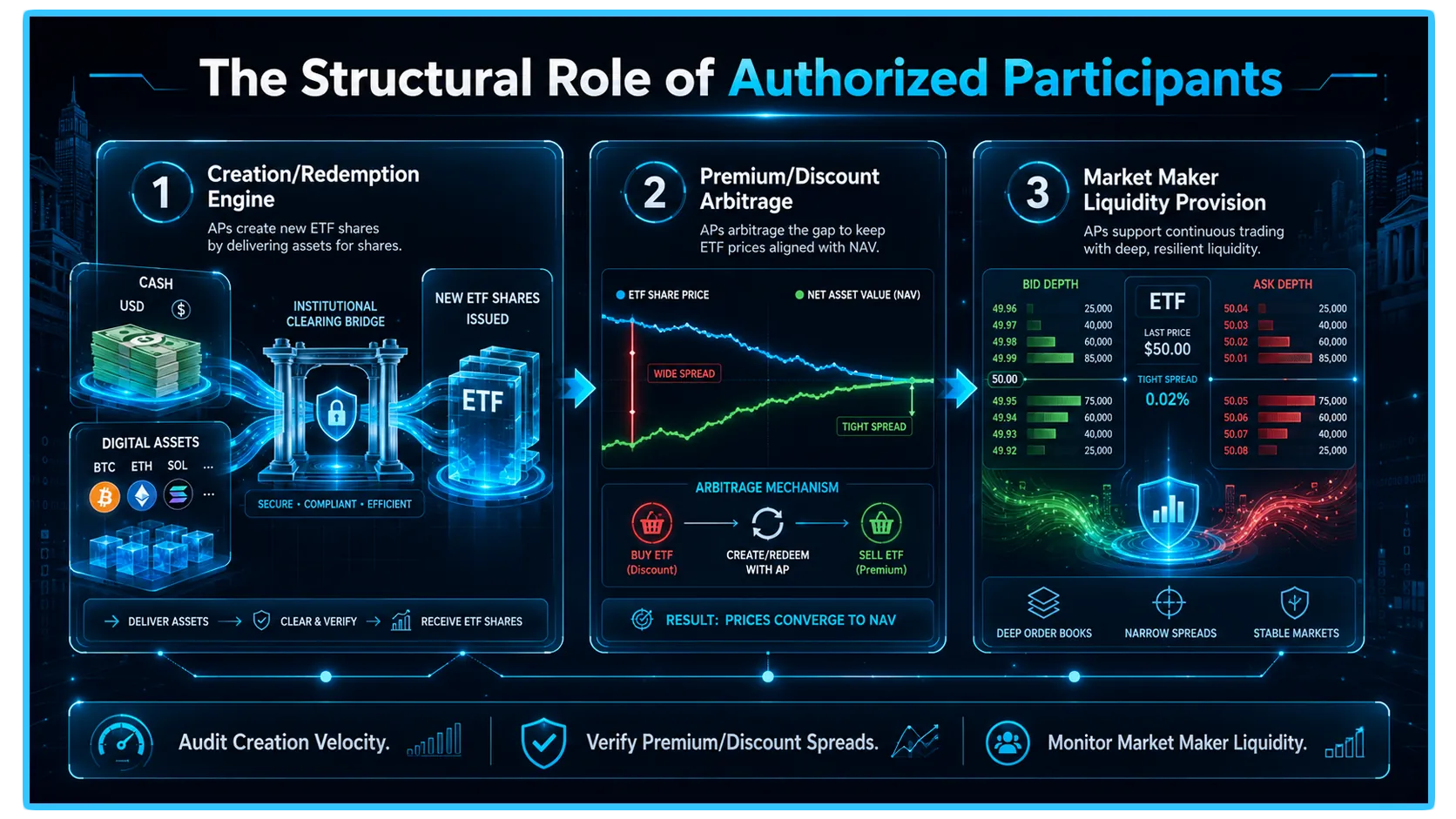
- The primary function of Authorized Participants is to manage the supply of ETF shares through the "Creation/Redemption" process. Unlike traditional stocks, where the number of shares is fixed, ETFs are dynamic; they can expand or contract to meet investor demand.
- When institutional demand for a crypto ETF surges, it creates upward price pressure, causing the share price to trade at a "premium" relative to the Net Asset Value (NAV) of the underlying digital assets. This is where the AP steps in. The Authorized Participants will purchase the underlying assets (using cash to buy BTC or ETH) and deliver these assets to the fund issuer. In return, the issuer creates a large block of new ETF shares, which the AP then sells into the secondary market. By increasing the supply of shares, the AP effectively exerts downward pressure on the price, bringing it back into alignment with the NAV.
- Conversely, during periods of heavy selling, the ETF shares might trade at a "discount" to the underlying NAV. In this scenario, the APs purchase the discounted ETF shares from the open market, deliver them to the issuer for "redemption," and receive the underlying digital assets back. The AP then sells these assets to liquidate their position. This constant feedback loop is the mechanical secret that keeps the ETF share price tethered to the real-world value of the digital assets it holds.
Arbitrage and Market Maker Synergy
- The efficiency of Authorized Participants relies heavily on the presence of robust arbitrage opportunities. Because the AP is essentially an arbitrageur, they do not take directional risk on the price of Bitcoin or Ethereum. Their profit margin is derived solely from the tiny discrepancy between the ETF share price and the underlying asset price.
- To operate this mechanism at scale, APs work in close partnership with market makers. Market makers provide the essential liquidity on the exchange order books, ensuring that investors can buy or sell shares without causing massive slippage. When a market maker identifies a persistent imbalance in the order book (for example, a wave of buy orders that creates a premium) they alert the Authorized Participants that there is a profitable opportunity to initiate a creation event.
- This symbiotic relationship creates an "order book equilibrium." The market maker handles the retail-facing liquidity, while the AP handles the institutional-facing settlement. Together, they form the structural backbone that allows these products to function as seamlessly as traditional equity funds, despite the underlying assets operating on complex, decentralized 24/7 global ledgers.
Maintaining Integrity in a 24/7 Market
- The challenge of settling crypto products is unique because traditional financial markets operate on a "T+1" (or T+2) settlement cycle, while digital asset networks operate in real-time. Authorized Participants bridge this gap by utilizing high-velocity clearing bridges and OTC (Over-the-Counter) desks that can lock in prices for the underlying assets instantaneously.
- When you observe the daily volume of a crypto ETF, you are essentially seeing the cumulative output of this AP-driven arbitrage process. If you see high volume without a corresponding significant change in price, it is often a sign that market makers and APs are successfully balancing the supply and demand, absorbing the institutional flow without creating excessive volatility. This stability is the ultimate value proposition of the ETF structure: it allows large-scale institutional capital to enter and exit the market through a regulated "pipe" without triggering the flash crashes or liquidity gaps that historically plagued smaller digital asset exchanges.
Verification through Telemetry
- For the retail investor, verifying that the ETF is performing as expected requires the same tools used by institutional arbitrageurs. DEXTools provides the critical data infrastructure needed to monitor the underlying liquidity of the assets that the Authorized Participants are moving. By tracking the depth of liquidity pools and the activity of large-scale wallets on-chain, analysts can gain visibility into when large creation or redemption events might be occurring.
- DEXTools acts as a window into the liquidity side of the equation, allowing you to cross-reference the ETF's daily volume with real-time on-chain movement. Maintaining this level of data-driven transparency is key to navigating the institutionalization of digital assets.
You can access DEXTools here and start trading today!
Disclaimer: This article is for informational purposes only and does not constitute investment advice, financial advice, trading advice, or any other kind of advice. DEXTools does not recommend buying, selling, or holding any cryptocurrency or token. Users should conduct their own research and consult with a qualified financial advisor before making any investment decisions. Cryptocurrency investments are volatile and high-risk. DEXTools is not responsible for any losses incurred.