Inflation vs. Burn Mechanisms: Real-Examples

Surface price movements often obscure the algorithmic supply mechanics that define a blockchain's long-term purchasing power. We analyze real-world programmatic asset reduction and token locking frameworks safely.
The Algorithmic Sovereign: Stripping the Illusion of Flat Supply
- In globalized, borderless blockchain networks, an asset's nominal price is simply a real-time reflection of a continuous auction. While retail day traders frequently expend their cognitive energy tracking short-term candlestick formations and social media sentiment loops, institutional allocators recognize that sustainable capital appreciation is anchored to programmatic scarcity. In traditional equity structures, stock buybacks serve as a reliable method for a corporation to reduce its outstanding float and return value to long-term shareholders. In the decentralized Web3 landscape, this economic function is completely automated by programmatic code.
- Understanding raw crypto token supply dynamics requires you to move past the superficial assumption that a coin's total circulating volume remains static over time. Every prominent layer-1 and ecosystem utility token operates under a unique, hardcoded monetary policy. Some systems utilize perpetual, linear token printing to continuously reward the network nodes that secure their ledgers, introducing constant structural dilution to passive spot holders. Conversely, vanguard protocols implement automated token sinks that systematically ingest and permanently destroy assets directly off the open market.
- By shifting your technical perspective from simple price tracking to advanced supply telemetry, you uncover the mechanical engines driving modern tokenomics. This practical guide analyzes the dual-burn framework of the BNB Chain, breaks down the transactional fee-destruction engine of Ethereum's EIP-1559 upgrade, evaluates the market impact of staked versus circulating asset ratios, and establishes a definitive technical playbook for navigating token scarcity parameters safely.
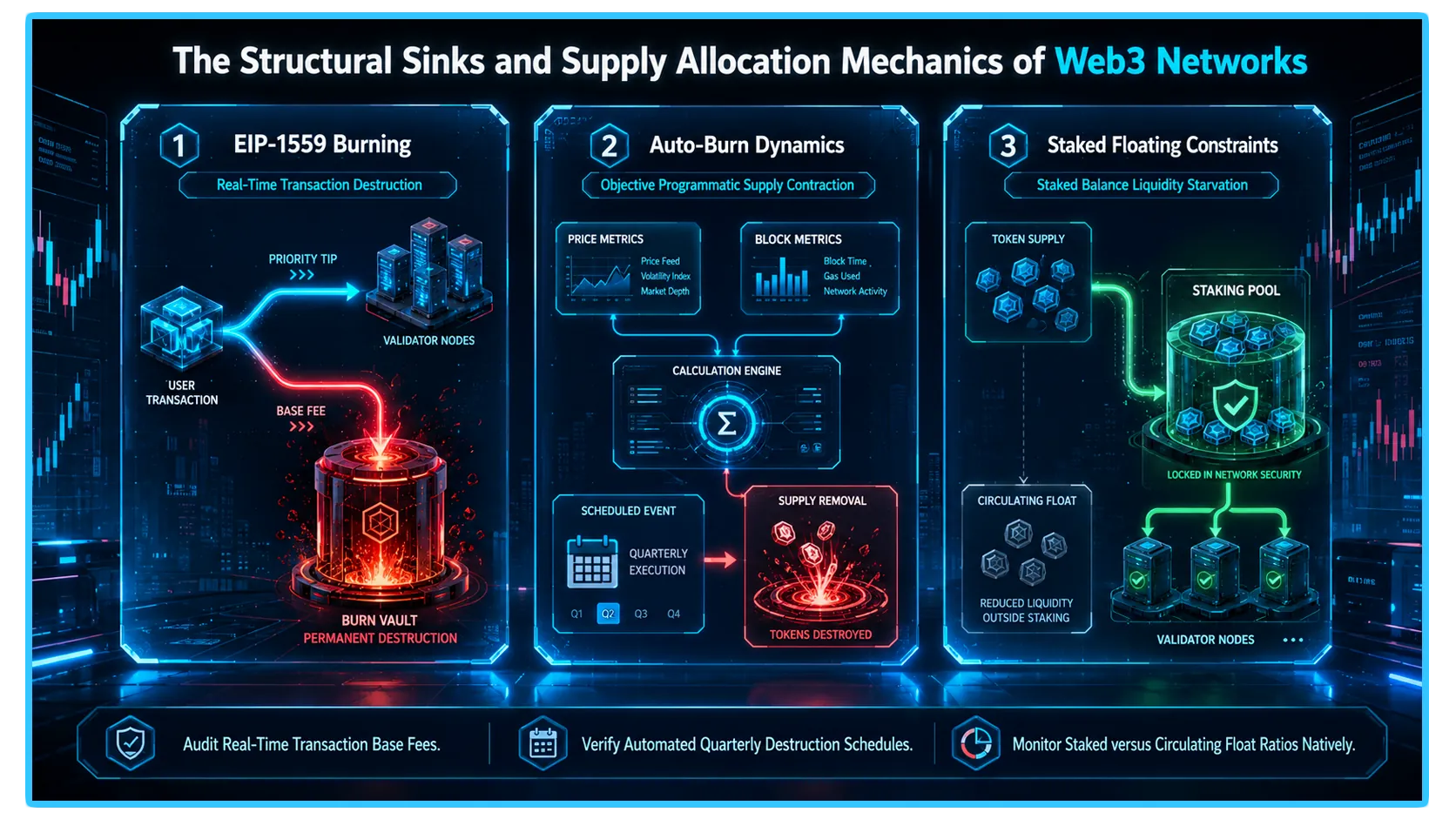
1. The BNB Dual-Burn Framework: Auto-Burns and Real-Time Sinks
- Binance Coin stands as a premier example of a multi-tiered, programmatic token contraction architecture. At its initial launch in 2017, the protocol established a firm, non-negotiable commitment: to permanently remove half of its total initial supply from circulation through an automated burning pipeline, eventually capping the lifetime ecosystem volume at exactly 100 million total tokens.
- To achieve this macroeconomic goal independently of centralized corporate intervention, the ecosystem deploys a dual-burn strategy composed of an independent quarterly calculation loop and a real-time transactional fee sink.
The Quarterly Architecture
- The primary tool driving the asset's structural scarcity is the Quarterly Auto-Burn. Rather than relying on centralized exchange revenue reporting, the auto-burn operates via an objective, independently auditable software script running directly on the blockchain ledger.
- The mechanism calculates the precise number of tokens to be sent to a dead blackhole address every quarter by processing two distinct real-time variables: the average market spot price of BNB and the total number of blocks successfully generated during that three-month horizon.
- This model introduced an innovative economic stabilizing function: if the market price of the token experiences a significant downward drop, the programmatic calculation automatically scales the number of tokens to be burned upward. This auto-balancing feature injects an aggressive deflationary cushion exactly when the ecosystem requires structural support.
- For instance, during the 34th quarterly burn executed in January 2026, the protocol successfully eliminated roughly 1.37 million BNB from the total supply. This continuous reduction has brought the remaining total supply down to approximately 136.36 million tokens as the system grinds steadily toward its ultimate 100 million target.
- Furthermore, as the network deployed major technical scaling developments (specifically the Lorentz and Maxwell upgrades) block generation speeds accelerated significantly. Because blocks are produced more frequently, token engineers proactively adjusted the internal parameters of the auto-burn formula. This fine-tuning ensures that the long-term deflationary path remains fully aligned with the original economic design of the network.
The BEP-95 Real-Time Fee Burn
- Complementing the quarterly contraction is the BEP-95 upgrade, which introduces an unyielding, transaction-based destruction layer. Operating directly inside the Proof-of-Staked-Authority consensus engine, BEP-95 mandates that a fixed ratio of the gas fees collected within every single block is instantly routed to a dead address, completely bypassing validator payout pools.
- This ensures that even during periods of sideways market consolidation, high dApp utility, opBNB Layer 2 traffic, and on-chain transactional volume actively drive permanent asset scarcity second by second.
2. Ethereum EIP-1559: Linking Scarcity Directly to Network Adoption
- Before August 2021, the Ethereum network operated on a standard first-price auction model for transaction fees. Users simply guessed how much gas an interaction required and paid that entire fee directly to the miners who validated the block. This system created highly volatile fee spikes and provided zero structural relationship between network adoption and asset scarcity.
- The activation of the EIP-1559 upgrade permanently reorganized the network's financial microstructure by introducing a dual-layered fee architecture composed of a Base Fee and a Priority Tip.
The Base Fee Liquidation Engine
- Under EIP-1559, every smart contract call, decentralized exchange swap, or layer-2 data storage settlement requires a mandatory Base Fee to be processed by the blockspace. This fee is dynamically calculated by the protocol itself on a block-by-block basis, expanding or contracting automatically depending on active congestion parameters.
- Crucially, the entire Base Fee portion of the transaction is instantly and permanently burned, routed away from validator address pools into cryptographic extinction. The priority tip remains the only component paid directly to the validator to incentivize rapid transaction inclusion.
The Post-Merge Macro Balance
Following the transition to Proof-of-Stake, the network's daily token printing rewards dropped drastically. This reduction created a highly reactive economic tipping point:
Low-Activity Environments: When on-chain transaction volumes drop and gas fees remain low, the programmatic token emissions paid to network validators outpaces the base-fee burn rate, causing the total circulating supply to expand at a gentle, inflationary pace.
High-Activity Environments: When decentralized finance utility surges, automated trading scripts multiply, or high-amplitude market volatility triggers a wave of on-chain liquidations, block congestion drives the Base Fee upward. The volume of tokens destroyed per block completely overrides validator emissions, causing the net supply of ETH to shrink, validating its status as an "ultra-sound" digital asset.
3. Staked vs. Circulating Supply: The Passive Liquidity Squeeze
- While programmatic burn mechanisms permanently eliminate tokens from the master ledger, analyzing the structural interaction between Staked and Circulating Supply reveals how a network temporarily alters its available market float.
- When you evaluate a modern protocol, auditing the percentage of tokens locked inside security contracts compared to the volume flowing through liquid exchange venues reveals a profound look into active crypto token supply dynamics.
The Liquidity Starvation Phenomenon
- When users deposit their assets into network staking nodes (whether to power a Proof-of-Stake validator pool or participate in a delegated consensus cabinet) those tokens are removed from active circulation. They are securely held within locked non-custodial smart contracts, rendering them completely unavailable to be sold, transferred, or utilized as short-term market collateral.
- This asset immobilization creates a technical condition known as Liquidity Starvation. If an ecosystem successfully incentivizes its community to stake a dominant portion of the circulating supply (for example, over sixty percent of tokens locked), the liquid depth resting across centralized and decentralized order books shrinks to a paper-thin margin.
- When a fresh wave of institutional demand or macroeconomic accumulation hits the market, the incoming market buy orders encounter virtually zero horizontal resistance on the depth ledger. Because there is an acute shortage of liquid floating supply available to absorb the capital influx, the spot price is forced to accelerate upward with massive, vertical momentum.
The Unbonding Temporal Guardrail
- The economic stability provided by staking is heavily reinforced by the Unbonding Period. Unlike standard decentralized lending pools where capital can be withdrawn within a single block transaction, unstaking a major network asset triggers a hardcoded temporal delay ranging from several days to a full calendar month.
- This unbonding runway serves as an essential macroeconomic circuit breaker. If a market-wide panic occurs, insiders and whales cannot instantly market-dump their staked positions onto exchange books. The temporal delay breaks up cascading capitulation loops, giving market makers and institutional over-the-counter desks the time required to step in, evaluate the network's structural health, and deploy stabilizing buy walls cleanly.
Supply Management Structural Matrix
| Metric Attribute | BNB Auto-Burn System | Ethereum EIP-1559 Engine | Staking Lockup Primitive |
| Data Reduction Vector | Objective Quarterly Calculation | Real-Time Transaction Base Fee | Temporal Float Immobilization |
| Consensus Anchor | Proof of Staked Authority (PoSA) | Proof of Stake (PoS) | Proof of Stake / Validator Delegation |
| Ecosystem Target | Cut total supply down to 100M | Dynamic supply equilibrium | Incentivize network security & alignment |
| Operational State | Permanent Ledger Extinction | Permanent Ledger Extinction | Reversible after Unbonding Period |
4. Operational Strategies for Tokenomics Allocators
To harvest a distinct technical advantage from these conflicting monetary tracks, sophisticated portfolio managers apply distinct execution rules based on live supply telemetry.
Trading the Deflationary Activity Wave
When tracking an asset utilizing a transactional burn engine like EIP-1559, your execution entries should be heavily aligned with macro on-chain activity trends. Monitoring metrics such as daily active addresses, smart contract deployment velocity, and gas congestion baselines allows you to anticipate structural supply contraction long before the market registers the deflationary shift on the daily chart. Entering spot positions right as network activity enters an expansionary regime protects your portfolio from late-stage trend traps.
Exploiting the Unbonding Expiration Window
Symmetrically, tracking the timeline of major staking unlocks provides an exceptional risk-management tool. If a protocol undergoes a massive governance event or network migration that causes a substantial concentration of whales to simultaneously trigger their unbonding scripts, you can map out the exact calendar window where a massive wave of liquid floating supply will hit the market. Standing completely aside or establishing short hedges ahead of these unstaking events isolates your capital from cascading distribution wicks.
5. Live Network Verification via DEXTools
Even when keeping your keys safe offline, real-time market data is vital for navigating programmatic token shifts. DEXTools delivers essential live metrics to monitor decentralized liquidity, evaluate pool depth, trace large wallet movements, and run contract security scans via tools like Pair Explorer, Big Swap Explorer, and Live New Pairs. This ensures your wallet interacts only with secure, liquid markets.
You can access DEXTools here and start trading today!
Disclaimer: This article is for informational purposes only and does not constitute investment advice, financial advice, trading advice, or any other kind of advice. DEXTools does not recommend buying, selling, or holding any cryptocurrency or token. Users should conduct their own research and consult with a qualified financial advisor before making any investment decisions. Cryptocurrency investments are volatile and high-risk. DEXTools is not responsible for any losses incurred.