Tokenomics Explained: Supply, Demand, and Sinks

Standalone price metrics mask the underlying dilution risks built into low-float, inflationary digital assets. We break down the emission schedules and structural sinks needed to audit token design safely.
The Macroeconomic Sovereign: Overriding Meme Hype with Cryptographic Incentives
- In the speculative arenas of Web3 asset design, price action frequently behaves as an erratic, hype-driven vector. The emergence of community-centric meme economies can temporarily generate parabolic market capitalizations, but beneath this superficial volatility lies a cold structural reality: any digital asset devoid of a highly optimized, sustainable economic framework is destined for systemic valuation collapse. In a decentralized network operating without a central state bank to enforce legal-tender usage, the value, durability, and utility of a protocol's native token must be orchestrated entirely by code.
- This programmatically hardcoded economic design is known as Tokenomics (the synthesis of game theory, monetary policy, market microstructure, and smart contract engineering) that dictates the allocation and flow of value within a decentralized ecosystem. Tokenomics is the foundational architecture that determines whether a decentralized protocol can successfully bootstrap its initial network liquidity, align the opposing incentives of founders, investors, and users, and survive multi-year market downcycles.
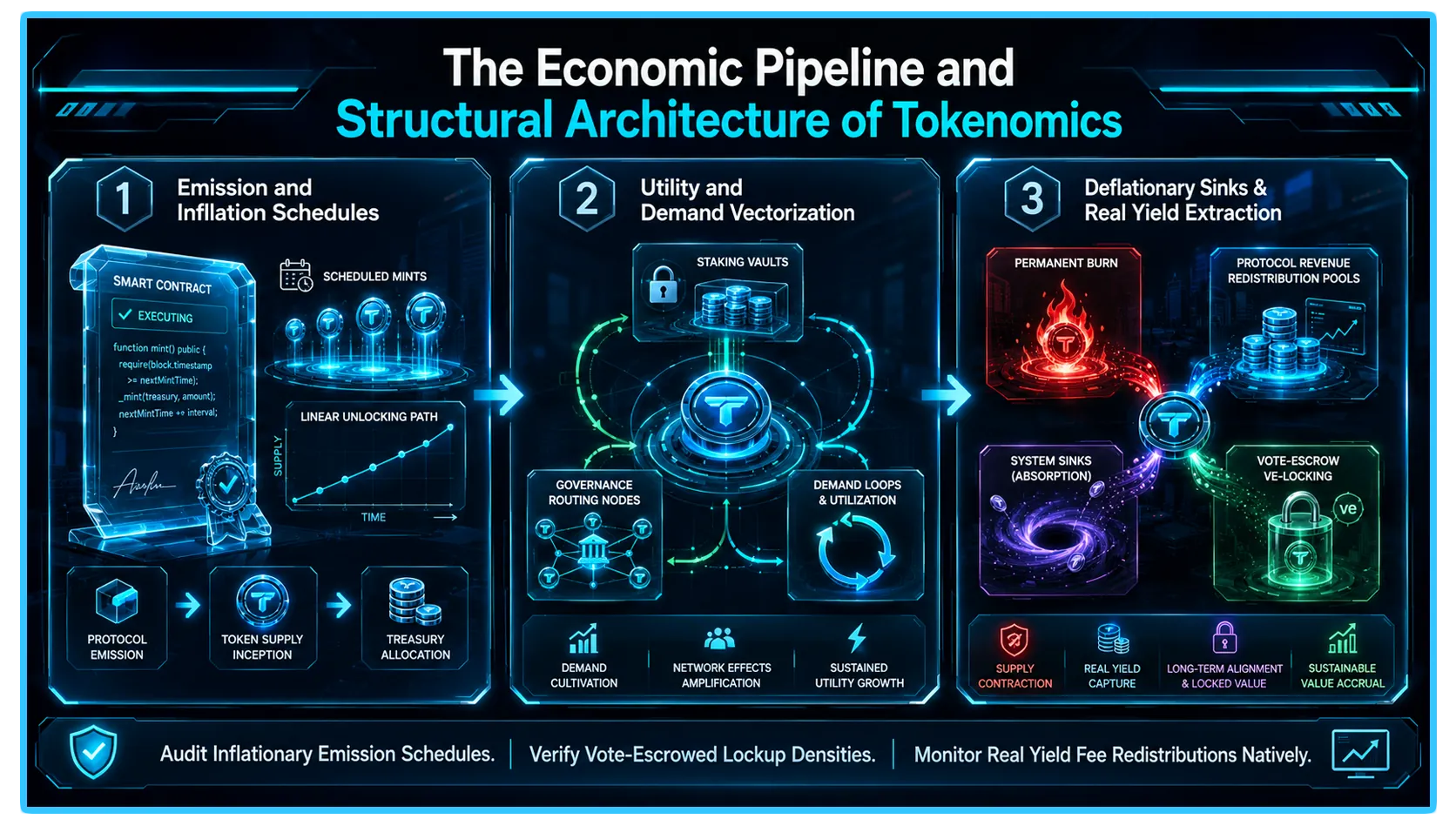
- To analyze a cryptographic economy and tokenomics with institutional rigor, you must move past basic market metrics. Instead, you must audit the interaction between three structural pillars: the inflationary velocity of the supply schedule, the organic monetization of the demand matrix, and the structural efficiency of token sinks. Understanding this multi-layered framework is the definitive requirement for separating terminal, dilutive capital traps from structurally sound, value-accruing Web3 infrastructures.
1. The Supply Dynamics: Inflation, Deflation, and Emission Schedules
To evaluate the structural integrity of the Tokenomics of a cryptographic asset, you must first deconstruct its supply-side plumbing. The supply profile of a token is not a static ledger value; it is a fluid, time-dependent data stream governed by strict architectural parameters hardcoded into genesis smart contracts.
The Valuation Framework: Circulating vs. Fully Diluted Supply
- A primary trap for retail market participants is evaluating an asset solely by its circulating market capitalization. To insulate a portfolio from catastrophic dilution, an analyst must look at the structural relationship between the active circulating supply and the maximum theoretical supply limit.
- Circulating market capitalization represents the total value of all tokens currently unlocked, liquid, and actively trading within secondary market venues. It is derived by multiplying the current spot price by the number of tokens freely available in circulation.
- Conversely, Fully Diluted Valuation represents the absolute total valuation of the protocol once the maximum cap of all scheduled tokens is fully unlocked, vested, and distributed into the market. It is calculated by multiplying the current market spot price by the maximum theoretical token capacity that will ever exist under the protocol's master code.
- If a protocol launches with an exceptionally low circulating supply but a massive fully diluted valuation (a setup frequently described as a low-float, high-fully-diluted tokenomics configuration), a permanent structural headwind materializes. The continuous unlocking of the remaining non-circulating supply acts as an ongoing dilutive tax on secondary market spot buyers. This dynamic requires an astronomical, uninterrupted influx of fresh buying capital simply to maintain a flat price baseline, as early seed investors and treasury vaults continuously distribute newly unlocked tokens into liquid markets.
Emission Schedules, Cliffs, and Linear Vesting
- The pipeline through which non-circulating tokens transition into liquid market supply is defined as the Emission Schedule. This schedule determines the inflation velocity of the network over time. Institutional allocations, which are typically granted to early-stage venture capital firms, founding core developers, and strategic advisory teams, are strictly quarantined behind protective vesting architectures to prevent immediate market dumping.
- The first major defensive layer is the Cliff Period, which operates as a hardcoded temporal lockup window following the token generation event. During this time, which typically lasts between six and twelve months, the protocol releases exactly zero tokens to its insiders. If a team member or contributor exits the project before this milestone, their allocation is completely voided and returned to the treasury.
- Once the cliff period expires, the protocol initiates the Linear Vesting Run. Rather than distributing massive amounts of tokens on a single calendar day, the smart contract releases a fractional amount of tokens continuously, second by second or block by block, over an extended multi-year horizon. This continuous, gradual release smooths out market supply shockwaves, giving secondary market liquidity pools the time required to absorb the incoming supply without suffering sudden, devastating price drops.
2. The Demand Matrix: Utility, Staking, and Staking Vectorization
Constructing a highly disciplined emission schedule means very little if the underlying network fails to generate organic demand. Value accrual inside Web3 economies requires tokens to act as essential, non-negotiable functional parameters within the protocol's internal lifecycle, moving past speculative trading to establish structural utility.
Transactional Utility and Gas Mechanics
- The most unyielding form of demand is Transactional Utility, structurally pioneered by primary layer-1 settlement networks. On these decentralized computing grids, the native token operates as the mandatory fuel, or gas, required to execute computational state changes, validate smart contract interactions, and settle peer-to-peer asset transfers.
- When network usage spikes, the computational demand for gas multiplies. Because every automated market maker swap, decentralized lending deposit, and digital art mint mandates an execution fee paid exclusively in the native network token, users are forced to access secondary markets to purchase the token. This creates a direct, non-emotional buying pressure that scales in perfect synchronization with the structural transaction volume of the underlying block space.
The Staking Absorption Loop
- To temporarily neutralize supply-side market velocity and incentivize long-term retention, protocols deploy Staking Architectures. Staking incentivizes token holders to voluntarily lock up their liquid assets inside network security or governance nodes in exchange for a yield payout.
- Staking serves a dual economic purpose within tokenomics design. First, it drives Liquidity Starvation. By locking up a substantial percentage of the circulating supply within core security smart contracts, the protocol starves secondary decentralized exchange order books of liquid depth. This token restriction dramatically amplifies price reflexivity; if a fresh wave of buying interest hits a highly illiquid, heavily staked token, the spot price accelerates upward with massive vertical force, as there is minimal available supply to absorb the demand.
- However, the allocator must carefully audit the underlying funding source of the staking yield. If a protocol boasts an extraordinary annual percentage yield but pays out that return purely by printing fresh tokens via native supply inflation, the yield is an economic illusion. Token holders are not accumulating real purchasing power; they are simply participating in a programmatic dilution race where their expanding token count is offset by a structurally decaying asset valuation.
3. Token Sinks: Dynamic Value Capture and Destruction Mechanics
The essential counterweight to inflationary emissions is the integration of highly efficient Token Sinks, programmatic mechanics designed to permanently absorb, redirect, or completely destroy token supply. A well-designed token sink functions as an automated deflationary engine, actively neutralizing the structural dilution generated by vesting schedules and liquidity incentives.
The Burn Mechanics: Systemic Supply Extinction
- The premier token sink architecture globally is the automated fee burn framework. Under this structural design, transactional fees generated by network activity are split into distinct segments: a priority tip directed to the validating nodes, and a foundational base fee that is instantly and permanently routed to a dead cryptographic burn address.
- This setup links asset scarcity directly to real economic output. When network usage crosses a critical activity threshold, the number of tokens permanently destroyed via the burn mechanism begins to outpace the inflationary tokens minted via standard block rewards. When this occurs, the net supply of the asset enters a state of negative growth, transforming the token into a programmatically deflationary asset that gains structural scarcity as protocol adoption expands.
Buyback-and-Burn vs. Mint-and-Burn
Decentralized applications deploy alternative localized fee-capture sinks to reward long-term allocators:
Buyback-and-Burn: The protocol collects platform revenues, such as trading fee cut-offs, lending spreads, or liquidation penalties, in various external assets like stablecoins. The smart contract continuously routes these revenues to automated liquidity pools, purchases the protocol's native token straight off the open market, and immediately destroys it. This architecture provides consistent, non-emotional market buy pressure that acts as a continuous price support floor.
Mint-and-Burn: Heavily pioneered by decentralized physical infrastructure networks, this model establishes a dynamic equilibrium. Users are forced to permanently burn the native token to purchase network-specific service credits, such as data storage or compute time. The protocol simultaneously mints new tokens to incentivize physical hardware providers, balancing supply inflation and demand destruction dynamically through real utility.
4. Advanced Tokenomics: Vote-Escrowed Models and Real Yield
As the Web3 ecosystem matured past primitive governance designs, quantitative developers engineered sophisticated value-locking primitives to permanently resolve the short-term incentives problem, where opportunistic yield farmers dump rewards immediately and destroy long-term protocol stability.
The Vote-Escrowed Framework
- The Vote-Escrowed Model completely transforms standard governance by turning loose, liquid tokens into long-term, illiquid protocol voting power. To participate in governance decisions and maximize incentive payouts, token holders must voluntarily lock their liquid tokens inside a non-custodial smart contract for a chosen duration, typically ranging from a single week up to a maximum lock window of four years.
- In return for this long-term lockup commitment, the smart contract generates a non-transferable, non-tradeable tracking balance known as vote-escrowed weight. This vote-escrowed power decays linearly as time moves forward, eventually returning to zero when the lock expiration date arrives. A user who locks their tokens for the maximum four-year window receives maximum voting weight and incentive multipliers, while a user locking for only a few months receives a microscopic fraction of power.
- This model creates profound game-theoretic alignment across the ecosystem. First, it drives Absolute Supply Immobilization. Tokens locked inside the vote-escrowed contract are completely frozen; they cannot be sold, transferred, or utilized as leverage collateral on lending platforms, removing massive tranches of circulating supply from secondary markets for years at a time. Second, it creates a permanent corporate demand layer, as secondary protocols are forced to actively buy the native token and lock it for the maximum duration simply to accumulate the voting power needed to route protocol incentives toward their own localized liquidity pools.
The Real Yield Paradigm Shift
- The modern benchmark for tokenomics sustainability is the transition to Real Yield. Real Yield is explicitly defined as protocol staking rewards that are fully funded by actual protocol cash flows and organic service fees, distributed exclusively in non-dilutive primary assets like dominant stablecoins, Ethereum, or wrapped Bitcoin.
- If a decentralized perpetual swap exchange generates millions of dollars in transaction fees over an operational cycle and routes a percentage of those stablecoin fees straight to users who have locked up their native tokens, that return is an authentic Real Yield. The protocol does not need to print a single native token to incentivize capital providers. This setup completely decouples yield optimization from token inflation, building a clean, sustainable financial ecosystem where capital distributions expand or contract in perfect synchronization with real economic output.
Structural Components Summary
| Metric Component | Core Economic Profile | Primary Strategic Role | Portfolio Hazard Risk |
| Circulating Supply | Liquid active market volume | Controls near-term price depth | Subject to massive sudden unlocks |
| Vesting Cliffs | Hardcoded temporal lockup | Aligns early contributor horizons | Triggers massive selling events at expiration |
| Token Sinks | Programmatic destruction layers | Offsets structural inflation velocity | Ineffective if protocol usage falls to zero |
| Locking Matrix | Multi-year linear decay contracts | Immobilizes supply / drives gauge wars | Permanent capital illiquidity exposure |
Yield Architecture Typologies
| Yield Structure | Underwritten Funding Source | Long-Term Economic Outlook |
| Dilutive Inflation | Programmatic native token printing | Highly dilutive / Structural capital trap |
| Real Yield | Organic application fees & user cash flow | Multi-cycle sustainability / Authentic value accrual |
5. On-Chain Telemetry Auditing via DEXTools
Evaluating a project's foundational tokenomic design requires constant verification against live on-chain data. DEXTools delivers real-time analytics to track token dynamics, smart contract configurations, and pool activities across alternative blockchains. By leveraging diagnostics like the Pair Explorer, Live New Pairs tracker, Big Swap Explorer, and Top Traders boards, participants can seamlessly analyze transactional volumes, monitor large whale reallocations, and run automated contract audits before executing on-chain swaps. This structural oversight ensures your hardened cryptographic setup interacts exclusively with legitimate, highly liquid trading venues while your foundational assets rest fully protected.
You can access DEXTools here and start trading today!
io.net Overhauls Tokenomics With Demand-Linked Incentive Dynamic Engine The Market Cap Mirage: Why Token Valuation Means Little Without Depth The Liquidity Decay Curve: How Token Markets Lose Depth Before They Lose Price Cliff Unlock vs Linear Vesting: Sell PressureDisclaimer: This article is for informational purposes only and does not constitute investment advice, financial advice, trading advice, or any other kind of advice. DEXTools does not recommend buying, selling, or holding any cryptocurrency or token. Users should conduct their own research and consult with a qualified financial advisor before making any investment decisions. Cryptocurrency investments are volatile and high-risk. DEXTools is not responsible for any losses incurred.