Liquidity Mirage: When a Pool Looks Deep but Trades Poorly
— By Whatsertrade in Tutorials

Explore the pitfalls of liquidity mirages in decentralized exchanges and learn how to identify misleading trading conditions for better decision-making.
Liquidity is one of the most important signals in DEX trading. A pool with high liquidity can look safer, more stable, and easier to trade. But liquidity can be misleading.
Sometimes a pool looks deep on the surface but still trades poorly. This is a liquidity mirage. Traders may see a large liquidity number and assume execution will be smooth, only to face high slippage, poor routing, imbalanced reserves, or sharp price impact.
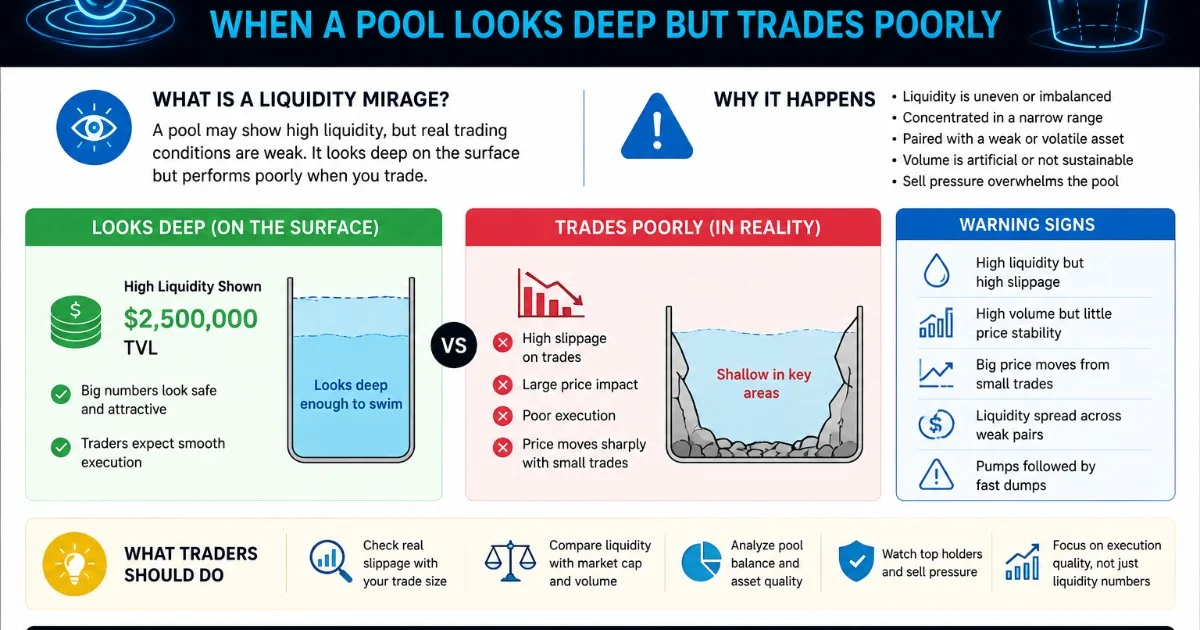
What Is a Liquidity Mirage?
A liquidity mirage happens when displayed liquidity appears strong, but real trading conditions are weak. The number looks impressive, but the pool does not behave like a healthy market.
This can happen because liquidity is uneven, concentrated in a narrow range, paired with a weak asset, or fragmented across multiple pools. It can also happen when volume is artificial or when sell pressure overwhelms available depth.
Why Deep Pools Can Still Trade Poorly
A deep pool is not always an efficient pool. Traders should consider:
- Pool balance
- Price impact
- Slippage
- Routing quality
- Pair quality
- Volume consistency
- Liquidity concentration
- Sell pressure from large holders
A pool can show high liquidity but still perform badly when traders enter or exit.
Warning Signs
A liquidity mirage may show these signs:
- Large liquidity but high slippage
- High volume but little price stability
- Big price moves from moderate trades
- Liquidity spread across weak pairs
- Strong buy candles followed by fast dumps
- Poor execution compared with similar tokens
When liquidity does not protect price action, traders should investigate deeper.
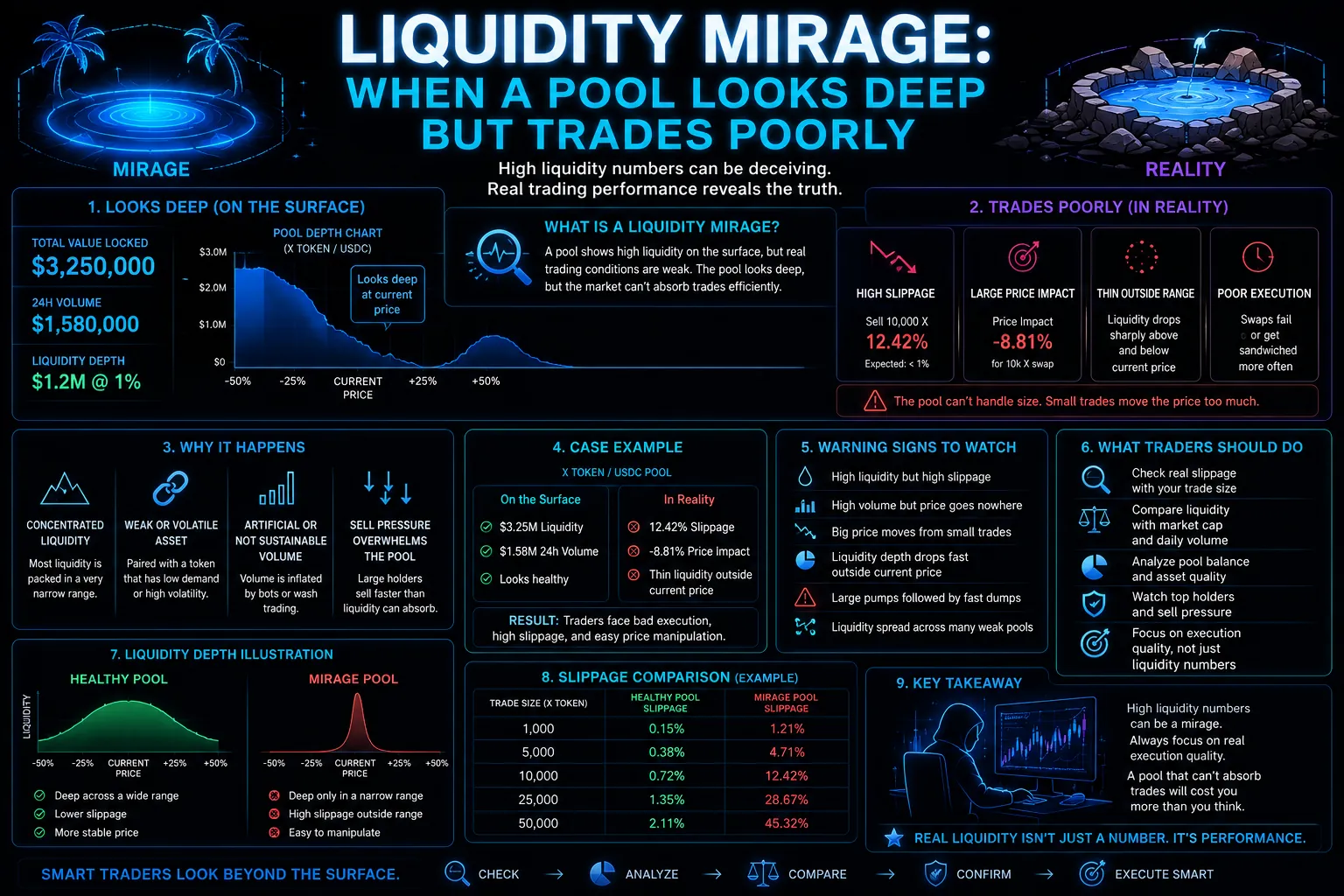
What Traders Should Check
Before trusting a pool, traders should test how the market reacts to trade size. They should compare liquidity with market cap, volume, holder concentration, and recent sell impact.
A strong liquidity pool should help absorb trades. If it cannot, the headline liquidity number may not reflect real trading quality.
Final Thoughts
Liquidity is essential, but not all liquidity is equal. A pool can look deep and still create poor execution.
Smart traders do not only ask how much liquidity exists. They ask how well that liquidity actually works.
Apparent Liquidity vs Executable Liquidity: Why a Large Pool Can Still Give You a Bad Entry DEX Volume Recap: Liquidity Trends & Price Impact Insights What Is Price Impact in Crypto? Beginner Guide Fake Volume vs Real Demand: How to Spot Artificial Momentum in DeFi Trading