Order Book Reading: Spoofing, Walls, and Iceberg Orders
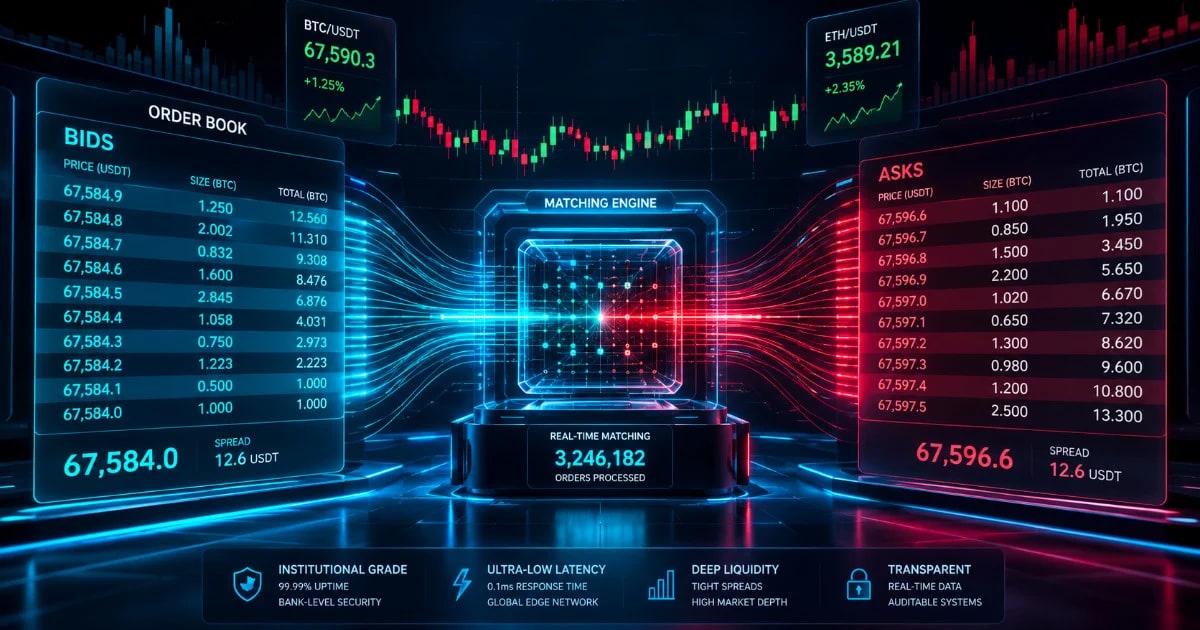
Standard candlestick charts mask the low-level algorithmic battles taking place inside the limit order book. We break down the bids, asks, and hidden execution layers needed to trade alongside smart money.
The Illusion of Price: Looking Under the Hood of the Order Book
- In the global ecosystem of digital assets, candlestick charts are merely a derivative product. A standard price chart displays the nominal history of finalized transactions, showing where past buyers and sellers shook hands across defined intervals of time. While these visual trends are useful for high-level technical analysis, they present an incomplete view of the current market state. Looking exclusively at completed candles leaves you blind to the live supply-and-demand forces that are actively shaping the market.
- To gain a true structural edge inside highly competitive execution venues, professional market participants look directly under the hood. They analyze the raw Order Book. The order book is the real-time, public registry of unexecuted limit orders, functioning as the primary battlefield for decentralized market microstructure. Every market-wide trend reversal, parabolic breakout expansion, and flash liquidation cascade begins as an imbalance deep within this ledger.
- By learning to read the shifting layers of the order book, you step away from reactive pattern matching and begin analyzing the immediate, forward-looking data stream of institutional capital allocation. This comprehensive guide pulls back the curtain on the order book matching engine, untangles the mechanics of buy and sell walls, exposes the manipulative architecture of spoofing algorithms, unmasks stealth iceberg strategies, and provides the diagnostic tools needed to trace hidden institutional footprints cleanly.
1. The Foundational Infrastructure: Bids, Asks, and Market Depth
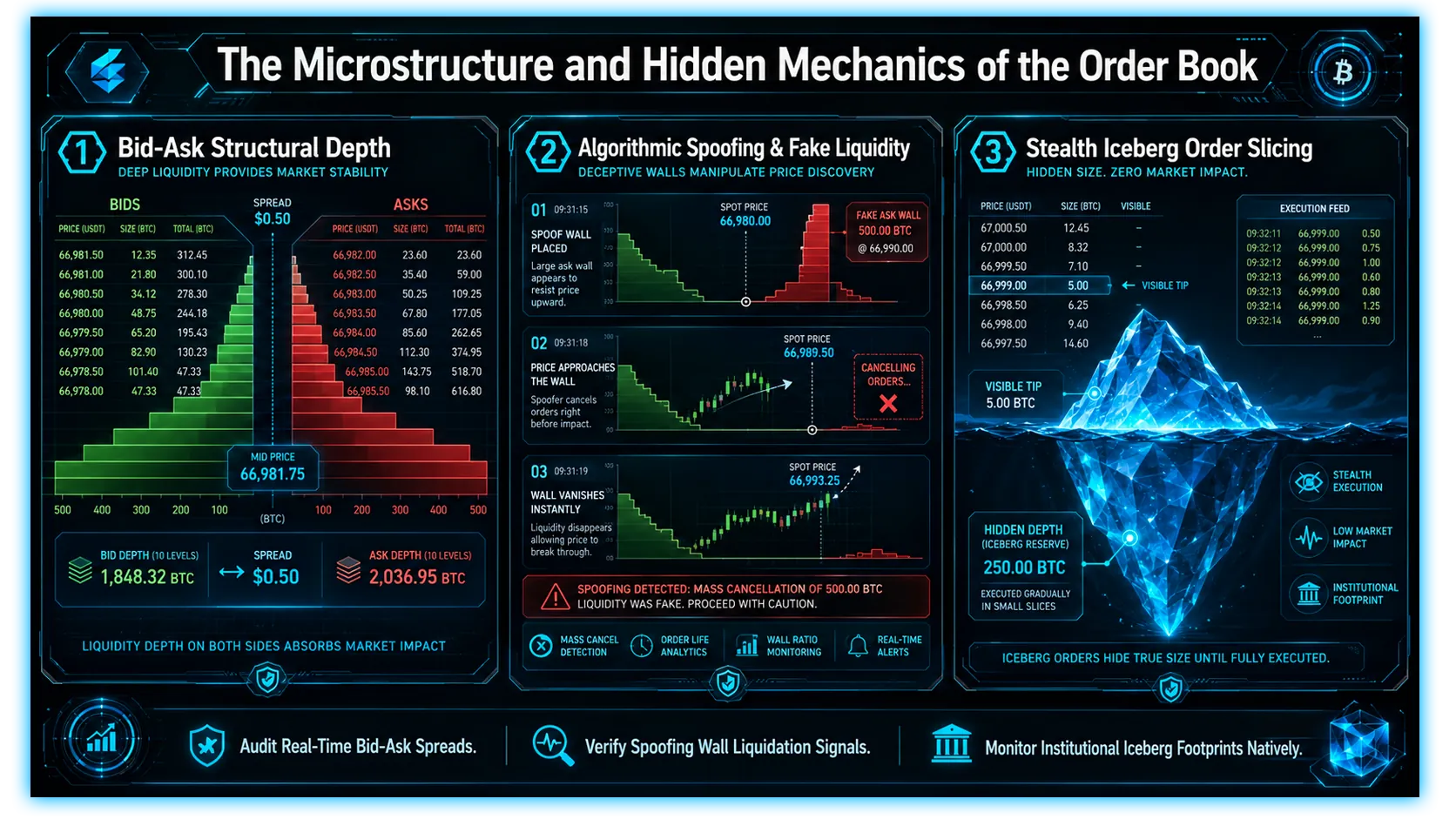
Before you can spot advanced institutional manipulation scripts, you must first master the baseline architecture of the central limit order book (CLOB). The ledger is organized as a dual-column matrix split directly down the center by the asset's active market price.
Bids, Asks, and the Spread
The Bid Column (The Buyers): Stacked on the green side of the ledger, the bids represent the resting limit orders of market participants looking to purchase the asset. Bids are arranged in descending mathematical sequence, with the highest price a buyer is willing to pay positioned at the very top of the column: a coordinate known as the Best Bid.
The Ask Column (The Sellers): Positioned on the red side of the ledger, the asks (or offers) track the resting limit orders of participants looking to liquidate or short the asset. Asks are organized in ascending sequence, with the lowest price a seller is willing to accept marked as the Best Ask.
The Bid-Ask Spread: The spatial gap or distance separating the Best Bid from the Best Ask defines the spread. In highly liquid, institutional venues, the spread is incredibly tight, often measuring fractions of a cent. In illiquid markets, the spread widens significantly, introducing immediate transactional friction.
The Mechanics of the Matching Engine
- The order book matching engine functions through a strict, automated protocol: Price-Time Priority. This rule dictates that the matching engine will always prioritize fulfilling the order with the best available price first. If multiple orders are placed at identical price levels, the engine executes them sequentially based on whichever order arrived earliest in time.
- Resting limit orders inject passive liquidity into the book, waiting for the market to migrate to their chosen coordinates. Conversely, market orders are aggressive capital injections that demand immediate fulfillment, instantly eating through the resting limit orders at the top of the book. Price only moves upward when an influx of aggressive market buy orders completely chews through all available limit sell asks at the Best Ask tier, forcing the ledger to tick up to the next available resistance coordinate.
2. Order Book Manipulations: Real Walls vs. Weaponized Spoofing
Because the order book is completely transparent and visible to all participants, it is a primary target for sophisticated behavioral manipulation. Large trading entities and algorithmic market makers frequently place highly calculated, deceptive orders to distort the crowd's perception of supply and demand.
The Dual Nature of Buy and Sell Walls
An order wall manifests on a depth chart as an exceptionally tall, vertical spike at a specific price coordinate. It represents a massive concentration of limit orders deployed by a single entity or a group of coordinated whales.
The Authentic Support Wall: A genuine wall is a rock-solid cushion of liquidity. If an institutional accumulator wants to establish an impenetrable floor under an asset, they will place a massive, multi-million-dollar buy limit wall at a major structural level. When a downward liquidation cascade hits this wall, the massive resting liquidity completely absorbs the aggressive sell pressure, stabilizing the price and forcing a mean-reversion bounce.
The Synthetic Resistance Wall: Conversely, a whale looking to quietly distribute a massive allocation of tokens without tanking the spot price will erect a massive fake sell wall slightly above the current market rate. This wall panics retail day traders into believing that an insurmountable layer of overhead resistance blocks the asset, prompting them to sell their positions immediately into the whale's hidden, lower-tier buy orders.
The Architecture of Spoofing
Spoofing is an aggressive, algorithmic market manipulation technique where a high-frequency trading (HFT) desk places massive, visible limit orders with the explicit intent of canceling them before they can ever be filled.
The operational cycle of a spoofing loop follows a precise tactical cadence:
The Trap Setup: An HFT algorithm deploys an enormous, multi-million-dollar buy limit order just a few tiers beneath the Best Bid. This massive injection instantly alters the visual depth chart, creating an illusion of intense, unyielding downside support.
The Retail Reaction: Retail day traders and short-term momentum bots spot this massive support wall. Fearing the price will bounce upward before their entries fill, they aggressively front-run the wall, placing market buy orders that drive the asset spot price higher.
The Microsecond Vanishing Act: The exact millisecond the spot price ticks down to touch the outer boundary of the spoofing wall, the algorithm executes a high-speed API cancel command. The wall vanishes instantly from the ledger within a fraction of a millisecond. The algorithm never intended to take on financial exposure; it simply used the fake wall to trick the crowd into pumping the price, allowing the spoofing entity to fill short positions or exit long allocations at a highly optimized premium.
3. Institutional Stealth: Unmasking Iceberg and Hidden Orders
While some market participants want their orders to be as visible as possible to manipulate human emotions, large-scale institutional funds require absolute stealth. If a multi-billion-dollar asset allocator attempts to buy fifty thousand Bitcoins using a standard limit order, the massive size would construct a visible wall so gargantuan that it would instantly panic the market, causing alternative buyers to front-run the order and destroy the fund's entry pricing. To execute large-scale accumulation quietly, institutions deploy specialized, stealth order types.
Hidden Orders
A Hidden Order is a basic native parameter supported by advanced matching engines. When a participant flags a limit order as hidden, the order retains its strict price-time priority within the matching system, but it is completely erased from the public user-facing order book interface. Aggressive sellers will look at an apparently empty ledger, dump their assets via market orders, and experience an immediate, unexpected price halt as they collide with an invisible, hidden wall of institutional buy liquidity.
Iceberg Orders
An Iceberg order is a sophisticated algorithmic sequence designed to slice a massive, institutional transaction size into a continuous pipeline of smaller, non-threatening tranches. The order functions exactly like its geographic namesake: a tiny visible peak floating above the surface, hiding a massive structural body underneath.
The technical execution of an iceberg order follows a systematic structural loop:
The Tranche Split: A fund instructs an algorithmic trading desk to buy ten million USDC worth of a token, configuring the iceberg parameter to a display size of exactly one hundred thousand dollars.
The Visible Layer Presentation: The algorithm writes the initial one-hundred-thousand-dollar limit order to the public book. To an outside retail observer, this order looks like a normal, non-threatening retail participant.
The Automated Replenishment Loop: Aggressive sellers market-dump their assets, completely filling the visible one-hundred-thousand-dollar slice. The exact microsecond that order component is filled to zero, the matching engine automatically fetches the next sequential slice from the institutional reservoir, instantly writing a fresh one-hundred-thousand-dollar limit order to the exact same price tier. This loop repeats seamlessly over hours or days, maintaining a flat, unmoving price floor until the massive underground capital pool is fully filled.
4. Advanced Telemetry: Order Book Footprints and Cumulative Volume Delta
To avoid falling into algorithmic spoofing traps and trace the hidden paths of institutional iceberg accumulations, advanced market analysts move past static depth charts and deploy real-time transaction telemetry tools.
Tape Reading (Time & Sales Processing)
The ultimate source of on-chain truth is the Time & Sales feed, historically referred to as "the tape." This real-time stream logs every single transaction the exact millisecond it executes, detailing the exact price, identical timestamp, and precise token size filled.
Spotting the Iceberg: If you look at the limit order book and see an ordinary ask order of only 5 BTC sitting at a resistance level, but the Time & Sales feed reveals a rapid sequence of market buy orders hitting that exact price tier for a cumulative total of 150 BTC without the price budging, you have successfully exposed an active iceberg order. Institutional sellers are continuously refreshing their supply, warning you that a heavy supply ceiling is actively capping the market.
Cumulative Volume Delta (CVD) Analysis
Cumulative Volume Delta is a highly efficient quantitative metric that aggregates the net difference between aggressive buying volume and aggressive selling volume over time.
By tracking CVD alongside immediate price action, you can diagnose the authenticity of order book walls:
The CVD Divergence Filter: If an asset's spot price approaches a massive sell wall and stalls, check the CVD line. If the price flattens out but the CVD line begins to shoot vertically upward, it proves that buyers are aggressively market-buying the resistance with massive size. They are chewing through an institutional iceberg, confirming a high-probability breakout setup.
The Spoofing Signal: Conversely, if the price approaches a wall and the wall vanishes while the CVD line remains flat, it confirms a pure algorithmic spoofing event, alerting you to ignore the visual breakout signal.
Order Book Component Taxonomy
| Component Name | Technical Core Mechanics | Market Microstructure Role | Visibility Status |
| Bids | Resting buy limit orders | Provides downside liquidity support | Fully Public |
| Asks | Resting sell limit orders | Provides overhead supply resistance | Fully Public |
| Spoofing Wall | High-frequency API limit placements | Artificial price manipulation trap | Public / Cancelled rapidly |
| Hidden Order | Native matching engine masking | Lowers execution slippage profiles | Completely Invisible |
| Iceberg Order | Automated slice replenishment loop | Stealth institutional volume scaling | Split (Visible peak / Hidden base) |
Order Book Manipulation Risk States
| Manipulation Type | Visual Representation | Target Market Victim | Counter-Trading Solution |
| Fake Buy Wall | Massive vertical depth chart spike | Late-stage retail short-sellers | Verify via real-time CVD metrics |
| Spoofing Ask | Sudden overhead wall formation | Fragile momentum long positions | Monitor Time & Sales cancellation latency |
| Institutional Iceberg | Flat price ceiling under heavy market buys | Impatient retail breakout traders | Track aggressive spot taker volume loops |
5. Integrating Telemetry Auditing via DEXTools
- Even when keeping your private keys safe offline with robust cold storage backups, maintaining visibility over the decentralized landscape remains vital. DEXTools delivers real-time analytics to track token dynamics, smart contract configurations, and pool activities across alternative blockchains.
- By leveraging diagnostics like the Pair Explorer, Live New Pairs tracker, Big Swap Explorer, and Top Traders boards, participants can seamlessly analyze transactional volumes, monitor large whale reallocations, and run automated contract audits before executing on-chain swaps. This ensures your hardened cryptographic setup interacts exclusively with legitimate, highly liquid trading venues.
You can access DEXTools here and start trading today!
AMM vs Order Book DEXs: Crypto Trade Dynamics The Whale Shadow: How Large Wallets Distort Retail Interpretation on DEX Charts Is On-Chain Data Replacing Technical Analysis in Crypto? Buyers vs Sellers Ratio: Why More Buyers Does Not Always Mean StrengthDisclaimer: This article is for informational purposes only and does not constitute investment advice, financial advice, trading advice, or any other kind of advice. DEXTools does not recommend buying, selling, or holding any cryptocurrency or token. Users should conduct their own research and consult with a qualified financial advisor before making any investment decisions. Cryptocurrency investments are volatile and high-risk. DEXTools is not responsible for any losses incurred.