The Five-Minute Token Triage Method for DEX Traders
— By Whatsertrade in Tutorials
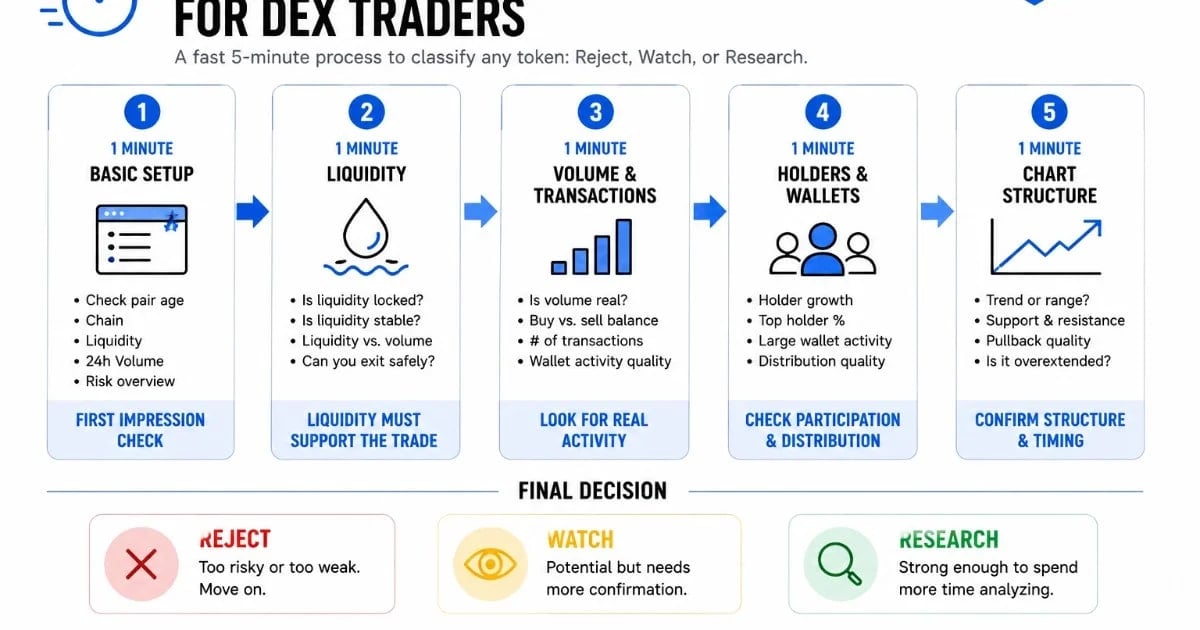
Learn a fast five minute token triage method using DEXTools to classify crypto tokens as reject, watch, or research before trading.
Not every token deserves deep research. In DEX markets, thousands of pairs compete for attention. If traders spend too much time on every token, they lose focus and react too slowly.
The Five-Minute Token Triage Method helps traders quickly classify tokens into three categories: reject, watch, or research deeper.
Key Takeaways
This method does not tell you what to buy. It helps you decide whether a token is worth your time.
What Is Token Triage?
Triage means sorting quickly based on urgency and quality. In trading, token triage means reviewing a token fast and deciding what to do next.
The goal is simple:
Reject weak tokens quickly.
Watch interesting but incomplete setups.
Research stronger candidates.
DEXTools gives traders enough real time data to make this first classification in just five minutes.
Minute 1: Check the Basic Setup
Start with the token page and basic pair information.
Look at:
Pair age.
Chain.
Volume.
Current price movement.
Basic risk indicators.
If the token immediately shows serious issues, do not continue. Reject it and move on.
The first minute is about avoiding obvious weak setups.
Minute 2: Review Liquidity
Liquidity decides whether the token can support real trading.
Ask:
Is liquidity too low?
Has liquidity changed recently?
Does liquidity match the trading activity?
Would selling be difficult?
If liquidity is extremely weak or unstable, the token may be a reject. If liquidity is acceptable but not perfect, it may go into the watch category.
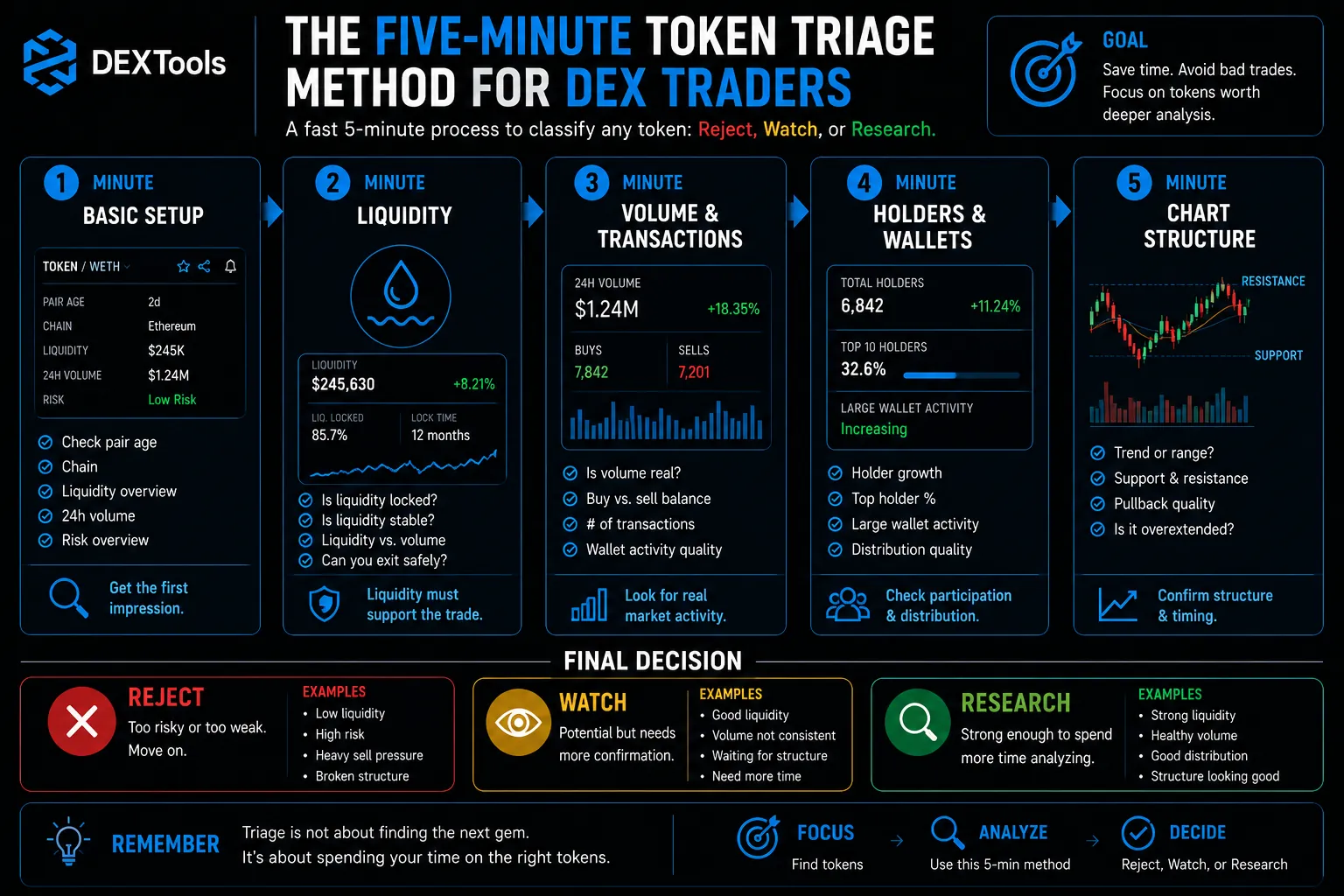
Minute 3: Review Volume and Transactions
Now check whether activity looks real.
Ask:
Is volume active or dead?
Are buys and sells balanced?
Are there many transactions?
Are a few wallets creating most of the movement?
Is sell pressure increasing?
If volume is active but suspicious, the token may need more observation. If volume is strong and supported by diverse activity, it may deserve deeper research.
Minute 4: Review Holders and Wallets
Holder data helps identify distribution quality.
Ask:
Are holders growing?
Are top holders too concentrated?
Are large wallets buying or selling?
Does holder growth match market activity?
If holders are weak, concentrated, or declining, be cautious. If holder data supports the market activity, the setup becomes more interesting.
Minute 5: Review Chart Structure
Finally, check the chart.
Ask:
Is the chart early, extended, or broken?
Are pullbacks controlled?
Is the trend still valid?
Is the token already too late?
A token with good data but a poor entry may still be a watch, not a trade.
The Three Triage Outcomes
After five minutes, choose one label.
Reject: The token has weak liquidity, poor activity, risky distribution, or broken structure.
Watch: The token is interesting but needs confirmation.
Research deeper: The token shows enough strength to justify more time.
This keeps your process clean and prevents overanalyzing every pair.
Why Triage Improves Trading
Triage protects your attention. It also helps prevent emotional chasing.
Instead of asking, “Should I buy this now?” ask, “Does this token deserve more research?”
That small change can improve decision quality.
Final Thoughts
The Five-Minute Token Triage Method is a simple way to use DEXTools more efficiently. It helps traders screen tokens quickly, reject weak setups, and focus on better opportunities.
In fast markets, speed matters. But structure matters more.
The goal is not to rush into trades. The goal is to quickly decide where your research time belongs.
Locked Liquidity Is Not Enough: What Traders Still Need to Check The Liquidity Decay Curve: How Token Markets Lose Depth Before They Lose Price Why Real Time Data Matters for DEX Traders When Not to Trade: 12 Red Flags Every DeFi Trader Should Know