The Silent LP Exit: How Liquidity Providers Leave Before Traders Notice
— By Whatsertrade in Tutorials

Explore the impact of liquidity provider exits on trading dynamics and market stability in decentralized finance. Learn how to stay ahead of hidden risks.
Sometimes the most important exit is not a trader selling tokens.
It is liquidity leaving the pool.
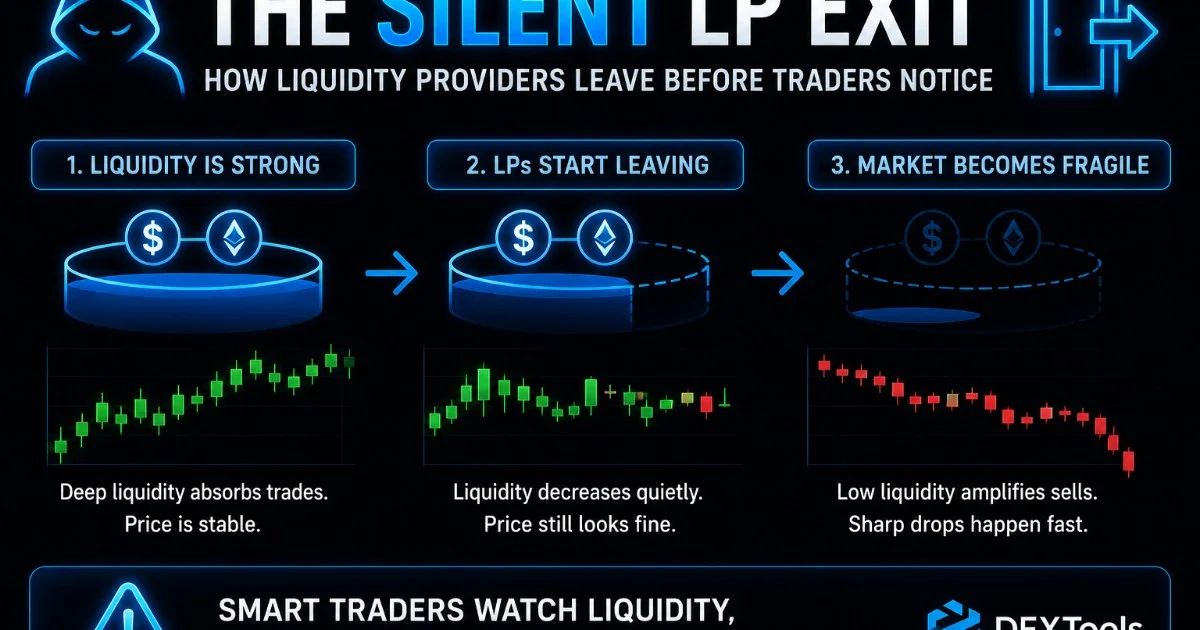
In DeFi, traders often focus on buyers and sellers. They watch green candles, red candles, volume spikes, whale swaps, and holder growth. But liquidity providers can quietly change the entire risk profile of a token without creating the same emotional reaction as a large sell.
This is the silent LP exit.
The silent LP exit happens when liquidity providers reduce or remove liquidity before most traders realize the market has become weaker.
What Is a Silent LP Exit?
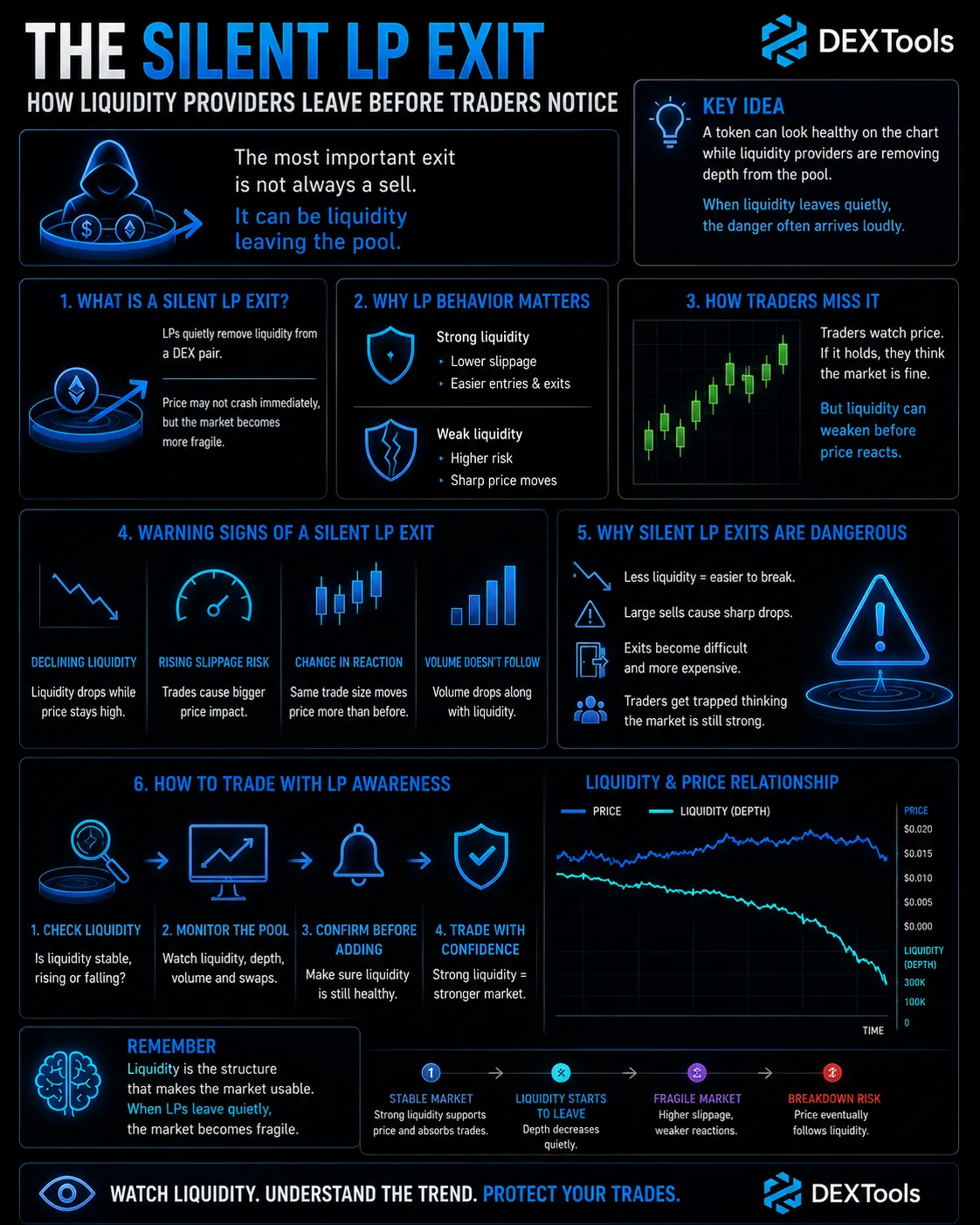
A silent LP exit is the quiet removal of pool depth from a DEX pair.
Liquidity providers are essential because they allow traders to buy and sell with less price impact. When liquidity is strong, the market can absorb larger trades. When liquidity disappears, even smaller trades can move price aggressively.
The danger is that liquidity removal does not always look like a normal sell. The chart may not immediately crash. Price may remain stable for a short time. But the market has become more fragile.
By the time traders notice, exits may already be worse.
Why LP Behavior Matters
Liquidity providers help define how safe or risky a market feels.
A token with strong liquidity gives traders more confidence because entries and exits are easier. A token with weak liquidity creates uncertainty because price can move sharply with limited activity.
When LPs start leaving, it may signal falling confidence, reduced commitment, or preparation for a more unstable phase.
This does not always mean a project is bad. Liquidity can move for many reasons. But traders should pay attention when pool depth declines without a clear explanation.
How Traders Miss Silent LP Exits
Many traders miss silent LP exits because they are trained to watch price first.
If price is still holding, they assume the market is fine. If candles remain green, they believe demand is strong. But liquidity can weaken before price reacts.
This creates a dangerous mismatch. The visible chart may suggest stability, while the pool has already become thinner.
DEXTools can help traders monitor liquidity changes, pool depth, volume, swaps, and price impact in one place.
Warning Signs of a Silent LP Exit
One warning sign is declining liquidity while price remains elevated. This can mean the market still looks attractive but has less support underneath.
Another sign is rising slippage risk. If trades begin to create larger price impact, the pool may be losing depth.
A third signal is a sudden change in how the chart reacts to normal swaps. If the same trade size moves the market more than before, liquidity may have quietly weakened.
Traders should also watch whether volume follows liquidity. If both liquidity and volume decline, market interest may be fading.
Why Silent LP Exits Are Dangerous
Silent LP exits make markets easier to break.
When liquidity is removed, the token becomes more vulnerable to sell pressure. A single large sell can create a sharper decline. Even moderate exits can damage the chart.
This can trap traders who entered based on price action alone. They may believe the token is still strong, only to discover that the exit door has become much smaller.
In DEX trading, liquidity is not just background data. It is the structure that makes the market usable.
How to Trade With LP Awareness
Traders should treat liquidity changes as market events.
Before entering a token, check whether liquidity is stable, rising, or falling. During a trade, monitor whether the pool continues to support the chart. Before adding to a position, confirm that liquidity has not quietly deteriorated.
A strong chart with shrinking liquidity deserves caution.
A moderate chart with growing liquidity may deserve more attention.
Final Thoughts
The silent LP exit is powerful because it often happens before the crowd reacts.
A token can look fine on the chart while liquidity providers are reducing the market's ability to absorb trades. That creates hidden risk.
Smart DEX traders do not only ask, "Is price going up?"
They ask, "Is liquidity staying in the market?"
Because when liquidity leaves quietly, the danger often arrives loudly.
DEX Volume Recap: Liquidity Trends & Price Impact Insights Liquidity Velocity: Why Fast LP Changes Matter More Than Total Liquidity The Liquidity Decay Curve: How Token Markets Lose Depth Before They Lose Price LP Lock Expiry Risk: What Happens When Token Liquidity Unlocks?Frequently Asked Questions
What is crypto liquidity?
Crypto liquidity refers to how easily a cryptocurrency can be converted into cash or other cryptocurrencies without significantly impacting its price. High liquidity means many buyers and sellers are active in the market.
How do liquidity providers (LPs) contribute?
LPs provide their crypto assets to decentralized exchanges or lending protocols, enabling trading and borrowing activities. In return, they typically earn fees or interest.
Why is liquidity important in crypto markets?
Liquidity ensures efficient trading, stable prices, and lower slippage for traders. It also indicates the health and depth of a market.
What are the risks for liquidity providers?
LPs face risks such as impermanent loss, where the value of their deposited assets changes relative to simply holding them. Smart contract risks and market volatility also exist.
How do LPs exit their positions?
LPs typically withdraw their deposited assets and any accumulated fees from the liquidity pool. The exit process usually involves a transaction on the blockchain to remove their contribution.