What Is a Deployer Wallet in Crypto? Guide (2026)
— By Tony Rabbit in Tutorials
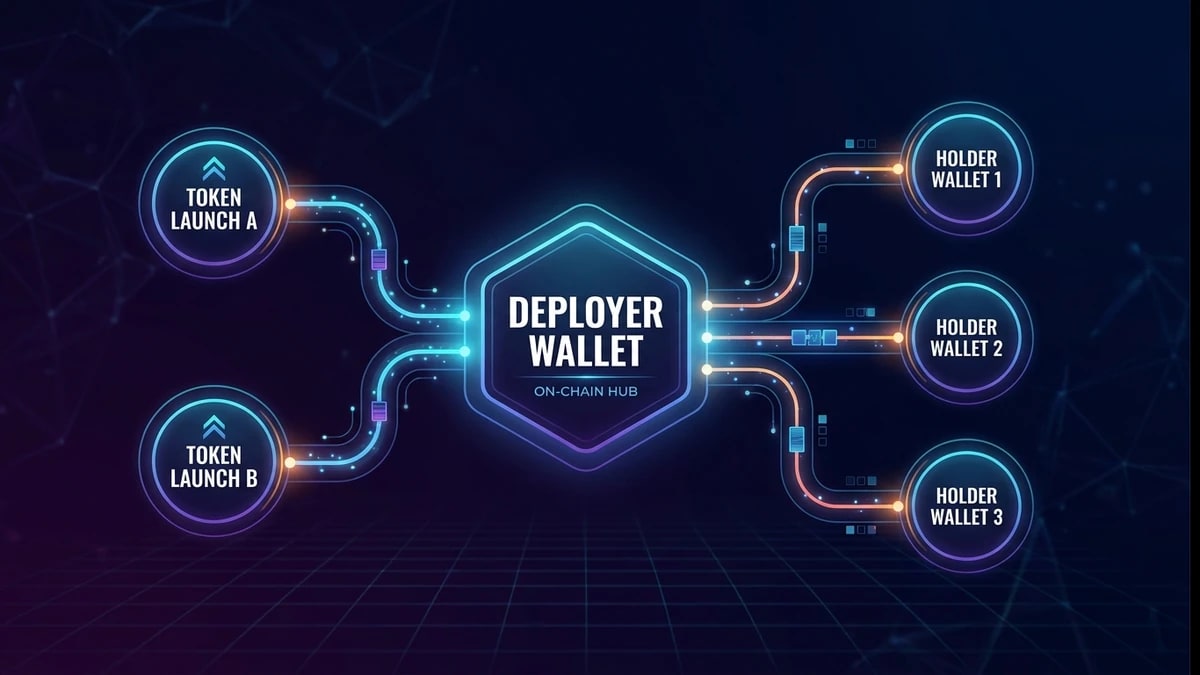
Deployer wallet explained: learn why a token's launch history matters and how deployer analysis helps you judge new tokens before you buy them.
When a token is only a few hours old, most traders do not have much real market history to work with. That is exactly why the deployer wallet matters so much. It gives you a direct path into the token’s origin story before the chart has had time to hide anything.
A deployer wallet is the wallet that creates the token or smart contract on-chain. On its own, that fact is neutral. Plenty of legitimate projects use a deployment wallet. What changes everything is the context around it: what else the wallet has launched, what wallets funded it, which addresses interact with it early, and whether its past tokens look like real builds or disposable charts.
This guide explains what a deployer wallet in crypto actually is, why traders should care, how deployer analysis differs from holder analysis, and what patterns should raise or lower trust before you buy a new token.
Quick take
- A deployer wallet is the wallet that creates the token or contract on-chain.
- Its value is not only technical. It helps you inspect launch ancestry, prior launches, funding paths, and linked wallet clusters.
- A single deployer is not enough to call a scam, but repeated bad patterns from the same wallet can become a meaningful warning sign.
- Deployer analysis works best when paired with holder distribution, liquidity quality, and sellability checks.
What a deployer wallet is in crypto
On most chains, every token starts with a deployment event. That event comes from a wallet, script, or contract-controlled wallet that pushes the token live. Traders refer to that origin wallet as the deployer wallet.
In practical analysis, deployer does not mean “this wallet still controls everything forever.” It means “this wallet was close enough to the launch that its history is worth examining.” For very fresh tokens, that can be one of the highest-signal data points available.
Deployer wallet vs other important wallets
Why deployer history matters before buying
Most early-stage token decisions happen with incomplete information. The deployer wallet helps fill that gap fast. If the same wallet keeps appearing on abandoned launches, shallow pools, insider-heavy charts, or quick collapses, that pattern matters before you ever open a position.
Why traders should inspect deployer wallets
What deployer analysis can and cannot tell you
Deployer analysis is powerful, but it is not magic. A clean deployer wallet does not guarantee a safe token, and a repeated deployer does not guarantee a scam. The point is to improve your odds by reading patterns earlier than the crowd.
What deployer analysis cannot prove by itself
- ✘ It cannot replace holder distribution analysis, because the deployer may no longer hold much supply after launch.
- ✘ It cannot prove the token is sellable, which is why traders should still use a process like checking whether a token can actually be sold.
- ✘ It cannot tell you whether liquidity is safe on its own. Pair it with liquidity lock checks or unlocked liquidity analysis.
- ✘ It cannot replace contract review, especially if owner permissions, blacklist logic, or taxes remain live.
How to inspect a deployer wallet in practice
The goal is not just to stare at one address. The goal is to understand the launch context around it. Start with the deployer, then expand outward into funders, early receivers, liquidity relationships, and prior launches from the same wallet or obvious cluster.
A practical deployer-wallet workflow
- ✔ Identify the deployer or creation wallet for the token and inspect its prior transactions.
- ✔ Check whether the wallet deployed multiple tokens, especially over short time windows or with similar liquidity structures.
- ✔ Look for repeated early participants across launches, including the same funders, top holders, or first recipients.
- ✔ Compare how previous charts behaved after launch. Repeated dead charts and shallow pools matter.
- ✔ Use deployer findings to guide position sizing, not as a stand-alone verdict.
When a repeated deployer is not automatically bad
Some deployers are simply active builders. They may test contracts, launch ecosystem assets, or iterate on product ideas. A repeated deployer becomes a strong warning sign only when the prior evidence repeatedly points in the same bad direction.
That is why the cleanest deployer read always combines history with structure. If the deployer repeats, but prior launches remained liquid, transparent, and functional, the repeat may be neutral. If the repeat pattern is low trust and short lifespan, the deployer becomes far more important.
How to read repeated deployers more intelligently
Final takeaway
A deployer wallet in crypto is one of the fastest ways to understand where a new token came from. It will not answer every risk question for you, but it can reveal whether the launch deserves trust, caution, or a much smaller position long before the chart tells the full story.
The practical rule is simple: start with the deployer, then widen the frame. Look at prior launches, linked wallets, liquidity structure, and early holder behavior. If the same bad patterns keep following the same wallet, that is exactly the kind of evidence traders are supposed to catch early.
Related reads on DEXTools
FAQ
What is a deployer wallet in crypto?
A deployer wallet is the wallet that creates and pushes a token or contract on-chain. It matters because the deployer often reveals early clues about ownership, launch structure, prior launches, and which wallet cluster may still matter after trading starts.
Is a deployer wallet always the same as the team wallet?
Not always. Teams can separate deployment, treasury, liquidity, and marketing wallets. But even when the deployer is not the only team wallet, it often remains a useful starting point for tracing the rest of the launch structure.
Why does deployer history matter?
Because repeated launch behavior can show whether a wallet is linked to clean builds, abandoned experiments, or serial low-quality token launches. Deployer history is one of the fastest ways to add context to a brand-new chart.
Can a good token still come from a repeated deployer?
Yes. A repeated deployer is not automatic proof of fraud. The key is whether the prior launches, holder behavior, liquidity structure, and contract risks form a healthy or unhealthy pattern.
Disclaimer: This content is for informational purposes only and does not constitute financial advice. Crypto investments carry risks, including loss of capital.
Related Guides
- How to Withdraw from a CEX to Self-Custody Wallets
- What Is Wallet Poisoning? Crypto Security Guide 2026
- Wallet Nonce: Fix Stuck Transactions (2026)
- What Is wagmi: React Hooks, Wallet Connectors and EVM State (2026)
- What Is Turnkey: Key Management, Signing and Wallet Infrastructure (2026)
Frequently Asked Questions
What is a deployer wallet in crypto?
A deployer wallet is the address that creates and publishes a token's smart contract to the blockchain. It is essentially the wallet responsible for launching the token.
Why does the deployer wallet matter?
The deployer wallet reveals a token's launch origin and can be linked to the project's creator. Reviewing it helps you judge a new token's history and the track record of whoever launched it.
What can deployer wallet analysis show?
By examining a deployer's past activity, you can see whether it has launched other tokens and how those tokens performed. A history of abandoned or failed launches from the same deployer can be a warning sign.
How do I find a token's deployer wallet?
You can use a block explorer to view a token's contract and trace back to the address that created it. The contract creation transaction typically shows the deploying wallet.